Good Neighbor Training
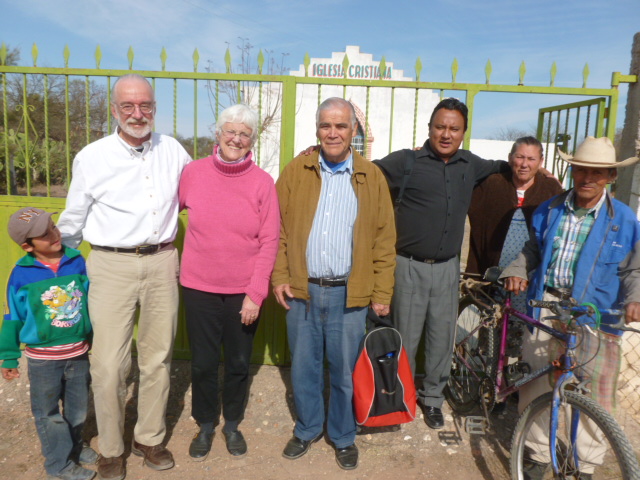
Language and Culture trainees on left with members and pastors of the rural La Reforma Disciples congregation
A new program of immersion in the language and culture of Mexico is now being offered. If you belong to a UCC or Disciples church in North America you can participate in up to three months of immersion training being offered by the churches we are serving in San Luis Potosi, located in the center of this beautiful country.
Participants in the “Good Neighbor Training” take Spanish at the Autonomous University, practice their new language skills in conversation, visit churches in the City and in rural settings and enjoy multiple, diverse experiences of Mexican culture. Their stay concludes with a visit and guided tour of the ruins at Tamtok, inhabited for over three thousand years and the largest city in northeast Mexico when the Spanish arrived.
One of the first participants in the training has written the account below of her experiences. UCC church members from Minneapolis, she and her husband are greatly enjoying the warmth of San Luis Potosi and the people they have met.
“As participants in the Language and Cultural Immersion program of the Mesa Conjunta in San Luis Potosi, Mexico my husband and I have gone to a boda (wedding) in a rural village, attended lively services with three different
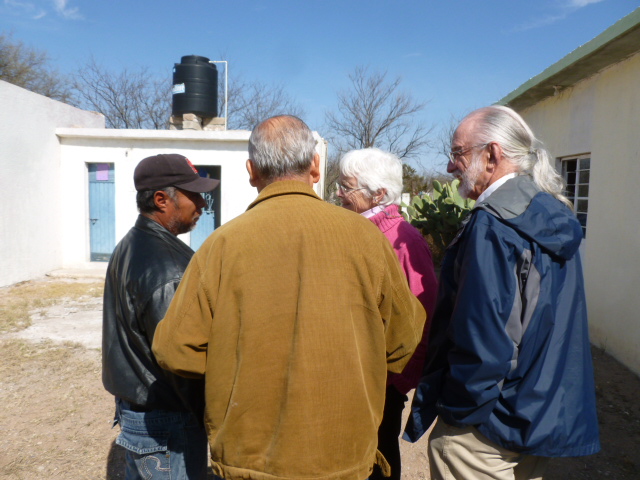
Trainees talk with La Reforma member Noel about building the new social hall/classroom on right
congregations and taken part in conversations and meals with many Disciple clergy and laity. All of this activity is arranged around 20 hours weekly of language class with excellent teachers at the Centro de Idioma that is right in the middle of this lovely colonial city with its countless plazas and parks.
Everywhere we go we are almost overwhelmed by the hospitality of the Potosinos and the Global Ministries volunteers based here. The conversations – always translated when our fragile Spanish is not sufficient – range widely. We have spent a meal discussing the complexities of being part of a small but vibrant protestant minority in a deeply Catholic country. Traveling to a rural congregation we heard leaders discussing the need to broaden seminary training opportunities within Mexico rather than sending young men and women who are called to the ministry to Puerto Rico or the US.
I am a woman worshipping in a UCC congregation in the US that is pastored by a straight white man and a lesbian. I listen carefully to the effort here to move the church community to a place where calling a female to a pastorate will no longer be unusual. We visited a well-established congregation that has called a female recent M.Div. graduate as co-pastor with a dynamic male pastor. The gender complexities that still linger in the US are being addressed here with impressive patience and energy.
The worship services and conversations are uniquely energetic and faith filled, clergy and congregations equally
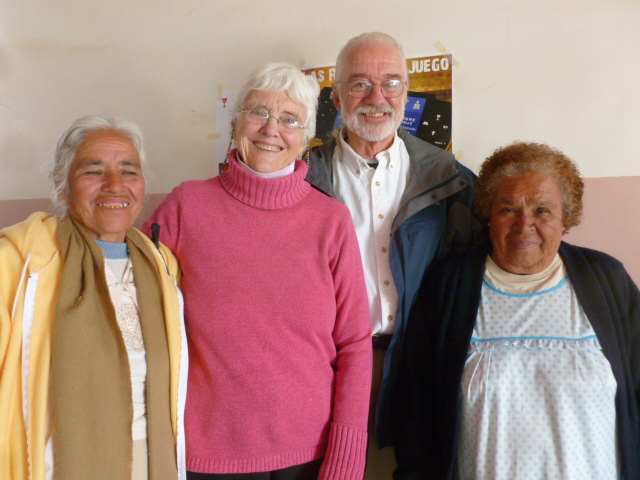
Fred and Mary greeting two of the La Reforma members who prepared the post-worship meal
engaged. This is a deep difference from my US experience and I am muddling through the cultural implications of what I am learning theologically and culturally. I am in the right place. Both my husband and I are learning so much on so many different fronts. We hope others will take advantage of this unique and invaluable opportunity.”
For more information and an application for the Immersion Program write: dougnslp@gmail.com or lhernandez@dom.disciples.org
*********************** *******************
La versión en español sigue con la ayuda en la traducción de la Revda. Lisania Sustaita Martinez.
Las Iglesias Discípulos de Cristo, apoyadas por la Mesa Conjunta en el área de San Luis Potosí, ofrecen ahora un inmersión de hasta tres meses en el lengua y la cultura de México para miembros norteamericanos de Iglesias Discípulos y UCC (Congregacionales).
Los participantes en el inmersión toman español en la Universidad Autónoma, practican su nuevo conocimiento de la lengua en conversaciones con miembros de la iglesia y otros, visitan iglesias en la ciudad y en el campo rural y disfrutan de experiencias múltiples, diversas de la cultura mexicana. Su permanencia concluye con una visita guiada a las ruinas en Tamtok, habitado durante más de tres mil años y la ciudad más grande en México de noreste cuando los españoles llegaron.
Una de los primeros participantes en esta “Formación” nos comparte abajo algunas de sus experiencias. Miembros de la iglesia de UCC de Minneapolis, ella y su marido disfrutan enormemente del calor de San Luis Potosí y la gente que han encontrado.
“Como participantes en el programa “Language and Cultural Immersion/ Inmersión en Lenguaje y Cultura” de la Mesa Conjunta en San Luis Potosí, México, mi marido y yo hemos ido a una boda en un pueblo rural, asistido a servicios animados con tres iglesias fieles diferentes y participado en conversaciones y comidas con muchos clérigos (pastoral) de los Discípulos y laicos también.
Toda esta actividad es arreglada alrededor de aproximadamente 20 horas cada semana en las clases de Español con profesores excelentes en el Centro de Idiomas que queda exactamente en el centro de esta ciudad colonial encantadora con sus plazas innumerables y parques.
En todas partes que vamos somos casi dominados por la hospitalidad de las y los Potosinos y los voluntarios de Ministerios Globales establecidos aquí. Las conversaciones – siempre traducidas cuando nuestro frágil español no es suficiente – son extensamente variadas.

Frederico y Maria leen sobre la hacienda en el rancho de Guanamé en donde se ubica otro templo Discipulos
Hemos compartido una comida hablando de las complejidades de ser parte de una minoría protestante, pequeña pero vibrante, en un país profundamente católico. En los viajes a visitar a unos fieles rurales oímos a líderes hablando de la necesidad de ensanchar oportunidades de formación al nivel seminario dentro de México en lugar de enviar a jóvenes y mujeres llamados a servir, a Puerto Rico o a los EE.UU.
Soy una mujer que mantiene membresía en una iglesia UCC en los EE.UU pastoreada por un hombre y una lesbiana como co pastora. Escucho cuidadosamente conversaciones acerca del esfuerzo aquí para mover la comunidad de la iglesia a un lugar donde la vocación de una mujer a pastorear, pronto ya no sea algo extraño.
Visitamos a unos fieles en una iglesia bien establecida que ha llamado a un graduado de M.Div. (Maestría en Divinidad) reciente de sexo femenino como co-pastora, con el dinámico pastor actual, de sexo masculino.
Las complejidades del género que todavía tardan en los EE.UU están siendo dirigidas aquí con paciencia

Asistentes de la boda en Los Remedios esperan su plato de barbacoa de borrego
impresionante y energía. Los cultos y las conversaciones son especialmente enérgicas y reflejan una fe fuerte, con su clero y fieles igualmente involucrados.
Esto es una diferencia profunda de mis experiencias en las iglesias de los EE.UU y yo, con mi marido, vamos buscando las implicaciones culturales de lo que aprendemos teológica y culturalmente.
Estoy en el lugar correcto para mí. Tanto mi marido como yo aprendemos tanto en tantos frentes diferentes. Esperamos que algunos otros aprovechen esta oportunidad única e invaluable”.
Para recibir mas información sobre este programa incluso como hacerse candidato envie un correo a dougnslp@gmail.com o lhernandez@dom.disciples.org
Prayers of Light

Revda. Lisania Martinez and cousin Rev. David Martinez prepare to release their “prayer of light”
The last two Christmases we have enjoyed the city of San Luis Potosi’s public celebration of light and its multiple forms and colors. Sponsored by the State Tourism office and some corporate funders, two of the largest and most beautiful plazas of the City are illuminated using new technologies available only in the last ten years. Although the city’s “Festival of Light” includes displays during Easter week, what better time for Latin America’s first and still the only “City of Light” to strut its colors than during the Christmas season?
This year’s celebration featured a light show on the theme of “Children’s Christmas” with multi-colored images

Piñatas and dragons were recurring images of the Light Show in the Plaza
projected on the façade of the “Plaza de Fundadores” (Founders’ Plaza) church and the city’s oldest university building. We marveled at the shapes and colors of the light playing on the background of the buildings’ columns and arches.
But like many in the crowd, it was the efforts of many in the crowded plaza to launch their “balloons of light” (globos de cantoyas) into the darkness above that most intrigued and delighted us. Strangers assisted in recovering fallen lights that had been released by hopeful families. The communal effort to fill the night sky with the light of ascending balloons tugged at our souls for words that might balance the scene’s play with praise of what it is within each of us that makes for such times of mutual aid, delight and peace.
Like most readers of this blog living in the U.S. we had never experienced or seen anywhere one of these “balloons of light”. Much to our surprise, we saw the photo of their use at the annual Disciples of Christ Youth Camp (Campamento de Huehuentepec) recently concluded. One of the Camp’s speakers this year, Rev. Lisania Sustaita Martinez, wrote the following for us about the balloons’ origin and use today in family and public celebrations in Mexico.

A “Cantoya’s Balloon” released by a family in the Plaza below
“They are known in Mexico by many names such as “Cantoya’s globes”, “light globes”, “globes of fire”, “globes of desire”, “luminescent globes”, “sky lanterns”, “Chinese lantern”, “Kongming lanterns”, “light lanterns” or “flying candles”. The Chinese used them for communication in military campaigns. Today they are a symbol of celebration.
The main reasons “Cantoya’s globes” (Cantoya being the Mexican who introduced them to his country in the early 1800’s) are released today are:
- To symbolize our connection with loved ones who are no longer with us or are now far away.
- To illuminate the pathway to festivals (weddings, dedication of a baby, birthdays, etc.
- To signify the hopes and dreams we release to the heavens in hopes they some day will become reality.
In the 2014 Huehuentepec Youth Camp, each of the nearly 80 globes was released by two persons. They are always part of a community event, sent aloft by two, three or more persons and signifying a common purpose or theme shared by all.
In the Youth Camp this year we released the globes at the conclusion of activities on the last night, beginning with a prayer to encourage and support each other in the paths and endeavors we were about to take. In our lighting the globe’s candle, David and I prayed for each other and a third person absent from us, giving thanks for our friendship and journey together as colleagues with the same calling and asking God to strengthen our relationship.”
(Ed. Note: David Flores Martinez is the recently elected President of the CICE Disciples denomination and Lisania Sustaita Martinez is the Education Coordinator for the Mesa Conjunta of the Disciples and Congregational Churches of Mexico.)
For more photos of the San Luis Potosi Fiesta de Luz, see the gallery below the Spanish translation.
************* *********************** *************
Las dos últimas Navidades hemos disfrutado de la ciudad de San Luis Potosí en celebración pública de la luz y sus múltiples formas y colores.
Patrocinado por la oficina de Turismo del estado y algunos patrocinadores corporativos, dos de las plazas más grandes y bellas de la ciudad están iluminadas utilizando las nuevas tecnologías disponibles sólo en los últimos diez años. Aunque el “Festival de Luz” de la ciudad incluye exhibiciones durante la Semana de Pascua, ¿qué mejor momento para que la primera y aun la única “Ciudad de Luz” se enorgullezca en sus colores, que durante la mismísima temporada de Navidad?
La celebración de este año contó con un espectáculo de luces sobre el tema de la “Navidad de los niños” con colores múltiples e imágenes proyectadas en la fachada de la iglesia de la “Plaza de Fundadores” y el edificio de la Universidad más antiguo de la ciudad.
Nos maravillamos de las formas y los colores de la luz jugando en el fondo de los edificios, columnas y arcos.
Pero al igual que muchos en la multitud, fue el esfuerzo de muchos en la concurrida plaza para lanzar sus “globos de luz” (globos de cantoya) en la oscuridad más arriba que nos deleitó y mas nos atrajó.
Extraños ayudaron en la recuperación de luces caídas que habían sido liberadas por familias esperanzadas. El esfuerzo comunitario para llenar el cielo nocturno con la luz de los globos en ascenso tiró de nuestras almas por palabras que podrían equilibrar el juego de la escena con la adoración que hay en cada uno de nosotros para esos momentos de paz, alegría y ayuda mutua en nuestro mundo.
Como la mayoría de los lectores de este blog viviendo en los Estados Unidos, nunca habíamos experimentado o visto en ningún sitio uno de estos “globos de luz”. Nos soprendimos mucho entonces cuando vimos la foto de su uso en el campamento anual de jóvenes Discípulos de Cristo (Campamento Huentepec) que concluyó recientemente. Una de los conferencistas del campo este año, la Reverenda Lisania Sustaita Martinez, escribió lo siguiente para nosotros acerca del origen y uso de los globos hoy en familia y celebraciones públicas en México.
“Se conocen en México por muchos nombres tales como “Globos de Cantoya”,”globos de luz”,”globos de fuego”,”globos del deseo”, “Globos Luminiscentes”, “linternas del cielo”,”Linterna de China”,”Linternas Kongming” o “velas voladoras”. China los había usado para la comunicación en las campañas militares. Hoy son aquí solo un símbolo de celebración (como en China también).
Las motivos principales para que “Globos de Cantoya” (Cantoya sería el mexicano quien los presentó a su país a principios de 1800) sean liberados hoy son:
– Para simbolizar nuestra conexión con los seres queridos que ya no están con nosotros o están ahora muy lejos.
– Para iluminar el camino de los celebrados en festejos diversos (bodas, dedicación de un bebé, cumpleaños, etc.)
– Para indicar los deseos y sueños que lanzamos al cielo con la esperanza de que algún día serán realidad.
En el campamento de la Juventud 2014 Huentepec, cada uno de los casi 80 globos fueron lanzado por dos personas. Siempre son parte de un evento comunitario, enviado arriba por dos, tres o más personas y lo que significa que un tema o propósito común es compartido por todos.
En el campamento de jóvenes este año lanzamos los globos en la conclusión de las actividades en la última noche, comenzando con una oración para animar y apoyar mutuamente en los caminos y emprendimientos que estábamos a punto de tomar.
En el encendido de nuestro globo, David y yo, teniendo en mente una tercera persona ausente de nosotros aquella noche, nos unimos en oración dando las gracias por nuestra amistad y nuestra jornada como colegas con la misma vocación y pidiendo a Dios fortalecer nuestra relación.”
(Nota: Rev. David Flores Martinez es el recientemente electo presidente de la denominación de CICE discípulos y Revda. Lisania Sustaita Martinez es la Coordinadora de Educación de la Mesa Conjunta de los Discípulos y las Iglesias Congregacional de México.)
-

- A father lights the family’s “Cantoya Balloon”
-

- A bystander recovers and lights an errant balloon
-
- In flames, this balloon will not make the parade into the heavens
-

- “Cantoya Balloons” fill the sky above the Plaza
-

- A light that shines in the darkness
-

- This year’s light show
-

- Another scene in the show this year that lasted more than 10 mins.
-

- A creche scene closed this year’s Fiesta de Luz
-

- The neighboring Plaza was decorated with lights
-

- The Cathedral of San Luis Potosi on the Plaza de Armas
-

- Last year’s Fiesta de Luz light show featured Huichol Indian images

-

- A Grandfather lights a balloon
Ayotzinapa and Ferguson

Is she a mother? an Aunt? an Activist? Whoever she may be, she holds this Ayotzinapa student in her heart.
“Injustice anywhere is a threat to justice everywhere.” – Rev. Martin Luther King, Jr.
Is it mere coincidence that during this Advent season both the United States and Mexico continue a national soul searching brought on by unjust police actions in Ferguson, Missouri and Iguala/Ayotzinapa, Guerrero State? That racism in the U.S. and impunity and corruption in Mexico have troubled the national conscience and brought about horrific acts of heart rending brutality for decades is no secret. While the primary cause too may seem evident in both nations – the practice of slavery in the U.S. for over one hundred fifty years and the rule by a single political party for seventy plus years in Mexico – the solutions remain elusive and a cause for deep division.
When nations struggle with such crises for such a long time, we need these times of national “soul searching” and thinking about our purpose, destiny and our true nature as human beings. Guided by the belief that human beings are created in the image of our loving Creator, we can seek to find if not enduring solutions to such intractable problems, and the evil that results from them, we can at least seek causes for hope that some day peace and justice will reign.
We want to share such a cause for hope discovered in our visit to the capital Mexico City last week. Cause for hope in the advance of the Disciples of Christ and Congregational Churches of Mexico and cause for hope that those churches will be active in helping shape human beings who will lead the way to State rule in Mexico dedicated to the priority of peace and justice for all.
Joined by Education Coordinator Rev. Lisania Sustaita Martinez and this year’s President of the Mesa Conjunta,
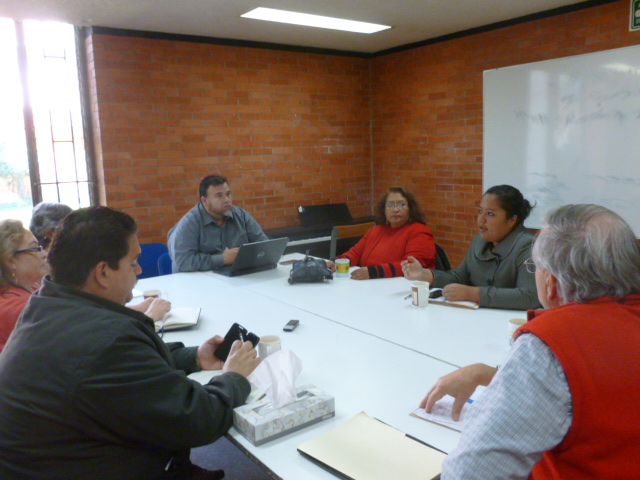
(r to l) Rev. Lisania Martinez and Yolanda Gutierrez of the Mesa Conjunta w/ the Comunidad’s Rector, Admin. Asst., Board Pres., and Vice Rector in Photo by Kate Moyer
Hna. Ana Yolanda Gutierrez Garcia, Kate and I met with the administration of the Comunidad Teológica de Mexico last week. The result was an agreement to explore ways in which this Consortium of seminaries and organizations could assist in training lay and clergy leaders of the Disciples of Christ and Congregational Churches. We are excited by the programs and diplomas offered in theology, liturgy, social transformation, Bible studies by the Comunidad Teológica.
On return to San Luis Potosí we read on the Comunidad web site the following statement in response to the murder and disappearance of 49 students in Ayotzinapa. The statement’s effect on us is twofold. First, the hope that a relationship with the Comunidad will further and more deeply involve the leaders of the Mesa Conjunta denominations and their churches in the national “soul searching” process. And second, we now have additional grounds for hope that our churches and their leaders will have a stronger voice in the future in seeking and bringing about the social change necessary to create a “peaceable kingdom” in Mexico.
In conclusion, our “soul searching” as citizens of the U.S. serving in Mexico tells us that it is no coincidence that both the U.S. and Mexico have recently been reminded how far away the nations remain in creating a just and peaceful society. After all, we are neighbors. And that fact has been both a blessing and a curse to each country. In this Advent season, we are thinking about what changes need to take place for our relationship as neighbors to become a blessing for all people in both countries.
Spanish translation of the above, edited by Rev. Lisania Martinez, is followed by the Comunidad Teológica statement in Spanish and English.
********************** **************************
“Cuanda occurre la injusticia dondequiera, eso amenaza la justicia en todas partes” – Rev. Martin Luther King, Jr.
¿Será mera coincidencia que durante esta temporada de Adviento tanto los Estados Unidos como México siguen un proceso de “búsqueda del alma” nacional provocada por acciones policíacas injustas en Ferguson, Misouri e Iguala/Ayotzinapa, el estado de Guerrero?
El racismo en los Estados Unidos e impunidad y corrupción en México que han preocupado la conciencia nacional y que han causado acciones horrorosas de brutalidad quebrando el corazón durante décadas no es ningún secreto.
Mientras la causa primaria también puede parecer evidente en ambas naciones – la práctica de la esclavitud en los Estados Unidos durante más de ciento cincuenta años y el régimen de solo un partido político por mas de setenta años en México – las soluciones permanecen evasivas y una causa para la división profunda.
Cuando las naciones luchan con tales crisis por tanto tiempo, necesitamos estas ocasiones de “búsquedadel alma” nacional y reflexión sobre nuestro objetivo, destino y nuestra naturaleza verdadera como seres humanos. Dirigido por la creencia que los seres humanos son hechos a la imagen de nuestro cariñoso Creador, podemos procurar encontrar sino soluciones perdurables a tales problemas y el mal que resulta de ellos; podemos al menos buscar causas para la esperanza de que algún día la paz y la justicia reinarán.
Queremos compartir una causa para la esperanza que descrubimos en nuestra visita a la ciudad capital de México la semana pasada. Una causa para la esperanza en el avance de los Discípulos de Cristo y las Iglesias Congregacionales del México y una causa para la esperanza de que aquellas iglesias serán activas capacitando a seres humanos de la forma en que mostrarán el camino a la regla estatal en México dedicado a la prioridad de paz y justicia para todos.
Con la Coordinadora de la Educación Revda. Lisania Sustaita Martinez y la Presidente este año de la Mesa Conjunta, la Hna. Ana Yolanda Gutierre García, Kate y yo nos encontramos con la dirección de la Comunidad Teológica de Mexico. El resultado era un acuerdo de explorar caminos de los cuales este Consorcio de seminarios y organizaciones basadas en la capital de México podrían asistir en la formación de los líderes del clero y laicos de los Discípulos de Cristo y las Iglesias Congregacionales de México. Nos entusiasman los programas y diplomados en teología, liturgia, transformación social y estudios de la Biblia ofrecidos por esta Comunidad Teológica.
Pero fue de vuelta a San Luis Potosí que vimos en el sitio web de la Comunidad la declaración siguiente en respuesta al asesinato y la desaparición de 49 estudiantes en Ayotzinapa. El efecto de la declaración en nosotros es doble. En primer lugar, nos motiva la esperanza de que una relación con la Comunidad Teológica implicará que los líderes de las denominaciones de la Mesa Conjunta y de sus iglesias se involucrarán mas en una manera mas profunda en el proceso de “búsqueda del alma” nacional. Y en segundo lugar, ahora tenemos motivos adicionales de la esperanza que nuestras iglesias y sus líderes tendrán una voz más fuerte en el cambio social necesario para crear un “reino justo y pacifico” en Mexico.
Para concluir, nuestra “alma que busca” como ciudadanos de los Estados Unidos que sirven en México nos dice que no es ninguna coincidencia que se nos recuerde recientemente tanto a los Estados Unidos como México lo mucho que ambas naciones han luchado por la creación de una sociedad más justa y pacífica. Después de todo, somos vecinos. Y ese hecho ha sido tanto una bendición como una maldición para cada país. En esta temporada de Adviento, pensamos en qué cambios tienen que ocurrir para que nuestra relación como vecinos signifique una bendición para toda la gente en ambas naciones.

“What Can We Hope for From a Government that Kills its Students? WE ARE ALL AYOTZINAPA”
The original statement by the Comunidad Teológica is followed by the English translation by Doug Smith (ed. note)
México, D.F. a 22 de octubre de 2014.
¡Grita con toda tu fuerza, no te reprimas! ¡Alza tu voz como trompeta!
Isaías 58:1
Las y los alumnos, cuerpo docente y administrativo de los Seminarios y Organizaciones que conformamos la Comunidad Teológica de México:
Seminario Luterano Augsburgo Seminario Bautista de México Seminario Anglicano San Andrés
Seminario Metodista Dr. Gonzalo Báez Camargo
AMEXTRA Asociación Mexicana de Transformación Rural y Urbana A.C. Facultad Latinoamericana de Teología Reformada
Instituto Palabra de Sabiduría
Indignados por el clima de violencia e inseguridad que impera en todo el país y reprobando los hechos sucedidos en Ayotzinapa el día 26 de septiembre del presente año:
Manifestamos nuestra impotencia, consternación y rechazo por el asesinato de 6 normalistas y la desaparición de otros 43, a manos de las fuerzas policiacas estatales. Este suceso es una muestra de un Estado fallido, inmerso en prácticas corruptas. Además, revela que existe una crisis humanitaria en México que tiene sus bases en la violencia sistémica, ya que la Ley ha sido incapaz de hacer justicia. Esta realidad se recrudece por la pobreza y el narcotráfico y ha generado una flagrante violación a los Derechos Humanos.
Estos hechos se suman a otras lamentables situaciones como el encuentro de numerosas fosas clandestinas, los asesinatos de luchadores sociales, el clima de inseguridad, la falta de oportunidades y la imposición de políticas públicas y reformas que generan un ambiente de violencia e inconformidad.
Como personas de fe, no podemos permanecer calladas ante esta terrible realidad. Ya que Jesucristo buscó la dignificación y humanización de cada persona, creemos que todas y todos los mexicanos tenemos derecho a una vida digna, a la paz, a la libertad y a la justicia.
Por lo que nos sumamos a las acciones de protesta por los acontecimientos ya mencionados y exigimos que el Estado mexicano garantice:
- La presentación con vida de los 43 estudiantes
- El resarcimiento de los daños físicos, psicológicos y económicos a las víctimas y sus familiares.
- Que estos delitos no queden
- La reconstrucción del orden público.
Y además, como muestra de nuestra sincera solidaridad, comunicamos que:
- La capilla de nuestras instalaciones está disponible para cualquier grupo o colectivo que necesite realizar un acto religioso por las víctimas y sus
- La Capellanía de la Comunidad Teológica extiende sus servicios de acompañamiento espiritual y psicológico a los afectados de forma
- Se abre un centro de acopio de víveres para las familias de los estudiantes
- Nos unimos al paro nacional de universidades programado para el 23 de octubre, conscientes de que nosotros también somos estudiantes, mexicanas y
- Estaremos pendientes de las siguientes acciones de apoyo para unirnos a
- Proponemos a toda la sociedad mexicana el uso permanente de un distintivo de listón color verde, en señal de esperanza y amor a la vida; de lucha y de resistencia ante esta situación de injusticia.
Llamamos al Señor y Él respondió, pedimos ayuda y Él nos dijo: Aquí estoy. Porque desechamos el yugo de opresión, el dedo acusador y la lengua maliciosa… Él hace brillar nuestra luz en las tinieblas. Isaías 58: 9,10
Datos de Contacto:
Comunidad Teológica de México San Jerónimo 137, San Ángel.
Tel. 56 16 37 42 y 55 50 38 22.
Correo electrónico: comunidadteologicaporayotzinapa@comunidadteologica.org.mx
Mexico City October 22, 2014
Isa 58:1 “Shout out, do not hold back!
Lift up your voice like a trumpet!”
The students, teaching staff and administration of the seminaries and organizations that make up the Theological Community of Mexico:
Augsburg Lutheran Seminary
Baptist Seminary of Mexico
Saint Andrew Anglican Seminary
Dr. Gonzalo Báez Camargo Methodist Seminary
Mexican Association of Rural and Urban Transformation, Civil Society Organization
Latin American Faculty of Reformed Theology
Word of Wisdom Institute
Outraged by the climate of violence and insecurity that grips the entire country and deploring the latest atrocity that occurred September 26 of this year in Ayotzinapa:
We declare our bewilderment, our great concern and dismay in response to the killing of 6 Normal Teaching School students and the disappearance of 43 others, at the hands of the state police troops. That this has happened is evidence of a failed State, ruling by base, corrupt practices. It also reveals that a humanitarian crisis resulting from systemic violence currently exists in Mexico and that the rule of Law has been unable to enforce justice in the country. This reality comes out of the poverty and narcotics trade and continues to produce flagrant violations of human rights.
The latest events are linked to similarly tragic facts such as the discovery of numerous hidden graves in the Ayotzinapa area, the assassination of social activists, a general climate of insecurity, lack of opportunities for personal advance and policies and reforms that create an environment of violence and disrespect for the rule of law.
As persons of faith, we cannot remain silent before this abominable reality. As Jesus Christ stood up for the dignity and value of every human being, we believe that all Mexicans have a right to a life of dignity, peace, freedom and justice.
It is to that end that we join in protesting what has recently occurred and call on the Mexican Government to carry out:
- The return of the 43 disappeared students alive.
- Reparations for the physical, psychological and economic damages suffered by the victims and their families.
- Punishment of those responsible for these crimes
- Restoration of public order and safety
In addition, as signs of our sincere solidarity, we announce that:
- Our chapel facilities are available for any group or organization that is planning a religious service for the victims and their families.
- The chaplain staff of the Comunidad Teológica offers its services of psychological counsel and spiritual accompaniment to all those affected at no cost.
- A food collection center has been opened to benefit the families of the disappeared.
- We are joining in the suspension of classes to be carried out by universities on October 23, in recognition and awareness that we too are students and Mexicans.
- We will be closely following the planning of other actions of support in order to participate in them as well.
- We propose that the regular wearing of a yellow ribbon in Mexico be practiced as a sign of hope and love of life and of struggle and resistance in the face of injustice.
Isa 58:9-10 “Then you shall call, and the Lord will answer;
You shall cry for help, and he will say, Here I am.
If you remove the yoke from among you,
The pointing of the finger, the speaking of evil …..
Then your light will rise in the darkness.” (NRSV, 1989)
Who’s Going to Pick the Fruit and Vegetables?/Quien Cosechará la Fruta y las Verduras
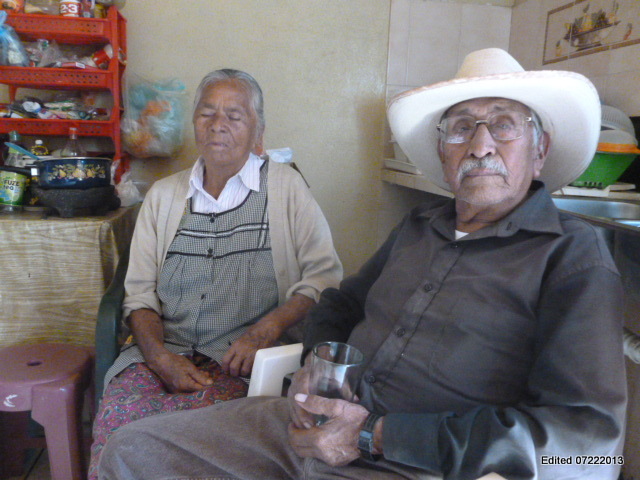
Former “bracero” with his wife at home in Zacatecas/”Bracero” en el pasado con su esposa en su casa de Zacatecas
“There is a definite need for a source of imported labor during the harvest peaks.”
-R.E. Browne, Southern California Farmers Association / Asociación de Agricultores del Sur de California, 1950
Is this the best way we can grow our big orchards?
Is this the best way we can grow our good fruit?
– Woody Guthrie in his poem and song “Deportee” , 1949
Since the boom in productivity of U.S. agriculture over one hundred years ago, who will cultivate the fields and pick the fruit and vegetables has remained a challenging question. Until the Chinese Exclusion Act of the early 1920’s the Chinese migrants led the way. Japanese and Mexican immigrants took their place until the outbreak of WW II when an agreement between

WWII poster promoting the Bracero Program
the U.S. and Mexican governments created the “bracero program”.
The fact that Mexican and Mexican-American workers are counted on by U.S. fruit and vegetable farmers today is in large part due to the bracero program. Between 1942 and 1964 4.5 million Mexicans signed contracts to work for a limited time in fields in the U.S.. During WWII, Mexican “braceros” (from the Spanish “brazos” for arms) were, in the words of President Roosevelt, “contributing with their skill and their labor to the production of vitally needed food”. Today, farm workers in California’s San Joaquin Valley, sometimes called the “breadbasket for the world”, are almost entirely Mexican and Mexican-American.
Providing labor for U.S. farmers when most needed and helping the worker to return home to Mexico was the design of the “bracero” program. It took advantage of the low wages paid on the other side of the U.S.-Mexico border, the longest border in the world between a rich nation and a poor nation.
We talked recently with a former “bracero” who returned to the U.S. eleven or twelve times between 1952 and 1963. Candelario Espino Rodriguez, the 86 year old father of San Luis Potosi Disciples pastor Rogelio Espino Flores welcomed us to his adobe home on a large lot in Ojo Caliente, Zacatecas. It is the same home he left for three month contracts to work for cotton farmers in Texas and to pick tomatoes in the Imperial Valley of California. The only complaint he shared with us was that the last meal of the day was served at 4:30 pm. (rather than the traditional hour of 9 pm or later for the Mexican “cena”) Our friend Rogelio says his father never mentioned the “bracero” experience except to counsel his children never to head “to the other side” in search of higher pay.
Several developments led to repeal of the law governing the “bracero” program in 1964. Some horrific accidents involving “braceros” drew attention to widespread mistreatment of the mostly
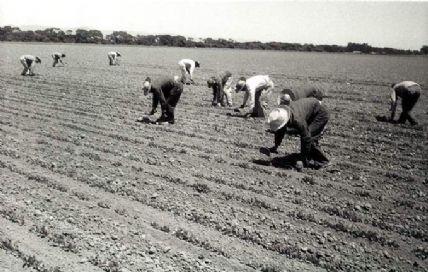
The Farmworkers’ Union successfully organized opposition to use of the “short handled hoe”/ “El cortito” azodón fue prohibido gracias a los esfuerzos de la Union de Campesinos en los 80’s.
non-English speaking Mexican workers, including frequent disputes over pay and discrimination within some of the farming communities. From its founding in 1962, the United Farmworkers Union led by Cesar Chavez and Dolores Huerta opposed the importing of labor from Mexico. In the view of UFW leaders, contracted labor from Mexico kept farmworker wages below the U.S. poverty level and made the worker more vulnerable to inhumane work conditions.
Some of the UFW’s early members first entered the U.S. as “braceros” and now can boast of children with a PhD. Their stories and those of other “ex-braceros” were collected by the Smithsonian’s “Bracero Archive Project”. They resemble stories of immigrants from other lands with a distinctive and very important twist: their former homeland lies a short trip away, across a border that changed eight times in the first hundred years of the U.S. as a nation. How these Mexican immigrants shaped a new identity is one of the fascinating sides of the stories told by these elders whose descendants will make up the largest ethnic group in California and other U.S. states by the middle of this century. Here are two of the captivating stories that can be found at the web site http://braceroarchive.org/
MY PAPA CAME TO THE US AS A BRACERO IN THE EARLY 1940’S FROM A SMALL VILLAGE IN MICHOCHAN, MEXICO…HE WAS AN ORPHAN AND BEGAN WORKING AS A YOUNG BOY IN MEXICO…HIS AUNT RAISED HIM…HE ONLY HAD A 3RD GRADE EDUCATION…BUT HE COULD READ AND WRITE…WHEN HE WAS A YOUNG MAN…THE VILLAGE HAD BEEN BULLETED WITH FLIERS ABOUT WORK IN THE US…HE TOLD HIS AUNT HE WAS GOING TO FIND OUT …HE NEVER RETURNED HOME. THEY SAW A STRONG YOUNG MAN AND BOARDED HIM ON THE TRAIN WITH OTHERS AND HE

Weighing cotton/Pesando algodón
BEGAN WORKING IN THE FIELDS OF SO. MONTEREY COUNTY. HE TOILED IN THE FIELDS WITH NO WATER, LITTLE FOOD AND OFTEN FILLED WITH MAGGETS…HE TOLD THE WORKERS NOT TO EAT THE FOOD…HE BECAME AN ADVOCATE FOR DECENT HUMAN CONDITIONS FOR THE BRACEROS…WHAT LITTLE MONEY HE MADE SENT IT BACK TO MEXICO. IN THE LATE 1940’S HE SETTLED IN SAN JUAN BAUTISTA, CA…HE WORKED AS COOK IN BOARDING HOUSE FOR BRACEROS BY NOW AND MET HIS WIFE, CARMEN MURO…THEY WOULD HAVE 8 CHILDREN…MANY OF HAVE RECEIVED A COLLEGE DEGREE, ONE A MASTER’S DEGREE…AND IN 2008 HE PASSED AWAY AT THE AGE OF 95…STILL ABLE TO TELL HIS STORIES OF HIS JOURNEY INTO THE US. AT THE AGE OF OF 82 YEARS OLD HE BECAME A US CITIZEN…REALIZING HE NEVER GOING TO RETURN HOME TO MEXICO.
Creator
CONSUELO ESPINOSA
It was not until 1953, at age 19, he finally entered the Bracero Program. Assigned to work in Arizona, his hard labor paid off. He found favor with his employers. Out of 160 braceros, 3 were chosen as supervisors to apply for legal residency. Their aplication fees were fully paid by his employer. They were the lucky ones. The less fortunate braceros were subjected to racism, segregation, physical abuse, and sometimes death.
This bracero is my father. He married in 1968 and migrated to the beautiful Salinas Valley, where he continued his work in farm labor and still takes pride in being a busy, hard working man. In 2002, 49 years later after entering this country, my father became a US Citizen! I was so proud of him.
Today, he sits and watches how the country which once desperately needed him, at times still continues to despise and mistreat Mexican laborers.
Creator
Mary Vargas
The Smithsonian’s Bracero History Archive and its article “Bittersweet Harvest: the Bracero Program 1942-1964” were primary resources in writing this
****************** ******************
Gracias a Revda. Lisania Sustaita Martinez por su ayuda en la traducción del blog.
“Hay una necesidad clara de una fuente de mano de obra importada durante los picos de la cosecha”.
– R.E. Browne, Asociación de Agricultores del Sur de California, 1950
¿Es esto el mejor modo
en que podemos cultivar
nuestros grandes huertos?
¿Es este el mejor modo
para cultivar nuestra buena fruta?
– Woody Guthrie en su poema y canción “Deportée”, 1949
Después del aumento considerable en la productividad de la agricultura estadounidense hace más de cien años, “¿quien cultivará los campos y quien cosechará la fruta y verduras?” ha permanecido como una pregunta provocativa.
Hasta el Acto de Exclusión de los Chinos de principios de los años 1920 los emigrantes chinos dominaron en los campos del país. Los inmigrantes japoneses y mexicanos tomaron su lugar hasta el brote de la Segunda Guerra Mundial cuando un acuerdo entre los gobiernos estadounidenses y mexicanos creó el “programa bracero”.
El hecho que los trabajadores mexicanos y mexicano-americanos sean los cultivadores y

U.S. Govt. issued card on completion of the bracero contract reads, “in appreciation of the labor rendered for the increased food and fiber required for the war effort” – in 1951!/ Tarjeta officiale del gobierno de los EEUU dice, “en appreciation de la contribución prestada al aumento del alimento y fibra necessarios para el esfuerzo de defensa de la nación”. – en el año 1951!
cosechadores de la fruta y las verduras estadounidenses hoy es en gran parte debido al programa bracero. Entre 1942 y 1964, 4.5 millones de mexicanos firmaron contratos para trabajar por un tiempo limitado en los campos del norte. Durante la segunda guerra mundial, “braceros” mexicanos, en las palabras del presidente Roosevelt, “contribuyen con su habilidad y su trabajo a la producción de la comida sumamente necesaria”. Hoy, los labradores en el Valle de San Joaquín de California, a veces llamado la “la panera del mundo”, son casi completamente mexicanos y mexicano-americanos.
El suministro del trabajo para agricultores estadounidenses cuando sea lo más necesario y la ayuda al obrero para volver a casa a México era el diseño del programa “bracero”. Aprovechó los salarios mal pagados al otro lado de la frontera de Estados-Unidos-México, la más larga en el mundo entre una nación rica y una nación pobre.
Hablamos recientemente con un antiguo “bracero” quien volvió a los Estados Unidos once o doce veces entre 1952 y 1963. Candelario Espino Rodriguez, el padre de 86 años del pastor de los Discípulos de Cristo de San Luis Potosí Rogelio Espino Flores, nos dió la bienvenida a su casa de adobe sobre un gran terreno en Ojo Caliente, Zacatecas. Es la misma casa que dejó por un contrato de tres meses para trabajar para agricultores de algodón en Texas y piscar tomates en el Valle Imperial de California. Su hijo, nuestro amigo Rogelio, dice que su padre nunca mencionó su experiencia de “bracero” excepto para aconsejar a sus hijos a nunca dirigirse “al otro lado” en busca de un pago más alto.
Varios acontecimientos condujeron a la abrogación de la ley que gobierna el programa “bracero” en 1964. Algunos accidentes horrorosos en que murieron “braceros” llamaron la atención hacia el maltrato sufrido por los trabajadores mexicanos generalmente quienes no hablaban inglés, incluso disputas frecuentes de paga y discriminación dentro de las comunidades en donde cultivaban la tierra. Desdé su fundación en 1962, la Unión de Campesinos conducida por Cesar Chavez y Dolores Huerta se opuso a la importación de mano de obra de México. En la visión de los líderes de la UFC, el trabajo contratado de México guardó salarios del labrador debajo del nivel de pobreza estadounidense e hizó al obrero más vulnerable a condiciones de trabajo inhumanas.
Algunos miembros al comienzo de la UFC entraron en los Estados Unidos como “braceros” y ahora se pueden jactar de hijos con doctorados. Sus historias y aquellas de otros “ex-braceros” fueron recogidos por el “Proyecto del Archivo de Bracero”. Se parecen a historias de inmigrantes de otros países a los EEUU con esta diferencia distintiva y muy importante: su patria de procedencia está cruzando una frontera que cambió ocho veces en los primeros cientos años de los Estados Unidos como una nación.
Cómo estos inmigrantes mexicanos formaron una nueva identidad, es uno de los aspectos fascinantes de las historias contadas por estos mayores cuyos descendientes representarán al grupo étnico más grande en California y otros estados estadounidenses en poco tiempo. Aquí están dos de las historias cautivadoras que se pueden encontrar en el sitio web http://braceroarchive.org/
MI PAPÁ VINO A LOS EE.UU COMO UN BRACERO A PRINCIPIOS DE LOS AÑOS 1940 DE UN PEQUEÑO PUEBLO EN MICHOCHAN, MÉXICO… ERA UN HUÉRFANO Y COMENZÓ A TRABAJAR COMO UN MUCHACHO JOVEN EN MÉXICO… SU TÍA LE CRIÓ… SÓLO TENÍA UNA EDUCACIÓN DEL 3ER GRADO… PERO PODÍA LEER Y ESCRIBIR… CUANDO ERA UN JOVEN… EL PUEBLO HABÍA SIDO EL BLANCO DE MUCHA PEOPAGANDA SOBRE EL TRABAJO EN LOS EE.UU… DIJO A SU TÍA QUE IBA A AVERIGUARLO… NUNCA VOLVIÓ A CASA. VIERON A UN JOVEN FUERTE Y LE ALOJARON EN EL TREN CON OTROS Y COMENZÓ A TRABAJAR EN LOS CAMPOS DEL CONDADO DE MONTEREY. TRABAJÓ DURO EN LOS CAMPOS SIN AGUA, POCA COMIDA Y A MENUDO SE LLENABA DE PARÁSITOS… INDICÓ A LOS TRABAJADORES NO COMER LA COMIDA… SE HIZO UN INTERCESOR PARA CONDICIONES HUMANAS DECENTES PARA LOS BRACEROS… LO POCO DE DINERO QUE HACÍA LO ENVIABA A MÉXICO. A FINALES DE LOS AÑOS 1940 SE INSTALÓ EN SAN JUAN BAUTISTA, CALIFORNIA… TRABAJÓ COMO COCINERO EN LA PENSIÓN PARA BRACEROS Y ALLÍ ENCONTRÓ A SU ESPOSA, CARMEN MURO… TENDRÍAN 8 NIÑOS. .. MUCHOS DE ELLOS HAN RECIBIDO UN TÍTULO UNIVERSITARIO, UN TÍTULO DE MAESTRÍA… Y EN 2008 FALLECIÓ A la edad de 95 años TODAVÍA CAPAZ DE CONTAR SUS HISTORIAS DE SU VIAJE EN LOS EE.UU. A LA EDAD DE 82 AÑOS SE HIZO CIUDADANO estadounidense DANDOSE CUENTA DE QUE NUNCA IBA A VOLVER A SU CASA EN MÉXICO.
ESCRITA POR SU HIJA,
CONSUELO ESPINOSA
“Un Bracero Humilde”
No fue sino hasta 1953, a la edad de 19 años, que finalmente entró en el Programa Bracero. Encomendado a trabajar en Arizona, sus trabajos duros dieron resultado. Encontró gracia delante de sus empleadores. De 160 braceros, 3 se eligieron como supervisores y para solicitar los papeles de residencia permanente. Sus gastos de la aplicación fueron totalmente pagados por su empleador. Eran afortunados. Braceros menos afortunados eran sometidos a racismo, segregación, abuso físico, y a veces muerte.
Este bracero es mi padre. Se casó en 1968 y emigró al Valle de Salinas, un valle muy hermoso, donde siguió su trabajo en granjas y todavía se siente orgulloso de ser un hombre trabajador. ¡En 2002, 49 años después de entrar en este país, mi padre se hizo un Ciudadano estadounidense!
Hoy, se sienta y mira cómo el país que una vez desesperadamente le necesitó, a veces todavía sigue despreciando y maltratando a trabajadores mexicanos.
Escrita por su hija,
Mary Vargas
El Archivo de la Historia Bracero de Smithsonian y su artículo “Bittersweet Harvest: the Bracero Program 1942-1964” eran recursos primarios en la escritura de este blog.
Mexico Speaks / Habla Mexico

We reach out to persons of a different culture by enjoying their traditions in food – and their sayings.
We know from our high school language teachers that there is much more to learning a language than expanding our vocabulary and following the rules of grammar. If we’ve never tasted an “agua de horchata” (the sweetened rice water popular all over Mexico) can we really claim to know the word “horchata”?? Unless we’ve heard musicians playing “las manañitas” to celebrate a birthday do we really know the words “serenata” – or the word serenade ?
Margaret Ramirez, Director of Seniors Programs at Eastmont Community Center http://www.eastmontcommunitycenter.org/ , was a wonderful Spanish teacher. With a smidgin of Spanish, after graduation from seminary, Doug began working with Margaret in East Los Angeles in what was once the largest concentration of Mexican-Americans in the U.S. His first day at the Eastmont Center, Margaret welcomed Doug with an “abrazo” (a warm hug) and invited him to join the rest of the staff for their daily morning ritual of “pan dulce” or Mexican pastry, conversation in Spanish and café. Learning how to eat “cocido” (vegetable soup stocked with chicken or beef bones), Margaret’s remedy for a cold, represented for Doug another significant step in learning the Mexican culture and language.
But it was Domingo Rangel’s arrival at Eastmont that made Doug feel he was really making progress in learning Spanish. Domingo was an elderly participant in a federal jobs program for seniors and he served as the Center’s chief maintenance staff for a couple of years. He also was a fount of Mexican traditional sayings, the collective folk wisdom that has helped shape the character of individuals and culture in Mexico from generation to generation. Domingo often made use of these sayings and his slight smile and shift in the tone of his voice would signal he was speaking not as a solitary individual but as his family had taught him, and as a people had taught them.
In preparing for the Center’s 25th Anniversary, Domingo pledged he and his volunteer helpers would:
“barrer por donde la suegra no mira” – “sweep where the mother in law doesn’t look.”
It was Domingo who taught Doug an important theological affirmation with the saying :
“No hay mal que por bien no venga” or “there is nothing so bad that something good cannot come from it.”
In keeping with that Gospel message, Domingo emphasized that a person’s worth could be measured only by his actions and not his words. For that conviction, he had several other sayings:
“De el dicho al hecho hay mucho trecho” or “There’s a long way to go between what one says and what one does.”
“De lengua me como un plato” (or “un taco”) equivalent to the saying in English “Words come a dime a dozen” .
The tolerance and acceptance of persons regardless of their past is taught through the following saying, also first shared with Doug by Domingo Rangel:
“Somos todos hijos o hijastros” or “We are all either children or step children in the eyes of God”. We’ve come across a similar saying in the Mexican homeland:
“Tener conciencia limpia es tener mala memoria” or “To claim a clean conscience is to show you have a bad memory”.
We’ve enjoyed hearing many Mexican “dichos” while here and learning a few of them. Our friends, the couple Marisela Huelga de Leon and Hemer Sierra Silva, have been a great help to us in so
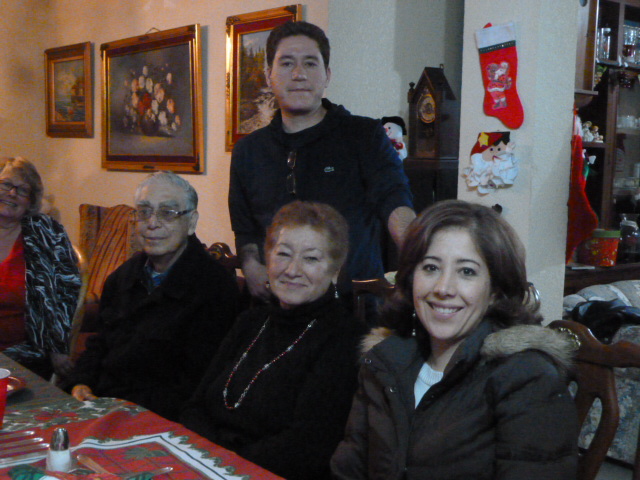
Hemer and Marisela with children Eddie and Cindy.
many ways, including teaching and explaining some new “dichos” or Mexican sayings.
Several of the “dichos” treat the theme of friendship:
“Son amigos como uña y mugre” – “They are as close as the dirt under fingernails.”
“Es major tener un amigo que un peso en el bolsillo” – “It’s better to have a friend than pesos in the pocket.”
“Solo el que trae el morralito sabe lo que pesa.” – “Only the one who is carrying the bag knows what it weighs.”
Another friend here, Heidi Sifuentes Sánchez, especially enjoys the more humorous sayings such as:
“Fondo salido, busca marido” – “If the slip is showing, she’s looking for a husband”.

Daughters Debi (at l.) and Nadya learn sayings from grandmother Lolis ( in m.) and Heidi (at r.)
And this one on the theme of “look who’s talking!” :
“El burro hablando de orejas” – “The burro is talking about someone else’s ears”.
Several of Heidi’s “dichos” issue warnings about what we say:
“En boca cerrada no entran moscas” “With a closed mouth/ flies can’t get in.”
“Por la boca muere el pez.” “A fish is caught and dies by its mouth”.
We could share many more “dichos” we’ve learned while in Mexico, and may just do that in a future blog, but before wrapping this up let us pass on a Mexican traditional saying that has had the greatest impact on us. For whatever reason, you seldom hear this expression of gratitude today in Mexico; is it a threadbare cliché? considered trite now? Whatever may be the fate of this saying when Doug was first thanked this way by an elderly Mexican woman at Eastmont Community Center the words reached his heart:
“Que Dios se lo pague”! or “May God pay you for it!”
That brief, simple way of saying thank you continues to come to mind as we experience the riches of God’s grace in sharing the journey of a life of faith in Mexico.
****************** ********************** *****************
Gracias a Lisania Sustaita Martinez por su ayuda en la traducción del blog:
Sabemos por nuestros profesores de la lengua de la escuela secundaria que hay mucho más en el aprendizaje de una lengua, que la ampliación de nuestro vocabulario y conocimiento de reglas de la gramática. ¿Si nunca hemos probado “agua de horchata” (el agua de arroz endulzada popular por todas partes de México) podemos realmente afirmar saber la palabra “horchata”?? ¿A menos que hayamos oído a los músicos tocar “las manañitas” para celebrar un cumpleaños realmente sabemos la palabra “serenata” – o la palabra en ingles “serenade”?
Margaret Ramirez, Directora de Programas de Personas Mayores en el Centro de la Comunidad Eastmont, en el Este de Los Angeles, era una maravillosa profesora de español. Con un poquitito de español, después de la graduación del seminario, Doug comenzó a trabajar con Margaret en la comunidad de Eastmont en lo que era en el pasado la concentración más grande de mexicoamericanos en los Estados Unidos. Su primer día en el Centro de Eastmont, Margaret dio la bienvenida a Doug con un abrazo cariñoso y le invitó a afiliarse al resto del personal para su ritual diario matutino de pan dulce, conversación en español y un cafecito. Aprendiendo cómo comer “cocido” (sopa de verduras abastecida de pollo o huesos de carne de vaca), el remedio de Margaret por la gripa o el resfriado, representó para Doug otro paso importante en el aprendizaje de la cultura mexicana y su lengua.
Pero era la llegada de Domingo Rangel a Eastmont que hizo a Doug sentir que realmente avanzaba en el aprendizaje de español. Domingo era un participante en un programa de empleos federal para personas mayores y sirvió como jefe de mantenimiento y aseo del Centro durante un par de años. También era una fuente de dichos tradicionales mexicanos, la sabiduría popular colectiva, que ha ayudado a formar el personaje y carácter de individuos y cultura en México de una generación a la proxima. Domingo a menudo hacía el uso de estos dichos y su sonrisa leve y el cambio en el tono de su voz señalaba que él hablaba no como un individuo solitario, sino como su familia le había enseñado, y como su gente los había enseñado.
En la preparación para el 25to Aniversario del Centro, por ejemplo, Domingo prometió que él y sus voluntarios “barrerián por donde la suegra no mira” .
Era Domingo quien enseñó a Doug una afirmación teológica importante con el dicho:
“No hay mal que por bien no venga.”
De acuerdo con ese mensaje Evangelico, Domingo subrayó que el valor de una persona sólo podría ser medido por sus acciones y no sus palabras. Para esa convicción, tenía varios otros dichos:
“Del dicho al hecho hay mucho trecho.”
Y
“¡De lengua me como un plato ( o un taco )!”
equivalente al dicho en ingles de “Las palabras se compran una docena a diez centavitos”.
La tolerancia y la aceptación de personas sin tener en cuenta su pasado se enseñan a través del dicho siguiente, también primero compartido con Doug por Domingo Rangel:
“Somos todos hijos o entenados (hijastros)”
Nos hemos encontrado con un refrán similar en la patria mexicana:
“Tener conciencia limpia es tener mala memoria”
Hemos disfrutado de oír muchos dichos mexicanos durante nuestro ministerio aquí y aprendimos algunos de ellos. Nuestros amigos, la pareja Marisela Huelga de Leon y Hemer Sierra Silva, han sido una gran ayuda a nosotros de tantos modos, incluso enseñanza y explicación de algúnos nuevos dichos.
Varios de los dichos de ellos tratan el tema de amistad:
“Son amigos (Amigas) como uña y mugre.”
“Es mejor tener un amigo que un peso en el bolsillo”.
“Solo el que trae el morralito sabe lo que pesa”.
Otra amiga aquí, Heidi Sifuentes Lopez, sobre todo disfruta de los dichos más graciosos como:
“Fondo salido, busca marido.”
Y éste en el tema del dicho en ingles de “¡mira quién habla!”:
“El burro hablando de orejas”
Varios de los dichos de Heidi publican advertencias sobre lo que decimos:
“En boca cerrada no entran moscas”. Y
“Por la boca muere el pez”.
Podríamos compartir muchos más dichos que hemos aprendido durante nuestra estancia en México, y se puede hacer esto en un futuro blog, pero antes de proceder mas dejenos compartir un dicho tradicional mexicano que ha tenido el mayor impacto en nosotros.
Por cualquier motivo, rara vez se oye esta expresión de gratitud hoy en México; ¿es un cliché gastado? ¿considerado trillado ahora? Independientemente de lo que puede ser el destino de este dicho en México contemporaneo cuando a Doug una mujer mexicana de tercera édad le agradeció a Doug en el Centro de la Comunidad de Eastmont con estas palabras lo tocaron en el corazón:
¡“ Que Dios se lo pague”!
Ese modo breve y simple de expresar la gratitud para la actuación de otra persona sigue viniendo a la mente aquí ya que experimentamos la riqueza de la gracia de Dios en el compartir de la jornada de la vida de fe en México.
Food is for Sharing /La Comida Se Hizo Para Compartir
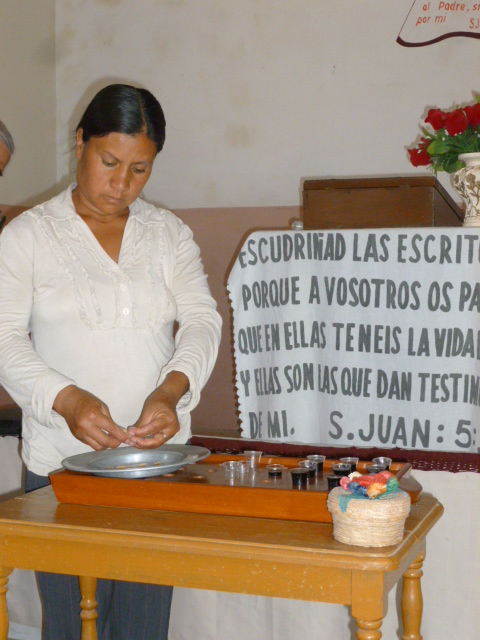
In the rural La Reforma Disciples Church, there are just enough cups filled for the communion service/Noten que se llenan las copas suficientes para la pequeña Iglesia rural de La Reforma
World Communion Sunday this year was a memorable occasion. It was our first Sunday in worship at the Julien Carrillo Disciples of Christ Church after undergoing major surgery in the States. On taking our seats, we were relieved that in a church which does not celebrate the Lord’s Supper every week, on this Sunday, the communion trays were present.
And the communion cups were filled. But not just filled; they were topped off to the extent it required some effort to avoid spilling the juice. Pastor Rogelio Espino Flores later told me this was not by accident. The filled to nearly overflowing cups are intended to make a theological statement. “Mi copa está rebosando” – “my cup overflows”. (Ps 23:5c)
But not just for me. For everyone around the table. Wherever they might be served the bread and the juice. In Mexico and Congo, in Haiti and the U.S. Our cups overflow if only for that moment of our lives.
It has struck me that in giving thanks for meals we’ve enjoyed at churches here, most persons include the petition that the hungry be fed. I’m continually reminded of the prayer, “Lord, to those who hunger, give bread. And to those who have bread, give the hunger for justice.”
Lifting up those who hunger while giving thanks for a meal is another reminder for us of the “materialist” significance of what we do in church. It leads us to consider the question of what Jesus really wants us to “remember” in the Lord’s Supper? Is it just the sacrifice of His body that He wants us to contemplate as we share with the world’s Christians in the bread and the cup? Or did Jesus intend the Supper to be a
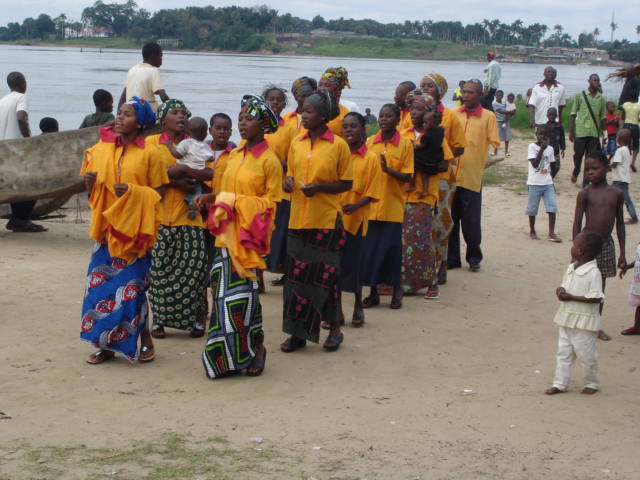
Powerful singing highlights the worship for this congregation in the middle of the Congo River. Lacking the cups, there was no communion when we visited./Faltando copas, esta congregación Discipulos en el Congo no celebrarón la Santa Ceña cuando la visitamos.
prefiguring, a celebration of that day when we all, all of God’s children, share the earth’s abundance? Could Jesus have also intended with this remembrance to call us and empower us to work for that day of cups overflowing for all?
Priest and theologian Tissa Balasuriya, of Sri Lanka, thinks the answer to that question is yes. In his 1977 book The Eucharist and Human Liberation, Father Balasuriya writes, “The ‘adaptation’ of the Christian religion to Latin American, African and Asian countries is not merely a matter of language, rites, music, art or even of having native clergy and bishops. We have to go through a whole revaluation of the whole thought and value content of what passes for Christianity and faith.”
In his thinking, Christian unity is the basis for joint efforts of rich and poor Christians on behalf of peace and justice worldwide. The Eucharist is in his view the rallying by Jesus of his followers to help bring about the equal sharing symbolized by his Supper. Father Balasuriya writes, “The churches are linked throughout the world. Earlier they have generally had an influence for domesticating people within Capitalism and Imperialism. Now they can be agents for human liberation if they really want to be so.”
But the Eucharist is not a time to hang our heads contemplating what we have not done. It is not a time to confess our complicity and feel guilty. It is a time to give thanks for the food of Christ’s body whose power enables us to be and do far more than we have ever thought possible (EP 3:20). In discerning the body as we share the Supper, as Paul exhorts (I CO 11:29), we give thanks that we all, rich and poor, can participate in helping fill to overflowing everyone’s cup.
Father Balasuriya closes his book with the words of another Asian Christian whose Declaration of Conscience was smuggled out of his prison cell:
“As you cannot go to heaven alone, Food is to be shared……
As all share the sight of the heavenly stars,
So food is something that must be shared……
Ah! Food is something that must be shared.”
Kim Chi Ha
*********** ************************ *********
Agradecemos a la Revda. Lisania Sustaita Martinez por su ayuda con esta traducción del articulo.
El Día de La Comunión Mundial este año era una ocasión memorable. Era nuestro primer domingo en la adoración en la iglesia de Julián Carrillo después de someterme a la cirugía grave en los Estados Unidos. Tomando nuestros asientos, notamos que en una iglesia que no celebra la Cena del Señor cada semana, este domingo las bandejas de la comunión estuvieron presentes.
Y las copas de la comunión estaban llenas. Pero no sólo llenas; se llenaron al grado que requirió a algún esfuerzo de evitar derramar el jugo. Pastor Rogelio Espino Flores más tarde me dijo que esto no era por casualidad. Las copas casi desbordantes se requieren para hacer una afirmación teológica. “Mi copa está rebosando”. (Ps 23:5c)
Pero no sólo para mí. Para cada uno alrededor de la mesa. Dondequiera que se pudiera servir el pan y el jugo. En México y Congo, en Haití y los Estados Unidos. Nuestras copas se desbordan para ese momento de nuestras vidas.
Me ha notado que al dar gracias por las comidas que hemos disfrutado en iglesias de Mexico, la mayor parte de personas incluyen la petición de que los hambrientos sean alimentados. Me recuerdan continuamente el rezo, “Señor, a aquellos que tienen hambre, dales pan. Y a aquellos que tienen el pan, dales hambre de justicia”.
La intercesión por aquellos que tienen hambre mientras damos gracias por una comida es otro recordatorio para nosotros del significado del “materialismo” de lo que hacemos en la iglesia. Nos lleva a considerar la pregunta de ¿qué Jesús realmente quiere que nosotros “recordemos” en la Cena del Señor? ¿Es sólo el sacrificio de su cuerpo? ¿qué quiere Él que nosotros contemplemos ya que compartimos con los cristianos del mundo en el pan y la copa? ¿O quiso Jesús la Cena para prefigurar como una celebración de ese día cuando todos nosotros, todos los hijos de Dios, compartimos la abundancia de la tierra? ¿Podría Jesús también haber tenido la intención con esta conmemoración de llamarnos y autorizarnos a trabajar para ese día de copas que se desbordan para todos?
El sacerdote y el teólogo Tissa Balasuriya, de Sri Lanka, creen que la respuesta a esa pregunta es sí. En su libro de 1977 La Eucaristía y Liberación Humana, el Padre Balasuriya escribe, “La ‘adaptación’ de la religión cristiana a países latinoamericanos, africanos y asiáticos no es simplemente un asunto de lengua, ritos, música, arte o hasta de tener clero natal y obispos. Tenemos que pasar por una revalorización entera del pensamiento entero y valorar el contenido de lo que entiendes por cristianismo y fe”.
En su pensamiento, la unidad cristiana es la base para esfuerzos conjuntos de cristianos ricos y pobres en favor de la paz y justicia por todos en el mundo. En la eucaristía está -en su opinión- la reunión por Jesús de sus seguidores para ayudar a causar el compartimiento igual simbolizado por su Cena. El padre Balasuriya escribe, “Las iglesias se unen y se relacionan en todo el mundo. Antes han tenido generalmente una influencia en domesticar a la gente dentro de Capitalismo e Imperialismo. Ahora pueden ser agentes para la liberación humana si realmente quieren ser así”.
Pero la eucaristía no es un tiempo para bajar nuestras cabezas reflexionando en lo que no hemos hecho. No es un tiempo para admitir nuestra complicidad y sentirse culpable. Es un tiempo para dar gracias por la comida del cuerpo de Cristo cuyo poder nos permite ser y hacer mucho más que hemos pensado alguna vez posible (Ef 3:20). En discernir el cuerpo ya que compartimos la Cena, ya que Pablo exhorta (I Co. 11:29), damos gracias que, rico y pobre, podemos participar en la ayuda de llenar la copa de todo el mundo hasta desbordarse.
El padre Balasuriya cierra su libro con las palabras de otro cristiano asiático cuya Declaración de la Conciencia se pasó de contrabando de su celda de la cárcel:
“Como no se puede ir al cielo solo,
La comida se debe compartir … …
Como todos comparten la vista de las estrellas divinas,
Por tanto la comida es algo que se debe compartir …
Kim Chi Ha
The Other Mexico / El Otro Mexico
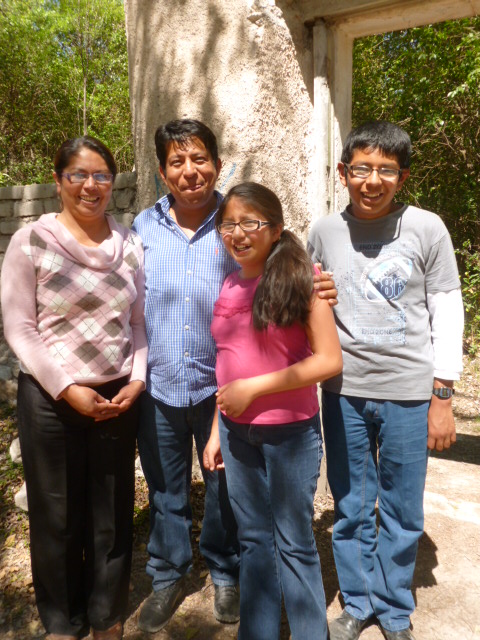
Enrique Retes and spouse Maria Luisa with Caleb and Rebecca serve the rural communities of Guanamé and Los Remedios in the State of San Luis Potosí
We’ve just spent a month living next to the green fields of soy beans and corn in Kansas. What a contrast to the expansive views of arid high desert in San Luis Potosí. Not long before we left Mexico, we enjoyed a barbeque in a rural community not far from San Luis. Our hosts told us the corn we saw growing was the first crop they would harvest after three years of sporadic rainfall. Most of the family’s agricultural earnings come from sale of the “tunas” their land’s nopal cactus produces and from livestock sales. In recent years it has become much harder to profit from growing corn , the staple of the Mexican diet and Mexico’s primary crop for hundreds of years.
Farming – life in general – in rural Mexico is and has been a hard scrabble existence for most “campesinos” for many

A variety of barrel cactus also produces a fruit – called “biznaches” – that are prized eating
years. As the Mexican novelist Juan Rulfo put it, “the people work very hard… they produce a lot … but when you leave the capital city (Guadalajara, capital of Rulfo’s home state of Jalisco) there is much suffering.” Rulfo wrote that in the early 1950’s and life in rural Mexico is now even more difficult for two reasons: the change in rainfall patterns and the flood of food imports from the U.S. and Canada after NAFTA.
We don’t have to go far to note the irregular rainfall; we are told the seminary grounds where we live used to be green most of the year. And yet most family farms of rural Mexico practice seasonal agriculture, relying still on the increasingly erratic rainfall patterns. At the end of 2011 only 6 % of Mexico’s agricultural land was irrigated; the average irrigated land for all countries of Latin America is more than 15 %. What is irrigated in Mexico are the industrial farms producing export crops for the U.S.
As for NAFTA, the impact on small farmers has been harsh. Earnings on locally grown produce have fallen with the increase in subsidized food imports from the U.S. and Canada. Imports now comprise 40 per cent of Mexico’s corn consumption, 33 per cent of its beans, 56 per cent of its wheat, 80 per cent of the rice consumed. Mexico’s food imports have increased in value from $1.8 billion U.S. dollars before NAFTA to more than $24 billion twenty years after NAFTA’s approval in 1994.
In an article titled “As U.S. Corn Flows South, Mexicans Stop Farming”, a farmer in Oaxaca is quoted as saying, “Of my generation, many people want nothing to do with farming because it doesn’t pay. (And) with all the changes in weather, there is no certainty that your harvest will be good”. One study estimates a net loss of at least two million small farmers in the NAFTA years.
Current pressures on small farmers constitute a push for migration to the U.S. Undocumented Mexican-born residents of the U.S. surged from 4.3 million pre NAFTA in 1990 to 9.4 million in 2000 and peaked at 12.9 million in 2009. Although only one quarter of Mexico’s population live in rural areas, they number 44 per cent of Mexican emigrants living without
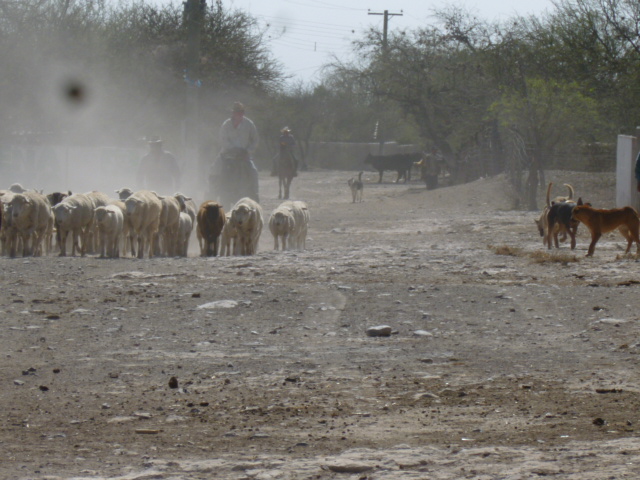
In Los Remedios, the sheep, goats and cattle, seen here passing in front of the Church, are the primary cash earners
immigration documents in the U.S.
And what has the U.S. done to mitigate the effects of climate change and the NAFTA trade agreements on rural Mexico? Very little it turns out. In 2009 96 per cent of U.S. aid to Mexico was assigned to the military and Mexican police. That same year, development assistance both to help create jobs and provide support for small farmers totaled $11.2 million, or .01 per cent of the total U.S. aid.
In 2010 the U.S. budget allotted $17 billion to patrol our borders. Imagine what a billion or two of that budget devoted to providing water management, credit and marketing assistance to Mexican small famers might do in reducing migration to the U.S. A Bread for the World/Church World Service Fact Sheet on “Poverty in Mexico and Migration to the U.S.” sums up a more “integrated” approach to border enforcement: “The U.S. must increase its focus on addressing poverty as one of the causes of immigration. These efforts should include poverty reduction and job creation projects targeted to immigrant-sending communities, particularly in rural zones.”
In spite of the poverty in rural communities, our churches, with the help of lay pastors in the urban churches of San Luis Potosí, impress us by their enthusiasm and spirited worship and fellowship. Enrique Retes with his partner and co pastor Maria Luisa have served two rural churches two hours from San Luis for over seven years. Money for their gas is usually provided, but when the offering drops the congregation supplies local produce. Around eighty children and adults attended the Sunday we preached at Los Remedios; several months earlier the church had hosted the annual women’s retreat of the Disciples churches.
****************** ************************ ******************
Acabamos de pasar un mes viviendo junto a los verdes campos de soja y maíz en Kansas. Qué contraste con las vistas expansivas del árido desierto de San Luis Potosí. No mucho tiempo antes de que salimos de México, disfrutamos de una barbacoa en una comunidad rural no muy lejos de San Luis. Nuestros anfitriones nos dijeron que el maíz que vimos era la

Is that a cracker? Grape juice or kool aid? We can hardly tell what is served at the Lord’s Supper but its celebration is always special in a church like Los Remedios
primera cosecha después de tres años de lluvias esporádicas. La mayoría de los ingresos agrícolas de la familia provienen de venta de las “tunas” que produce el cactus “nopal” de sus tierras y de las ventas de ganado. En los últimos años se ha vuelto mucho más difícil sacar provecho del cultivo de maíz, el alimento básico de la dieta mexicana y el cultivo primario de México durante cientos de años.
La agricultura -la vida en general – en zonas rurales de México es y ha sido una existencia de lucha difícil para la mayoría de “campesinos” por muchos años. Como dijo el gran escritor mexicano Juan Rulfo, “la gente trabaja mucho… produce mucho… pero usted va fuera de la capital (Guadalajara, capital del estado de Jalisco de Rulfo) y hay mucha miseria.” Rulfo lo escribió al principio de los años ’50 y ahora es aún más difícil la vida en zonas rurales por dos causas: el cambio en los patrones de lluvia y la importación de alimentos procedentes de los Estados Unidos y Canadá después del TLCAN.
No tenemos que ir lejos para observar el efecto de las lluvias irregulares; nos dicen que los terrenos del seminario donde vivimos recientemente solían ser verde todo el año. Y aún la mayoría de las granjas familiares practican agricultura de temporada, apoyándose en los patrones de lluvias cada vez más errático en estos años. A finales de 2011 sólo el 6% de tierra agrícola en Mexico se regó; el promedio del riego para todos los países de América Latina es más del 15%. Qué es irrigado en México son las granjas industriales productoras de cultivos de exportación para Estados Unidos.
En cuanto al TLCAN, el impacto en las pequeñas granjas ha sido severo. Las ganancias en productos cultivados localmente ha caído con el aumento de las importaciones de alimentos subsidiados de los Estados Unidos y Canadá. 40 por ciento del consumo de maíz de México, 33 por ciento de sus granos, 56 por ciento de su trigo, 80 por ciento del arroz que se consume en México se importa actuellemente. Las importaciones de alimentos de México han aumentado en valor de $ 1,8 billones de dólares antes del TLCAN a más de $ 24 billones de dolares después de la aprobación del TLC en 1994.
En un artículo titulado “Como Fluye Hacia el Sur El Maíz de Estados Unidos, los Mexicanos Dejan de Cultivar la Tierra”, un campesino en Oaxaca es citado como diciendo: “de mi generación, muchas personas quieren nada que ver con la agricultura porque no vale la pena. (Y) con todos los cambios en el clima, no hay ninguna certeza de que la cosecha será buena”. Un estudio estima una pérdida neta de al menos 2 millones de pequeños agricultores en los años del TLCAN.
Es cierto que las actuales presiones sobre pequeños agricultores constituyen un impulso para la migración a los Estados Unidos. Indocumentados de nacimiento Mexicano residentes en los Estados Unidos aumentaron de 4,3 millones pre TLCAN en 1990 a 9,4 millones en el año 2000 y alcanzó el 12,9 millones en 2009. Aunque sólo una cuarta parte de la población de México vive en zonas rurales constituyen el 44 por ciento de los mexicanos que viven sin documentos de inmigración en los Estados Unidos.
¿Y como ayuda los Estados Unidos para mitigar los efectos de los cambios de clima y del TLCAN en México rural? Parece muy poco. En 2009 un 96 por ciento de la ayuda estadounidense a México fue asignado a la policía y militares en Mexico. Ese mismo año, asistencia para el desarrollo tanto para ayudar a crear puestos de empleo y prestar apoyo a los pequeños agricultores totalizaron $ 11,2 millones, o .01 por ciento de la ayuda total de Estados Unidos.
En 2010 el presupuesto de los Estados Unidos asignó $ 17 billones para patrullar las fronteras. Imaginemos lo que 1 billón o dos de ese presupuesto dedicados a proporcionar la gestión de agua, el préstamo de crédito y asistencia en el mercadeo para los pequeños agricultores en México podrían hacer para reducir la migración a los Estados Unidos.
En un articulo sobre “La pobreza en México y la migración a los Estados Unidos”, Bread for the World y Church World Service piden un enfoque más “integrado” a la politica de la frontera. “Estados Unidos debe aumentar su enfoque en la atención de la pobreza como una de las causas de la inmigración. Sus esfuerzos deben incluir la reducción de la pobreza y proyectos de creación de empleo dirigidas a las comunidades que envían inmigrantes, particularmente en zonas rurales. ”
A pesar de la pobreza en las comunidades rurales, nuestras iglesias, con la ayuda de las iglesias urbanas de San Luis Potosí, demuestran un regocijo impressionante en su adoración y compañerismo. Enrique Retes con su esposa y co-pastora Maria Luisa han servido dos iglesias rurales dos horas de San Luis durante siete años. Dinero para su gasolina se proporciona generalmente, pero cuando les falta efectivo suficiente ofrecen los cultivos de la congregación. Alrededor de ochenta niños y adultos asistieron el domingo que os hemos predicado en Los Remedios; varios meses antes la iglesia había dado la bienvenida a las que participaron en el retiro anual feminil de las iglesias de los Discípulos de Cristo.
******************* ****************************** *****************
The following articles helped in the writing of this blog entry/ He consultado estos articulos siguentes en escribiendo este “blog”:
Spring 2014 issue of nacla Report on the Americas highlighting Mexico, especially the following articles
“Mexican Workers in the Continental Crucible” by Richard Roman and Edur Velasco
“The Crusade Against Hunger and the Persistence of Poverty” by Enrique Ochoa
And the Fact Sheet produced by Bread for the World and Church World Service on
“Poverty in Mexico and Migration to the United States: A Call for an Integrated Development Approach”
And the study published by the Center for Economic and Policy Research
“Did NAFTA Help Mexico? An Assessment After 20 Years” by Mark Weisbrot, Stephen Lefebvre and Joseph Sammut
Full Hearts / Corazones Llenos
The couple embracing in the background of this photo might represent those of us so far from the migrants’ experience./La pareja que se abraza en el fondo de esta foto puede ilustrar a nosotros tan alejados de la experiencia de los migrantes.
The Roman Catholic international aid agency Caritas chose San Luis Potosí to locate its House of Charity-Home of the Migrant. Its mission is “to provide help to brothers and sisters, Mexican and Central American, in their migration to the north”. Eighteen sculptures created by some of the migrants temporarily housed at the “House of Charity” are now on exhibit downtown.
Using recycled materials – cardboard, newspaper, plastic, glue – the artists created works on the theme “Dreams of the Heart”. The result is a moving revelation of the dreams’ force in the hearts of the migrants and fulfills amply the exhibit’s objective “to connect us to the migrants’ experience”.
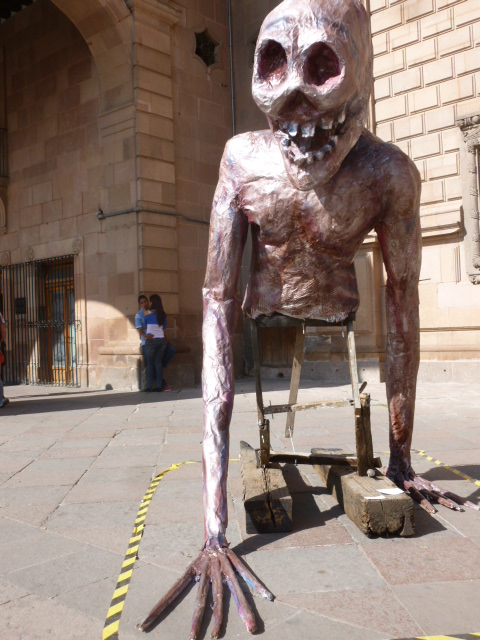
Looming over the seventeen hearts is the “monumental” sculpture representing a victim of the migration whose body was severed below the belt in the trek north. San Luis Potosi is on the route of the freight train known as “the beast” among migrants for consuming arms and legs of those who fall from the train’s roof during the journey.
******************** ********************************* ******************
La agencia de ayuda internacional católica Cáritas eligió San Luis Potosí para localizar su Casa de la Caridad-Hogar del Migrante. Su misión es ” de auxiliar a nuestros hermanos, mexicanos y centroamericanos, en situation migratoria”. Dieciocho esculturas creadas por algunos de los migrantes alojados temporalmente en la “Casa de la Caridad” se encuentran ahora al frente de la Catedral Metropolitano de San Luis Potosí.
Por el uso de materiales reciclados – cartón, periódico, plástico, pegamento – los artistas crearon obras sobre el tema “Sueños del corazón”. El resultado es una revelación del poder de los sueños en los corazones de los migrantes y cumple con el objetivo de la exposición “para conectarnos con estas experiencias migrantes”.
Dominando por su tamaño las otras esculturas, y serviendo como el trasfondo de la realidad de la experiencia migratoria, hay una escultura “monumental” que representa una “víctima” de la migración que ha perdido su tronco y ambas piernas en la ardua caminata hacia el norte. San Luis Potosí está en la ruta del tren de carga, conocido como “la bestia” por los migrantes a causa el consumo de los brazos y las piernas de los que caen desde el techo del tren durante el viaje.

This introduction to the “Dreams of the Heart” art exhibit describes the Home of the Migrant’s dream of contributing to the creation of a “city of love, a just and inclusive society” in San Luis Potosí.
La introducción a la exposición de arte, describe el sueño de La Casa de la Caridad “se encuentra en la búsqueda constante de influir entre la sociedad potosina a fin de construir la civilización del amor, una sociedad justa y incluyente”

Javier Iván known as “The Skinny One” dedicates his sculpture to his mother Sra. Anselma Bardales. Below the heart he wrote, “To the most beautiful mother that life could have given me, I miss you and love you with a tender, deep love”. He also wrote, “This is the emptiness in my mother’s heart when I left her”.
Javier Iván conocido como “El Flaco” dedica su escultura a su madre Sra. Anselma Bardales. Por debajo del corazón, escribió, “La madre mas Hermosa que la vida me ha regalado. Te extraño y te amo con amor y con cariño.” También escribió: ” El vacio que deje en el corazón de mi madre al partir”.
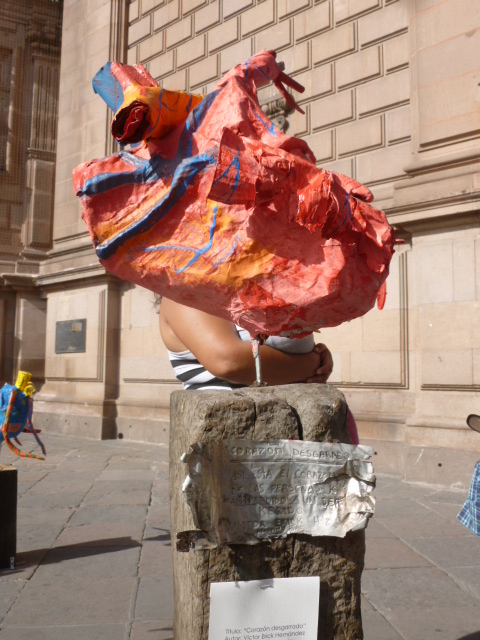
On the jagged piece of metal, Viktor Erick Hernandez of Honduras has titled his piece “Torn Heart” followed by “This is the heart of those persons who have lost someone they dearly loved”.
En la pieza dentada de metal, Viktor Erick Hernández, de Honduras ha titulado su obra “Corazon desgarrado”, seguido de “Asi esta el Corazon de las personas k (sic, ed.) han perdido un ser kerido (sic, ed.)”.
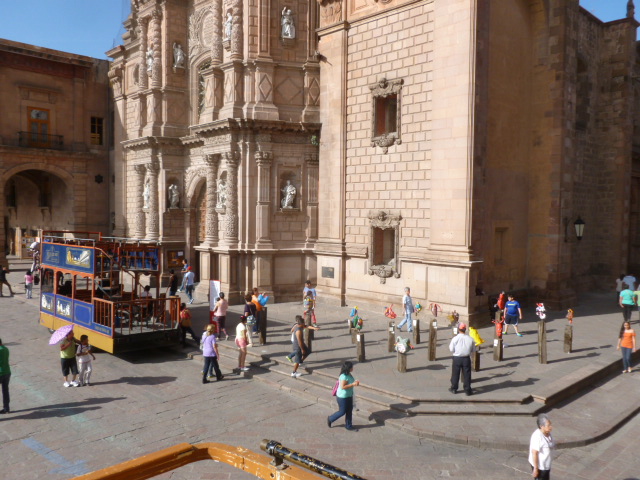
The exhibit is located on one of the city’s busiest corners, in front of the main cathedral of the San Luis Potosi Archdiocese. The “victim” sculpture is to the left of the tourist bus.
La exposición está situada en una de las esquinas más concurridas de la ciudad, frente a la catedral principal de la Arquidiócesis de San Luis Potosí. La escultura monumental de “la víctima” está a la izquierda del bus turístico.
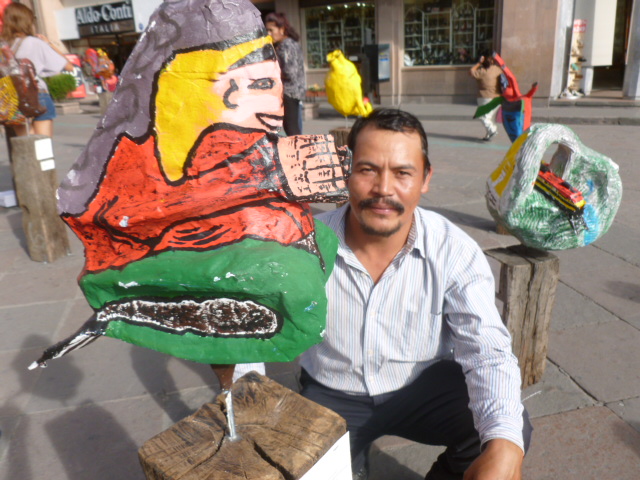
The exhibit introduction reads: “These sculptures represent a bridge for dialog and a means to enter into the desires, motives, fears and dreams within the hearts of our migrant brothers and sisters.” A Honduran migrant in his early forties, Dimas, interpreted for me his sculpture which he had named “A Testimony”:
“This is a child kneeling in prayer. It shows me as a child on my knees in prayer because Jesus taught us that we must humble ourselves when we come before him and before God. I am praying here for a safe journey to the north. Jesus also teaches us that to love one another as brothers and sisters we must also humble ourselves as little children. The only way we can change and gain a healthy mind is by prayer.”
******************* **************************** *****************
La introducción a la exposición lee: ““Son estas esculturas un puente para el diálogo y una manera de adentrarnos a los anhelos, las motivaciones, los miedos y los sueños contenidos en todos los corazones de nuestros hermanos migrantes.”
Un migrante hondureño de unos cuarenta años, Dimas por nombre, me interpretó su escultura que él había llamado “Un testimonio”:
“Se trata de un niño arrodillado en oración. Me muestra como un niño en mis rodillas en la oración por que Jesús nos enseñó que tenemos que humillarnos cuando nos presentamos ante él y ante Dios. Estoy orando aquí para un viaje seguro hacia el norte. Jesús también nos enseña que amarnos unos a otros como hermanos y hermanas, también debemos humillarnos como niños. La única manera que podemos cambiar y tener una mente sana es mediante la oración.”
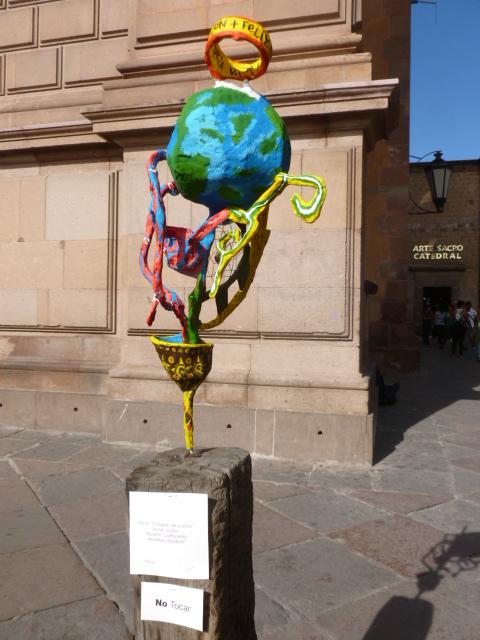
The sculpture by the migrant artist known simply as “Junior” comes from a fertile imagination. The earth and “the fullness thereof” flows from a cup – the “heart of God”?? – inscribed with the words “free”, “light”, “love”, “peace”, “to create”, “imagine”, “grow”, “live”, “health”. Along with the white rivers bordered by green and then yellow, from the heart flows arteries of the flag colored red, white and blue.
La escultura del artista migrante conocido simplemente como “Junior” viene de una imaginación fértil. “La tierra y su plenitud” fluye de una taza – la del “corazón de Dios”? – Con las inscripciónes “libre”, “luz”, “amor”, “paz”, “crear”, “imagina”, “crece”, “salud”, “vive”. Junto a los ríos blancos bordeados de verde y luego amarillo, desde el corazón fluye las arterias de la bandera del rojo, blanco y azul.
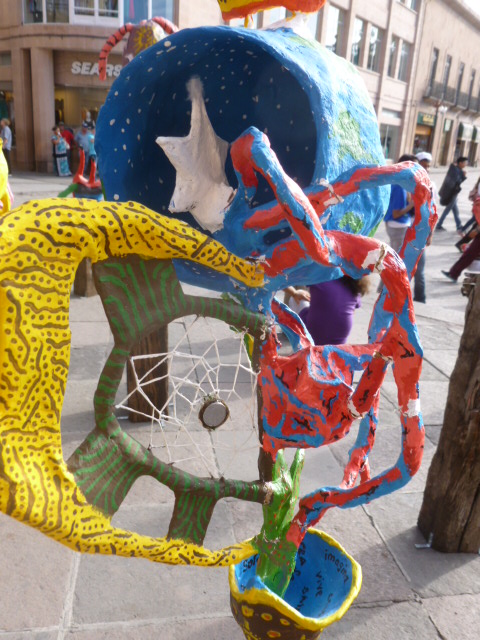
On the other side of Junior’s sculpture he created a “Dream Catcher” with a battery at the center of the web emerging from a jungle setting of green and brown. The fierce and courageous rule of the jaguar over the jungle of dreams is in balance with the large star at the center of the earth.
Junior calls his sculpture “Heart of Dreams” and bids us ask several questions with his art. Among the questions we ask ourselves, “Will Junior make it to the red, white and blue of his dreams?” and “If he makes it north will his dream catcher enable him to hold on to some of the dreams”?
***************** *************************************** *****************
En el otro lado de la escultura de Junior creó un “Cazador de Sueños” con una batería en el centro de la telaraña que emerge de un entorno de selva de verde y marrón. La regla feroz y valiente del jaguar en la selva de los sueños se encuentra en equilibrio con la gran estrella en el centro de la planeta, nuestra tierra.
Júnior llama su escultura “Corazon de Sueños ” y nos invita a hacer varias preguntas con su arte. Entre las preguntas que nos preguntamos, “¿Logrará Júnior llegar a la azul, rojo, blanco y de sus sueños?” Y “Si él llega al norte, hará el cazador de sueños que pueda aferrarse a algunos de los sueños”?
Gracias al Sr. Alfonso Amparan por su ayuda en la traducción del articulo al español.
Janet’s Visit / La Visita de Janet

One of the wonderful families I met, Heidi and Rojelio, made this welcome sign for me. Exhausted as I was after a long day of travel, I was touched by the effort put in by people whom I had yet to meet. /
Una de las familias maravillosas que conocí fue de Sra. Heidi con Pastor Rogelio quienes hicieron este rotolo de bienvenida para mi. Aunque agotada después de un largo dia de viaje, me tocó fuerte el esfuerzo de la parte de gente que yo no había todavía conocida.
Our daughter Janet just returned to California after a wonderful two week visit with us. We had not seen her in over two years as she served in the Peace Corps following her college graduation. A few pictures, most taken by her, from our time together follow along with her commentary. We already miss her and look forward to following her next venture, a short term assignment in Mali, West Africa. (Our occasional notes by the editor are in parentheses)
*********************** ******************* ***********************
Nuestra hija Janet acaba de dejarnos para volver a California después de una estancia deleitosa de dos semanas en San Luis Potosi. No la habíamos visto durante mas de dos años debido a su termino de servicio con el Cuerpo de la Paz a partir de su graduación de la universidad. Pueden ustedes revisar unas photos de su visita, la mayoría tomadas por ella, con sus comentarios aquí abajo. Ya nos echa a menos a ella luego que anticipamos sus informes de su nueva posición, un termino corto en Mali, Africa Poniente. (Hay notas del editor en parénteses de vez en cuando)

One of my favorite parts of Mexican culture was the ubiquity of children’s toys. From blow up balloons, to piñatas, to slides and swing sets, every restaurant, rest stop and random patch of grass was supplied. /
Un aspecto encantador de la cultura Mexicana fue los juguetes de niños en todas partes. Se encuentran en cada restaurante, parador de la carretera, y pedacito de césped, unos globos a soplar, piñatas, colompios y resbaladores.
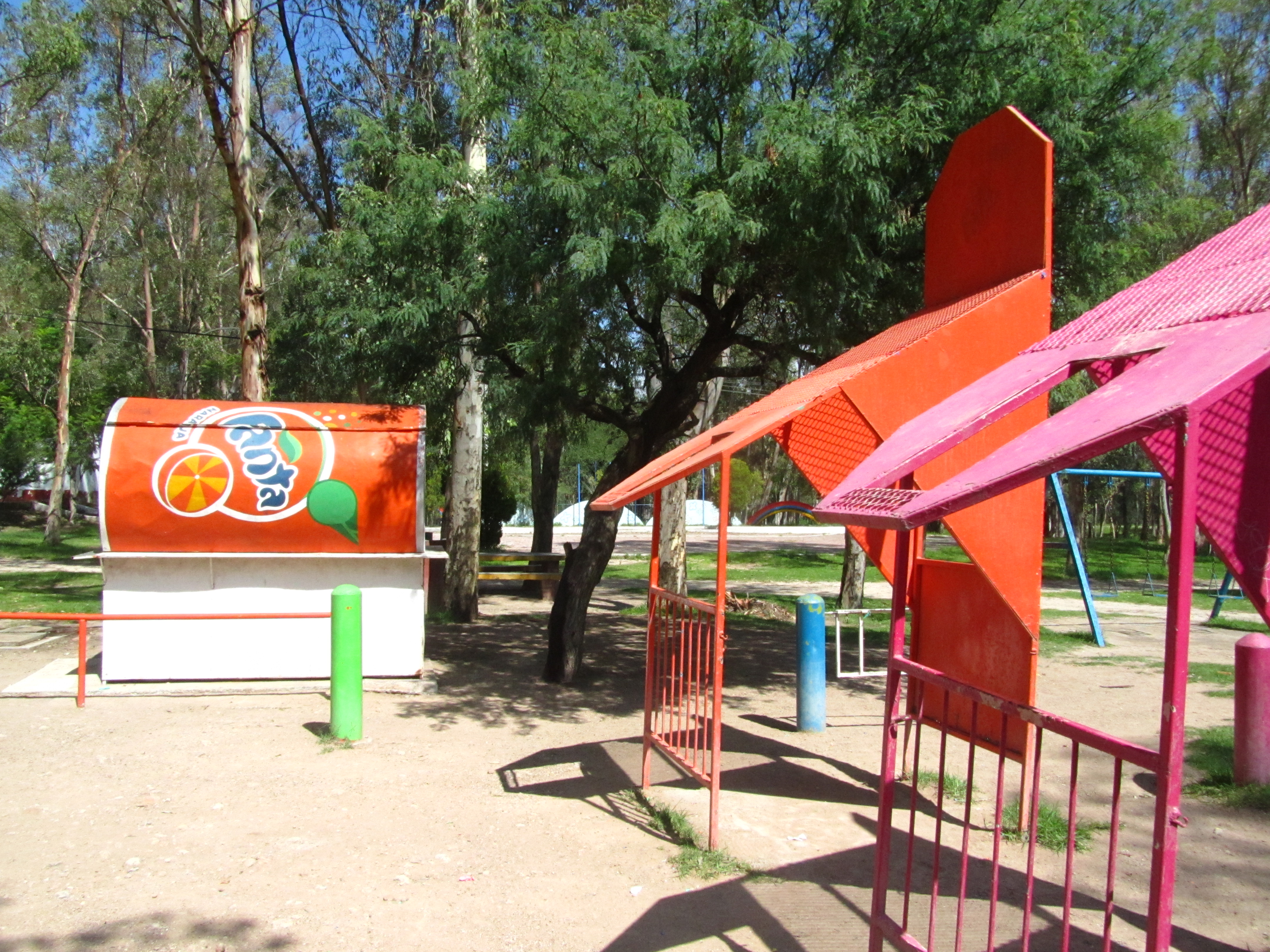
I spent several hours walking and running around the second biggest urban park in Mexico, a close 15 minute drive from Dad’s home. I know the park far better than Dad ever will and this spot held a special place for me. Partially for the ‘Fanta’ sign, reminiscent of my previous sobriquet, and for the Doctor Seuss style structures. /
Pasé yo unas hora caminando y corriendo en el parque Tangamanga, el segundo mas grande de las ciudades de Mexico, quince minutos de la casa de los padres. Ya yo conozco el parque mucho mejor que mi padre y este lugar me agarró fuerte por su sentido especial. En parte por las letras “Fanta”, que fue mi nombre en el pueblito en Senegal, y también por los juguetes al estilo Dr. Seuss.

Everyone says that Mexican food in the US is nothing like Mexican food in Mexico. While there were some definite similarities, I tried multiple dishes that I had never experienced. My favorite of which was this- huevos divorciados! /
Todos dicen que la comida Mexicana en los EUA se diferencia tanto de la comida en Mexico. Aunque hayan semejanzas, yo probé varios platillos por la primera vez – mi favorito se ve aquí – los huevos divorciados! Chile verde y chile rojo!
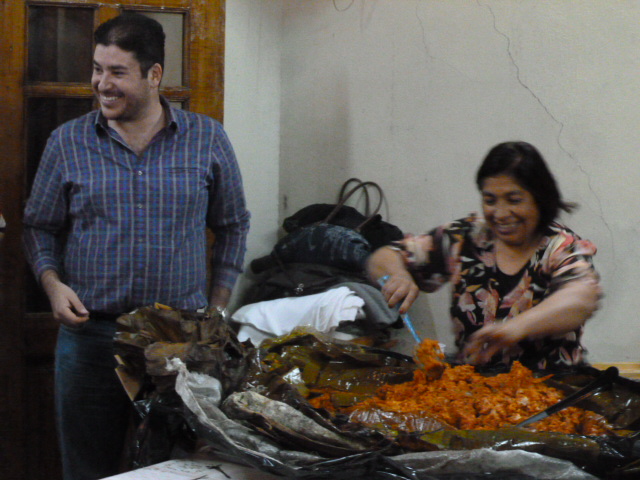
My least favorite of which was this… (a “zacahuil” or tamale like dish a yard or more in length prepared in the Sierra Huasteca east of San Luis Potosi) /
El platillo el menos favorito fue este ….. (el zacahuil es el platillo tradicional de la Sierra Huasteca, como un tamal de un metro o mas)
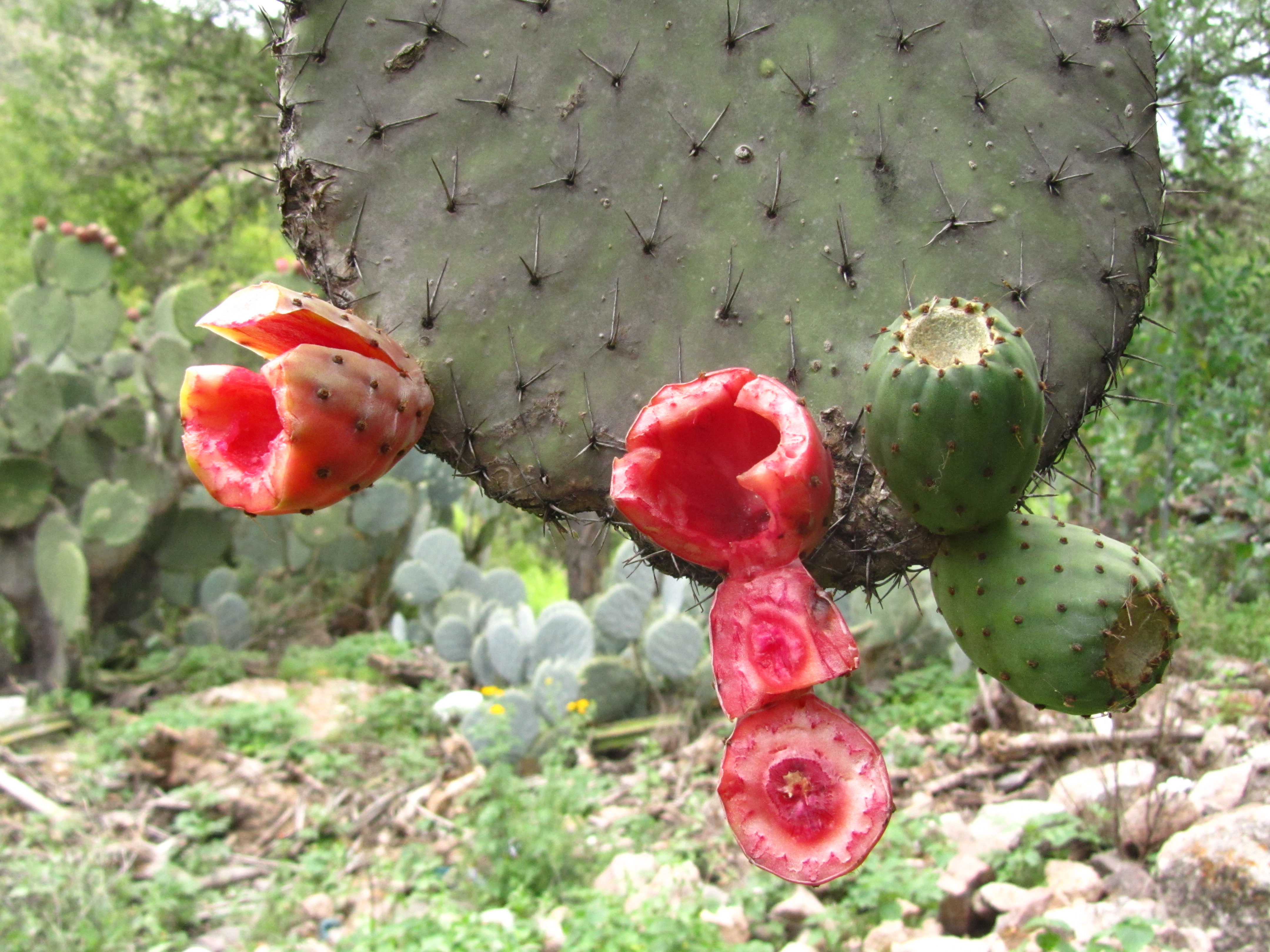
Cactus scattered the land scape outside of San Luis. Contrary to assumption, they are fruitful specimen and grow these red fruits called ‘tuna’. I would never eat one again but I could understand why others may find them savory. /
En las orillas de la ciudad de San Luis Potosi hay nopales por todas partes. Al contrario de lo que pensábamos, estas plantas dan buena fruta llamada “tunas”. Yo no volveré a comer una mas podría comprender como unos las consideran sabrosas.

The ancient ruins at Tamtok was possibly the highlight of my trip. Second to seeing Dad and Kate of course 😉 To get to the ruins, one must venture down an obstacle packed road, fit with broken cattle grates, and Senegal sized pot holes. Contrary to Dad’s negativity, my response was that these hurdles weed out the less inclined tourist, and makes for a superior, more pleasant experience. /
La experiencia la mas sobresaliente de mi estancia – por supuesto a parte de volver a ver a mi papa y a Katalina – quizás fue la de visitar las ruinas muy antiguas de Tantok. Para alcanzar a llegar ahí fue menestar atreverse a manejar por un camino a tropezones incluso baches como los de Senegal y enrejados de hierro quebrados protegiendo el ganado en el entorno. Al contrario de lo que pensó el chofer mi Papi, yo los veía como preveniendo que pasen los turistas menos dedicados y asi lo que hace una experiencia mas linda y apreciable para los demás.

One of the two beautiful falls we visited in the Huasteca region./
Una de las dos cascadas hermosas que visitamos en la Región Huasteca.
Dad and I spent a good hour swimming at this impeccable spot above the Tamasopo falls, just far enough away to be free of the strong currents and the plethora of tourists. /
Mi papi y yo pasamos una hora nadando por esta lugar prístina encima de las cascadas Tamasopo, retirados por ser libre de los corrientes fuertes del rio y el enjambre de turistas.

Street art back in San Luis Potosi./ Arte publica en San Luis Potosí
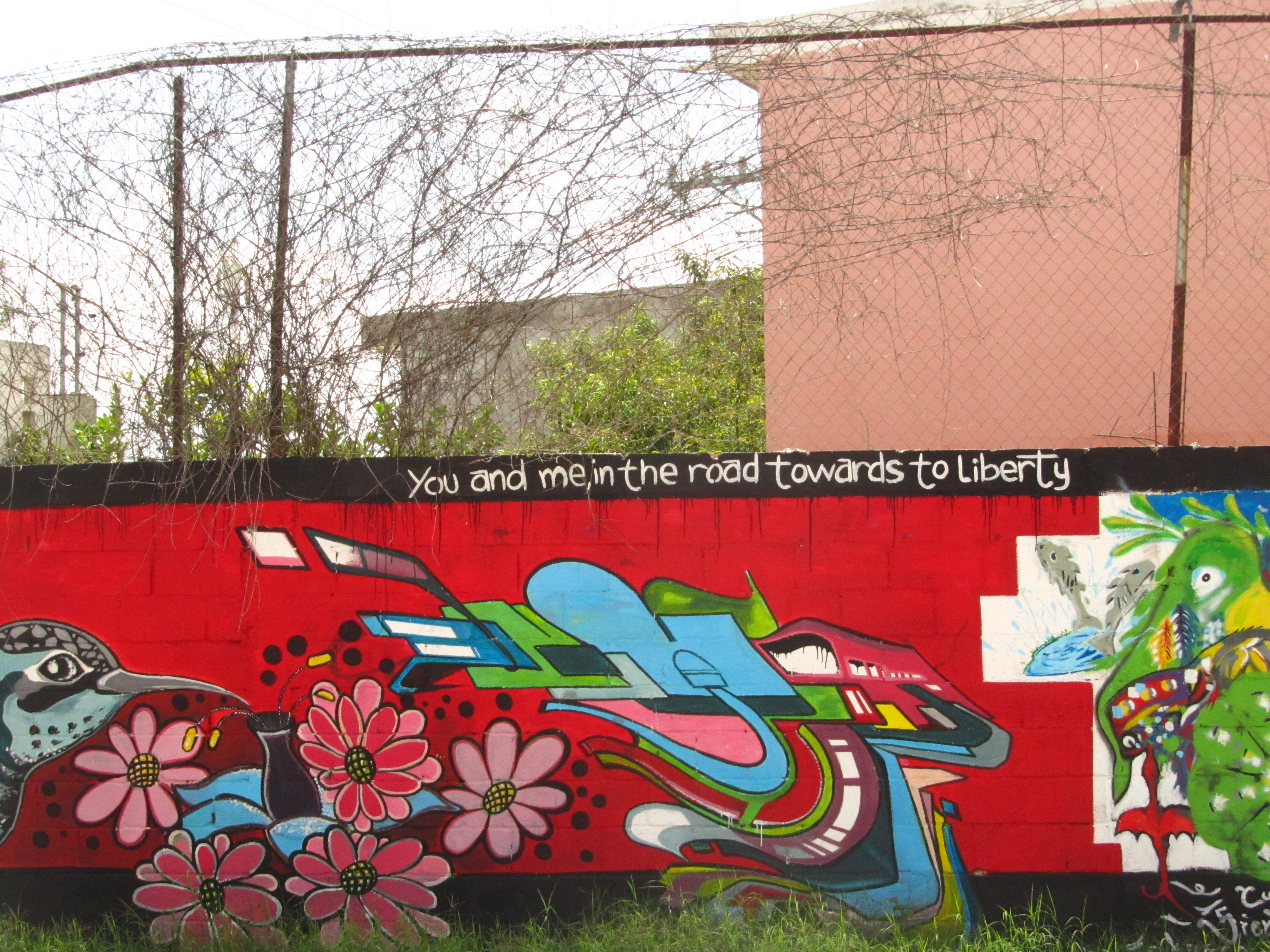
Loved the street graffiti, this picture is layered with ironies that I will let you all mull over. /
Me agradó el “graffiti” de la calle, en este ejemplo se encuentran unas ironias para contemplar
Viva Lila Downs!

Lila Downs performing with her band “La Misterioso” on the Plaza de Fundadores, San Luis Potosi
Lila Downs has become another of our teachers here, mentoring both of us in the language and culture of this country, so close and yet so different from our own. As we listen again and again to her 2001 album “Border”/”La Linea”, doors keep opening to a new and better understanding of the people of Mexico.
The singer/songwriter is a child of both nations, her father an art professor from Minnesota and her mother a Mixtec Indian cabaret singer from the State of Oaxaca, Mexico. She grew up on both sides of the border, graduating from the University of Minnesota in voice and anthropology.
Like the young Bob Dylan, she found in Woody Guthrie’s music the key to moving a listener by telling the truth. Her medley on the “Border” album of Guthrie’s “This Land is Your Land” and “Pastures of Plenty” includes her own words,
“now that you have all the things that you want did you ever look around to see who you forgot?”
With a three octave range voice, she sings of a dazzling variety of people from all over Mexico. In her own composition “The Girl”, she sings about ‘maquiladora’ factory worker Rosa Maria and in “I Am a Fisherman” about a fisherman looking for the love he cannot forget. She takes us behind and beyond official accounts of the Mexican army’s 1999 massacre of villagers in Chiapas in her composition “Smoke”. And in the song “The Line” the life of the holy spirit brings hope and is celebrated.
Lila Downs gives voice to the wisdom, the spirituality and strength of the Mexican people. At a deeper, more comprehensive level than most, she lifts up the old Mexican saying, “out of poverty, poetry, out of suffering, song”. On the “Border” album, her brave trust in the roots of Mexican spirituality helps produce music that is powerful as well as beautiful.
The day after Easter, San Luis Potosi opened its annual Cultural Festival with Lila Downs performing a free downtown

After we stood for 45 minutes, this kind woman admitted us to the front row press section for the concert
concert. Not surprisingly, the artist proved to be a generous performer as well, doing four encore songs, the last of which we listened to from inside the restaurant on the plaza where she performed.
While the sound is lousy on the You Tube clip I filmed at the concert, watch Lila Downs take on the personality of the dove mourning a lost love as she sings the classic song “Cucurrucucu Paloma”. Downs as the dove flaps her wings as she coos with the beautiful, painful memories.
“They all say it is nothing less than his soul that coos for his lost love, and that still awaits her return, the return of his unhappy mate……”
Wikipedia tells us “Cucurrucucu Paloma” is in the “Son Huasteco” style (originating then in San Luis Potosi’s State among others) and was a signature song for another great Mexican singer, Lola Beltran. ********************** ***********************
Lila Downs se ha convertido en otro de nuestros maestros aquí, nos ha instruido tanto en el idioma como en la cultura de este país, tan cerca pero tan diferente del nuestro. Al escuchar una y otra vez a su álbum del 2001 “Border ” / ” La Línea “, puertas siguen abriéndose a una nueva y mejor comprensión del pueblo Mexicano.
La cantante / compositora es hija de ambas naciones, su padre un profesor de arte de Minnesota y su madre una india Mixteca que canta en cabarets del Estado de Oaxaca, México . Lila Downs creció en ambos lados de la frontera, graduándose de la Universidad de Minnesota en la Voz y la Antropología.
Al igual que el joven Bob Dylan , Downs encontró en la música de Woody Guthrie la clave para conmover a un oyente, contando la verdad . Su mezcla de las canciones de Guthrie “This Land is Your Land ” y “Pastures of Plenty” incluye sus propias palabras ,
” Ahora que tiene todas las cosas que usted desea ¿alguna vez mira a su alrededor para ver quién se lo olvidó ? ”
Con una voz rango de tres octavas , canta acerca de una deslumbrante variedad de personas de todas partes de México . En su propia composición ” La Niña” , ella canta sobre una obrera, Rosa Maria, en una fábrica ‘ maquiladora ‘ y en “Soy pescador” acerca de un pescador en busca del amor que no puede olvidar. Ella nos lleva detrás y más allá de las historias oficiales de la masacre del ejército mexicano en 1999 de unos campesinos de Chiapas en su composición “Humo” . Y en la canción ” La Linea” canta de como la vida del Espíritu Santo trae esperanza y se celebra.

El concierto tuvo lugar al lado del edificio de la Universidad sobre la lindissima Plaza de los Fundadores/ The concert took place in front of the main University building on the beautiful Founders’ Plaza
Lila Downs da voz a la sabiduría, la espiritualidad y la fuerza del pueblo mexicano. Como todos los mas grandes artistas, ella confía en que al contar la verdad de su pueblo, resultará belleza. Hasta un nivel más global y más profunda que la mayoría, ella resalta el viejo dicho mexicano “, de la pobreza, viene la poesía, del sufrimiento, viene la canción” . Su fe y su valentía ayudan a producir música que es de gran alcance, así como hermosa también.
El día después de la Pascua, San Luis Potosí inició su Festival de la Cultura con Lila Downs con un concierto gratis al aire libre en el Centro de la Ciudad. Llegamos ahí media hora antes y tuvimos la fortuna de conseguir unos asientos en primera fila. No es sorprendente que la artista demostró ser una persona generosa, presentando cuatro canciones como “encore” , la última de las cuales la escuchamos desde el interior del restaurante en la plaza donde actuó .
Mientras que el sonido es pésimo en el clip de You Tube que filmé en el concierto, vera á Lila Downs ahí asumir la personalidad de la paloma que esta de luto lamentándose por un amor perdido mientras canta la canción clásica “Cucurrucucu Paloma”. Downs como la paloma aleteando sus alas mientras se arrulla con los hermosos recuerdos dolorosos,
” juran que esa paloma
no es otra cosa más que su alma,
que todavía la espera
a que regrese la desdichada”
Wikipedia nos dice que ” Cucurrucucu Paloma ” es en el estilo de ” Son Huasteco ” (originado en el Estado de San Luis Potosí, así como otros ) y fue una canción de firma para otra gran cantante mexicana , Lola Beltran.
Gracias a Sra. Marisela Huelga de Leon por su ayuda con la traducción al Español


 Erasing Borders