Category Archives: Uncategorized
Mexico Speaks / Habla Mexico

We reach out to persons of a different culture by enjoying their traditions in food – and their sayings.
We know from our high school language teachers that there is much more to learning a language than expanding our vocabulary and following the rules of grammar. If we’ve never tasted an “agua de horchata” (the sweetened rice water popular all over Mexico) can we really claim to know the word “horchata”?? Unless we’ve heard musicians playing “las manañitas” to celebrate a birthday do we really know the words “serenata” – or the word serenade ?
Margaret Ramirez, Director of Seniors Programs at Eastmont Community Center http://www.eastmontcommunitycenter.org/ , was a wonderful Spanish teacher. With a smidgin of Spanish, after graduation from seminary, Doug began working with Margaret in East Los Angeles in what was once the largest concentration of Mexican-Americans in the U.S. His first day at the Eastmont Center, Margaret welcomed Doug with an “abrazo” (a warm hug) and invited him to join the rest of the staff for their daily morning ritual of “pan dulce” or Mexican pastry, conversation in Spanish and café. Learning how to eat “cocido” (vegetable soup stocked with chicken or beef bones), Margaret’s remedy for a cold, represented for Doug another significant step in learning the Mexican culture and language.
But it was Domingo Rangel’s arrival at Eastmont that made Doug feel he was really making progress in learning Spanish. Domingo was an elderly participant in a federal jobs program for seniors and he served as the Center’s chief maintenance staff for a couple of years. He also was a fount of Mexican traditional sayings, the collective folk wisdom that has helped shape the character of individuals and culture in Mexico from generation to generation. Domingo often made use of these sayings and his slight smile and shift in the tone of his voice would signal he was speaking not as a solitary individual but as his family had taught him, and as a people had taught them.
In preparing for the Center’s 25th Anniversary, Domingo pledged he and his volunteer helpers would:
“barrer por donde la suegra no mira” – “sweep where the mother in law doesn’t look.”
It was Domingo who taught Doug an important theological affirmation with the saying :
“No hay mal que por bien no venga” or “there is nothing so bad that something good cannot come from it.”
In keeping with that Gospel message, Domingo emphasized that a person’s worth could be measured only by his actions and not his words. For that conviction, he had several other sayings:
“De el dicho al hecho hay mucho trecho” or “There’s a long way to go between what one says and what one does.”
“De lengua me como un plato” (or “un taco”) equivalent to the saying in English “Words come a dime a dozen” .
The tolerance and acceptance of persons regardless of their past is taught through the following saying, also first shared with Doug by Domingo Rangel:
“Somos todos hijos o hijastros” or “We are all either children or step children in the eyes of God”. We’ve come across a similar saying in the Mexican homeland:
“Tener conciencia limpia es tener mala memoria” or “To claim a clean conscience is to show you have a bad memory”.
We’ve enjoyed hearing many Mexican “dichos” while here and learning a few of them. Our friends, the couple Marisela Huelga de Leon and Hemer Sierra Silva, have been a great help to us in so
Hemer and Marisela with children Eddie and Cindy.
many ways, including teaching and explaining some new “dichos” or Mexican sayings.
Several of the “dichos” treat the theme of friendship:
“Son amigos como uña y mugre” – “They are as close as the dirt under fingernails.”
“Es major tener un amigo que un peso en el bolsillo” – “It’s better to have a friend than pesos in the pocket.”
“Solo el que trae el morralito sabe lo que pesa.” – “Only the one who is carrying the bag knows what it weighs.”
Another friend here, Heidi Sifuentes Sánchez, especially enjoys the more humorous sayings such as:
“Fondo salido, busca marido” – “If the slip is showing, she’s looking for a husband”.

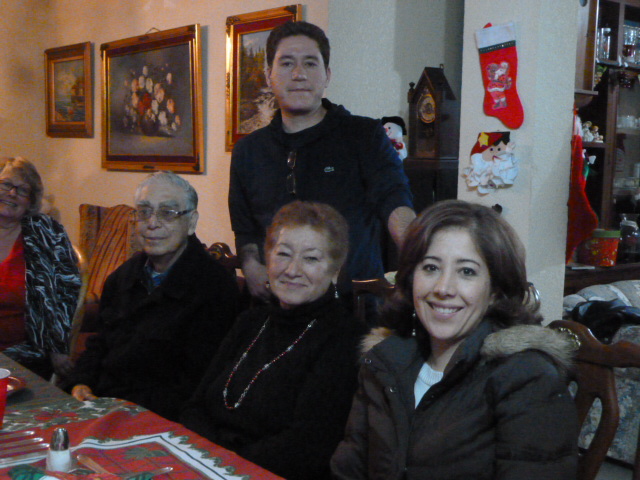
Daughters Debi (at l.) and Nadya learn sayings from grandmother Lolis ( in m.) and Heidi (at r.)
And this one on the theme of “look who’s talking!” :
“El burro hablando de orejas” – “The burro is talking about someone else’s ears”.
Several of Heidi’s “dichos” issue warnings about what we say:
“En boca cerrada no entran moscas” “With a closed mouth/ flies can’t get in.”
“Por la boca muere el pez.” “A fish is caught and dies by its mouth”.
We could share many more “dichos” we’ve learned while in Mexico, and may just do that in a future blog, but before wrapping this up let us pass on a Mexican traditional saying that has had the greatest impact on us. For whatever reason, you seldom hear this expression of gratitude today in Mexico; is it a threadbare cliché? considered trite now? Whatever may be the fate of this saying when Doug was first thanked this way by an elderly Mexican woman at Eastmont Community Center the words reached his heart:
“Que Dios se lo pague”! or “May God pay you for it!”
That brief, simple way of saying thank you continues to come to mind as we experience the riches of God’s grace in sharing the journey of a life of faith in Mexico.
****************** ********************** *****************
Gracias a Lisania Sustaita Martinez por su ayuda en la traducción del blog:
Sabemos por nuestros profesores de la lengua de la escuela secundaria que hay mucho más en el aprendizaje de una lengua, que la ampliación de nuestro vocabulario y conocimiento de reglas de la gramática. ¿Si nunca hemos probado “agua de horchata” (el agua de arroz endulzada popular por todas partes de México) podemos realmente afirmar saber la palabra “horchata”?? ¿A menos que hayamos oído a los músicos tocar “las manañitas” para celebrar un cumpleaños realmente sabemos la palabra “serenata” – o la palabra en ingles “serenade”?
Margaret Ramirez, Directora de Programas de Personas Mayores en el Centro de la Comunidad Eastmont, en el Este de Los Angeles, era una maravillosa profesora de español. Con un poquitito de español, después de la graduación del seminario, Doug comenzó a trabajar con Margaret en la comunidad de Eastmont en lo que era en el pasado la concentración más grande de mexicoamericanos en los Estados Unidos. Su primer día en el Centro de Eastmont, Margaret dio la bienvenida a Doug con un abrazo cariñoso y le invitó a afiliarse al resto del personal para su ritual diario matutino de pan dulce, conversación en español y un cafecito. Aprendiendo cómo comer “cocido” (sopa de verduras abastecida de pollo o huesos de carne de vaca), el remedio de Margaret por la gripa o el resfriado, representó para Doug otro paso importante en el aprendizaje de la cultura mexicana y su lengua.
Pero era la llegada de Domingo Rangel a Eastmont que hizo a Doug sentir que realmente avanzaba en el aprendizaje de español. Domingo era un participante en un programa de empleos federal para personas mayores y sirvió como jefe de mantenimiento y aseo del Centro durante un par de años. También era una fuente de dichos tradicionales mexicanos, la sabiduría popular colectiva, que ha ayudado a formar el personaje y carácter de individuos y cultura en México de una generación a la proxima. Domingo a menudo hacía el uso de estos dichos y su sonrisa leve y el cambio en el tono de su voz señalaba que él hablaba no como un individuo solitario, sino como su familia le había enseñado, y como su gente los había enseñado.
En la preparación para el 25to Aniversario del Centro, por ejemplo, Domingo prometió que él y sus voluntarios “barrerián por donde la suegra no mira” .
Era Domingo quien enseñó a Doug una afirmación teológica importante con el dicho:
“No hay mal que por bien no venga.”
De acuerdo con ese mensaje Evangelico, Domingo subrayó que el valor de una persona sólo podría ser medido por sus acciones y no sus palabras. Para esa convicción, tenía varios otros dichos:
“Del dicho al hecho hay mucho trecho.”
Y
“¡De lengua me como un plato ( o un taco )!”
equivalente al dicho en ingles de “Las palabras se compran una docena a diez centavitos”.
La tolerancia y la aceptación de personas sin tener en cuenta su pasado se enseñan a través del dicho siguiente, también primero compartido con Doug por Domingo Rangel:
“Somos todos hijos o entenados (hijastros)”
Nos hemos encontrado con un refrán similar en la patria mexicana:
“Tener conciencia limpia es tener mala memoria”
Hemos disfrutado de oír muchos dichos mexicanos durante nuestro ministerio aquí y aprendimos algunos de ellos. Nuestros amigos, la pareja Marisela Huelga de Leon y Hemer Sierra Silva, han sido una gran ayuda a nosotros de tantos modos, incluso enseñanza y explicación de algúnos nuevos dichos.
Varios de los dichos de ellos tratan el tema de amistad:
“Son amigos (Amigas) como uña y mugre.”
“Es mejor tener un amigo que un peso en el bolsillo”.
“Solo el que trae el morralito sabe lo que pesa”.
Otra amiga aquí, Heidi Sifuentes Lopez, sobre todo disfruta de los dichos más graciosos como:
“Fondo salido, busca marido.”
Y éste en el tema del dicho en ingles de “¡mira quién habla!”:
“El burro hablando de orejas”
Varios de los dichos de Heidi publican advertencias sobre lo que decimos:
“En boca cerrada no entran moscas”. Y
“Por la boca muere el pez”.
Podríamos compartir muchos más dichos que hemos aprendido durante nuestra estancia en México, y se puede hacer esto en un futuro blog, pero antes de proceder mas dejenos compartir un dicho tradicional mexicano que ha tenido el mayor impacto en nosotros.
Por cualquier motivo, rara vez se oye esta expresión de gratitud hoy en México; ¿es un cliché gastado? ¿considerado trillado ahora? Independientemente de lo que puede ser el destino de este dicho en México contemporaneo cuando a Doug una mujer mexicana de tercera édad le agradeció a Doug en el Centro de la Comunidad de Eastmont con estas palabras lo tocaron en el corazón:
¡“ Que Dios se lo pague”!
Ese modo breve y simple de expresar la gratitud para la actuación de otra persona sigue viniendo a la mente aquí ya que experimentamos la riqueza de la gracia de Dios en el compartir de la jornada de la vida de fe en México.
Food is for Sharing /La Comida Se Hizo Para Compartir
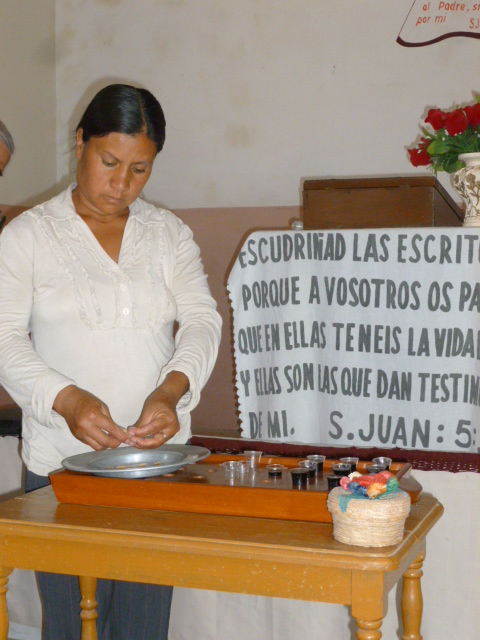
In the rural La Reforma Disciples Church, there are just enough cups filled for the communion service/Noten que se llenan las copas suficientes para la pequeña Iglesia rural de La Reforma
World Communion Sunday this year was a memorable occasion. It was our first Sunday in worship at the Julien Carrillo Disciples of Christ Church after undergoing major surgery in the States. On taking our seats, we were relieved that in a church which does not celebrate the Lord’s Supper every week, on this Sunday, the communion trays were present.
And the communion cups were filled. But not just filled; they were topped off to the extent it required some effort to avoid spilling the juice. Pastor Rogelio Espino Flores later told me this was not by accident. The filled to nearly overflowing cups are intended to make a theological statement. “Mi copa está rebosando” – “my cup overflows”. (Ps 23:5c)
But not just for me. For everyone around the table. Wherever they might be served the bread and the juice. In Mexico and Congo, in Haiti and the U.S. Our cups overflow if only for that moment of our lives.
It has struck me that in giving thanks for meals we’ve enjoyed at churches here, most persons include the petition that the hungry be fed. I’m continually reminded of the prayer, “Lord, to those who hunger, give bread. And to those who have bread, give the hunger for justice.”
Lifting up those who hunger while giving thanks for a meal is another reminder for us of the “materialist” significance of what we do in church. It leads us to consider the question of what Jesus really wants us to “remember” in the Lord’s Supper? Is it just the sacrifice of His body that He wants us to contemplate as we share with the world’s Christians in the bread and the cup? Or did Jesus intend the Supper to be a
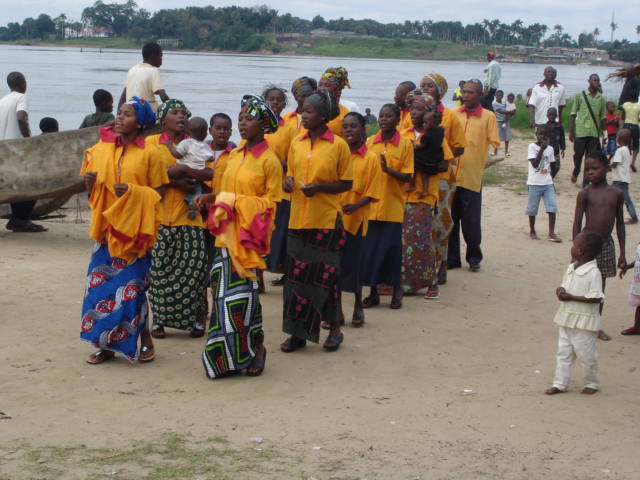
Powerful singing highlights the worship for this congregation in the middle of the Congo River. Lacking the cups, there was no communion when we visited./Faltando copas, esta congregación Discipulos en el Congo no celebrarón la Santa Ceña cuando la visitamos.
prefiguring, a celebration of that day when we all, all of God’s children, share the earth’s abundance? Could Jesus have also intended with this remembrance to call us and empower us to work for that day of cups overflowing for all?
Priest and theologian Tissa Balasuriya, of Sri Lanka, thinks the answer to that question is yes. In his 1977 book The Eucharist and Human Liberation, Father Balasuriya writes, “The ‘adaptation’ of the Christian religion to Latin American, African and Asian countries is not merely a matter of language, rites, music, art or even of having native clergy and bishops. We have to go through a whole revaluation of the whole thought and value content of what passes for Christianity and faith.”
In his thinking, Christian unity is the basis for joint efforts of rich and poor Christians on behalf of peace and justice worldwide. The Eucharist is in his view the rallying by Jesus of his followers to help bring about the equal sharing symbolized by his Supper. Father Balasuriya writes, “The churches are linked throughout the world. Earlier they have generally had an influence for domesticating people within Capitalism and Imperialism. Now they can be agents for human liberation if they really want to be so.”
But the Eucharist is not a time to hang our heads contemplating what we have not done. It is not a time to confess our complicity and feel guilty. It is a time to give thanks for the food of Christ’s body whose power enables us to be and do far more than we have ever thought possible (EP 3:20). In discerning the body as we share the Supper, as Paul exhorts (I CO 11:29), we give thanks that we all, rich and poor, can participate in helping fill to overflowing everyone’s cup.
Father Balasuriya closes his book with the words of another Asian Christian whose Declaration of Conscience was smuggled out of his prison cell:
“As you cannot go to heaven alone, Food is to be shared……
As all share the sight of the heavenly stars,
So food is something that must be shared……
Ah! Food is something that must be shared.”
Kim Chi Ha
*********** ************************ *********
Agradecemos a la Revda. Lisania Sustaita Martinez por su ayuda con esta traducción del articulo.
El Día de La Comunión Mundial este año era una ocasión memorable. Era nuestro primer domingo en la adoración en la iglesia de Julián Carrillo después de someterme a la cirugía grave en los Estados Unidos. Tomando nuestros asientos, notamos que en una iglesia que no celebra la Cena del Señor cada semana, este domingo las bandejas de la comunión estuvieron presentes.
Y las copas de la comunión estaban llenas. Pero no sólo llenas; se llenaron al grado que requirió a algún esfuerzo de evitar derramar el jugo. Pastor Rogelio Espino Flores más tarde me dijo que esto no era por casualidad. Las copas casi desbordantes se requieren para hacer una afirmación teológica. “Mi copa está rebosando”. (Ps 23:5c)
Pero no sólo para mí. Para cada uno alrededor de la mesa. Dondequiera que se pudiera servir el pan y el jugo. En México y Congo, en Haití y los Estados Unidos. Nuestras copas se desbordan para ese momento de nuestras vidas.
Me ha notado que al dar gracias por las comidas que hemos disfrutado en iglesias de Mexico, la mayor parte de personas incluyen la petición de que los hambrientos sean alimentados. Me recuerdan continuamente el rezo, “Señor, a aquellos que tienen hambre, dales pan. Y a aquellos que tienen el pan, dales hambre de justicia”.
La intercesión por aquellos que tienen hambre mientras damos gracias por una comida es otro recordatorio para nosotros del significado del “materialismo” de lo que hacemos en la iglesia. Nos lleva a considerar la pregunta de ¿qué Jesús realmente quiere que nosotros “recordemos” en la Cena del Señor? ¿Es sólo el sacrificio de su cuerpo? ¿qué quiere Él que nosotros contemplemos ya que compartimos con los cristianos del mundo en el pan y la copa? ¿O quiso Jesús la Cena para prefigurar como una celebración de ese día cuando todos nosotros, todos los hijos de Dios, compartimos la abundancia de la tierra? ¿Podría Jesús también haber tenido la intención con esta conmemoración de llamarnos y autorizarnos a trabajar para ese día de copas que se desbordan para todos?
El sacerdote y el teólogo Tissa Balasuriya, de Sri Lanka, creen que la respuesta a esa pregunta es sí. En su libro de 1977 La Eucaristía y Liberación Humana, el Padre Balasuriya escribe, “La ‘adaptación’ de la religión cristiana a países latinoamericanos, africanos y asiáticos no es simplemente un asunto de lengua, ritos, música, arte o hasta de tener clero natal y obispos. Tenemos que pasar por una revalorización entera del pensamiento entero y valorar el contenido de lo que entiendes por cristianismo y fe”.
En su pensamiento, la unidad cristiana es la base para esfuerzos conjuntos de cristianos ricos y pobres en favor de la paz y justicia por todos en el mundo. En la eucaristía está -en su opinión- la reunión por Jesús de sus seguidores para ayudar a causar el compartimiento igual simbolizado por su Cena. El padre Balasuriya escribe, “Las iglesias se unen y se relacionan en todo el mundo. Antes han tenido generalmente una influencia en domesticar a la gente dentro de Capitalismo e Imperialismo. Ahora pueden ser agentes para la liberación humana si realmente quieren ser así”.
Pero la eucaristía no es un tiempo para bajar nuestras cabezas reflexionando en lo que no hemos hecho. No es un tiempo para admitir nuestra complicidad y sentirse culpable. Es un tiempo para dar gracias por la comida del cuerpo de Cristo cuyo poder nos permite ser y hacer mucho más que hemos pensado alguna vez posible (Ef 3:20). En discernir el cuerpo ya que compartimos la Cena, ya que Pablo exhorta (I Co. 11:29), damos gracias que, rico y pobre, podemos participar en la ayuda de llenar la copa de todo el mundo hasta desbordarse.
El padre Balasuriya cierra su libro con las palabras de otro cristiano asiático cuya Declaración de la Conciencia se pasó de contrabando de su celda de la cárcel:
“Como no se puede ir al cielo solo,
La comida se debe compartir … …
Como todos comparten la vista de las estrellas divinas,
Por tanto la comida es algo que se debe compartir …
Kim Chi Ha
The Other Mexico / El Otro Mexico
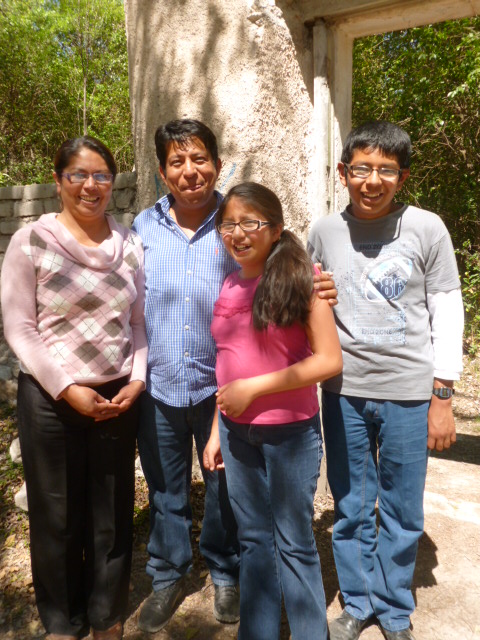
Enrique Retes and spouse Maria Luisa with Caleb and Rebecca serve the rural communities of Guanamé and Los Remedios in the State of San Luis Potosí
We’ve just spent a month living next to the green fields of soy beans and corn in Kansas. What a contrast to the expansive views of arid high desert in San Luis Potosí. Not long before we left Mexico, we enjoyed a barbeque in a rural community not far from San Luis. Our hosts told us the corn we saw growing was the first crop they would harvest after three years of sporadic rainfall. Most of the family’s agricultural earnings come from sale of the “tunas” their land’s nopal cactus produces and from livestock sales. In recent years it has become much harder to profit from growing corn , the staple of the Mexican diet and Mexico’s primary crop for hundreds of years.
Farming – life in general – in rural Mexico is and has been a hard scrabble existence for most “campesinos” for many

A variety of barrel cactus also produces a fruit – called “biznaches” – that are prized eating
years. As the Mexican novelist Juan Rulfo put it, “the people work very hard… they produce a lot … but when you leave the capital city (Guadalajara, capital of Rulfo’s home state of Jalisco) there is much suffering.” Rulfo wrote that in the early 1950’s and life in rural Mexico is now even more difficult for two reasons: the change in rainfall patterns and the flood of food imports from the U.S. and Canada after NAFTA.
We don’t have to go far to note the irregular rainfall; we are told the seminary grounds where we live used to be green most of the year. And yet most family farms of rural Mexico practice seasonal agriculture, relying still on the increasingly erratic rainfall patterns. At the end of 2011 only 6 % of Mexico’s agricultural land was irrigated; the average irrigated land for all countries of Latin America is more than 15 %. What is irrigated in Mexico are the industrial farms producing export crops for the U.S.
As for NAFTA, the impact on small farmers has been harsh. Earnings on locally grown produce have fallen with the increase in subsidized food imports from the U.S. and Canada. Imports now comprise 40 per cent of Mexico’s corn consumption, 33 per cent of its beans, 56 per cent of its wheat, 80 per cent of the rice consumed. Mexico’s food imports have increased in value from $1.8 billion U.S. dollars before NAFTA to more than $24 billion twenty years after NAFTA’s approval in 1994.
In an article titled “As U.S. Corn Flows South, Mexicans Stop Farming”, a farmer in Oaxaca is quoted as saying, “Of my generation, many people want nothing to do with farming because it doesn’t pay. (And) with all the changes in weather, there is no certainty that your harvest will be good”. One study estimates a net loss of at least two million small farmers in the NAFTA years.
Current pressures on small farmers constitute a push for migration to the U.S. Undocumented Mexican-born residents of the U.S. surged from 4.3 million pre NAFTA in 1990 to 9.4 million in 2000 and peaked at 12.9 million in 2009. Although only one quarter of Mexico’s population live in rural areas, they number 44 per cent of Mexican emigrants living without
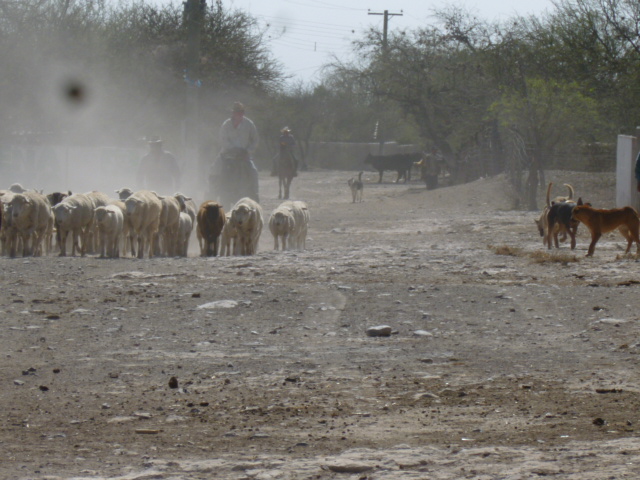
In Los Remedios, the sheep, goats and cattle, seen here passing in front of the Church, are the primary cash earners
immigration documents in the U.S.
And what has the U.S. done to mitigate the effects of climate change and the NAFTA trade agreements on rural Mexico? Very little it turns out. In 2009 96 per cent of U.S. aid to Mexico was assigned to the military and Mexican police. That same year, development assistance both to help create jobs and provide support for small farmers totaled $11.2 million, or .01 per cent of the total U.S. aid.
In 2010 the U.S. budget allotted $17 billion to patrol our borders. Imagine what a billion or two of that budget devoted to providing water management, credit and marketing assistance to Mexican small famers might do in reducing migration to the U.S. A Bread for the World/Church World Service Fact Sheet on “Poverty in Mexico and Migration to the U.S.” sums up a more “integrated” approach to border enforcement: “The U.S. must increase its focus on addressing poverty as one of the causes of immigration. These efforts should include poverty reduction and job creation projects targeted to immigrant-sending communities, particularly in rural zones.”
In spite of the poverty in rural communities, our churches, with the help of lay pastors in the urban churches of San Luis Potosí, impress us by their enthusiasm and spirited worship and fellowship. Enrique Retes with his partner and co pastor Maria Luisa have served two rural churches two hours from San Luis for over seven years. Money for their gas is usually provided, but when the offering drops the congregation supplies local produce. Around eighty children and adults attended the Sunday we preached at Los Remedios; several months earlier the church had hosted the annual women’s retreat of the Disciples churches.
****************** ************************ ******************
Acabamos de pasar un mes viviendo junto a los verdes campos de soja y maíz en Kansas. Qué contraste con las vistas expansivas del árido desierto de San Luis Potosí. No mucho tiempo antes de que salimos de México, disfrutamos de una barbacoa en una comunidad rural no muy lejos de San Luis. Nuestros anfitriones nos dijeron que el maíz que vimos era la

Is that a cracker? Grape juice or kool aid? We can hardly tell what is served at the Lord’s Supper but its celebration is always special in a church like Los Remedios
primera cosecha después de tres años de lluvias esporádicas. La mayoría de los ingresos agrícolas de la familia provienen de venta de las “tunas” que produce el cactus “nopal” de sus tierras y de las ventas de ganado. En los últimos años se ha vuelto mucho más difícil sacar provecho del cultivo de maíz, el alimento básico de la dieta mexicana y el cultivo primario de México durante cientos de años.
La agricultura -la vida en general – en zonas rurales de México es y ha sido una existencia de lucha difícil para la mayoría de “campesinos” por muchos años. Como dijo el gran escritor mexicano Juan Rulfo, “la gente trabaja mucho… produce mucho… pero usted va fuera de la capital (Guadalajara, capital del estado de Jalisco de Rulfo) y hay mucha miseria.” Rulfo lo escribió al principio de los años ’50 y ahora es aún más difícil la vida en zonas rurales por dos causas: el cambio en los patrones de lluvia y la importación de alimentos procedentes de los Estados Unidos y Canadá después del TLCAN.
No tenemos que ir lejos para observar el efecto de las lluvias irregulares; nos dicen que los terrenos del seminario donde vivimos recientemente solían ser verde todo el año. Y aún la mayoría de las granjas familiares practican agricultura de temporada, apoyándose en los patrones de lluvias cada vez más errático en estos años. A finales de 2011 sólo el 6% de tierra agrícola en Mexico se regó; el promedio del riego para todos los países de América Latina es más del 15%. Qué es irrigado en México son las granjas industriales productoras de cultivos de exportación para Estados Unidos.
En cuanto al TLCAN, el impacto en las pequeñas granjas ha sido severo. Las ganancias en productos cultivados localmente ha caído con el aumento de las importaciones de alimentos subsidiados de los Estados Unidos y Canadá. 40 por ciento del consumo de maíz de México, 33 por ciento de sus granos, 56 por ciento de su trigo, 80 por ciento del arroz que se consume en México se importa actuellemente. Las importaciones de alimentos de México han aumentado en valor de $ 1,8 billones de dólares antes del TLCAN a más de $ 24 billones de dolares después de la aprobación del TLC en 1994.
En un artículo titulado “Como Fluye Hacia el Sur El Maíz de Estados Unidos, los Mexicanos Dejan de Cultivar la Tierra”, un campesino en Oaxaca es citado como diciendo: “de mi generación, muchas personas quieren nada que ver con la agricultura porque no vale la pena. (Y) con todos los cambios en el clima, no hay ninguna certeza de que la cosecha será buena”. Un estudio estima una pérdida neta de al menos 2 millones de pequeños agricultores en los años del TLCAN.
Es cierto que las actuales presiones sobre pequeños agricultores constituyen un impulso para la migración a los Estados Unidos. Indocumentados de nacimiento Mexicano residentes en los Estados Unidos aumentaron de 4,3 millones pre TLCAN en 1990 a 9,4 millones en el año 2000 y alcanzó el 12,9 millones en 2009. Aunque sólo una cuarta parte de la población de México vive en zonas rurales constituyen el 44 por ciento de los mexicanos que viven sin documentos de inmigración en los Estados Unidos.
¿Y como ayuda los Estados Unidos para mitigar los efectos de los cambios de clima y del TLCAN en México rural? Parece muy poco. En 2009 un 96 por ciento de la ayuda estadounidense a México fue asignado a la policía y militares en Mexico. Ese mismo año, asistencia para el desarrollo tanto para ayudar a crear puestos de empleo y prestar apoyo a los pequeños agricultores totalizaron $ 11,2 millones, o .01 por ciento de la ayuda total de Estados Unidos.
En 2010 el presupuesto de los Estados Unidos asignó $ 17 billones para patrullar las fronteras. Imaginemos lo que 1 billón o dos de ese presupuesto dedicados a proporcionar la gestión de agua, el préstamo de crédito y asistencia en el mercadeo para los pequeños agricultores en México podrían hacer para reducir la migración a los Estados Unidos.
En un articulo sobre “La pobreza en México y la migración a los Estados Unidos”, Bread for the World y Church World Service piden un enfoque más “integrado” a la politica de la frontera. “Estados Unidos debe aumentar su enfoque en la atención de la pobreza como una de las causas de la inmigración. Sus esfuerzos deben incluir la reducción de la pobreza y proyectos de creación de empleo dirigidas a las comunidades que envían inmigrantes, particularmente en zonas rurales. ”
A pesar de la pobreza en las comunidades rurales, nuestras iglesias, con la ayuda de las iglesias urbanas de San Luis Potosí, demuestran un regocijo impressionante en su adoración y compañerismo. Enrique Retes con su esposa y co-pastora Maria Luisa han servido dos iglesias rurales dos horas de San Luis durante siete años. Dinero para su gasolina se proporciona generalmente, pero cuando les falta efectivo suficiente ofrecen los cultivos de la congregación. Alrededor de ochenta niños y adultos asistieron el domingo que os hemos predicado en Los Remedios; varios meses antes la iglesia había dado la bienvenida a las que participaron en el retiro anual feminil de las iglesias de los Discípulos de Cristo.
******************* ****************************** *****************
The following articles helped in the writing of this blog entry/ He consultado estos articulos siguentes en escribiendo este “blog”:
Spring 2014 issue of nacla Report on the Americas highlighting Mexico, especially the following articles
“Mexican Workers in the Continental Crucible” by Richard Roman and Edur Velasco
“The Crusade Against Hunger and the Persistence of Poverty” by Enrique Ochoa
And the Fact Sheet produced by Bread for the World and Church World Service on
“Poverty in Mexico and Migration to the United States: A Call for an Integrated Development Approach”
And the study published by the Center for Economic and Policy Research
“Did NAFTA Help Mexico? An Assessment After 20 Years” by Mark Weisbrot, Stephen Lefebvre and Joseph Sammut
Full Hearts / Corazones Llenos
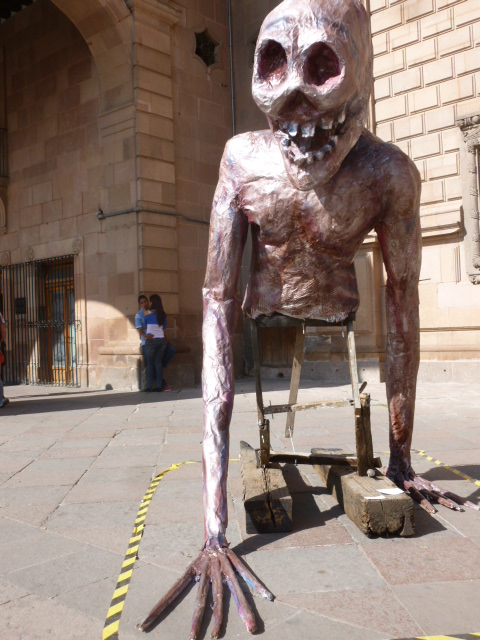
The couple embracing in the background of this photo might represent those of us so far from the migrants’ experience./La pareja que se abraza en el fondo de esta foto puede ilustrar a nosotros tan alejados de la experiencia de los migrantes.
The Roman Catholic international aid agency Caritas chose San Luis Potosí to locate its House of Charity-Home of the Migrant. Its mission is “to provide help to brothers and sisters, Mexican and Central American, in their migration to the north”. Eighteen sculptures created by some of the migrants temporarily housed at the “House of Charity” are now on exhibit downtown.
Using recycled materials – cardboard, newspaper, plastic, glue – the artists created works on the theme “Dreams of the Heart”. The result is a moving revelation of the dreams’ force in the hearts of the migrants and fulfills amply the exhibit’s objective “to connect us to the migrants’ experience”.
Looming over the seventeen hearts is the “monumental” sculpture representing a victim of the migration whose body was severed below the belt in the trek north. San Luis Potosi is on the route of the freight train known as “the beast” among migrants for consuming arms and legs of those who fall from the train’s roof during the journey.
******************** ********************************* ******************
La agencia de ayuda internacional católica Cáritas eligió San Luis Potosí para localizar su Casa de la Caridad-Hogar del Migrante. Su misión es ” de auxiliar a nuestros hermanos, mexicanos y centroamericanos, en situation migratoria”. Dieciocho esculturas creadas por algunos de los migrantes alojados temporalmente en la “Casa de la Caridad” se encuentran ahora al frente de la Catedral Metropolitano de San Luis Potosí.
Por el uso de materiales reciclados – cartón, periódico, plástico, pegamento – los artistas crearon obras sobre el tema “Sueños del corazón”. El resultado es una revelación del poder de los sueños en los corazones de los migrantes y cumple con el objetivo de la exposición “para conectarnos con estas experiencias migrantes”.
Dominando por su tamaño las otras esculturas, y serviendo como el trasfondo de la realidad de la experiencia migratoria, hay una escultura “monumental” que representa una “víctima” de la migración que ha perdido su tronco y ambas piernas en la ardua caminata hacia el norte. San Luis Potosí está en la ruta del tren de carga, conocido como “la bestia” por los migrantes a causa el consumo de los brazos y las piernas de los que caen desde el techo del tren durante el viaje.

This introduction to the “Dreams of the Heart” art exhibit describes the Home of the Migrant’s dream of contributing to the creation of a “city of love, a just and inclusive society” in San Luis Potosí.
La introducción a la exposición de arte, describe el sueño de La Casa de la Caridad “se encuentra en la búsqueda constante de influir entre la sociedad potosina a fin de construir la civilización del amor, una sociedad justa y incluyente”

Javier Iván known as “The Skinny One” dedicates his sculpture to his mother Sra. Anselma Bardales. Below the heart he wrote, “To the most beautiful mother that life could have given me, I miss you and love you with a tender, deep love”. He also wrote, “This is the emptiness in my mother’s heart when I left her”.
Javier Iván conocido como “El Flaco” dedica su escultura a su madre Sra. Anselma Bardales. Por debajo del corazón, escribió, “La madre mas Hermosa que la vida me ha regalado. Te extraño y te amo con amor y con cariño.” También escribió: ” El vacio que deje en el corazón de mi madre al partir”.
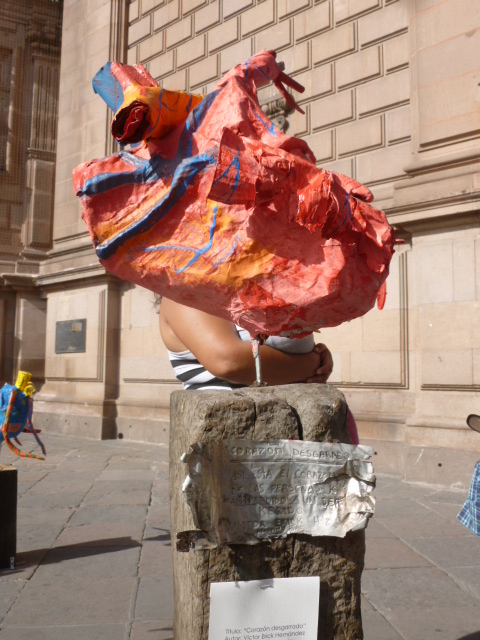
On the jagged piece of metal, Viktor Erick Hernandez of Honduras has titled his piece “Torn Heart” followed by “This is the heart of those persons who have lost someone they dearly loved”.
En la pieza dentada de metal, Viktor Erick Hernández, de Honduras ha titulado su obra “Corazon desgarrado”, seguido de “Asi esta el Corazon de las personas k (sic, ed.) han perdido un ser kerido (sic, ed.)”.
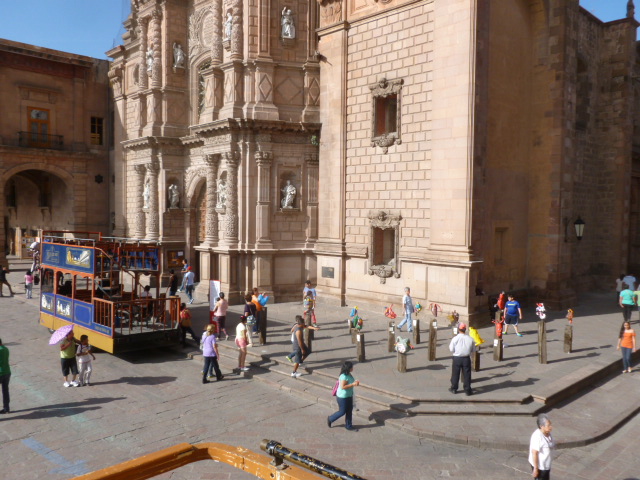
The exhibit is located on one of the city’s busiest corners, in front of the main cathedral of the San Luis Potosi Archdiocese. The “victim” sculpture is to the left of the tourist bus.
La exposición está situada en una de las esquinas más concurridas de la ciudad, frente a la catedral principal de la Arquidiócesis de San Luis Potosí. La escultura monumental de “la víctima” está a la izquierda del bus turístico.
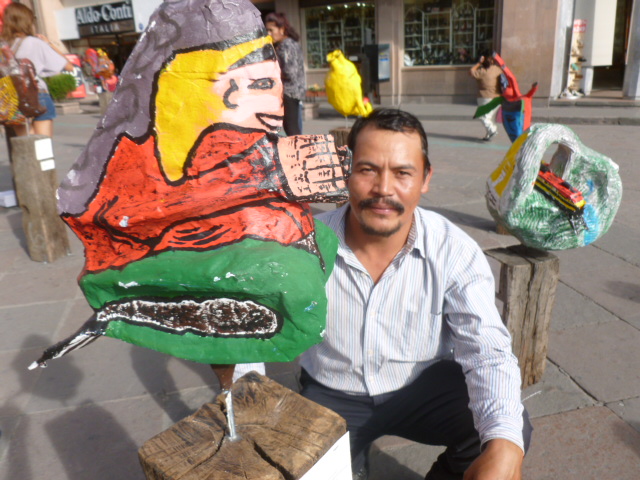
The exhibit introduction reads: “These sculptures represent a bridge for dialog and a means to enter into the desires, motives, fears and dreams within the hearts of our migrant brothers and sisters.” A Honduran migrant in his early forties, Dimas, interpreted for me his sculpture which he had named “A Testimony”:
“This is a child kneeling in prayer. It shows me as a child on my knees in prayer because Jesus taught us that we must humble ourselves when we come before him and before God. I am praying here for a safe journey to the north. Jesus also teaches us that to love one another as brothers and sisters we must also humble ourselves as little children. The only way we can change and gain a healthy mind is by prayer.”
******************* **************************** *****************
La introducción a la exposición lee: ““Son estas esculturas un puente para el diálogo y una manera de adentrarnos a los anhelos, las motivaciones, los miedos y los sueños contenidos en todos los corazones de nuestros hermanos migrantes.”
Un migrante hondureño de unos cuarenta años, Dimas por nombre, me interpretó su escultura que él había llamado “Un testimonio”:
“Se trata de un niño arrodillado en oración. Me muestra como un niño en mis rodillas en la oración por que Jesús nos enseñó que tenemos que humillarnos cuando nos presentamos ante él y ante Dios. Estoy orando aquí para un viaje seguro hacia el norte. Jesús también nos enseña que amarnos unos a otros como hermanos y hermanas, también debemos humillarnos como niños. La única manera que podemos cambiar y tener una mente sana es mediante la oración.”
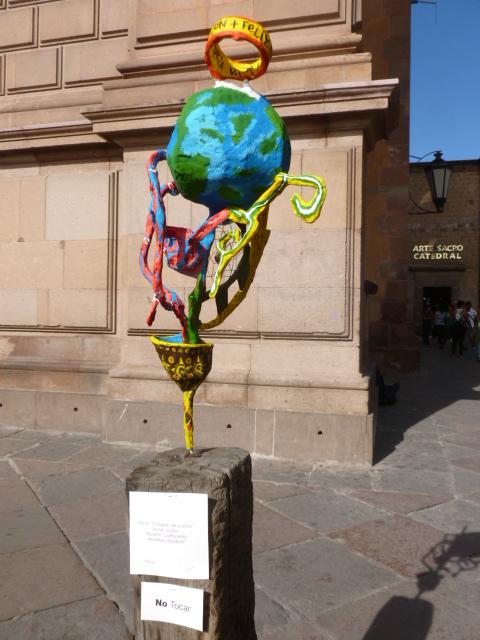
The sculpture by the migrant artist known simply as “Junior” comes from a fertile imagination. The earth and “the fullness thereof” flows from a cup – the “heart of God”?? – inscribed with the words “free”, “light”, “love”, “peace”, “to create”, “imagine”, “grow”, “live”, “health”. Along with the white rivers bordered by green and then yellow, from the heart flows arteries of the flag colored red, white and blue.
La escultura del artista migrante conocido simplemente como “Junior” viene de una imaginación fértil. “La tierra y su plenitud” fluye de una taza – la del “corazón de Dios”? – Con las inscripciónes “libre”, “luz”, “amor”, “paz”, “crear”, “imagina”, “crece”, “salud”, “vive”. Junto a los ríos blancos bordeados de verde y luego amarillo, desde el corazón fluye las arterias de la bandera del rojo, blanco y azul.
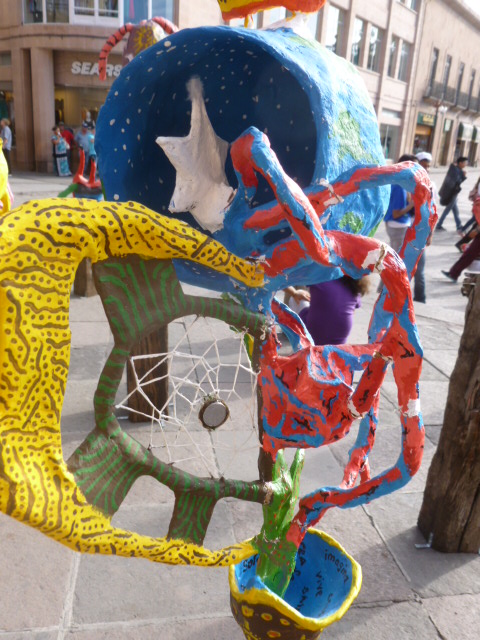
On the other side of Junior’s sculpture he created a “Dream Catcher” with a battery at the center of the web emerging from a jungle setting of green and brown. The fierce and courageous rule of the jaguar over the jungle of dreams is in balance with the large star at the center of the earth.
Junior calls his sculpture “Heart of Dreams” and bids us ask several questions with his art. Among the questions we ask ourselves, “Will Junior make it to the red, white and blue of his dreams?” and “If he makes it north will his dream catcher enable him to hold on to some of the dreams”?
***************** *************************************** *****************
En el otro lado de la escultura de Junior creó un “Cazador de Sueños” con una batería en el centro de la telaraña que emerge de un entorno de selva de verde y marrón. La regla feroz y valiente del jaguar en la selva de los sueños se encuentra en equilibrio con la gran estrella en el centro de la planeta, nuestra tierra.
Júnior llama su escultura “Corazon de Sueños ” y nos invita a hacer varias preguntas con su arte. Entre las preguntas que nos preguntamos, “¿Logrará Júnior llegar a la azul, rojo, blanco y de sus sueños?” Y “Si él llega al norte, hará el cazador de sueños que pueda aferrarse a algunos de los sueños”?
Gracias al Sr. Alfonso Amparan por su ayuda en la traducción del articulo al español.
Janet’s Visit / La Visita de Janet

One of the wonderful families I met, Heidi and Rojelio, made this welcome sign for me. Exhausted as I was after a long day of travel, I was touched by the effort put in by people whom I had yet to meet. /
Una de las familias maravillosas que conocí fue de Sra. Heidi con Pastor Rogelio quienes hicieron este rotolo de bienvenida para mi. Aunque agotada después de un largo dia de viaje, me tocó fuerte el esfuerzo de la parte de gente que yo no había todavía conocida.
Our daughter Janet just returned to California after a wonderful two week visit with us. We had not seen her in over two years as she served in the Peace Corps following her college graduation. A few pictures, most taken by her, from our time together follow along with her commentary. We already miss her and look forward to following her next venture, a short term assignment in Mali, West Africa. (Our occasional notes by the editor are in parentheses)
*********************** ******************* ***********************
Nuestra hija Janet acaba de dejarnos para volver a California después de una estancia deleitosa de dos semanas en San Luis Potosi. No la habíamos visto durante mas de dos años debido a su termino de servicio con el Cuerpo de la Paz a partir de su graduación de la universidad. Pueden ustedes revisar unas photos de su visita, la mayoría tomadas por ella, con sus comentarios aquí abajo. Ya nos echa a menos a ella luego que anticipamos sus informes de su nueva posición, un termino corto en Mali, Africa Poniente. (Hay notas del editor en parénteses de vez en cuando)

One of my favorite parts of Mexican culture was the ubiquity of children’s toys. From blow up balloons, to piñatas, to slides and swing sets, every restaurant, rest stop and random patch of grass was supplied. /
Un aspecto encantador de la cultura Mexicana fue los juguetes de niños en todas partes. Se encuentran en cada restaurante, parador de la carretera, y pedacito de césped, unos globos a soplar, piñatas, colompios y resbaladores.
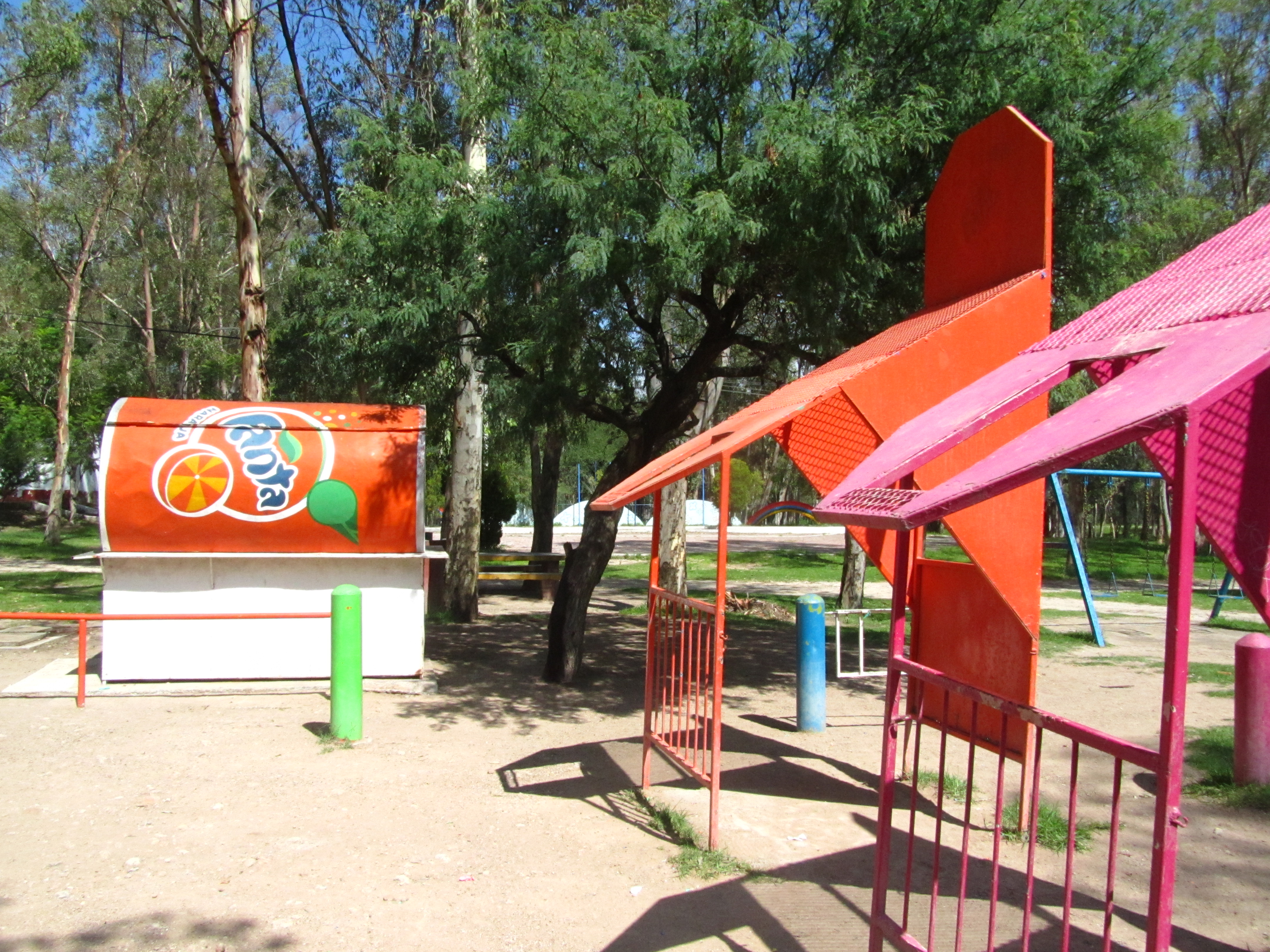
I spent several hours walking and running around the second biggest urban park in Mexico, a close 15 minute drive from Dad’s home. I know the park far better than Dad ever will and this spot held a special place for me. Partially for the ‘Fanta’ sign, reminiscent of my previous sobriquet, and for the Doctor Seuss style structures. /
Pasé yo unas hora caminando y corriendo en el parque Tangamanga, el segundo mas grande de las ciudades de Mexico, quince minutos de la casa de los padres. Ya yo conozco el parque mucho mejor que mi padre y este lugar me agarró fuerte por su sentido especial. En parte por las letras “Fanta”, que fue mi nombre en el pueblito en Senegal, y también por los juguetes al estilo Dr. Seuss.

Everyone says that Mexican food in the US is nothing like Mexican food in Mexico. While there were some definite similarities, I tried multiple dishes that I had never experienced. My favorite of which was this- huevos divorciados! /
Todos dicen que la comida Mexicana en los EUA se diferencia tanto de la comida en Mexico. Aunque hayan semejanzas, yo probé varios platillos por la primera vez – mi favorito se ve aquí – los huevos divorciados! Chile verde y chile rojo!
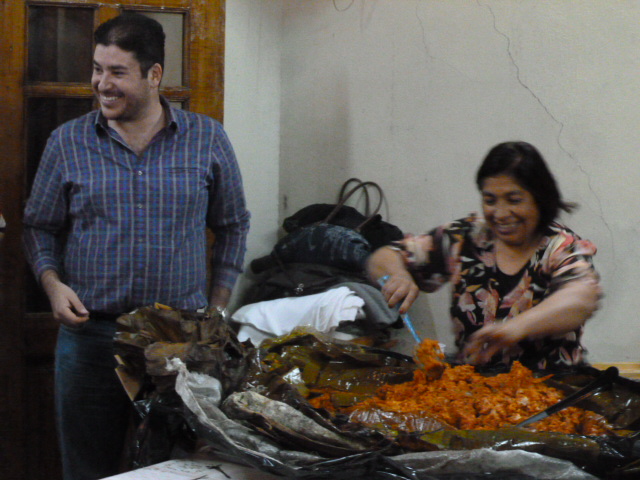
My least favorite of which was this… (a “zacahuil” or tamale like dish a yard or more in length prepared in the Sierra Huasteca east of San Luis Potosi) /
El platillo el menos favorito fue este ….. (el zacahuil es el platillo tradicional de la Sierra Huasteca, como un tamal de un metro o mas)
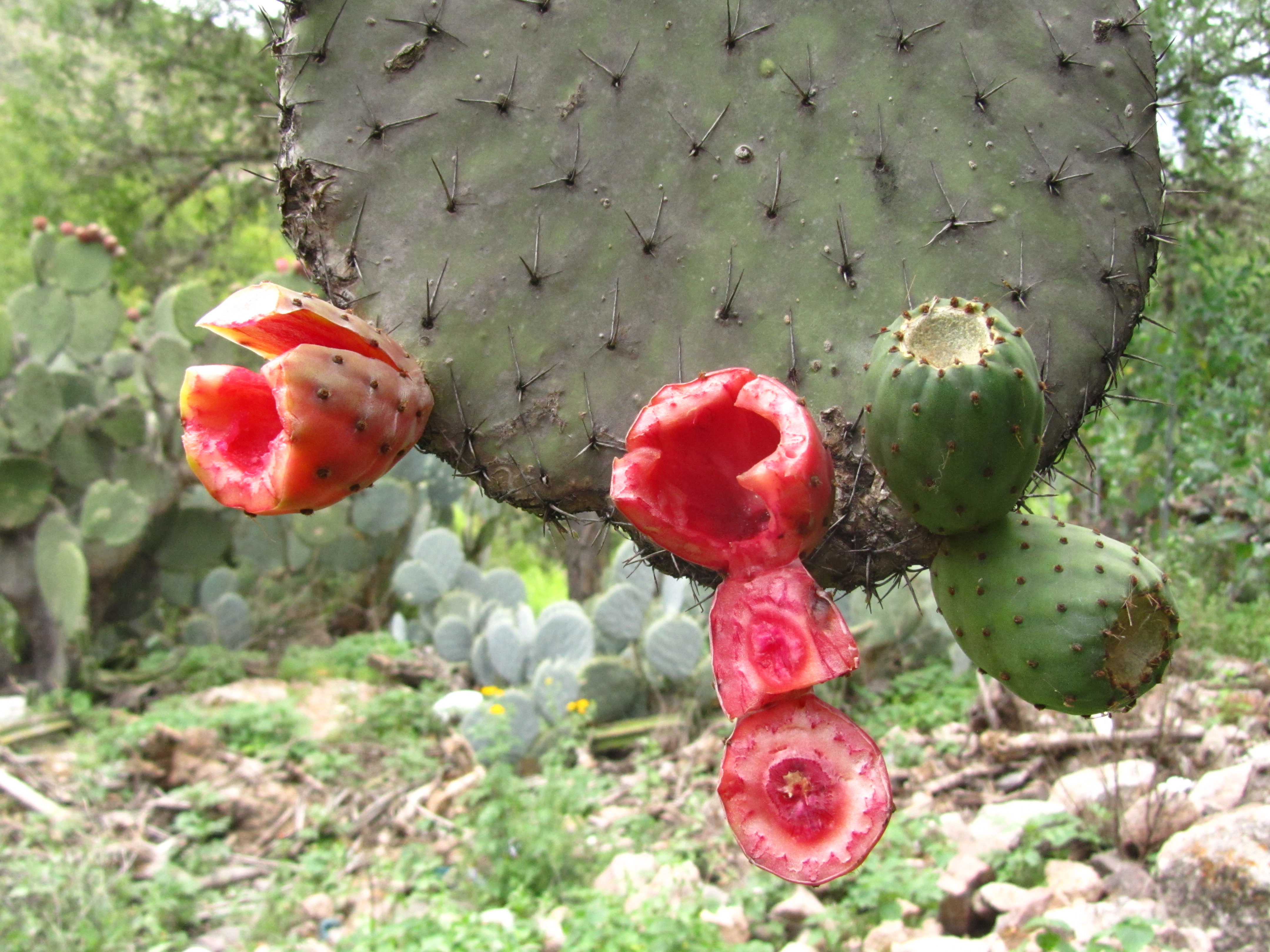
Cactus scattered the land scape outside of San Luis. Contrary to assumption, they are fruitful specimen and grow these red fruits called ‘tuna’. I would never eat one again but I could understand why others may find them savory. /
En las orillas de la ciudad de San Luis Potosi hay nopales por todas partes. Al contrario de lo que pensábamos, estas plantas dan buena fruta llamada “tunas”. Yo no volveré a comer una mas podría comprender como unos las consideran sabrosas.

The ancient ruins at Tamtok was possibly the highlight of my trip. Second to seeing Dad and Kate of course 😉 To get to the ruins, one must venture down an obstacle packed road, fit with broken cattle grates, and Senegal sized pot holes. Contrary to Dad’s negativity, my response was that these hurdles weed out the less inclined tourist, and makes for a superior, more pleasant experience. /
La experiencia la mas sobresaliente de mi estancia – por supuesto a parte de volver a ver a mi papa y a Katalina – quizás fue la de visitar las ruinas muy antiguas de Tantok. Para alcanzar a llegar ahí fue menestar atreverse a manejar por un camino a tropezones incluso baches como los de Senegal y enrejados de hierro quebrados protegiendo el ganado en el entorno. Al contrario de lo que pensó el chofer mi Papi, yo los veía como preveniendo que pasen los turistas menos dedicados y asi lo que hace una experiencia mas linda y apreciable para los demás.

One of the two beautiful falls we visited in the Huasteca region./
Una de las dos cascadas hermosas que visitamos en la Región Huasteca.
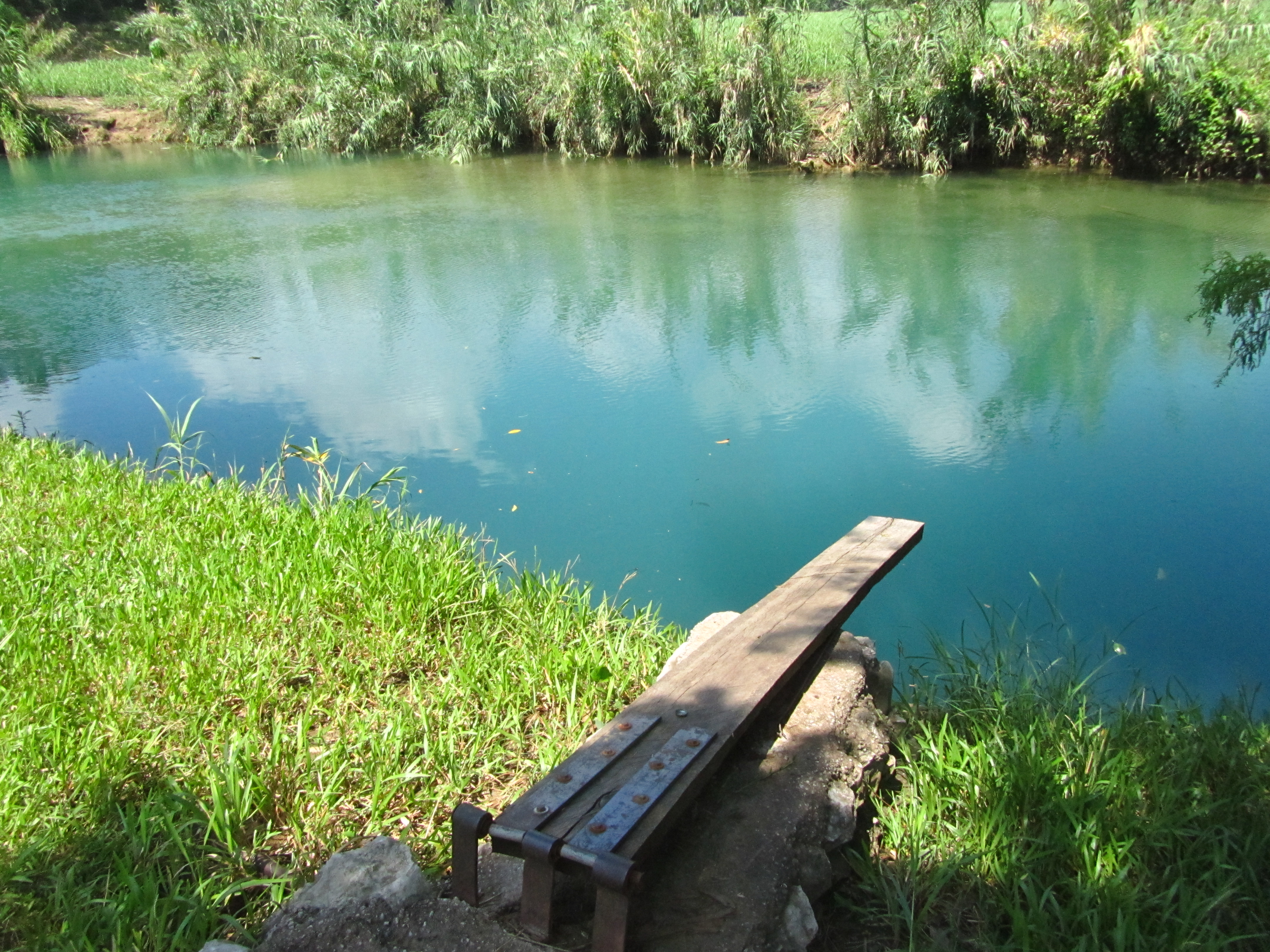
Dad and I spent a good hour swimming at this impeccable spot above the Tamasopo falls, just far enough away to be free of the strong currents and the plethora of tourists. /
Mi papi y yo pasamos una hora nadando por esta lugar prístina encima de las cascadas Tamasopo, retirados por ser libre de los corrientes fuertes del rio y el enjambre de turistas.
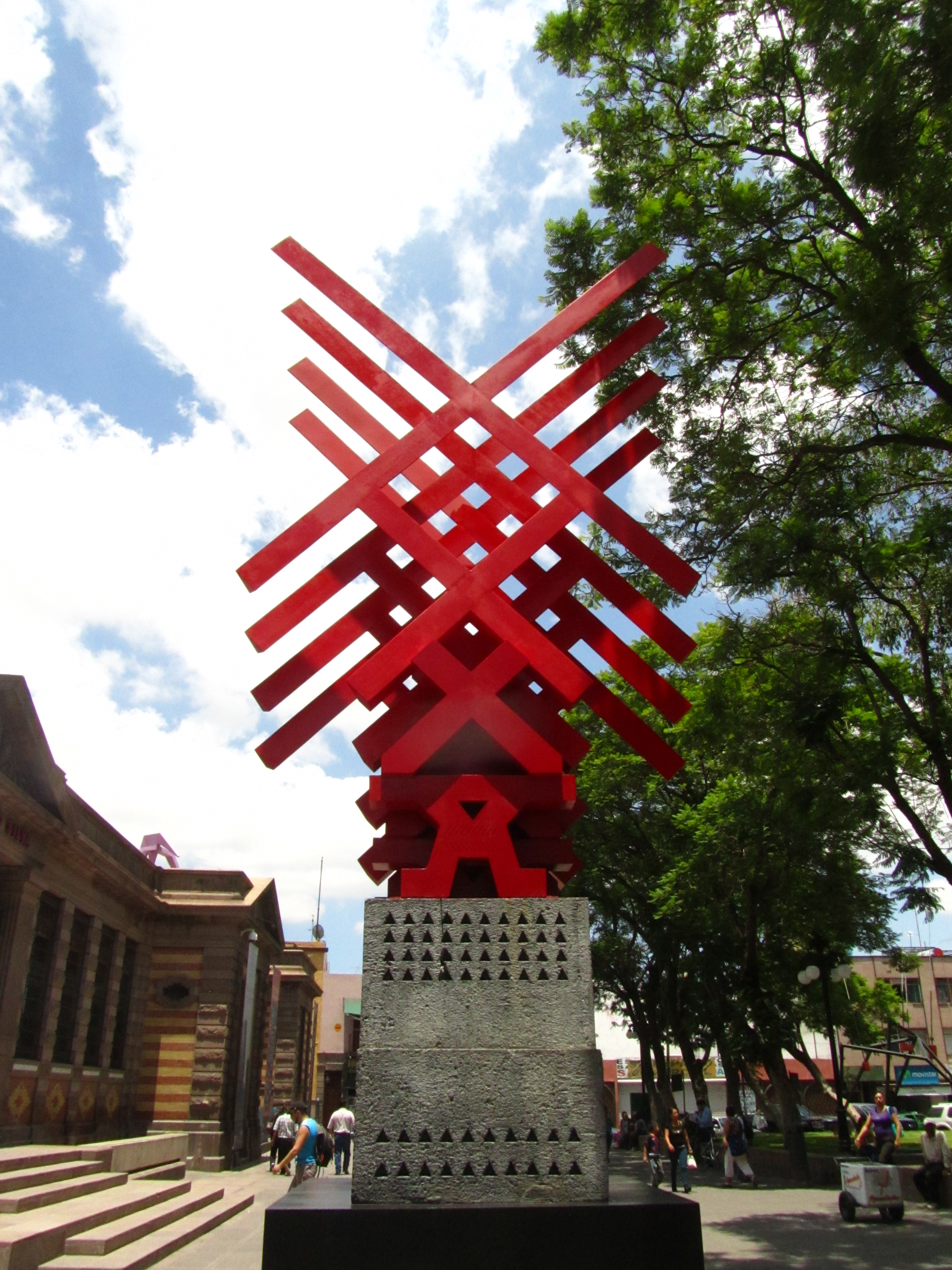
Street art back in San Luis Potosi./ Arte publica en San Luis Potosí
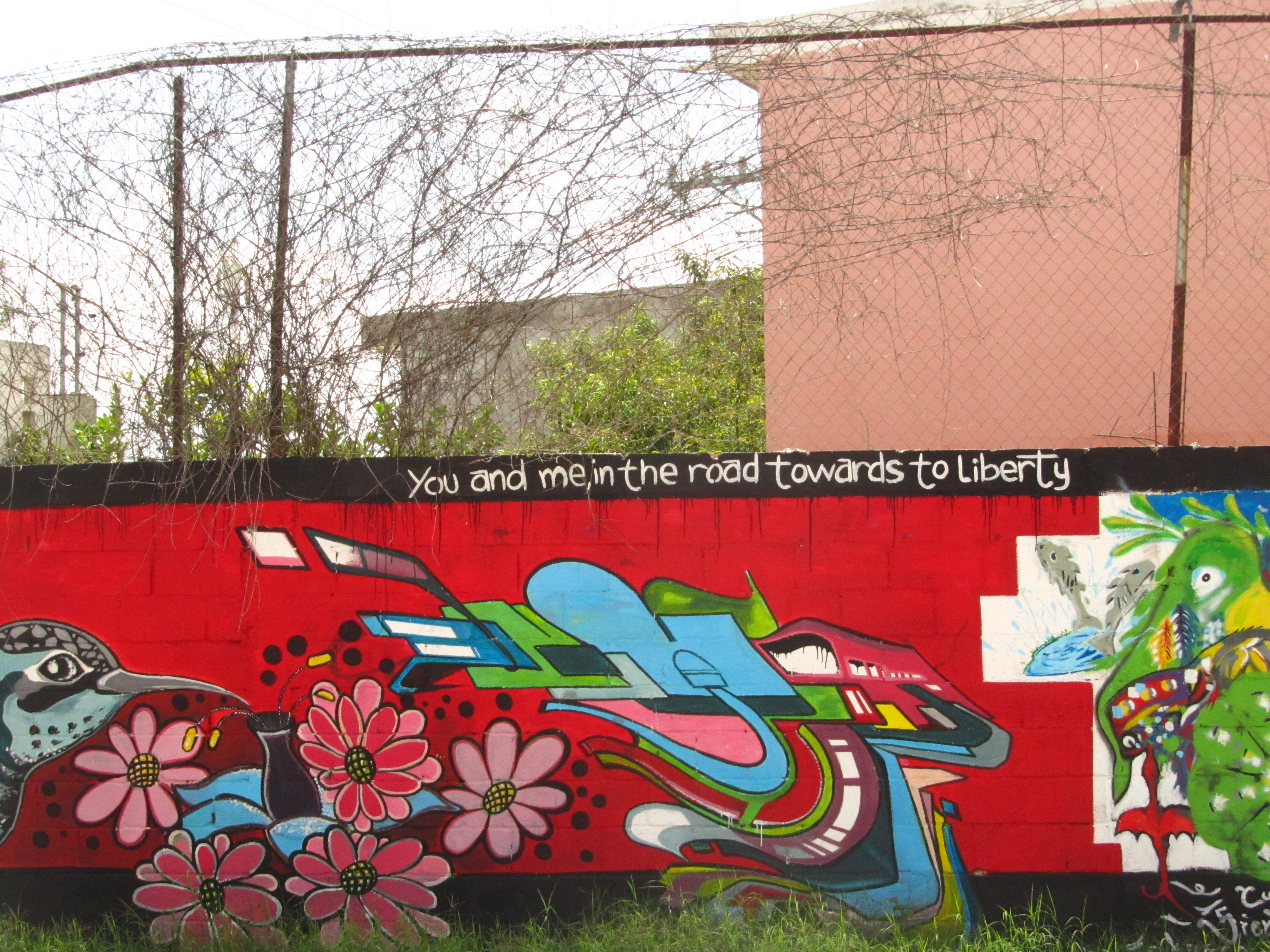
Loved the street graffiti, this picture is layered with ironies that I will let you all mull over. /
Me agradó el “graffiti” de la calle, en este ejemplo se encuentran unas ironias para contemplar
Viva Lila Downs!
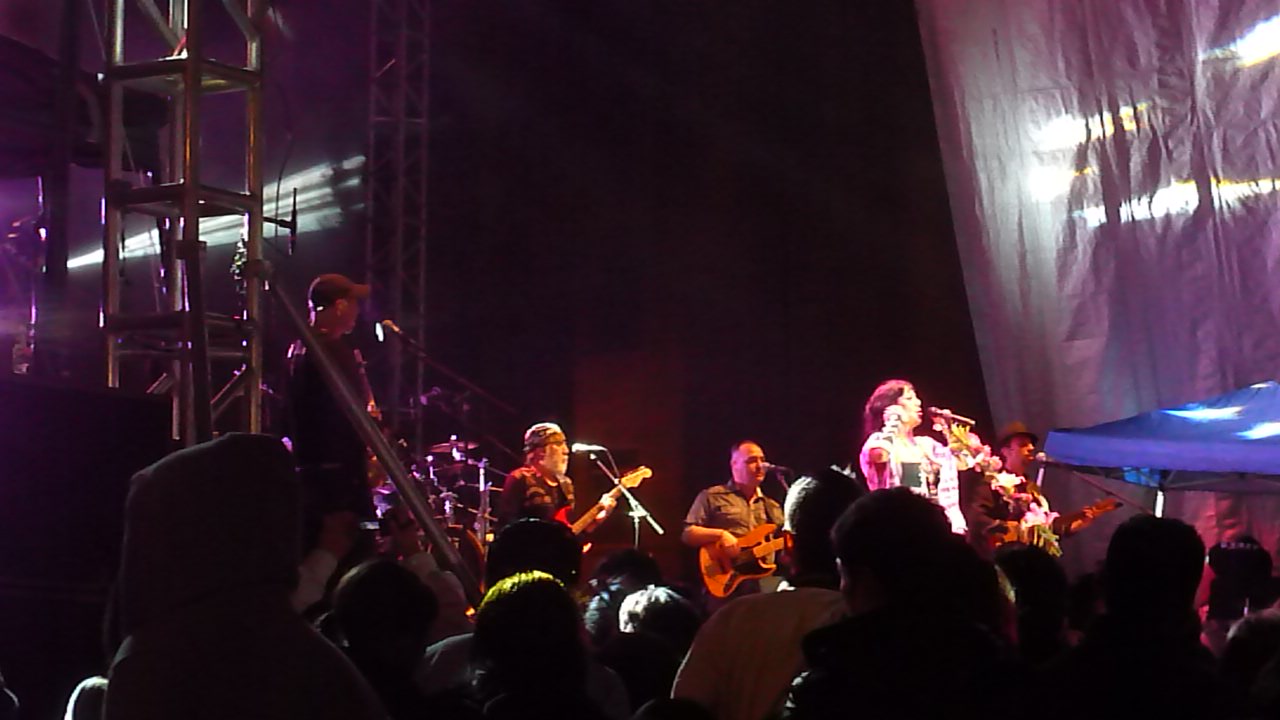
Lila Downs performing with her band “La Misterioso” on the Plaza de Fundadores, San Luis Potosi
Lila Downs has become another of our teachers here, mentoring both of us in the language and culture of this country, so close and yet so different from our own. As we listen again and again to her 2001 album “Border”/”La Linea”, doors keep opening to a new and better understanding of the people of Mexico.
The singer/songwriter is a child of both nations, her father an art professor from Minnesota and her mother a Mixtec Indian cabaret singer from the State of Oaxaca, Mexico. She grew up on both sides of the border, graduating from the University of Minnesota in voice and anthropology.
Like the young Bob Dylan, she found in Woody Guthrie’s music the key to moving a listener by telling the truth. Her medley on the “Border” album of Guthrie’s “This Land is Your Land” and “Pastures of Plenty” includes her own words,
“now that you have all the things that you want did you ever look around to see who you forgot?”
With a three octave range voice, she sings of a dazzling variety of people from all over Mexico. In her own composition “The Girl”, she sings about ‘maquiladora’ factory worker Rosa Maria and in “I Am a Fisherman” about a fisherman looking for the love he cannot forget. She takes us behind and beyond official accounts of the Mexican army’s 1999 massacre of villagers in Chiapas in her composition “Smoke”. And in the song “The Line” the life of the holy spirit brings hope and is celebrated.
Lila Downs gives voice to the wisdom, the spirituality and strength of the Mexican people. At a deeper, more comprehensive level than most, she lifts up the old Mexican saying, “out of poverty, poetry, out of suffering, song”. On the “Border” album, her brave trust in the roots of Mexican spirituality helps produce music that is powerful as well as beautiful.
The day after Easter, San Luis Potosi opened its annual Cultural Festival with Lila Downs performing a free downtown

After we stood for 45 minutes, this kind woman admitted us to the front row press section for the concert
concert. Not surprisingly, the artist proved to be a generous performer as well, doing four encore songs, the last of which we listened to from inside the restaurant on the plaza where she performed.
While the sound is lousy on the You Tube clip I filmed at the concert, watch Lila Downs take on the personality of the dove mourning a lost love as she sings the classic song “Cucurrucucu Paloma”. Downs as the dove flaps her wings as she coos with the beautiful, painful memories.
“They all say it is nothing less than his soul that coos for his lost love, and that still awaits her return, the return of his unhappy mate……”
Wikipedia tells us “Cucurrucucu Paloma” is in the “Son Huasteco” style (originating then in San Luis Potosi’s State among others) and was a signature song for another great Mexican singer, Lola Beltran. ********************** ***********************
Lila Downs se ha convertido en otro de nuestros maestros aquí, nos ha instruido tanto en el idioma como en la cultura de este país, tan cerca pero tan diferente del nuestro. Al escuchar una y otra vez a su álbum del 2001 “Border ” / ” La Línea “, puertas siguen abriéndose a una nueva y mejor comprensión del pueblo Mexicano.
La cantante / compositora es hija de ambas naciones, su padre un profesor de arte de Minnesota y su madre una india Mixteca que canta en cabarets del Estado de Oaxaca, México . Lila Downs creció en ambos lados de la frontera, graduándose de la Universidad de Minnesota en la Voz y la Antropología.
Al igual que el joven Bob Dylan , Downs encontró en la música de Woody Guthrie la clave para conmover a un oyente, contando la verdad . Su mezcla de las canciones de Guthrie “This Land is Your Land ” y “Pastures of Plenty” incluye sus propias palabras ,
” Ahora que tiene todas las cosas que usted desea ¿alguna vez mira a su alrededor para ver quién se lo olvidó ? ”
Con una voz rango de tres octavas , canta acerca de una deslumbrante variedad de personas de todas partes de México . En su propia composición ” La Niña” , ella canta sobre una obrera, Rosa Maria, en una fábrica ‘ maquiladora ‘ y en “Soy pescador” acerca de un pescador en busca del amor que no puede olvidar. Ella nos lleva detrás y más allá de las historias oficiales de la masacre del ejército mexicano en 1999 de unos campesinos de Chiapas en su composición “Humo” . Y en la canción ” La Linea” canta de como la vida del Espíritu Santo trae esperanza y se celebra.

El concierto tuvo lugar al lado del edificio de la Universidad sobre la lindissima Plaza de los Fundadores/ The concert took place in front of the main University building on the beautiful Founders’ Plaza
Lila Downs da voz a la sabiduría, la espiritualidad y la fuerza del pueblo mexicano. Como todos los mas grandes artistas, ella confía en que al contar la verdad de su pueblo, resultará belleza. Hasta un nivel más global y más profunda que la mayoría, ella resalta el viejo dicho mexicano “, de la pobreza, viene la poesía, del sufrimiento, viene la canción” . Su fe y su valentía ayudan a producir música que es de gran alcance, así como hermosa también.
El día después de la Pascua, San Luis Potosí inició su Festival de la Cultura con Lila Downs con un concierto gratis al aire libre en el Centro de la Ciudad. Llegamos ahí media hora antes y tuvimos la fortuna de conseguir unos asientos en primera fila. No es sorprendente que la artista demostró ser una persona generosa, presentando cuatro canciones como “encore” , la última de las cuales la escuchamos desde el interior del restaurante en la plaza donde actuó .
Mientras que el sonido es pésimo en el clip de You Tube que filmé en el concierto, vera á Lila Downs ahí asumir la personalidad de la paloma que esta de luto lamentándose por un amor perdido mientras canta la canción clásica “Cucurrucucu Paloma”. Downs como la paloma aleteando sus alas mientras se arrulla con los hermosos recuerdos dolorosos,
” juran que esa paloma
no es otra cosa más que su alma,
que todavía la espera
a que regrese la desdichada”
Wikipedia nos dice que ” Cucurrucucu Paloma ” es en el estilo de ” Son Huasteco ” (originado en el Estado de San Luis Potosí, así como otros ) y fue una canción de firma para otra gran cantante mexicana , Lola Beltran.
Gracias a Sra. Marisela Huelga de Leon por su ayuda con la traducción al Español
Hummingbird Visitations / Visitaciónes de Colibries

There are more hummingbird species in Mexico than in any other country
When Doug and I first moved to San Luis Potosi in October, 2012, we arrived with only the “stuff” that would fit in our Toyota Corolla (besides us and the two dogs). Nothing on the roof, but the rest of the car was jam packed with our “stuff”. And of course, we have bemoaned the stuff we didn’t bring!
One of the things we neglected to bring along was hummingbird feeders! Seeing the hummers around in the middle of winter made me crazy to get some feeders; but there were no hummingbird feeders that I could find anywhere in San Luis! When we drove back to the states for a family visit in May and June, you may be assured that hummingbird feeders were purchased to return to Mexico with us: I brought back about 8 of them! I immediately hung several on our return and WOW, did the hummers love our feeders! We were amazed at all the different varieties that came to feast!
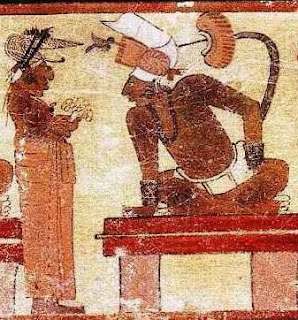
To the Maya, the hummingbird was created by the gods transmit thoughts and desires / Segun los Maya se crearon los colibrís para llevar los pensamientos de las personas
Mexico is special in the world of hummingbirds because there are around 50 varieties of hummingbirds listed in our bird book for Mexico! With the comedores de colibri (Spanish for hummingbird dining room) placed next to the windows in our study and bedroom, we have seen them up close and personal! Regular guests at the feeders are White-Eared Hummingbird, Lucifer Hummingbird, White-bellied Emerald, and Dusky Hummingbird.
Once people have seen our feeders, of course, they want one! I finally found a couple at a Sears store, and was shocked to see the 364 peso price tag (about 28 dollars US)—especially since I had just purchased the same feeder in the US for $7.00! On every trip back to the states, I buy as many feeders as I can carry back. Doug says that I have a “ministry of hummingbirds”!
There are many legends regarding hummingbirds. The Guarani of Paraguay believe that the hummingbird represents the place where heaven touches earth in fleeting instants. WOW! I love that idea, kind of like the Irish “thin places”—places where heaven and earth come close. Certainly hummingbirds are quick and elusive and we do try to entice them to our feeders, even as we seek the moments when we feel closest to God whether in worship, prayer or in beautiful places.
There is also a wonderful hummingbird story told by Wangari Maathai of Kenya, the first African woman to win the Nobel Peace Prize for her work in organizing the planting of trees and saving the forests.
Dr. Maathai tells us:
“One day a terrible fire broke out in a forest – a huge woodlands was suddenly engulfed by a raging wild fire. Frightened, all the animals fled their homes and ran out of the forest. As they came to the edge of a stream they stopped to watch the fire and they were feeling very discouraged and powerless. They were all bemoaning the destruction of their homes. Every one of them thought there was nothing they could do about the fire, except for one little hummingbird.
This particular hummingbird decided it would do something. It swooped into the stream and picked up a few drops of water and went into the forest and put them on the fire. Then it went back to the stream and did it again, and it kept going back again and again and again. All the other animals watched in disbelief; some tried to discourage the hummingbird with comments like, “Don’t bother, it is too much ……..you are too little ……….your wings will burn………your beak is too tiny, it’s only a drop ……..you can’t put out this fire.”
And as the animals stood around disparaging the little bird’s efforts, the bird noticed how hopeless and forlorn they looked. Then one of the animals shouted out and challenged the hummingbird in a mocking voice, “What do you think you are doing?” And the hummingbird, without wasting time or losing a beat, looked back and said, “I am doing what I can.” Like the hummingbird, we each must do what we can.
Imagine the drops of water that we can put on the fires we all face if we only have the determination of a hummingbird, just trying to do what we can. Imagine the Kingdom of Heaven coming close to us in fleeting moments, and imagine all of us working toward extending the kingdom in whatever way we can! Imagine what you can do.
To watch Wangari’s story on youtube, please go to
http://www.youtube.com/watch?v=IGMW6YWjMxw
Many thanks to Elena Huegel for the hummingbird stories. Elena is a Missionary in Chile for Global Ministries (UCC & DOC) whose blog is •colibrienchile.blogspot.com (Blog in English) and
http://capellanacentroshalom.blogspot.com/ (Blog en español)
************************ **************************
Cuando Douglas y yo hicimos el viaje hasta San Luis Potosí desde nuestro hogar en Pomona, California, llegamos solamente con las cosas que pudieron caber en el carro marca Toyota Corolla aparte de nosotros y dos perros. No pusimos nada en el techo, entonces el carro iba colmado de las cosas que consideramos mas esenciales para nuestra vida en México. Por supuesto, una vez llegados aquí nos dimos cuenta de muchas cosas que se nos habían olvidado.
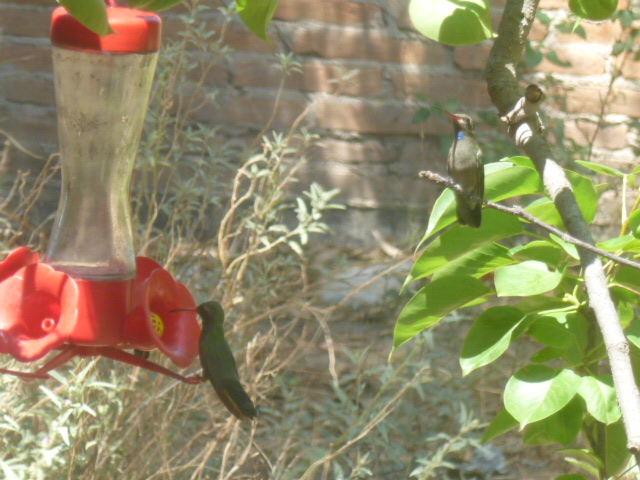
A menudo dos y mas colibris se acercan al comedoro/ Frequently there are two or more of the little ones at the feeders
Una de las cosas ignoradas fue un comedero de colibrís. El primer invierno me hizo sentir loca de ver tantos de esos pequeños pájaros y no tener un comedero para nutrir y admirarlos mas cerca. Desafortunadamente no pude hallar ni un comedero en San Luis Potosí. Luego de una visita en mayo pasado a la familia en EUA, seguro que al regresar trajimos unos comederos de colibrí. Volví con algunos ocho creo yo. El primer dia de regreso aquí colgué unos dos o tres y caray! disfrutaron muy bien los pequeñitos la fiesta. Nos asombramos con tantas especies de colibrí que estaban visitando los comederos.
Según un libro que tenemos sobre los pájaros de México hay mas de 50 especies de colibrí habitando el país favorito de los pequeñitos. Una vez que colgamos los comedores afuera de las ventanas en la recámara y el escritorio de la casa, empezamos a observar y conocer a su variedad de una manera de muy cerca e íntima. Pues nos visitan regularmente colibrís de las muchas variedades de nuestra Región.
Se interesan mucho nuestros amigos en los pajaritos visitantes y expresan su deseo de colgar un comedero afuera de su casa también. Después de haber buscado por muchas tiendas por fin hallé un comedero en una tienda Sears, pero a un precio de 386 pesos Mexicanos (alrededor de $28 dolares US). Que choque considerar que fue el mismo modelo que había comprado en los EUA por el precio de $7 dolares US. Entonces cada visita a los EUA me compro tantos comederos como puedo llevar de regreso a México. Doug dice que tengo ya un “ministerio de colibrí”.
En el mundo hay muchas leyendas tocante a los colibrís. Los indígenas de Paraguay, los Guaranís, creen que con los colibrís se halla súbitamente el lugar en donde el cielo se reúne con la tierra. Zowie! Me encanta esta idea semejante a la de los Irlandeses que hablan de “los lugares delgaditos” por los cuales el cielo y la tierra se acercan. Con sus vuelos erráticos de prisa si tratamos nosotros de motivar a los colibrís a pasar a nutrirse y descansar aunque también procuramos acercarnos a Dios con la oración, la alabanza y en lugares con la belleza de la naturaleza.
Nos encanta una historia acerca de colibrís relatada por la primera Africana en ganar el Premio Nobel de la Paz por sus esfuerzos en organizar a su pueblo a cultivar arboles y conservar los bosques de Kenia. Cuenta Dr. Wangari Maathai:
“Un día en un bosque grande se incendió un fuego terrible. Temerosos, todos los animales del bosque dejaron sus hogares para huir del bosque. Llegaron todos a un arroyo a una distancia del fuego y descansaron sintiéndose desamparados y derrotados. Lamentaron la perdida de sus hogares. Pensaron todos que no podían hacer nada contra este incendio tan espantoso e inmenso. Todos con la excepción de un pequeño colibrí.
Este colibrí había decidido que SI PODIA hacer algo. Se bajaba al arroyo y con el pico lleno de agua volvía al bosque para dejar caer unas gotitas al fuego. Seguía con sus paseos entre el arroyo y hasta el fuego. Seguía y seguía continuamente. No podían creer los demás animales lo que estaban observando y unos hicieron comentarios al colibrí para desalentarlo. “No seas necio! Estas demasiado pequeño! Tu pico lleva tan poca agua, no haces nada contra este incendio. Te vas a quemar las alas.” Notó el colibrí que estos animales menospreciaban mucho sus esfuerzos y tenían un aspecto deprimido y desamparado. Al animal que le grito, “Tu colibrí, necio, no estás haciendo nada” , el pequeño respondió con calma, “Yo estoy haciendo todo lo que puedo para extinguir este fuego”.
Como el colibrí, cada uno de nosotros puede hacer algo. Como la dedicación del colibrí, así también nosotros podemos hacer algo respondiendo a los fuegos que enfrentamos nosotros. Imaginemos que el reino de Dios se acercara súbitamente a nosotros de vez en cuando. Imaginemos que cada uno de nosotros podríamos hacer algo para extender los momentos de la presencia del reino de Dios en nuestro mundo . ¿Que puede hacer usted mismo?
Para ver Dr. Maathai relatando la historia del colibrí pase a esta dirección en la You Tube: http://www.youtube.com/watch?v=IGMW6YWjMxw
Mil gracias a Elena Hueghel misionera de los Ministerios Globales en Chile por haber compartido los relatos del colibrí conmigo. Ella escribe sobre sus experiencias en Chile en los blogs a:
http://www.colibrienchile.blogspot.com (en Ingles) y
http://capellanacentroshalom.blogspot.com/ (Blog en español)
The Quinceñara of a Separated Family/ Quinceñara de Una Familia Viviendo Aparte

Marina on her big day. The quinceñara is celebrated throughout Latin America.
Another gift for the newly fifteen year old Marina on this unforgettable day was presented by her father Oscar. He cradled the old, faded doll and, overcome with his emotions, could not speak before holding out his arms for a long embrace with his daughter. It was the last of the “community blessings” and concluded the worship service before the feast and cake celebrating Marina Cuevas Espinosa’s fifteenth birthday “quinceñara”.
Commemorating her passage from childhood, three roses were presented by three friends to signify Marina’s childhood, adolescence and current status as an adult. Another friend in the Church slipped a new ring on her finger to symbolize her “authority” as a free adult “child of God”. The pastor reminded us in the crowded sanctuary that the prodigal son’s return home was also celebrated by the father’s gift of a ring (Lk 15:22). The series of blessings on this occasion concluded with the daughter receiving from her mother the infant-sized wool outfit knitted by her grandmother, followed by her father with the doll.
And what about a boy’s passage to manhood? Does the culture here commemorate the male achievement of adulthood in a similar way? We are not aware that Marina’s older brother or other young Mexican males have their “authority” and the sources of their wisdom affirmed by any cultural tradition.
Perhaps that is why the pastor began his sermon by addressing the quinceñara’s father. He began by reminding Oscar of fifteen years ago when he held his daughter for the first time and how he was filled with joy then as now. Later in the sermon, he suggested it was that joy along with a deep love that had enabled her parents to make “immense sacrifices” for Marina.
Not wanting to divert us from the celebratory mood, there was no mention of the fact Oscar had not seen his family in over four years. Nor was there mention of the fact that Dad has been working two jobs in the States to enable the family to live comfortably in a gated community here in San Luis Potosi. Those “sacrifices” have been felt especially at Christmas when Oscar has had to let his wife know that, again, he could not risk returning home.
Having met Oscar, it is easier now to imagine the anguish of the father far away from his wife, two daughters and older son. Having met him, we now have a better idea of what the pastor’s reference to the “immense sacrifices” was about. And along with celebrating Marina’s quinceñara, last Saturday we had something else equally wonderful to celebrate. We celebrated a father’s return home.
NOTE: The Spanish translation below was edited by our friend Hemer Sierra Silva and wife Marisela Huelga. When we asked Hemer what he thought of the article he replied, “Oh it’s fine, a moving story. You know it’s the same story with millions of other Mexican males.” We said we did know that as we’ve heard that the current immigration legislation stalled in the U.S. Congress would “legalize” the status of over ten million people now living in the U.S.
************* *************
Marcando este día inolvidable, Oscar el papá, entregó otro regalo mas a la recién cumplida quinceañera, la señorita Marina. Abrazando la muñeca vieja, aconteció que tan conmovido estaba el papá que no pudo hablar ni una palabra y se detuvo con sus brazos extendidos para un largo abrazo con su hija. Fue la ultima de las “bendiciones de la comunidad” y concluyó el culto para después continuar con la fiesta y el respectivo pastel para celebrar a la quinceañera Marina Cuevas Espinosa.
En conmemoración del evento de dejar la niñez, tres amigas de la Iglesia le presentaron a Marina tres rosas blancas como símbolos de las tres etapas de la niñez, la adolescencia y su vida actual. Se deslizó al dedo un anillo afirmando su potestad como adulto libre de ser “hija de Dios”. Nos recordó el Pastor que en la parábola del hijo pródigo Jesús contó que el papá le regaló al hijo un anillo luego de su retorno al hogar paterno. (Lc 15:22) Concluyó toda una variedad de regalos bendiciendo a la quinceañera con la presentación por la mamá del vestido de lana tejida por la abuela para la bebé hace quince años y al fin con la presentación del papá de la muñeca vieja.
¿Y para la celebración de la transición del niño joven al estatus de adulto? Esta celebración nos hizo pensar si la cultura tradicional ofrece una ocasión semejante a la quinceañera para marcar algo similar con un hijo. Nos preguntamos si el hermano mayor de Marina o los jóvenes varones de México se ven afirmados en su autoridad y sus fuentes de sabiduría por una tradición cultural semejante.
Quizás por eso el Pastor se dirigió al principio de su sermón al Papá de la quinceañera. Empezó por recordar al papá de la primera vez hace quince años que abrazó a la niña ahora una linda señorita y del regocijo que había sentido en esa ocasión. Sugirió después en el sermón que fue tal regocijo al lado de su amor profundo que hizo posible los “inmensos sacrificios” de los padres en favor de Marina y toda la familia.
Evitando alejarnos de la alegría del evento el Pastor no hizo mención del hecho que Oscar no había visto a la familia en mas de cuatro años. No hizo mención de que el Papá había tenido que trabajar a la vez en dos trabajos en los Estados Unidos, para mandar lo suficiente que permitiera a la familia vivir en una colonia confortable y de alta seguridad aquí en San Luis Potosí. Los papás han sentido el efecto agudo de tales sacrificios cada Navidad cuando Oscar tuvo que quedarse tan lejos en vez de arriesgarse a volver a cruzar la frontera.
Con la bendición de haber conocido a Oscar, podemos imaginar mejor su angustia en no poder regresar y disfrutar los eventos especiales con la familia. Ahora conocemos mejor de los “inmensos sacrificios” a las cuales hizo referencia el Pastor. Y con la celebración magnifica de la quinceañera del sábado pasado ya tuvimos algo mas, también maravilloso, para celebrar. Celebramos el retorno de un papá al hogar de su querida familia.
NOTA: Hemer Sierra Silva y su esposa Marisela Huelga nos ayudaron otra vez con la versión espanole del articulo. Cuando preguntamos a Hemer como lo halló lo que escribimos respondió el, “Bueno, me conmovió. Pero ustedes saben que hay unos millones mas con la misma historia.” Dejimos que si sabemos por que nosotros escuchamos que hay may de diez millones de personas en EUA que están esperando la aprobación de nueva ley de imigración para una “legalisazión” de su estatus migratoria.
“Woman of the Year” / “La Mujer del Año”
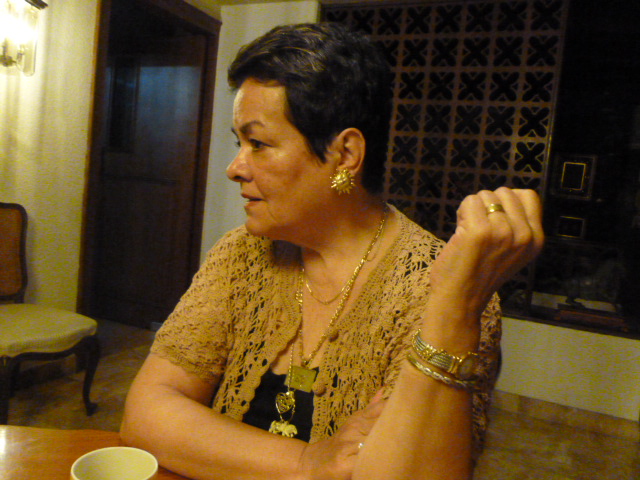
“Woman of the Year” Sra. Rosa Helia Villa de Mebius was also recently awarded the “Legion of Honor” by the President of France
INTRODUCTION
Recently named Woman of the Year in San Luis Potosi, our friend Rosa Helia Villa de Mebius was recognized for her many and varied contributions to civic life. A member of Central Christian Church in San Luis, Rosa thanked us for attending the event in the capital city’s Teatro de la Paz where the governor presented her the award. We’ve enjoyed the way the March 8 International Day of Women is celebrated in Mexico; this year’s commemoration of Rosa Villa will be hard to top.
Rosa’s leadership in conserving the 400 year old city’s architectural treasures led to its official status as a Zone of Monuments. Her advocacy for women’s rights resulted in her publishing the first book written on women in the State of San Luis Potosi. She has taught at the university level, worked as a journalist and public relations officer and as a grandchild of Pancho Villa has labored to present a more intimate, truthful portrait of the mythical figure of the Mexican Revolution.
Shortly after she received the award, Rosa welcomed us to an interview in her home to introduce her to you. She began the conversation by sharing news of progress in finding a distributor for the film based on her book, Villa: Itinerary of a Passion. After winning awards at film festivals in New York, Montreal, Honolulu and St. Tropez, she now looks forward to the film Amorous Pancho Villa ‘s premiere in the States.
Married to the San Luis architect Jorge Mebius Isbrandt, now deceased, for 39 years, Rosa is the mother of two sons. She concludes her 2009 book The Image and the Reality of Women in San Luis Potosi (Imagen y Presencia de la Mujer Potosina) with a vision of the expanded role of women in all areas of civic life in the future. Her imagining of women freed to fulfill their potential as human beings ends with this tribute to Mexican mothers: “We will continue to be moved by the heroic devotion, sacrifice and love of Mexican mothers who give of themselves for their families as they always have.”
THE INTERVIEW
In your life as a public figure, what among your many contributions to civic life would you like most like to be remembered for?
The books I’ve written about the Region of San Luis Potosi. There are fourteen books and several treat the history and culture of the State of San Luis Potosi. One of the most important of these is The Religious Art of San Luis Potosi .
You’ve told us that your family left the Catholic Church as a result of your grandmother’s relationship with Pancho Villa. What was that about?
When my great grandmother learned that her daughter was intent on marrying a man who was already married, it drove her crazy. “How in the world could she do this? A married man?” Those were the questions that she couldn’t stop asking herself. Villa, for his part, was determined to get along with his beloved Lupe’s parents and sent members of his “security

Pancho Villa with Rosa’s Grandmother Lupe on the Cover of “Itinerary of a Passion”
guard” to try to reason with them; the only thing they accomplished was to learn that the parents had sent Lupe to another village, Ranchos de Santiago, Chihuahua to be exact. So the response of Villa’s men was “Well, okay, we’ll go see Lupe there.” And Villa sent Lupe the message, “I’m coming for you soon.” He went to the village by train, picked up Lupe there and they had two days on the train together honeymooning.
After Lupe became pregnant, the Bishop of Chihuahua blessed the couple in a ceremony on board the same train. As a result, my great grandmother Toñia refused to recognize Lupe as her daughter any more and gathered up every prayer book, rosary, religious picture and icon in the house, put them all in a pile and set it all on fire.
Now due to all the mines in Chihuahua, there were more Protestant churches than Catholic in the State, and one day Toñia was strolling in the nearby town and heard a hymn coming from a Protestant Church. She listened and several members of the church invited her to come in off the sidewalk. Within a few months, all her remaining children had been baptized in the Methodist Church of Chihuahua.
I understand that you grew up in Durango. What brought you to San Luis Potosi? I lived in Durango as a child but was living in Mexico City when the national Health Service decided they would build a chain of new hospitals across the country. The architect Jorge Mebius worked for a company that won the contract to build the hospital in San Luis Potosi and on the weekends for two years he would come to visit me in Mexico City. After two years of visits, he asked me to marry him and I, well I was crazy in love with him, I of course accepted. I married him and came to live in this house. We were married and lived here together for 39 years.
In the early 80’s the President of Mexico gifted a statue of Pancho Villa to the City of Tucson and quite a brouhaha broke out over accepting the statue and
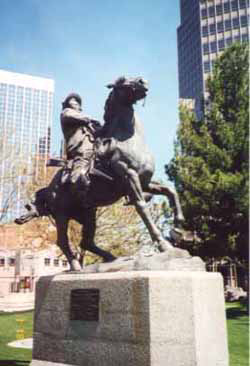
Pancho Villa Statue in downtown Tucson
then where to place it in the city. There was a lot of opposition to the City even accepting the gift. Why should the United States honor your grandfather Pancho Villa?
Well, I really don’t know, but a year after the burial of Pancho Villa 50 U.S. citizens who had joined Villa’s air force as pilots and mechanics honored him. On the anniversary of the burial, they went up in their planes and dropped on the cemetery 10,000 Hawaian orchids. 50 men were part of this tribute! In the town of Columbus, New Mexico, the only town in the U.S. that Villa attacked, there’s a Pancho Villa museum, the main street is named “Francisco Villa Avenue” and the most popular restaurant is called “Pancho Villa”. The museum invited me to participate in an event and I kept asking myself, “Why?” Considering that Villa had come and done some real damage to the town. And I had to be content with the thought that none of the townfolk of our day were around when it happened and those that were weren’t killed in the raid.
I had an interview on CNN in English and they asked the same thing. Why? And I just said I still don’t know. I don’t understand but those 50 men who knew Villa honoring him with 10,000 orchids. It’s fantastic!
We conclude this introduction to this remarkable woman with some words she wrote for her book The Image and the Reality of the Potosina Woman
“When sexism is ended, there will not be “liberated women” but free human beings. Free to choose this or that for themselves, free to be or not to be as Shakespeare put it – and that’s the question we all always face. Certainly there will be females who betray themselves and others but there will be more heroines. And there will still be those who have to pay for their freedom.”
********** *********************** *********
Agradecemos a nuestros amigos queridos Hemer Sierra Silva y Marisela Huelga Diaz de Leon por su ayuda con la entrevista y la traducción de esta Introducción
INTRODUCCIÓN
Recientemente nombrada como: “Mujer del Año” en San Luis Potosí, nuestra amiga Rosa Helia Villa de Mebius, ha sido reconocida por sus muchas y variadas contribuciones a la vida cívica. Miembro de la Iglesia Cristiana Central “Discípulos de Cristo” de San Luis Potosí, Rosa nos agradeció por haber asistido al evento celebrado en el Teatro de la Paz de la capital, en donde el Gobernador del Estado, le otorgó la Presea. Nos hemos gozado en la manera que se celebra en México el Día Mundial de la Mujer y la conmemoración a Rosa Villa en este año será algo difícil de igualar.
El liderazgo de Rosa en la conservación de los tesoros arquitectónicos de la antigua ciudad de San Luis Potosi ha logrado el reconocimiento oficial de: “Zona de Monumentos”. Su defensa de los Derechos de la Mujer y su Advocación por el avance de la mujer en el Estado de San Luis Potosí ha resultado en la publicación del primer libro escrito sobre la mujer en la historia del Estado. Ella ha enseñado a nivel universitario, trabajó como periodista y Directora de Relaciones Publicas en la Universidad Autonoma de San Luis Potosi; como nieta de Pancho Villa ha trabajado en presentar una más intimo y verdadera aspecto de la mítica imagen de la Revolución Mexicana.
Un poco después de haber recibido la Presea, Rosa nos permitió entrevistarla en su hogar, para poder presentarla ante Uds. Ella inició la conversación compartiendo la noticia del avance en encontrar una distribuidora para su película basada en uno de sus libros: Villa: Itinerario de una Pasión” . Después de ganar Premios en los Festivales Cinematograficos de Nueva York, Montreal, Honolulú y St Tropez, ella espera ahora la premier de la película “Pancho Villa Amoroso” en Estados Unidos.
Casada con el Arquitecto Potosino, Jorge Mebius Isbrandt , ya fallecido, Rosa es madre de dos hijos. Concluyó el libro escrito en el 2009, “La Imagen y Presencia de la Mujer Potosina” con una visión de la expansión en el futuro de ellas en su rol en todas las áreas de la vida cívica. Se imagina la liberación del potencial de la mujer como seres humanos y termina con un homenaje a las madres Mexicanas, “Y seguiremos viendo los sempiternos ejemplos de heroínas, entrega, devoción y amor de las madres mexicanas comprometidas con sus familias, como siempre”.
LA ENTREVISTA
¿En su vida como personaje público y entre sus múltiples contribuciones a la vida cultural por la cual prefiere ser reconocida?
“Los libros que escribi sobre la historia regional de San Luis Potosí. Hay como 14 libros y varios tratan de la historia de esta región, su cultura y arte. Uno mas importante trata sobre El Arte Religioso de San Luis Potosí.”
Nos dijo antes de que su familia había dejado la Iglesia Católica a causa de la relación de su abuela con Francisco Villa. ¿Qué pasó en la familia en esa época?
“Cuando mi bisabuela supo que su hija Lupe iba a casarse con un hombre casado se puso como loca. “¿Como de que con un hombre casado? ¿Cómo puede suceder esto?”, fueron las preguntas que se hacía de bisabuela. Villa, por su parte, quiso acercarse a la mamá y al papá de su querida Lupe y mandó su cuerpo de seguridad a hablar con ellos. Aquellos se enteraron de que los papás habían mandado a Lupe a otro rancho, Los Ranchos de Santiago, Chihuahua precisamente . Y la respuesta de los hombres de Villa fue nada más que, “Bueno, vamos por Lupe allá”. Y Villa mandó a Lupe el mensaje, “voy por ti”. Él se fue al rancho a bordo de su tren y luego subió a Lupe al mismo para pasarse dos días de “Luna de Miel” ahí. Cuando se embarazó Lupe el Obispo de Chihuahua bendijo el matrimonio en una ceremonia a bordo del tren.
Entonces mi bisabuela Toñia renunció a reconocer a Lupe como su hija y recogió todas las imágenes, cuadros, sus rosarios, los misarios y no se que mas. Se llevó todo a una pila y les prendió fuego.
Y como en Chihuahua había mas iglesias Evangélicas que Católicas, debido a las minas, un cierto día caminando Doña Toñia por un pueblo cercano oyó un himno y se detuvo. La gente de la iglesia la invitó a que pasara. En pocos meses se bautizaron todos sus hijos, en esa Iglesia Metodista de Chihuahua”.
¿Entonces por qué se desplazó usted de Durango a San Luis Potosí?
Vivi en Durango como niña pero vivía en Mexico Distrito Federal cuando el Seguro Social de México se comprometió a construir hospitales por todo el país. El Arq. Jorge Mebius trabajaba en una compañía que ganó el contrato para construir el hospital en San Luis Potosí y durante dos años los fines de semana iba hasta Mexico a visitarme. Después de dos años me pidió la mano y como no, acepté pues estaba yo loca de amor por él. Vine aquí para vivir en ésta casa. Estuve casada con él durante 39 años.
El Presidente de México en los años 80 le regaló a la ciudad de Tucson una estatua de Villa y esto desató mucha discusión en aquel entonces sobre aceptar y en donde colocar tal estatua. Muchos se opusieron a que la ciudad aceptara este donativo. ¿Por qué los de EE UU debían honrar a Pancho Villa?
Bueno, no sé, pero un año después del entierro de Pancho Villa lo honraron 50 ciudadanos norteamericanos que habían luchado por Villa como pilotos y mecánicos de su Fuerza Aérea. Estos hombres subieron a sus aviones ese día de aniversario del entierro de Villa y derramaron 10 mil orquídeas Hawaianas en el camposanto en donde él está enterrado. ¡50 hombres honrándolo!. En Columbus, Nueva México, es la única ciudad que invadió Villa y existe el “Museo Francisco Villa”, la calle principal se llama “Francisco Villa”, y el restaurante más importante del pueblo se llama “Pancho Villa”. El Museo me invitó para participar en un evento y yo me pregunté ¿por qué?. Tomando en cuenta de que Pancho Villa si vino y causó daños en Columbus. Y pensé que ellos de Columbus de hoy no experimentaron ellos mismos lo que pasó y no tuvieron muertos.
Tuve una entrevista en el CNN en inglés y me preguntaron lo mismo. ¿Por que? Y no lo sé hasta ahora. No entiendo pero los hombres, quienes lo conocieron en su tiempo, le regalaron 10 mil orquídeas. ¡Fantástico!
Concluyamos con estas palabras escritas por Rosa Villa de Mebius en su libro Imagen y Presencia de la Mujer Potosina:
“Al acabar con el sexismo habrá, no mujeres liberadas, sino seres humanos libres. Libres para optar por esto o aquello, libres para ser o no ser, lo que como bien apunto Shakespeare, es el eterno dilema. Sin duda habrá más villanas, pero veremos más heroínas. Es el costo de la libertad.”
“La Joya Divina” Transforming a Community
La Joya women on front row with Pastor Francisco at left met the U.S. Women to Women delegation last year
More than a six hour drive from San Luis Potosi through mountains and hills, the town of Xilitla is nestled at the bottom of a mountain in the Sierra Huasteca Region. Throughout this Region live some of the indigenous peoples of Mexico who have held on to forms of the original Aztec (Nahuatl) and Mayan languages and whose lifestyle bears many signs and characteristics of how people in Mexico lived before the Spanish conquest. Flight to these mountain retreats promised an escape from other Indian cultural groups as well as from the Spanish. Today, the cool mountain breezes and
A statue of the Huastec culture carved from stone around 1400 AD
natural beauty of the area have made the Huasteca a favored destination for summer vacationers from all over Mexico and elsewhere.
For several decades, two churches in the Region have maintained contact with Disciples of Christ churches in cities and towns of the State of San Luis Potosi and surrounding States. Last year, the national Disciples Women organization began a coffee project to enable purchase of the high quality Huasteca-grown coffee from women of the Church in “La Joya” (the jewel in English). Although less than a year in operation, the “La Joya Divina” project has benefited women and families in the Huasteca in some significant ways. For an update on the project, funded initially by a grant from the UCC/Disciples of Christ Global Ministries, we interviewed a month ago the Coordinator of “La Joya Divina” Sra. Nohemi Nidia Bravo Pardo.
************* **************
Se maneja por mas de seis horas desde San Luis Potosí, atreves de montañas y colinas, hasta el pueblo de Xilitla, que está arropado en el fondo de una montaña en la Sierra en la Región de la Huasteca Potosina. En esta Región viven indígenas, quienes han mantenido las lenguas Huasteca y Azteca y cuyo estilo y costumbres de vida guardan mucha similitud con los habitantes del México de antes de la Conquista Española. Un vuelo a estos retiros promete un escape de otras culturas, así como de la Española. Actualmente, la brisa fresca de la montaña y la belleza natural de esta área ha hecho de la Huasteca Potosina un destino favorito de los vacacionistas de México y de otras partes.

Waterfalls with pools abound in the Huasteca
Durante varias décadas, dos Iglesias de la Región han mantenido contacto con las Iglesias Discípulos de Cristo del Estado de San Luis Potosí y Estados circunvecinos. El año pasado, la organización de la Sociedad Feminil de los Discípulos de Cristo en Mexico, iniciaron un Proyecto para poder comprar el café Huasteco de alta calidad vendido por las mujeres de la Iglesia de “La Joya”. Aun con un Proyecto de escaso un año de iniciado el projecto “La Joya Divina” ha beneficiado a mujeres y familias de la Huasteca de una manera significativa. Nos llena de satisfacción el avance del Proyecto y el aporte económico de los Ministerios Globales de la UCC/Discípulos de Cristo que proveyeron la semilla de los fondos. Aqui abajo es una entrevista con la Sra. Nohemí Nidia Bravo Pardo, Coordinadora de “La Joya Divina”.
**************** ****************
We thank Sr. Hemer Sierra Silva for his Spanish translation of the introduction. Below is the interview translated from the original Spanish transcript. Several photos follow the Spanish text.
What is the “La Joya Divina” (The Divine Jewel) project of the Disciples
A platform next to the La Joya Church for drying coffee
Women in Mexico?
In the Huasteca area of the State of San Luis Potosi, indigenous men and women are taken advantage of in their sale of the coffee they have grown. They sell their picked, unprocessed coffee at two and a half pesos the kilo. Those who buy it, grind it and sell it at 30 pesos the kilo. The Board of the Disciples Women agreed in our 2012-13 program year to buy their processed coffee ready for consumption at a just price and sell it on our own. That is to say, we committed to help them with the marketing and sale of their coffee. To carry the project out, they named me as Coordinator, responsible for organizing the sale of the coffee.
So I, as the Coordinator, am accountable to the Executive Committee of the Disciples Church and to the Board of the Disciples Women. They supervise the project.
Describe for us the conditions in the Huasteca area
I became President of the Disciples Women for the 2012-13 program year and in 2012 made a visit to our churches in the Huasteca noting that their needs had increased since the last time I visited. Instead of the deep poverty there diminishing, it had actually increased. Our sisters and brothers there were not eating well; they ate twice a day and were usually restricted to a diet of tortillas, beans and coffee. That was it. But the feeling among them was this is what we have and we are going to be content with what we have. All those who went on that trip picked up on that feeling and were moved by it – that is, my sister in law, my husband and children and Jemimah Duran, the current President of Disciples Women. When we got there, the women came out of the forest and always offered us something to eat. It was a package containing what they ate – folded over tortillas with chiles inside – and a lot of it. We were really touched.
We had thought about a coffee project before but without the resources we had gotten nowhere. But the same year as this Huasteca visit the possibility of some startup funds presented itself. We became aware that year that Global Ministries in the U.S. was going to provide Disciples Women in Mexico with around $7000 for micro enterprise development. So we were ready to consider helping the women in the Xilitla area of the Huasteca with this project. Other Board members of the Disciples Women were quite aware of the situation in the Huasteca (the annual DW retreat had been held there a few years ago, ed.) and we agreed this was the best use of the funds. So what was our plan at the time? Well, we saw it as “commercializing the coffee production” of women in the area.
So how did you go about the start up of the “La Joya Divina” project?
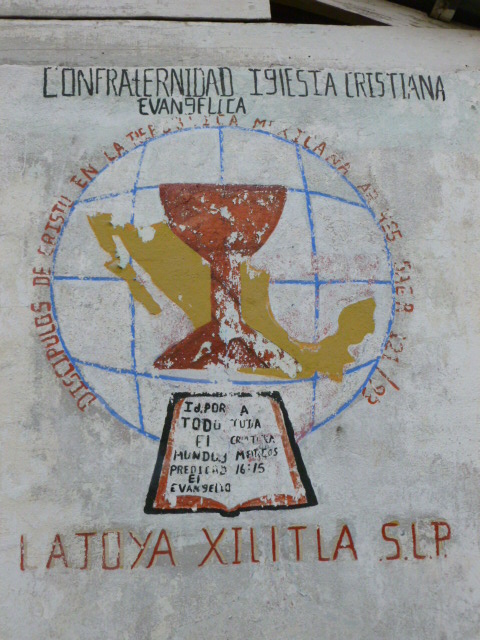
La Joya Church sign
We organize trips we call Volunteer Mission Trips to the Huasteca’s La Joya Disciples of Christ Church with the intention of buying coffee from the women there and returning with it to the cities and towns of other Disciples women to sell the coffee. This year we plan to make at least 4 trips to buy and bring back more coffee. This coming Monday Mary Helen from the Los Retes Church on the edge of San Luis Potosi (who has visited regularly the La Joya Church since 2010) will be taking a group from the Guadalupe, Zacatecas Church to the Huasteca. These Mission Trip participants are responsible for covering their expenses and another group has already volunteered to go in March.
In the La Joya Church there are 15 women actively participating in the project processing and selling the coffee to us. AmoTng them is a Project Coordinator Dolores Anaya. Her role is to gather up and buy the coffee from the women, package it up and keep the accounts and deposit in the bank the payments I send when she mails us coffee between the trips we are making.
So what are the benefits for the participants you’ve seen so far?
The first time we bought coffee from the women one of them told us how her son had been admitted to “Prepa” (three year preparation for university equivalent to last years of high school in U.S., ed.) but had been told that without purchasing a uniform and the required books he wouldn’t be able to attend. She of course had been saddened by the fact there was no way they could buy these for him. When we paid her for the coffee she began to cry and asked if she could bring another gunny sack full of coffee to sell. On her return she told us she had never before earned cash for herself and her family. She then went to buy the uniform for the boy. It was very satisfying for us to see how the project had helped this woman in a practical, concrete way.
There is also a financial benefit for the women in the cities and towns who are selling the coffee. We take them the coffee and let them have it on consignment; when they sell it they send us the money for however many kilos they have received. Whatever profit they have in the sale they get to keep. So this is another group benefiting from the project.
How did the Disciples begin this relationship with the Huasteca Region?
Around 35 years ago Pastor Bernabe Lara of the Disciples Julien Carillo Church in San Luis Potosi got to know and work with Pastor Francisco Hernandez who was serving three churches in the Huasteca including the La Joya Church. A little while later, Pastor Francisco decided to bring his churches into the Disciples with the support of the Julien Carillo Church. So members of Julien Carillo began to visit the Huasteca at least once a year. I grew up in that Church so I too had the opportunity to go but then around the year 2000 we sort of lost contact with the churches there. Aside from the difficulty of getting to the Huasteca there is the poverty one has to deal with. Around 2008 we began thinking about how we could really help the people there. We were sending some offerings to the churches but we wanted to find another way to help. At that time we didn’t consider how the people there grow coffee and process it, and although it was all done by hand it was good quality coffee.
How has the project affected the traditional gender roles of the culture? How do the men see the women now that they are earning some money from the coffee sales?
Well the man has been the one to provide and care for the physical needs of the family. And the women is to look after the family and stay in the house, toasting the
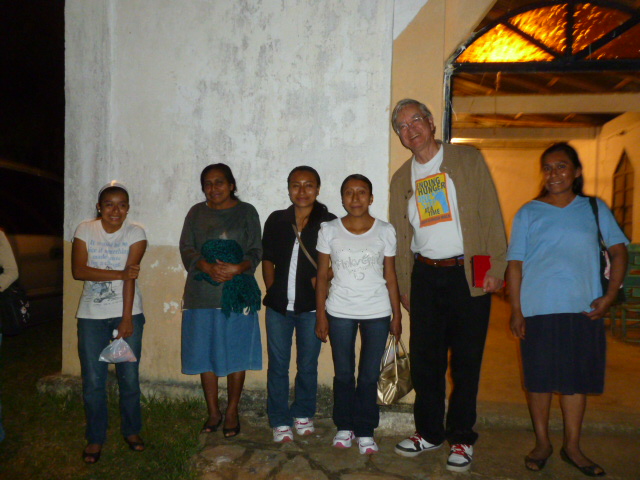
Some of the coffee project participants with Doug outside the Church
coffee on a comal and grinding it, all domestic labor. Now although normally it is the men who cultivate the coffee plants and harvest the coffee and the women who process it, there are now men who want to be involved in all of it.
In the Sierra Huasteca women normally do not speak up. Even now when we visit the women will sit quietly some with their heads bowed. This complicated the beginning of the project as we would present the plan and the women would say nothing.
So we would ask who wants to participate in the project, who wants to process and sell coffee to us and we would not get a response. Then one day Dolores raised her hand and asked if I could explain what we proposed in the Nahuatl language. They normally only talk Nahuatl among themselves. When I described the project in their language, there was more of a response. We learned from what they said that the women do not bring in money for the household. They look after the family. There are women who do earn something but they are the housekeepers who leave the Huasteca and go work for a family in the cities.
Although it brings changes, the project since it comes from the Church has not faced any opposition. In fact, there are now men who want to help out the project. There’s a man who has volunteered to take Dolores to Xilitla any time she needs to mail us a coffee order with the help of the overnight delivery service. There’s also a local council made up of respected men in the community. Normally it is these men who guide the community through moral and political issues. For example, if someone wants to marry a person who is not from the community, it is the local council who must give their approval. So we asked ourselves if we would need to present the project to them for their approval. Without our making a formal presentation they let it be known that since we were from the Church and were clearly honorable, honest people there would be no problem. That was really good news for us as it showed us that the Church in La Joya really carried some weight among the people. It was also good to know that although the gender roles are so very rigid in their culture they saw us women of the city as not representing any threat to them.
What are the future plans for the project?
We plan to be able to recoup the original investment of 85,000 pesos (the help from Global Ministries) within three years. We’ve been at it only a little over six months and have already brought in 12,000 pesos which encourages us to think that we are on track to begin the second stage in three years. The project has three stages. The first consisted of the investment in a scale, packages, sacks and the coffee and we still need to buy a packages’ sealer. In the second stage we want to “semi industrialize” the processing of the coffee for sale. “Semi industrialize” would include building a site to prepare the coffee for export. That means having a toaster machine and packaging equipment at the site. We could build a plant next to the church in La Joya but lack of power would be the challenge right now. So we’ve projected a 2020 date for the building and having everything ready for exporting the coffee. And the third stage of the project is to begin another project elsewhere to develop the local economy and opportunities for women.
Are there benefits other than the financial and economic for the participants in this project?
Yes, there is more openness now among those who participate. The way they relate to us women of the city is different. Before the lines were clearly drawn: we are from the Sierra and you all are from the cities. Before they emphasized the difficulties they had in taking part in events organized by Disciples Women. Now one of the woman has told us there is no excuse for them not to participate in such events even when they take place several hours away. Evidence of their commitment in that area is how they now have set aside funds for some of their women to go to these events. It has also really impressed me how they are talking about now being able to help the Church and the pastor with their needs.
What about benefits for women of the city?
We’ve talked about the fact that some of the women earn from their sale of the coffee which they buy at a wholesale price. Even at wholesale prices, what they pay promises to be enough to pay something to those who are now coordinating the project, Mary Helen and I in the cities of San Luis Potosi and Guadalajara and Dolores in La Joya. This project comes from God (“divina”, ed.) and as such it promises to benefit us in economic terms as well as the women in the Huasteca. We hope to learn and experience that a business such as this can bless us and others in many ways.
**************** *****************
Gracias al hermano Hemer Sierra Silva por la traduccion en Espanol de la introduccion que se halla arriba. Unas photos se muestran despues de la entrevista.
Entrevista con Nohemí Nidia Bravo Pardo
¿Que es el proyecto Mujer a Mujer “La Joya Divina” de las Sociedades Femeniles de los Discípulos?
En la Huasteca Potosina, en la parte de la Sierra de Xilitla, los hermanos y hermanas estaban explotados en su venta de su café. Vendían su café a dos pesos con cincuenta centavos el kilo de café seco. Los que compraban su café lo vendían a 30 pesos o más. La Directiva de la Unión de Sociedades Femeniles en el año 2012-2013 acordamos comprar el café listo para consumir de ellos y pagar un precio justo. Es decir nos comprometimos a “comercializar el café”. Al cambio de la directiva me nombraron como encargada del Proyecto, con la responsabilidad de venderlo.
Yo, como Coordinadora del proyecto Mujer a Mujer “La Joya Divina” doy cuentas al Comité Ejecutivo de la Confraternidad y a la Unión de Sociedades Femeniles. Ellos son los que supervisan este proyecto.
Describe las condiciones actuales en la Sierra.
Yo llegue a ser Presidente de la Unión nacional de las mujeres en 2012-13 y visite la Huasteca en 2012 viendo que la carestía era mayor a diferencia a lo que había visto en años anteriores que había ido. En lugar de disminuir la pobreza aumentaba. Los hermanos no comen bien, lo máximo que comen es dos veces al día y su comida regularmente es tortilla, frijol y café. No hay más. Pero el sentido fue siempre este es lo que tenemos y este es lo que vamos a disfrutar. Este satisfacción lo proyectaron a los que fuimos, mi cuñada, mi esposo, mi hijo y mi hija y Jemimah (actual Presidente de la Sociedad Fem). Cuando llegamos las hermanas salieron de entre los arboles con un bulto a ofrecernos algo de comer, la comida de ellos y era tortillas dobladas con chile y las ofrecieron con liberalidad. Fue un momento emotivo.
Y fue entonces en 2012 que nos informaron que había posibilidad de recibir ayuda para este proyecto que ya estaba pensado desde antes, pero no teníamos los recursos para llevarlo a cabo. A través de la programa de la Mesa Conjunta (hubo un donativo de alrededor de $7000 US de la parte de Ministerios Globales), con lo que se inició la ayuda a La Joya, Xilitla en S.L.P. La Directiva de la Sociedad Femenil como conocemos la situación de la Sierra Huasteca votamos para destinar los recursos y ayudar con estos fondos. ¿Que vamos a hacer? Bueno, “comercializar café”. El objetivo en aquel entonces fue “la comercialización del café”.
Y que hicieron ustedes para que “La Joya Divina” con la ayuda de Ministerios Globales arrancará?
Organizamos lo que llamamos Viajes Misiones Fraternales a la iglesia de La Joya en la Sierra Huasteca, pagamos al contado el café y lo llevamos a los de la ciudad que están vendiendo. A partir de este año 2014 realizaremos 4 viajes al año. Este lunes que viene por ejemplo Elena de la Iglesia de Los Retes en San Luis Potosí (que empezó a visitar constantemente a partir del ano 2010, ed.) con un grupo de la Iglesia Discípulos de Guadalupe en Zacatecas salen para la Sierra. Y ellos asumen sus propios gastos. Otro grupo sale en marzo para visitar, comprar y llevar café. Al menos cuatro visitas al año.
Aha en la Iglesia Discípulos de La Joya participan activamente 15 hermanas en el proyecto haciendo el procesamiento y vendiendo el café. Tenemos una coordinadora entre las 15 participantes que es la hermana Dolores Anaya. Su función es recolectar el café, comprarlo, ponerlo en paquete y manejar la cuenta bancaria en la cual hago depósitos ella lo envía por paquetería o si alguien viaje nos lo manda.
Ya han visto ustedes unos beneficios para las participantes?
Un testimonio que me impacto mucho fue de una hermana que después de la primera compra que hicimos nos dijo que su hijo había estado aceptado por entrar en la Preparatoria pero la habían dicho que sin uniforme y sin la compra de los libros el no podía entrar a la Prepa. Y ella estaba muy triste por que no tenia dinero para comprárselo nada. Cuando la pagamos por su café empezó a llorar y nos pregunto si podía traer más café hasta un costal más. Cuando vino con más café nos dijo ella que fue la primera vez que vio un fruto de su trabajo. Fue para comprar el uniforme y se lo llevo al muchacho. Fue algo muy grato, muy satisfactorio sentir como esa compra la ayudo.
Ahora hay tambien beneficio financiero para unas mujeres Discípulos de las ciudades en donde venden el café en sus lugares. Se lo entregamos el café a ellas a consignación y nos pagan con el pago que reciben para el café.
Cuando ellas lo venden van a pagar el costo por el kilo y su ganancia es de ellos. Este es el segundo grupo que se ha beneficiado de este proyecto.
Como empezó la obra de los Discípulos en la Sierra Huasteca?
Hace unos anos (alrededor de 35 anos, ed.) el pastor de la Iglesia Discípulos Julián Carillo, Pastor Bernabé Lara, (originario de la iglesia de Los Peregrinos) conocía al Pastor Francisco Hernandez que servia en dos iglesias en la Huasteca incluyendo la Iglesia de La Joya. Y un tiempo después Pastor Francisco se decidió afiliarse con los Discípulos con el apoyo de los de la Iglesia Julián Carillo. Entonces los de Julián Carillo visitaba la Huasteca mínimo una vez al ano. Yo crecí en esa iglesia y tuve la oportunidad de visitar pero desde el ano alrededor de 2000 hubo un tiempo de poco contacto. Además de lo difícil el acceso a esa zona para nosotros en SLP hay también la pobreza. Y alrededor de 2008 empezamos a pensar como podemos ayudar. Buscamos otra forma a parte de llevar ofrendas otra forma de ayudar. Habia perdido de vista que en esa zona hay café y que los hermanos saben procesar el café, en manera rustica pero saben hacerlo bien y es un café de muy buena calidad.
¿Como ha afectado el desarrollo del proyecto los roles tradicional del genero? ¿Como vieron los hombres de la comunidad a las participantes cuando empezaron a ganar mas con su venta del café?
Como el hombre esta para proveer y para cuidar. Y la mujer para estar en casa, para la crianza de los hijos, para tostar el café, para labores domesticas totalmente. Ahora aunque normalemente los hombres cultivan y recogen el café y se lo entregan a las mujeres para procesar ya hay unos hombres que están involucrados en el todo.
Para las mujeres en la Sierra normalmente las mujeres no hablan. Cuando vamos a visitar no hablan, a veces se asientan con cabeza agachada. Fue un poco complicada cuando empezamos el proyecto por que nosotros explicamos los beneficios y no decían nada.
Entonces preguntábamos quienes quieren participar, quienes podrían hacer la producción y no recibimos respuesta. Pero una vez la hermana Dolores levanto la mano y nos pregunto “¿Se los puedo explicar en Nahuatl?” Por que en la Sierra entre ellos hablan en Nahuatl. Y cuando los explico en Nahuatl tuvimos un poco mas de respuesta. Nos dimos cuenta que la mujer no gana activamente en la comunidad. Ellas tienen la familia. Hay muchachas que salen a trabajar como trabajadora en casas pero tienen que irse a otro estado a hacerlo.
Hasta ahorita como el proyecto es de la iglesia no hemos tenido reacciones desfavorables. De hecho hay hermanos que respaldan a las hermanas en el proyecto. Hay un hermano que la lleva a la hermana Dolores cada vez que quiere llevar café hasta Xilitla para mandarlo hacia nosotros. También hay un consejo local conformado por miembros respectados en la comunidad. Normalmente son ellos que moralmente administran la comunidad. Por ejemplo si alguien de La Joya quiere casarse con una persona afuera de la comunidad hay que pedir permiso a esas personas. Entonces lo que nos preguntábamos era si seria necesario tener aprobación del proyecto por estas personas. Y nos dijeron que como era de la iglesia y como eramos gente honorable no es un problema. Fue muy buena noticia para nosotros. Y que la iglesia La Joya tiene reconocimiento por la comunidad. Aunque es muy marcado los roles de genero no hemos (las mujeres de la ciudad ed.) experimentado ningún rechazo de la parte de los hermanos.
¿Cuales son los planes para el desarrollo de “La Joya Divina” en el futuro?
Nosotros pensamos que vamos a recuperar la primera inversión de 85 mil pesos (la ayuda de Ministerios Globales) dentro de 3 anos. Ya llevamos medio ano y hemos recibido hasta ahora 12 mil pesos lo cual nos alienta planear que en tres anos vamos a recuperar la inversión y empezar la segunda etapa del proyecto. Nuestro proyecto tiene tres etapas. La primera inversión fue para comprar basculas, paquetes, bolsas y tenemos aun que comprar una selladora y la compra del café. En la segunda etapa queremos semi-industrializar el proceso de preparar el café para la venta. Semi industrializar la producción y preparar lo necesario incluso un sitio para exportar el café. Entonces construir un local para preparar el café con tostadora, paquetería y todo. Podríamos erigirlo allá cerca del templo de La Joya pero la cuestión de la energía ahora nos impediría. De todos modos pusimos la fecha del año 2020 para lograr con este plan. Y la tercera etapa que proyectamos para 2021 seria patrocinar otro proyecto de ayuda en otro lugar.
Hay unos beneficios a parte de lo financiero para las mujeres que participan en el proyecto?
Si, entre las que participan hay mas apertura. La forma de relacionarse es diferente a como la que veía antes. Si antes fue muy marcada nosotros somos de la Sierra y ustedes son de la ciudad. Antes las hermanas veían que era muy difícil que ellas participen en los eventos de la Sociedad Feminil como Confraternidad que tenemos. Ahora no, una hermana nos dijo que ya no hay pretexto para decir que nosotros no tenemos. Ahora pueden convivir con nosotros. Yo creo que lograron avances en todas las áreas, hasta armaron un plan que van a apartar una porción de lo que ganan del proyecto para participar en los eventos de la Sociedad Femenil de la Confraternidad. Y también me llamo mucho la atención que han hablado que de sus ingresos van a apoyar a la iglesia en caso de necesidad del pastor o otra necesidad.
Y beneficios para las de la ciudad? –
Las hermanas de la ciudad, tiene también un beneficio económico se les da un precio de mayoreo y la ganancia de la venta es para ellas, y lo que pagan va directo al proyecto. Elena y yo, no recibimos algún salario por lo que hacemos en cuestión de coordinación y viajes, pero esperamos ya que este consolidado el proyecto también poder recibir ayuda. La “Joya Divina” proviene de Dios y creemos que Dios nos bendecirá también en la área económica. Como a través de un negocio se puede bendecir a nosotros y a los demás.
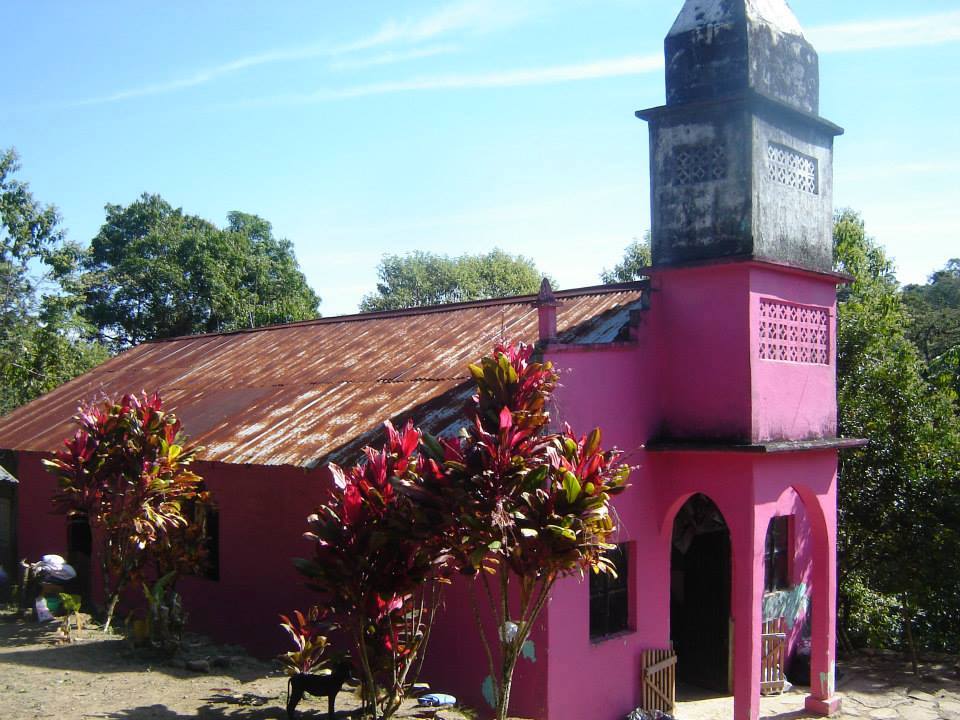
The freshly painted Cuilinilco Disciples Church an hour hike from La Joya Church
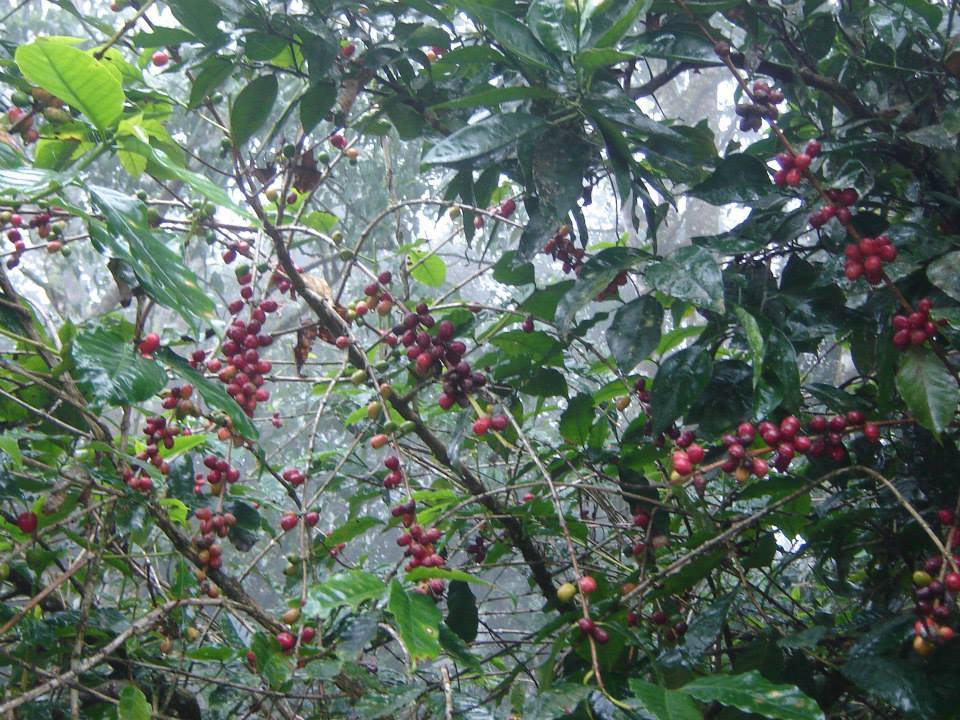
Coffee and oranges are the “cash crops” in the La Joya area

Coffee Project Coordinator Dolores Anaya in her kitchen. Grinder for coffee is seen in background with a bowl cover.
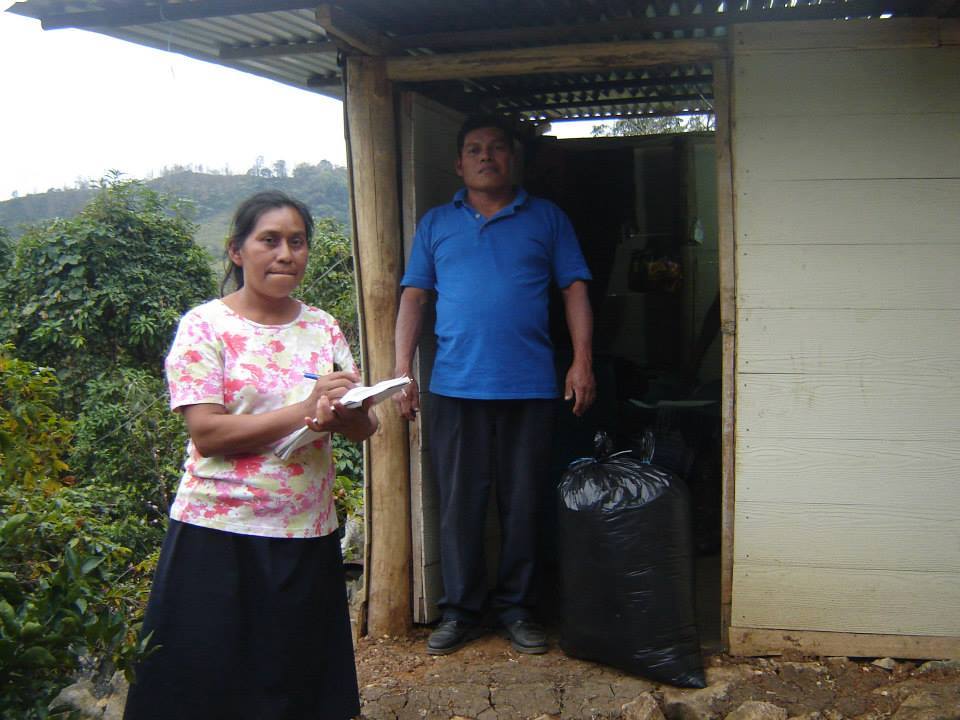
Dolores purchasing coffee from a La Joya household
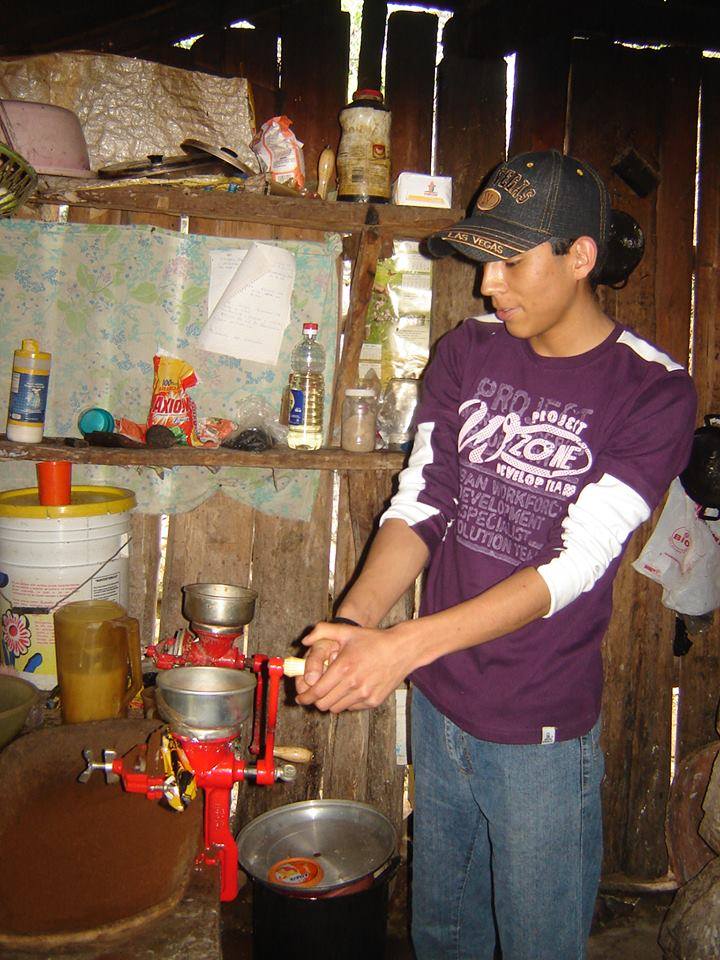
A Mission Volunteer tries out the coffee grinder
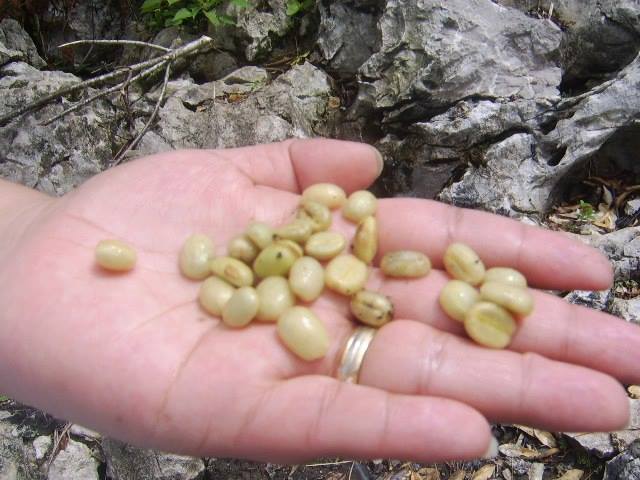
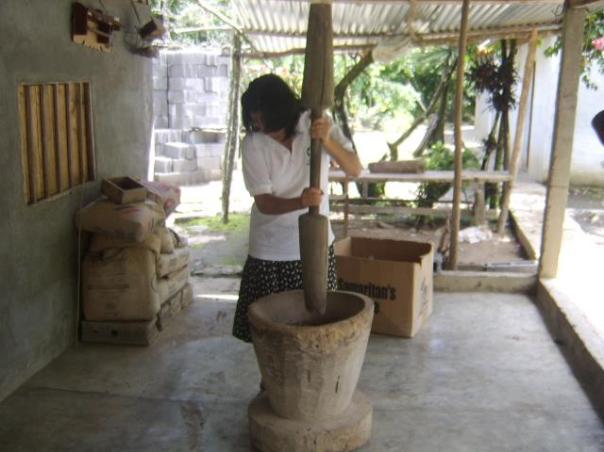 The first step in grinding the coffee beans. The wooden mortar and pestle resembles the essential tool used in Africa and worldwide.
 Toasting the coffee beans on a hot comal
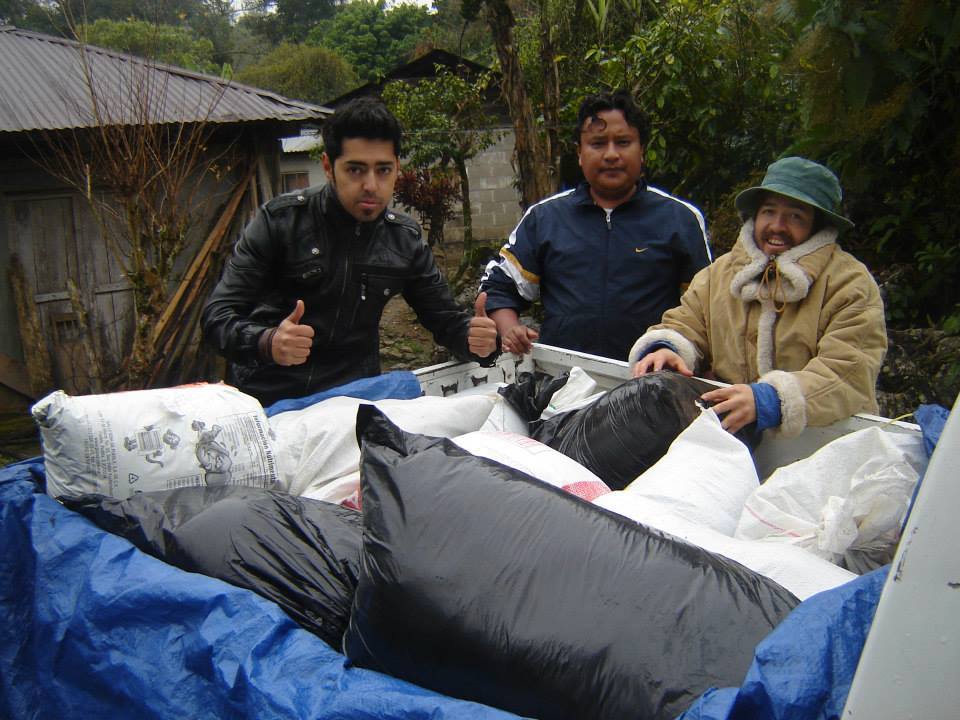 Mission Volunteers preparing the coffee purchased for the trip to the city

Nohemi Bravo is selling coffee after presenting the project at a church in San Luis Potosi
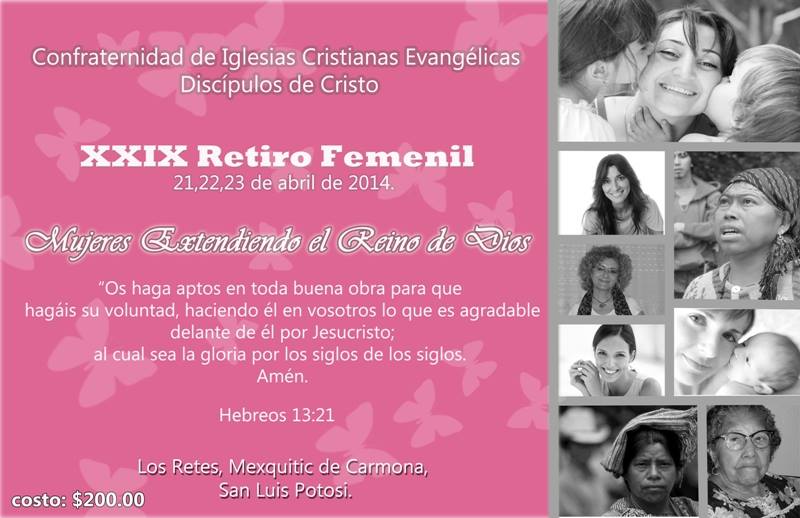
The coffee project will be a major theme at the Disciples Women’s Retreat this year
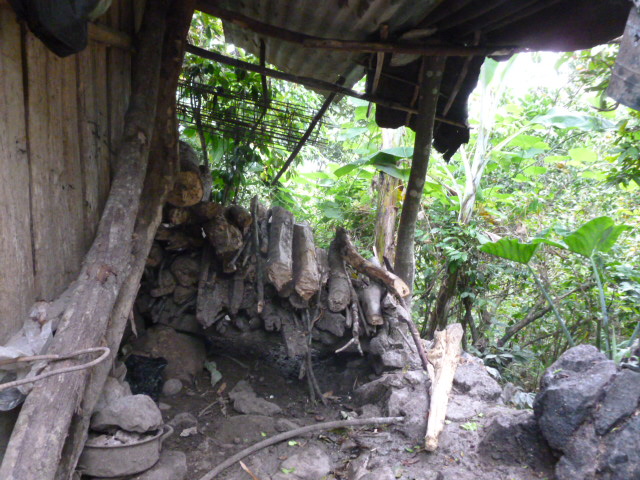
Will the coffee project help enable families on the mountain to begin cooking with gas or electricity?

A new strain of disease resistant coffee plants supplied by the State line the front of this house

A poster on the wall of Dolores’ home warns coffee growers of a new pest to guard against
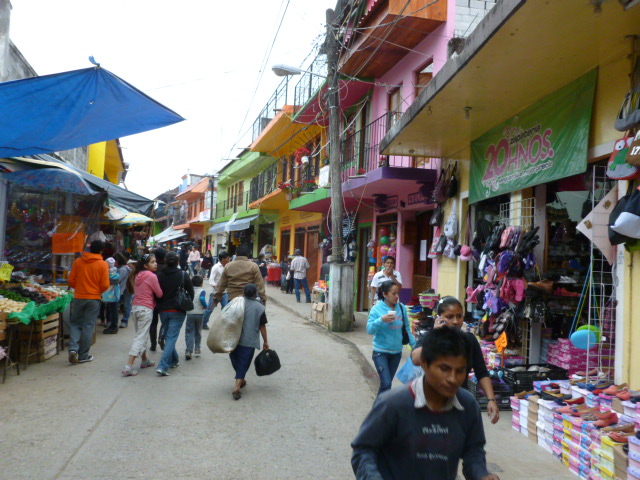
Xilitla is a bustling town, and a tourist attraction, 20 minutes down the mountain by truck
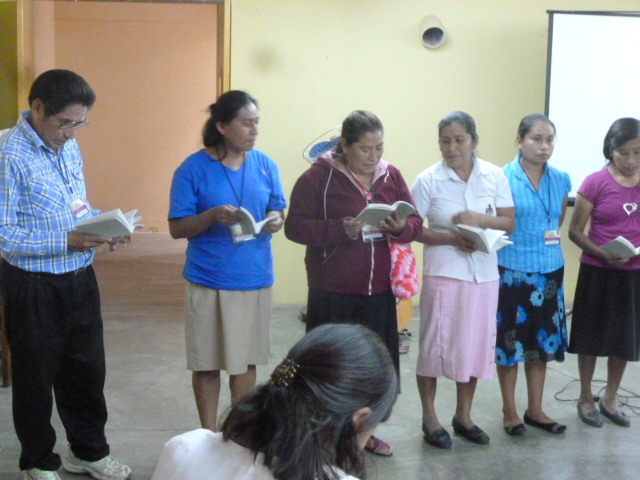
The La Joya delegation at the Mujer a Mujer event prepare to sing in
Spanish although they mostly use Nahuatl in their worship


 Erasing Borders