Category Archives: Mexican Directors’ Impact on Hollywood
The Fossil Fuel Era is Over

In the year the U.S. elected a President well known to be a denier of the global climate crisis, the world had an important milestone to celebrate. Shortly before the gloom and doom brought on by the policies and pronouncements of the new administration, the cost of producing energy from capturing sunlight dropped below the cost of fossil fuel generated energy. This development surprised even the best informed energy experts. The Bloomberg journalist assigned to tracking solar power progress, Jenny Chase, told the New York Times in 2024, “I simply can’t believe where we are with solar.” She concluded, “There is genuinely a revolution happening.”
The revolution was happening worldwide. Apartment residents in Italy were hanging solar panels from their balconies The Times reported. In Pakistan people were laying panels on the ground to provide electricity. As the cost of solar generated power had dropped significantly below that of fossil fuels, Pakistani farmers were purchasing solar panels with no government subsidies. It was estimated that use of solar power in the Middle East would grow from 2% in 2023 to providing half of the oil-rich region’s energy needs by 2050. In the month before the U.S. election the International Renewable Energy Association declared the costs of solar power had dropped below half the cost of the cheapest fossil fuel alternative. Even the Kentucky Coal Mining Museum had installed solor panels with the expectation of cutting its costs by 10% a year.
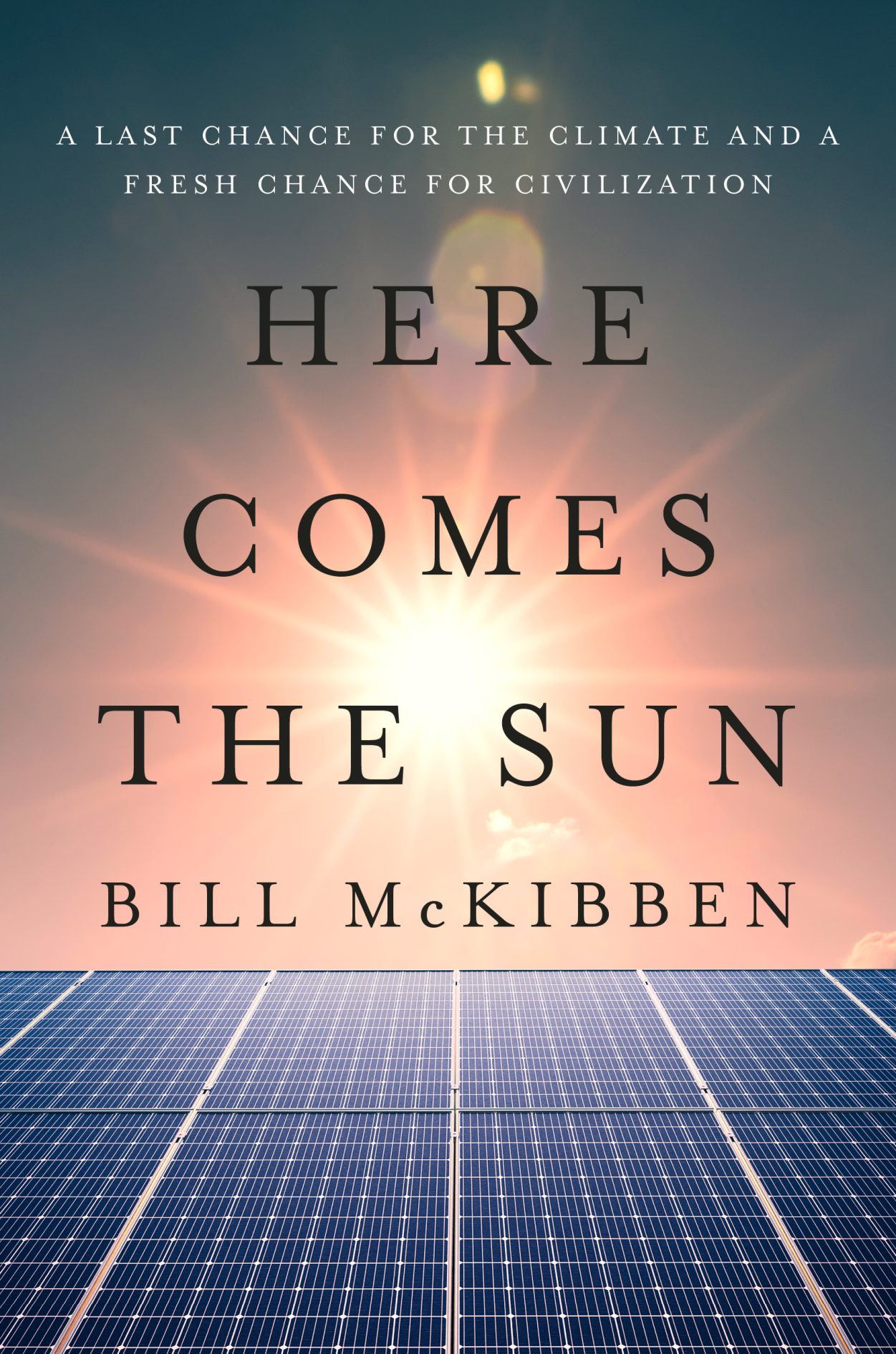
The “revolution” Jenny Chase reports on has been celebrated by the leading U.S. anti-fossil fuel activist Bill McKibben in his book published last year Here Comes the Sun. A comprehensive survey of the worldwide growth of renewable energy use, McKibben revels in the progress of renewables in the U.S. “On election day 2024, California produced 100% of its energy from solar, wind and hydropower. By the end of ’24 the State had cut natural gas consumption 25% from the year before and by the spring of 2025 its use had dropped another 43%. “That’s the most hopeful statistic I’ve seen in 40 years of writing (around 20 books, ed.) about our predicament” he declares in his latest book.
More surprising than the CA progress is the fact that Texas now leads the U.S. in implementing renewables. In 2024 the State installed more solar panels than 39 states have ever installed. Last year TX expected to install more clean energy sources than CA and AZ combined. After TX survived a late spring heat wave with no blackouts of its power grid, The Houston Chronicle urged the State legislature to stop “strangling the wind and solar projects in the hope of reviving the natural gas market”. Equally shocking to observers of U.S. politics was the resignation prior to the ’24 election of ultra conservative Rep. Marjorie Taylor Greene from Congress. Would building in her District of the largest solar panel factory in the Western Hemisphere have had anything to with her stepping down?
Current wars in the Middle East and rising costs of fossil fuels propel the drive to make the transition to renewable energy sources of power. Eighty per cent of the world’s countries in the early 2020’s were net importers of fossil fuels. Their trade deficits and debt burdens largely resulted from dependence on fossil fuel imports. Non-profits, private enterprise and international agencies are now financing renewable projects on every continent. Cutting the costs of energy even in the poorest nations means everyone can benefit with installing renewables. Experts and officials with renewable experience emphasize the falling cost since the first solar cell was invented in 1954 in New Jersey and the first wind farm put up in the late 40’s. Ten years after The Economist British journal declared solar and wind to be by far the most expensive energy sources available the magazine published in 2024 a special issue “The Dawn of the Solar Age”. In a summary of the issue they stated, “An energy source that gets cheaper the more you use it markes a turning poin in industrial history.” Read the next Erasing-Borders blog post for examples of how poor nations are making the transition from fossil fuel and quickly benefiting.
Mexico’s Roma Helps Globalize U.S. Film Industry

At the Oscars this year Alfonso Cuaron’s almost became the first “foreign film” to win the Best Picture award. Photo by West of the NY Times
Zorba in Zorba the Greek , Auda abu Tayi in Lawrence of Arabia, Paul Gauguin in Lust for Life, Zampano in Fellini’s La Strada – Anthony Quinn was Mexican-American. He was born to a Mexican mother and an Irish father in the Mexican State of Chihuahua during the Mexican Revolution.
Working in East Los Angeles, I was surprised to learn Quinn grew up as a Mexican immigrant in the Eastmont Community Center neighborhood. The Anthony Quinn Public Library on East Third Street is located on the corner where Quinn’s childhood home stood. But Quinn paid little attention to his Mexican heritage in his life or his acting career. His 1952 Oscar-winning role as Emiliano Zapata’s brother in Viva Zapata was one of the very few he took playing a Mexican.
I also learned that children in the schools Quinn attended had been punished for speaking Spanish in the classroom. Anthony Rodolfo Quinn (paternal surname) Oaxaca (maternal surname) was taught that to get ahead in the U.S. you had to assimilate, leave behind your culture of origin and become “American”.
Having financed Roma with his own production company, Alfonso Cuaron left no doubt it was a Mexican film. “It doesn’t exist without Mexico” Cuaron emphasized on Oscar night. The same could be said of other enduring films like The Treasure of the Sierra Madre, Night of the Iguana , and The Wild Bunch. But Roma uniquely was made in Mexico with a Mexican cast and crew speaking Spanish and Mixtec.
The film also was made first and foremost for Mexican audiences. Alfonso Cuaron implied as much when in the post-awards press conference, he stated that he was most gratified by how the film had generated a national conversation about the rights of domestic workers and racism in his Mexican homeland. He also mentioned that he was proud to have strengthened the organizing and outreach of two groups, one in the U.S. and the other in Mexico, who are working on behalf of domestic workers like the protagonist of his film.
All the heralded immigrant Hollywood filmmakers – Fritz Lang, Billy Wilder, Ernst Lubitsch, Alfred Hitchcock – helped U.S. audiences understand the U.S. better and, in some cases, revealed for us what others don’t want us to see, as Cuaron put it on Oscar night. But the director of Roma is the first immigrant filmmaker to focus on his childhood homeland for his setting, his themes and inspiration and for the audience he wanted to reach above all. There is no doubt that Roma belonged in the Oscars’ Foreign Film category.
Roma has now raised the question of when the top award at the Oscars will go to a foreign film. Hollywood insiders have said Cuaron’s film came very close this year. With movies making more money overseas and some even premiering outside the U.S., this Mexican film signals an important, new advance in the globalization of the U.S. film and television industry. When a foreign film finally wins the Best Picture award, Oscar voters will be highlighting and celebrating movies’ potential to communicate with audiences all over the world as well as the domestic U.S. audience.
For those of us who have experienced a film’s potential to deepen our understanding and appreciation of other cultures, Roma’s success is

Mexican star Cantinflas was inspired by Chaplin’s “The Tramp” in creating his film persona.
During the era of silent movies, Chaplin’s Tramp succeeded in communicating powerfully with audiences around the world. It is worth mentioning here that the first couple of minutes of Cuaron’s motion picture is silent. By filming the chores of a domestic worker, Cuaron was able to touch audiences in a way that even surprised the filmmaker. “I least expected it (Oscar recognition) for this movie” Cuaron said in the post-awards press room. We all can attest that a kind of mysterious magic is at work in the best films. At the 1972 Oscars when Chaplin made his first U.S. appearance after a 25 year exile abroad the audience stood and applauded for eleven minutes. They stood in awe of Chaplin and in awe of movies’ potential to move us and remind us of what makes us all human.


