Monthly Archives: March 2019
Congolese-American Defends Immigrants’ Right to Asylum
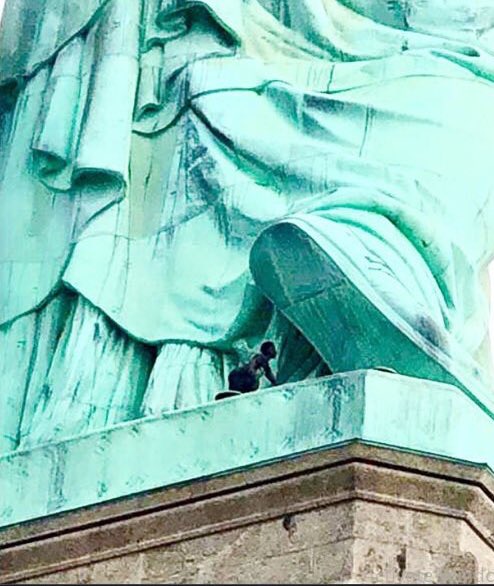
Patricia Okoumou protests U.S. treatment of families seeking asylum by climbing to base of Statue of Liberty last July 4. Photo by Abagond at wordpress.com
In a dramatic defense of the right of migrants to seek asylum when fleeing persecution and threats to their life, a Congolese-American U.S. citizen climbed the Statue of Liberty on 2018. U.S. Independence Day 2018. This year Patricia Okoumo continued her protest of the official U.S. response to migrants at the southern border by scaling the Austin, TX Southwest Key immigrant detention facility last month. Southwest Key is contracted by U.S. Immigration and Customs Enforcement (I.C.E.) to detain and/or keep tabs on migrants who have fled their violence-plagued homelands.
In interviews following her climb to the base of the Liberty statue, Okoumou highlighted the plight of hundreds of migrant families separated by ICE detention. Despite prior pledges to reunite the families, ICE reported there were still up to 3000 children who remained in children-only detention when the climb at the Statue took place. In one interview the 44 year old protestor stated, “I felt peaceful, that I was with those children in spirit. I could feel their isolation and their cries being answered only by four walls.” Buffeted by high winds for three hours before her arrest and descent from the Statue, Okoumou said, “I was thinking of Lady Liberty above me, you are so huge, you have always been a symbol of welcome to people arriving in America and right now, for me under this sandal, she is a shelter.”

Surrounded by fellow Rise and Resist members, Patricia Okoumou spoke to the press at her December hearing. Photo by Jeenah Moon (Reuters)
For a decade now, both the Obama and Trump administrations have sought to discourage Central Americans seeking refuge in the U.S. from their countries’ rampant violence. Although El Salvador and Honduras both rank among the five most violent countries in the world today, the Trump administration has drastically reduced the number of asylum applicants admitted to this country. For the fiscal year 2018, there was a cap set of 45,000 asylees, but only 22,491 people were eventually accepted. Further discouraging migrants who might willfully submit to the U.S. immigration process, as of July 2018 the average wait time for an immigration hearing was 721 days. While funding of ICE apprehension and detention of migrants increased substantially during the Obama years and has continued to rise under Trump, allocations for hiring more immigration judges has not kept up.
Under the 1951 Convention Relating to the Status of Refugees signed by the U.S. and more than 140 other countries, “Everyone has the right to seek and to enjoy in other countries asylum from persecution”. A study by the UN High Commission for Refugees found that 80 per cent of the women from Central America and Mexico applying for asylum at the U.S. southern border were found to have a significant possibility of establishing eligibility for asylum or protection under the Convention against Torture.” In practice, the U.S. denied 89 per cent of the asylum applications in 2016. Among those deported to their countries of origin, there are well documented cases of asylum seekers being attacked and killed on their return.

Rise and Resist activists called for abolition of ICE at the December court hearing. Photo by NYDailyNews
The right to seek refuge from potential persecution and violence in one’s home country is a well established principle of internationally recognized human rights. The UN Declaration of Human Rights upheld the right which dates back at least to the time of Ancient Greece. More recently, the U.S. joined 145 other countries in ratifying the Protocol Relating to the Status of Refugees in 1967.
Following her arrest in Texas, the New York City court ordered Patricia Okoumou to wear an ankle bracelet to enable monitoring of her movements until her sentencing on March 19. Meanwhile, the group Rise and Resist, to which she belongs, calls for the abolition of ICE by the U.S. “We stand on the right side of history,” Okoumou said after she was found guilty by the judge in New York. “I am not … discouraged” she continued. “Today our laws sometimes lack morality and this is a perfect example of that.” In summing up the motives for her dramatic protests she declared while choking up, “I wanted to send a strong statement that children do not belong in cages”.
Mexico’s Roma Helps Globalize U.S. Film Industry

At the Oscars this year Alfonso Cuaron’s almost became the first “foreign film” to win the Best Picture award. Photo by West of the NY Times
Zorba in Zorba the Greek , Auda abu Tayi in Lawrence of Arabia, Paul Gauguin in Lust for Life, Zampano in Fellini’s La Strada – Anthony Quinn was Mexican-American. He was born to a Mexican mother and an Irish father in the Mexican State of Chihuahua during the Mexican Revolution.
Working in East Los Angeles, I was surprised to learn Quinn grew up as a Mexican immigrant in the Eastmont Community Center neighborhood. The Anthony Quinn Public Library on East Third Street is located on the corner where Quinn’s childhood home stood. But Quinn paid little attention to his Mexican heritage in his life or his acting career. His 1952 Oscar-winning role as Emiliano Zapata’s brother in Viva Zapata was one of the very few he took playing a Mexican.
I also learned that children in the schools Quinn attended had been punished for speaking Spanish in the classroom. Anthony Rodolfo Quinn (paternal surname) Oaxaca (maternal surname) was taught that to get ahead in the U.S. you had to assimilate, leave behind your culture of origin and become “American”.
Having financed Roma with his own production company, Alfonso Cuaron left no doubt it was a Mexican film. “It doesn’t exist without Mexico” Cuaron emphasized on Oscar night. The same could be said of other enduring films like The Treasure of the Sierra Madre, Night of the Iguana , and The Wild Bunch. But Roma uniquely was made in Mexico with a Mexican cast and crew speaking Spanish and Mixtec.
The film also was made first and foremost for Mexican audiences. Alfonso Cuaron implied as much when in the post-awards press conference, he stated that he was most gratified by how the film had generated a national conversation about the rights of domestic workers and racism in his Mexican homeland. He also mentioned that he was proud to have strengthened the organizing and outreach of two groups, one in the U.S. and the other in Mexico, who are working on behalf of domestic workers like the protagonist of his film.
All the heralded immigrant Hollywood filmmakers – Fritz Lang, Billy Wilder, Ernst Lubitsch, Alfred Hitchcock – helped U.S. audiences understand the U.S. better and, in some cases, revealed for us what others don’t want us to see, as Cuaron put it on Oscar night. But the director of Roma is the first immigrant filmmaker to focus on his childhood homeland for his setting, his themes and inspiration and for the audience he wanted to reach above all. There is no doubt that Roma belonged in the Oscars’ Foreign Film category.
Roma has now raised the question of when the top award at the Oscars will go to a foreign film. Hollywood insiders have said Cuaron’s film came very close this year. With movies making more money overseas and some even premiering outside the U.S., this Mexican film signals an important, new advance in the globalization of the U.S. film and television industry. When a foreign film finally wins the Best Picture award, Oscar voters will be highlighting and celebrating movies’ potential to communicate with audiences all over the world as well as the domestic U.S. audience.
For those of us who have experienced a film’s potential to deepen our understanding and appreciation of other cultures, Roma’s success is

Mexican star Cantinflas was inspired by Chaplin’s “The Tramp” in creating his film persona.
During the era of silent movies, Chaplin’s Tramp succeeded in communicating powerfully with audiences around the world. It is worth mentioning here that the first couple of minutes of Cuaron’s motion picture is silent. By filming the chores of a domestic worker, Cuaron was able to touch audiences in a way that even surprised the filmmaker. “I least expected it (Oscar recognition) for this movie” Cuaron said in the post-awards press room. We all can attest that a kind of mysterious magic is at work in the best films. At the 1972 Oscars when Chaplin made his first U.S. appearance after a 25 year exile abroad the audience stood and applauded for eleven minutes. They stood in awe of Chaplin and in awe of movies’ potential to move us and remind us of what makes us all human.


 Erasing Borders