Monthly Archives: November 2019
Pope and the Grand Imam Pledge to Work For “Human Fraternity”
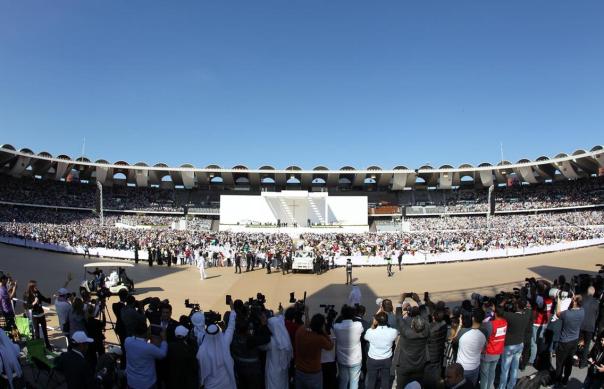
Pope Francis became the first Pope to visit the Arabian Peninsula in February 2019. The Abu Dhabi Papal mass was attended by 135,000 of the estimated one million plus Catholics living in the United Arab Emirates (U.A.E.) as migrant workers. (Photo by The National.ae)
In a dramatic initiative to ease Muslim-Christian tensions and violent conflict, the Pope and the Grand Imam, the highest authority in Sunni Islam, pledged last February to “work strenuously to spread the culture of tolerance and of living together in peace”. Although largely ignored by secular media, notably in the U.S., the leaders of the world’s two largest religious bodies jointly created a document stating that “faith leads a believer to see in the other a brother or sister to be supported and loved”.
Intended as a model and a guide for peacemaking and dialog in our times, the “Document on Human Fraternity for World Peace and Living Together” was signed by Pope Francis and the Grand Imam Sheikh Abu Tayeb in Abu Dhabi. It was the first visit ever of a Pope to the Arabian peninsula, the cradle of Islam. While Christians have led the refugee flight from Iraq, Syria and the Palestinian territories, the Pope has worked to enhance understanding and respect for Christians now living in predominantly Muslim countries. Improving relationships with Muslim leaders is a priority of Pope Francis’ papacy and can also be seen as repairing the damage done by his predecessor Pope Benedict. A 2006 speech by the former Pope was widely interpreted as characterizing Islam as a religion which condones violence.
The “Human Fraternity” document signed in February and the current Pope’s warm relationship and ongoing dialog with the Grand Imam and other Muslim leaders encourage “all who believe that God has created us to understand one another, cooperate with one another and live as brothers and sisters who love one another.” The document identifies several obstacles to creation of a culture of dialog and peace in today’s world.

The Abu Dhabi signing of the “Human Fraternity” document followed the Grand Imam’s Vatican audience with the Pope in May, 2016. (Vatican photo)
Echoing Martin Luther King’s observation that our technological advance has surpassed our knowledge of how to live in peace, the document identifies the causes of conflict today as “a desensitized human conscience, a distancing from religious values and a prevailing individualism accompanied by materialistic philosophies that deify the human person and introduce worldly and material values in place of supreme and transcendental principles.” Strongly condemned are religious groups who, “have taken advantage of the power of religious sentiment in the hearts of men and women in order to make them act in a way that has nothing to do with the truth of religion. This is done for the purpose of achieving objectives that are political, economic, worldly and short-sighted.” Such “False Religion” has supported military build up leading to “signs of a ‘third world war being fought piecemeal’”.
Also contributing to the crises today the document points to increasing economic inequality, and the exploitation of women and denial of their rights. In its conclusion the document urges “research and reflection” on its contents in all places of learning “to educate new generations to bring goodness and peace to others, and to be defenders everywhere of the rights of the oppressed and of the least of our brothers and sisters”.
Unfortunately, most American media emphasized the political implications of the February meeting of the two leaders while ignoring the document’s contents. The two New York Times articles reporting on the Pope’s visit to the Arabian peninsula failed to mention the document or its contents. By contrast, the official Vatican News headline the day after the meeting celebrated “the historic declaration of peace, freedom, women’s rights”. Conservative Catholic media and commentators rued the document language characterizing the diversity of religions as “willed by God in His wisdom”. One commentator speculated that “this is not what Muslim converts (to Christianity, ed.) want to hear from their Pope”.
The lack of attention paid the document is troubling. Our secular media’s tepid response suggests we live in a world captivated by the force of armaments. Ignorance of this significant effort to bring about a world of “human fraternity” reminds of Stalin’s reputed response to the suggestion that the Pope be invited to the Tehran Conference in 1943. “And how many divisions does the Pope have?” the Russian leader was reported to have asked.
Despite the neglect of the “Human Fraternity” document, and the opposition of Catholic critics of the Pope’s embrace of “religious pluralism”, Francis and the Vatican are following through on the dialog with Muslim leaders. Meetings in August resulted in some edits of the February document and were followed by another conversation between the Grand Imam and the Pope this month in Rome. Discussion focused on the progress of the joint “Superior Committee” in efforts to achieve the objectives agreed on in February.
To read the complete document signed in February 2019 go to:
Trump Vs. the UN

The United Nations was founded “to establish conditions under which justice and respect for the obligations arising from treaties and other sources of international law can be maintained” according to the UN Charter.
In speeches at the United Nations the last two years the President of the U.S. has defended national sovereignty and national interest as the pathway to global progress and prosperity. Choosing the forum created to foster global cooperation in the cause of world peace, economic development and human rights to extol national sovereignty highlights Trump’s heedless defiance of what makes for understanding and consensus building among nations. In a summary statement of his position, he declared in his September 2018 remarks, “We reject the ideology of globalism, and we embrace the doctrine of patriotism.”
This year in another September address, the U.S. President again attacked “the ideology of globalism” in the citadel of global cooperation. After acknowledging the UN as “the world’s biggest stage” in this year’s speech Trump chastised and bullied UN agencies on several fronts. He announced the U.S. withdrawal from the UN Human rights council, withdrawal from the UN Arms Trade Treaty, withdrawal of support for he International Criminal Court, and rejection of the Global Compact on Migration. In explanation of the last action he told the UN, “Migration should not be governed by an international body unaccountable to our own citizens.”
U.S. opposition to the global pact on migration stems in part from the U.S. administration’s hostility to references to a human caused climate crisis as a cause of increased migration. A leaked email of a U.S official working for the UN’s International Organization for Migration (IOM) warned of U.S. cuts in funding for the agency. The US appointee stated the IOM policies and positions “must not be in conflict with
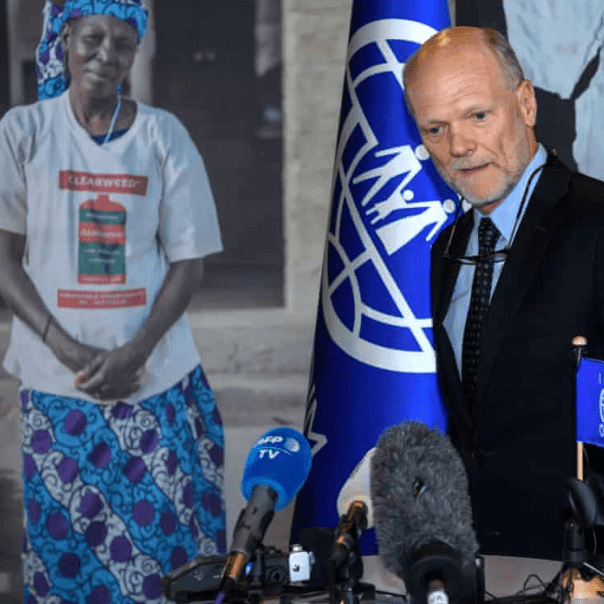
U.S. nominee Ken Isaacs was rejected to be head of the International Organization for Migration (IOM) after he made social media comments about the “hoax” of global climate change. Photo: Martial Trezzini /EPA
An article in The Guardian newspaper of September 11 links the warning to the rejection by UN officials of the Trump administration’s nominee to be head of the IOM. Most reports concurred that Ken Isaacs’ failure to be approved was due to his denials of human caused climate change. The Guardian noted that the U.S. has been contributing one fourth of the IOM budget.
Just this week, on November 4, the current U.S. Administration officially withdrew the wealthiest nation in the world from the Paris climate Accord. As the only developed country to give precedence to increasing fossil fuel production over reversing the ongoing climate catastrophe, the U.S. has now formally ceded its leadership role on the “world’s biggest stage”. The action is the most dramatic and decisive declaration that the U.S. considers its “national interest” the priority above the survival of coastal communities and survival of the human species.
Trump’s two speeches at the UN communicate his administration’s determination to pursue its nationalistic, “America First” ideology in its international relations. They ignore that progress in protection of the environment, in advancing world peace, international human rights and combatting world poverty all demand the consensus, compromise and understanding of other nations for which the UN was created. No nation, including the most powerful, can provide solutions to the world’s ills without cooperation and collaboration with other UN members. The bluster and aggressive unilateral actions of the U.S. in its foreign policies today are also a primary threat to world peace.
Having warned that the U.S. will not pay more than 25 per cent of the UN’s peacekeeping operations in last year’s speech, Trump boasted in this year’s speech of increased funding of the U.S. military. In an introductory segment of his remarks, he declared that the U.S. has “spent over two and a half trillion dollars since my election to completely rebuild our great military”. Such muscle flexing begs the question of whether excessive military expenditures and pride in U.S. military might have deluded foreign policy makers of this and previous U.S. administrations.
Perhaps the most revealing segment of the speech this year came at the beginning when Trump stated, “The essential divide that runs all around the world and throughout history is once again thrown into stark relief. It is the divide between those whose thirst for control deludes them into thinking they are destined to rule over others and those people and nations who want only to rule themselves.” Since the United States played such an important in the UN founding in 1946, its continual expansion of its armaments and military might suggest that our country has crossed over the divide Trump mentioned in the conviction we are “destined to rule over others”. The U.S. has deployed active troops in over 150 countries in the world and maintains bases in 38 nations today.


 Erasing Borders