Category Archives: Uncategorized
Renewable Energy Frees National Economies

Renewable Sources and National Soverignty
For most countries lacking fossil fuel reserves the increased cost of oil due to the war on Iran will mean more indebtedness. Loans from the World Bank and/or the International Monetary Fund (IMF) will come at the high cost of austerity measures cutting government services ranging from subsidies for the poor to health systems and education. The lending country often will also be required to transfer extraction of vital natural resources from the government to private enterprise.
Although Uruguay lacks fossil fuels in its subbsoils, it will escape the pressures of relying on the world financial system due to its transition to renewable energy sources. This was accomplished thanks to nearly half of its power coming from its dams on major rivers and the renewable energy commitment of the leftist-liberal Broad Front coalition which gained the Presidency and legislative control for the first time in 2005.
When a NYT journalist interviewed Uruguayans in 2023, he referred to the country’s transition to renewable energy as a Latin American revolution and was surprised by the common response: “Well, there wasn’t really a revolution in the Latin American sense. It was that we were worried about sovereignty. We were worried about the future. We were worried about our economy being yoked to commodity prices that were being affected by global wars that were very far away from Uruguay.”
Wind Power Led the Way
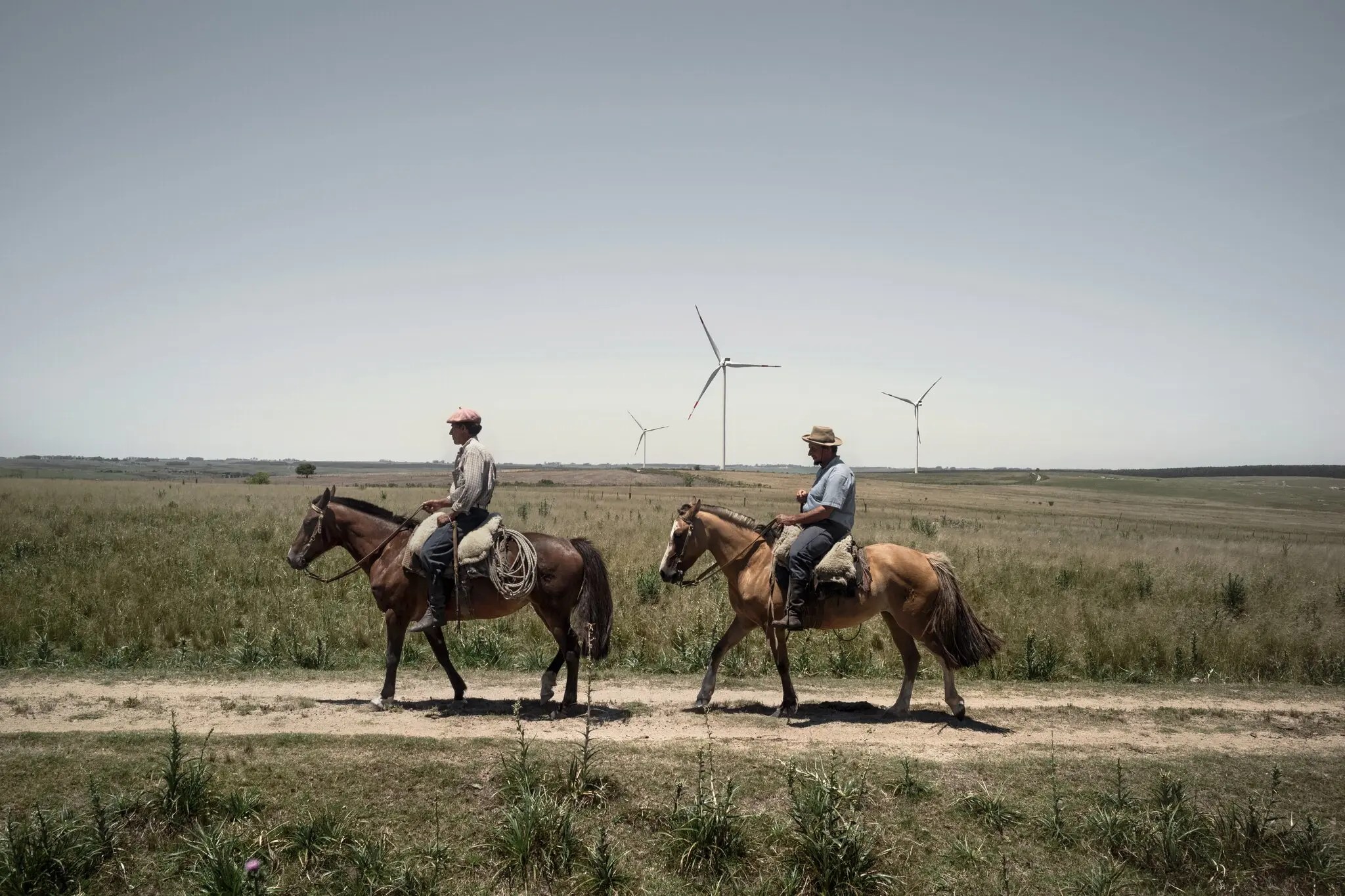
When the Broad Front took power, it was evident that the increases and fluctuations in the price of natural gas and oil restricted their ambitions to develop social services and reduce inequality in Uruguay. Rather than continuing to devote over 2 % of the Gross Domestic Product to fossil fuel purchases, the Broad Front coalition created a National Directorate of Energy as one of its first acts. Growth of wind power through public-private partnerships was the new Department’s first emphasis.
Within a few years, wind power was supplying over 30 per cent of Uruguay’s energy needs, had provided jobs to 50,000 workers and enabled smaller, family farms to survive in the face of rising costs. After fifteen years of coalition rule (2005-2020), wind, hydro and biofuel combustion accounted for 98 % of the country’s power.
Largely due to the development of the wind power grid, by 2020, Uruguay’s nation wide power company had made electricity available in every home in the country and all its rural schools. Heading the company, known as UTE, for a decade was an electrical engineer who now states that he’s always considered delivery of power as a tool of income redistribution.
Energy Savings Enabled Social Services Reforms
When the leftist Coalition ceded power to a neoliberal one in 2020, multiple social reforms had been implemented and a National Health Service created. The poverty rate had dropped from nearly 20 % when the Broad Front began to rule to 8.8 % in 2019. Much of the progress in reversing hardships of the poor was made possible by savings in the energy sector.
The Director of the Energy Department has stated,“We didn’t need to depend on imported fossil fuels or on the energy markets or the energy fluctuation of energy commodity prices. So there was a better solution” . Although trained as a nuclear physicist, the Directer of the new Department has also stated that nuclear energy was ruled out early in Uruguay’s transition to renewable sources. “I realized that this was not the best solution for us because we still are having to continue importing technology, importing uranium. We don’t have uranium, either” he points out.
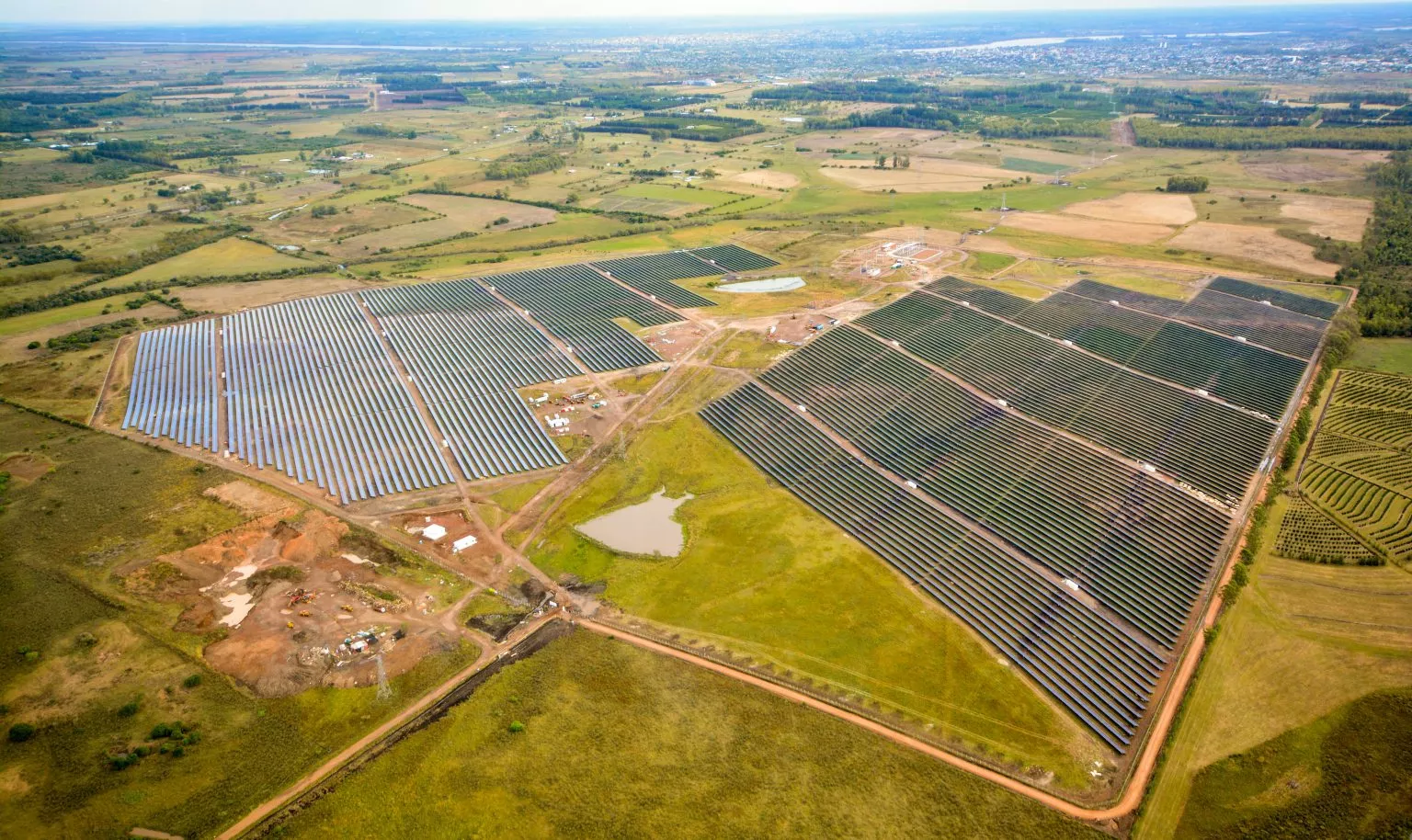
With solar energy now contributing less than 5% to the power grid, its development will be the primary aim of the new Department of Energy with the Broad Front’s 2025 return to the Presidency. Savings gained with the minimal use of fossil fuels will be devoted to new solar projects and further upgrades of the nation’s power grid. Uruguay now leads poor nations in relying on their own natural resources to supply all their energy needs. The country is at the front in demonstrating the benefits of transforming the world’s economic order from one with a fossil fuel engine to a system powered by domestic energy sources.
José “El Pepe” Mujica Describes the “Unsustainable” Global Economic Order

When Jose “El Pepe” Mujica became President of Uruguay, the country was already well on its way to freeing itself from fossil fuels. During his five year term, he led in gaining consensus from all of Uruguay’s political parties for relying on renewable sources. As a result of continued growth in hydro, wind and solar power the country began exporting its excess power to neighboring Argentina and Brazil. Payments for its power exports enabled increases in funds for programs benefiting workers and the poor.
Following the 2014 election, Mujica soon gained an international reputation as the “poorest President in the world”. He remained housed in the three room farmhouse owned by his wife Lucia, also a veteran of the Tupamaros guerrilla movement. He rode public transit and drove a vintage VW beetle. Ninety percent of his presidential salary the couple gave away to small businesses and non profits benefiting the poor.
“El Pepe“ objected to being described as “poor”. In correcting this miscaracterization he usually cited the Stoic philosophers, “As the old thinkers Epicurus and Seneca defined it, and as the Aymara people, indigenous to South America do: it is not the one who has little who is poor. The one who is truly poor is the one who needs infinitely more, the one who is never satisfied.”
Our current international system which compels us to think we need more to be fulfilled and live happily is simply unsustainable. At the 2012 UN Conference for Sustainable Development, Mujica declared, “The real problem is not climate change”. He explained, “Humanity is in grave danger because of the system we have created.”
His diagnosis of the problem conveys the solution: “The danger is rooted in what we have come to seek to make us happy.” It seems Mujica’s fifteen years in the military dictatorship’s jails, seven of which he was denied any books, may have taught him the primacy of living simply. “My message is very simple: Economic growth and progress must add to human happiness, not take away from it.”
Our current system is not only not sustainable he reminded leaders at the Rio Conference: “Does the world have enough resources for the entire human race, seven to eight billion of us, to live like the Western societies that keep making more and buying more than they need?” What is the effect on relationships with other people he then asked, “Can we really talk about the solidarity of humankind and kindness to each other, even togetherness, when we are constantly competing to outdo each other?”
He then concluded his talk with these words: “These are the building blocks of our happiness as humans: having satisfying relationships with others; raising children; making friends; spreading love in the world.” One is again led to ponder how his years of solitary confinement contributed to “El Pepe’s” bold, simple wisdom.
From Aid to Empire

“But seek the welfare of the city where I have sent you into exile, and pray to the Lord on its behalf, for in its welfare you will find your welfare.” (Jer 29:7)
We now know that we have not just lost an election. Those declared victorious are intent on desecrating and destroying the best values of a nation ruled by and for its people. They have dedicated themselves to creating a state ruled by and for its wealthiest citizens and crippling if not eliminating programs to further the equal opportunity of the most disadvantaged. We have not just lost an election; the victors aim to reverse all advances we have made towards becoming a multi-racial democracy. They trample on this vision. They hurl abuse on it with their decrees are intended to silence us and seize the country from us. They would exile us with their reign of lies, intimidation and fear.
The election measured for us the distance between our prophets’ vision and a nation yet gripped by degrading lies, xenophobia, racism, and rampant militarism. We have been cast back to an age of empire when most of the globe is seen as supplying the resources for the economic development of select countries. Aid for new or long impoverished nations to enhance the well being of their people was one of the first targets of the multi billionaire charged with enhancing government efficiency.
I have personal experience of some of the benefit a small U.S. AID grant can have on lives in poor nations. I administered the $10,000 grant the Disciples’ Church in Congo received in 1970 for construction of a dormitory at its farmer training center. Youth from many villages were housed there while training in animal husbandry and growing vegetables in dense rain forest. Pigs raised at the Ikengo Farm were prized in the provincial capital with the Governor visiting often to purchase a pig or two. In a visit forty years after the dorm was completed the majority of the trainees were young men of “pygmy” Batswa ethnicity formerly ostracized by Ikengo’s Bantu villagers.
Entitled solely by personal fiat, Elon Musk intends to curtail, or at least, severely cripple U.S. AID programs. Created by the Kennedy Administration to support the economic development of the new nations freed from colonial rule, the agency soon became the lead agency in U.S. contributions to fighting hunger, disease and poverty in the world. Musk and the new President’s attempt to eliminate U.S. AID’s programs carries out an aim to reverse history and return the world to a colonial era of white European domination in South Africa and the world.
Another Musk-inspired decree withdraws all forms of U.S. aid for black majority ruled South Africa. The focus on South Africa reveals the influence of Musk’s upbringing to age 18 as the heir of a white nationalist grandfather and father in the time of apartheid. These facts make difficult an escape from interpreting this important U.S. foreign policy decision as anything but an act of resentment and vengeance for South African legislation returning land seized by whites to black farmers. Withdrawal of U.S. support for the further growth of the largest economy in Africa also seeks to punish South Africa’s firm opposition to Israel’s war on Palestinians in Gaza and the West Bank.
Presenting the case in the International Court of Justice that Israel is bent on genocide of Palestinians confirms 21st Century South Africa’s independence from its colonial masters. The new nation was one of the original members of the BRICS alliance of countries balancing U.S. and European dominance in world politics. The strength of that new alliance can be seen in South African leaders’ resolute position on the Israeli War.
We exiles need not remain discouraged by policies inspired by white nationalist ideologies of empire. We are joined in opposition by the vast majority of the world’s people who have thrown off the yoke of imperial rule and become independent nations in this ever evolving world. As British Prime Minister Harold MacMillan, a Tory, noted shortly before numerous African nations declared their independence in the early 1960’s, “the winds of change” are blowing across the continent – and the world he might have added. Those winds can never be reversed.
Formation of the new BRICS alliance of nations now encourages new and the long oppressed nations of Latin America, Asia and Africa to be steadfast in their independent political and economic positions. They are our allies in our acts of resistance and opposition to policies and ideologies aiming to turn back the “winds of change” continuing to blow across our world.
Jeremiah in the 7th Century BCE foresaw the rise of other empires to challenge that of Babylonia. After 70 years of their exile in Babylon, the Jews were freed by the Kingdom of Persia from their captivity and exile. The prophet had paid attention to the “winds of change” in the world of that time and saw that in their return to Judah and Israel God would offer a new covenant to the exiles and would “write it on their hearts”. Gaining their freedom confirmed they would now know their God to be a God of justice. Jeremiah’s words were echoed by Martin Luther King when he proclaimed “the arc of the moral universe is long but it bends toward justice”. An abolitionist minister first spoke those words in the 1850’s.
The U.S. Heresy of “Christian Nationalism”

Christian pastors pray before the President signs the declaration of a national day of prayer in the White House September 2017. Note that no leader of any other faith community appears to be present.
“When Jesus heard him, he was amazed and said to those who followed him, ‘Truly I tell you, in no one in Israel have I found such faith’.” Mt 8:10
Fifty days from an election that has been called the most important in our nation’s history I’ve been thinking of Christians around the world who pray with us now about the outcome. I’ve been thinking of Christians who have survived years of political instability, coups d’etat, civil war and dictatorial rule. Thinking of how at this time they are praying for us, because they are aware how fragile is a political system of democratic rule by the people.
I’ve been thinking of Christians in Mexico and Congo where I’ve served with them for five years and how as they pray for us and the fate of our nation, we are threatened by the kind of civil unrest and rigging of the election that they have experienced in their own countries in an electoral season. “It’s not my brother, not my sister …..in Mexico, in Congo, in India, in the Philippines and China O Lord ….it’s me, O Lord, standing in the need of prayer!”
When they pray for us, I imagine they are praying that the Jesus who served among the poor and the scorned of his world will guide U.S. Christians in their political action now. I imagine they are praying that our nation’s values of “liberty and justice for all” will be upheld and strengthened by this year’s political process. I imagine they pray that “the heresy of religious nationalism” (in the phrase of Rev. William Barber of the U.S. Poor People’s Campaign) will be rejected by the citizens of the nation with the largest Christian population in the world.
“Islamaphobia” and the denigration of the faithful of other religions that characterizes U.S. Christians infected by “religious nationalism” is not an option in minority Christian nations like Egypt or India. At this time it is worth remembering that the Bishop of the Coptic Church in Egypt (the oldest Christian community in the world) declined to meet with Vice President Pence in January, 2018. Responding to the Vice President’s defense of the administration’s decision to move the U.S. Embassy in Israel from Tel Aviv to Jerusalem, the Bishop said the decision had been made “at an unsuitable time and without consideration for the feelings of millions of people.” The Bishop’s dismay over the U.S. decision was shared by Pope Francis and the World Council of Churches.
“Religious nationalism” is on the U.S. election ballot this year. A belief that our nation’s policies and actions represent the will of God has inspired the current administration to spurn international treaties and agreements. As a result, we have been opposed by our allies and friends for rejecting collaborative global solutions to threats of pandemics, climate crisis, economic collapse and nuclear warfare. Our boundless “religious nationalism” has excluded us from participation in solutions agreed on by the overwhelming majority of nations. Can we doubt that the majority of the world’s Christians are praying we abandon our current position and rejoin the world’s nations as a responsible leader? Can we doubt they are praying we rejoin the majority of the world’s Christians in solidarity with the cause of of the poor and peace in our world.
The life and words of Dietrich Bonhoeffer have become more relevant since his execution 75 years ago by the Nazis. As the guards took the young German theologian to the gallows, Bonhoeffer asked a British fellow prisoner to give a message to his closest British friend. His final words, for the Bishop of Chichester, might have been addressed to us today, “Tell him, that with him I still believe in the reality of our Christian brotherhood which rises above all national interests and conflicts, and that our victory is certain.” May our actions as Christian citizens of the U.S. be guided by a love that “rises above all national interests and conflicts”. And may that love of God, of Jesus and of all humankind be the soil for growth of a faith which knows “our victory is certain”.

I am convinced that the future victory Bonhoeffer referred to depends on the recognition that the “our” who share in that victory does not exclude any nationality, class, or racial construct. The victory is certain only when and if it is claimed and enjoyed by all of humanity. When our own actions as individuals and those of leaders of all nations can be judged as contributing to the well being of us all, then and only then are we moving toward the “victory”.
The Economic Argument for Increased Immigration

The fresh take on the immigrant issue presented in this book deserves our attention
Contrary to what we often hear and read, the U.S. problem isn’t that “too many immigrants want to come here. It’s going to be that too few might want to”. So argues Seketu Mehta, U.S. immigrant from India, in his important new book This Land Is Our Land: An Immigrant’s Manifesto . The author’s position on immigration, well supported by multiple facts and stories, is so seldom heard in the current debate as to be shocking. Although the 2016 average income of the Indian immigrant to the U.S., at $110,026 annually, far exceeds that of the average “White” resident’s income, $61,349, the anti-immigrant policies and language today have already deterred some from coming to this country. Today, Mehta points out, Canada accepts three times as many immigrants per capita than the U.S. And Mexico in recent years is seeing more of its nationals return from the U.S. than cross the border for the “promised land”.
It is the demographic statistics Mehta cites that best bolster his argument for “Why They Should Be Welcomed” as the book’s final section puts it. As the “white nationalist” emphasizes in often hysterical fashion, the U.S. white population is declining and becoming increasingly older. By contrast, 80 per cent of the immigrants to the U.S. are under age 40 while half the U.S. population, white and persons of color, are over 40. We are now familiar with the Social Security statistics indicating that in 1960 there were 5 workers for every retired and disabled person enjoying benefits compared to fewer than 3 workers in 2013 supporting the system. In 2018 Social Security paid more in benefits than it received in payments. Important to consider also is the Social Security payments of $13 billion by undocumented immigrants in 2010 while seniors and the disabled without documents received only $1 billion in benefits.

Guyana Day is now an annual festival of food and culture in Schenectady, NY
This book should help convince anyone that immigration has contributed and will support even more in the future the economic stability and health of the U.S. Stemming from their younger age and their relatively recent arrival, immigrants today make up 40 % of the home buyers in the country while representing 13 % of the U.S. population. Dramatic revivals of U.S. towns have occurred due to the welcoming of immigrant settlers. Mehta describes how 10,000 Guyanese transformed the abandoned downtown of Schenectady, New York as they restored decrepit houses “with little or no government assistance”. Most of the Guyanese immigrants, now 12 % of the entire town population, had been renting housing in the New York City borough of Queens when the Mayor of Schenectady in 2002 invited them to settle in the northern New York town. Other New York upstate urban areas have experienced similar improvements thanks to welcoming over 40,000 immigrants to their towns.
U.S. immigration policies fall far short of recognizing and supporting the vital contributions of the newly arrived workers. Restricting the flow of younger workers into the country now holds sway in our policies. Since 2000 the number of Border Patrol agents has more than doubled to the current total of 20,000 and the budget for “border security” has grown four times as large as two decades ago. In 2017, of the 1.1 million permanent resident permits, “green cards”, issued by the U.S. authorities, only 12 % were employment related.
Seketu Mehta’s book issues a wake up call to Europe and the U.S. that the racism and white nationalist fervor of the colonial era are proving difficult to overcome in accepting and implementing the policy changes called for now. Statistics tell us that the population growth of Europe is below the replacement rate of 2.1 babies per woman, and only 27 % of Europeans are under 25 while 60 % of Africans are in that age group. At current growth rates the population of Europe and Russia will decline from 740 million to around 700 million in 2050 while Africa’s will double to an estimated 2.4 billion persons.
Due to even more dire consequences of the climate crisis expected in the global South, the flight of migrants to Europe and North America will keep immigration issues in the forefront of our civic dialog and politics. This “Immigrant Manifesto” as the author subtitles This Land Is Our Land challenges us in the North to view the immigrant “invasion” as an opportunity to strengthen the economies and ideals of our nations. Failure to change our attitudes and policies will, this book argues convincingly, seriously undermine our economic strength and our quality of life.
Why She Left Honduras

Sra. Wendy Garcia and her two year old son are living with a family in Portland, OR while awaiting a hearing on her application for political asylum.
Wendy Garcia, a Honduran mother of seven, joined others in her rural community to protest pollution of their primary source of water. While many U.S. immigrants fear reprisals for their political protest, we need to remember that there are many other Honduran immigrants who silently resist by fleeing from the desperate poverty and violence resulting from what the U.S. has claimed is “foreign aid” in their country.
Policies of aid that favor dictatorships either led by or beholden to the country’s military have sown seeds of violence and civil war throughout Central and South America for many years. Our policies consistently have been guided by the interests of U.S. based international corporations and call for limiting government social services and support for foreign investors who export most of the profits to off shore bank accounts.
These policies need to be taken into account in any discussion of U.S. immigration policies. They have created the conditions of deprivation and desperation that lead so many to leave home in order to sustain their families’ health and well being. The following account of Wendy Garcia’s resistance to pollution of her community’s water source establishes her application for asylum status as a political refugee. We must however remember those other immigrants from the south who have silently resisted their governments’ brutal repression and corporate exploitation of their communities’ resources by marching north.
Mrs. Garcia’s story below has been shortened. For the full account, go to:
“I am seeking asylum in the US because of a hydroelectric dam. I fled Honduras fearing for my life after being tear gassed by police and arrested when our community resisted a dam which contaminated the water we rely on for drinking, cooking and washing.
I come from a small community where our water flows from the mountains into the River Mezapa. The communities who rely on the river organised many years ago to install a water system which stores and distributes water to people’s houses.
Every household paid a monthly contribution to ensure the riverbanks stayed clean, and the system functioned well. We had enough water, and it was crystal clear – clean enough to drink.
The problems started as soon as construction began: the dam company chopped down lots of trees on the river bank. The water turned browny yellow and tasted like iron, so we couldn’t use it any more.
In early 2017, a roadblock was set up in the Pajuiles community to stop the heavy machinery getting past. At first I didn’t want to get involved: I was scared because there are powerful people behind the dam.
But as our clean water turned to mud, I realised that if we didn’t stop the dam we could all die from thirst.
Early in the morning of 15 August 2017, we were coming to the end of the night shift at the roadblock when we heard that the police were on their way. It was only my third or fourth time at the roadblock.
Suddenly, there were armed police and Swat teams everywhere, throwing teargas into people’s houses. There was so much smoke we could barely see, and I’ve suffered from blurry vision ever since.
I ran into a house but went back out to look for my son – and that’s when they arrested me. Ten of us were arrested, including several elderly neighbours and a pregnant woman. We were held from 10am to 1am the next day.
Our camp was destroyed, and the police escorted the company’s machinery to the river. We were charged with trespass for blocking a public road. The police took our photos – and this really frightened me because in Honduras the police kill ordinary people.
I became even more scared when a few months later in January 2018, a colleague in the community struggle, Geovanni , was murdered by police who dragged him into the street and shot him dead.
If they did that to him, they could kill me too, and then who would support my children? In Honduras, money is power, and we, the poor people, don’t have access to justice.
That’s why I left Honduras. That’s why I’m seeking asylum in the US.”

For Love of “Roma” and Mexico

Poster for “Roma” by Academy Award winning Director Alfonso Cuaron of Mexico
In 1951 when I began elementary school less than 100 miles from the California border with Mexico most of the migrant farmworker children – the “second language learners”- occupied trailers next to the back fence. The only contact with the Mexican children I now recall was with a boy whose English proficiency gained him a seat in my class. His family had found year end employment and settled in the town’s barrio, a step up from the migrant families whose children were assigned to the school trailers.
A declining number of children in the United States raised in lower middle class and middle class families have much contact with children or adults who are poor. Our communities, our schools, our cities are designed to prevent interaction with the poor. The “security” industry sells us on a lifestyle and an outlook that disdains, when it does not fear, a relationship with someone of the “lower class”. In Mexico, as the middle class has grown with industrialization and urban growth, it has become customary for families to contract with the poor for domestic help who live with the family.

The film’s protagonist Cleo celebrates a new year with [a cup of pulque served by a fellow nanny/housekeeper
Having fled to the city, poor women, often of Indian heritage, work in these homes to help their families survive the harsh conditions typical of rural Mexico today. Forty years ago, in a middle-class Guadalajara neighborhood, I rented a two bedroom house with a room on the roof just large enough for doing laundry and housing a maid/housekeeper if we chose to hire one. We managed quite well without that luxury but we didn’t have four children and our mother living with us like the family in the new film “Roma”.
Alfonso Cuaron dedicates “Roma” to “Libo”, the Mixtec Indian woman Liboria Rodriguez, who served his family throughout his childhood in the Mexico City neighborhood still known as Roma. One reviewer has pointed out that Roma is “amor” – love in Spanish – spelled backwards. The film was conceived and shaped by the filmmaker’s gratitude for the heroic role of “Libo” (Cleo in the film) in caring for, watching after and ultimately saving Cuaron’s family members. By telling the story of his childhood from Cleo’s perspective the film’s script writer/director/cinematographer Cuaron enriches and deepens the viewer’s experience while revealing Mexico’s barriers and boundaries of class, ethnic origin, and language.
According to an extensive article by Marcela Valdes in the New York Times Sunday Magazine (https://www.nytimes.com/2018/12/13/magazine/alfonso-cuaron-roma-mexico-netflix.html) Cuaron spent long hours speaking with Liboria Rodriguez about her life serving as nanny/housekeeper in his childhood home. He wanted to depict her life of domestic labor accurately, but he also wanted to understand better the conditions in her village that drive so many to seek work in the city. In the article Cuaron is quoted as saying, “When I was a boy, she would tell me about her pueblo, and she told me about the terrible cold they suffered and the hunger they suffered. But for me as a boy, it’s the cold equivalent to ‘Shoot, I forgot my sweater to the movie,’ and the hunger is ‘[Expletive], they’re running two hours late with dinner,’ you know? I had no awareness.” Apart from the wizardry and beauty of Cuaron’s black and white imaging of his past, the triumph of the movie is the filmmaker’s coming to terms with his empathy for the humble woman who served as a second mother to him.
Having gained international recognition as a leading Hollywood film director, with “Roma” Cuaron has also come to terms with his identity as a Mexican film maker. He told the writer of the NYT article, “The film confronted me with the mystery of what I no longer am yet still am at the same time,” In his embrace of his Mexican homeland, Cuaron enthralls us with his love of the clever children’s toys, the cries of street vendors, the unrestrained lunacy and melodrama of Mexican television, the country’s fiesta traditions and much more. Applying the empathy encouraged by his relationship with Libo, the filmmaker also explores the forces which continue to divide and suppress people in Mexico – and elsewhere.
Cleo’s boyfriend in the film is seen in training and later as a member of the paramilitary mercenaries who beat and killed students and workers in the Corpus Christi Massacre on June 10, 1971 in Mexico City. Cuaron notes in his interviews with Valdes that the young man, like so many worldwide, find their adult identity as members of an undercover force who repress the aspirations of their own class. He comments, “They’re invisible, and they’re given a visibility. They’re given training. They’re given discipline, a feeling of belonging, a feeling of being needed. And what is this used for? Not to improve society, to improve social services. No.” The film also portrays members of the U.S. CIA who organize and oversee the training of the poor youth.
Few films aim to depict the social and political context operating behind the story but “Roma’s” creator paints a huge canvas. As the camera follows Cleo through a year and a half of her life we are immersed in Mexican life as lived by middle class professionals like Cuaron’s parents, hacienda owners, soldier and para military trainees, health workers, street vendors, television personalities and more. They are depicted responding to divorce, pregnancy, earthquake, forest fire, a mass political protest, death, near drowning and a lot of dog poop. By the end, I felt as though the soul of a person and a culture had been laid bare before me.
In the course of their long conversations recalling their life together nearly fifty years before, Cuaron asked his nanny Liboria if she would like to be paid for her help on the film. Her response, as reported to Valdes, was “How barbaric. I did it because he’s my child. It’s something done for love.” That also describes the filmmaker’s incentive for making this film: “something done for love”. The film tells the story of a life and a love that for many viewers will be easy to remember and hard to forget.
“The World House” of Martin Luther King

Dr. King with the first President of Zambia, Kenneth Kaunda, in Atlanta, 1960. They issued a joint statement opposing U.S. investment in South Africa…Wikimedia Commons
In the face of Trump administration efforts to roll back or repeal U.S. legislation and government actions to reduce economic inequality, further civil rights and protect the environment, the words and courageous life of Rev. Dr. Martin Luther King, Jr. have taken on added weight and importance. Here in Kansas City, this January’s King holiday celebrations of his life and message have been especially well attended. The public gatherings also served this year as an opportunity to call on people to resume the Poor People’s Campaign begun by Dr. King the year of his assassination fifty years ago.
That Poor People’s Campaign mobilized people of many races against the scourges of racism, militarism and materialism and marked King’s expansion of his organizing from the civil rights of African Americans to the human rights of oppressed people world wide. The civil rights leader had long been inspired by the progress of persons overseas in claiming their rights, having early in his ministry made the connection between the struggle of U.S. blacks and those in Africa in opposing colonial rule.
Soon after the 1957 integration of public transportation in the city of Montgomery, Alabama, Dr. King attended the festivities celebrating the independence of Ghana in West Africa. Ghana was the first English speaking African nation to achieve independence from European colonial rule and Dr. King drew inspiration and strength from this historic advance. One month after Ghana’s Independence Day, on April 7, 1957, he preached at his Dexter Avenue Baptist Church in Montgomery on the new nation’s, and our own, march toward freedom and liberation.
“There is something in the soul that cries out for freedom. There is something deep down within the very soul of man that reaches out for Canaan. Men cannot be satisfied with Egypt. They tried to adjust to it for awhile. Many men have vested interests in Egypt, and they are slow to leave. Egypt makes it profitable to them; some people profit by Egypt. The vast majority, the masses of people never profit by Egypt, and they are never content with it. And eventually they rise up and begin to cry out for Canaan’s land.”
Dr. King briefly summarizes in the sermon the five hundred years of slave trading and colonial rule by Britain and the European powers across the continent of Africa. He then describes the struggle of the new nation’s first Prime Minister, Kwame Nkrumah, and the Ghanaian people against colonial rule. Ghana’s opposition to colonial rule and its similarity to the movement for civil rights of African-Americans in the U.S. made a deep impact on Martin Luther King. He shared his reaction with his congregation:

Prime Minister Nkrumah at the Eisenhower White House in 1958 – Image by © Bettmann/CORBIS
“When Prime Minister Nkrumah stood up before his people out in the polo ground and said, ‘We are no longer a British colony. We are a free, sovereign people,’ all over that vast throng of people we could see tears. And I stood there thinking about so many things. Before I knew it, I started weeping. I was crying for joy. And I knew about all of the struggles, and all of the pain, and all of the agony that these people had gone through for this moment.”
“After Nkrumah had made that final speech, it was about twelve-thirty now. And we walked away. And we could hear little children six years old and old people eighty and ninety years old walking the streets of Accra crying, “Freedom! Freedom!” They couldn’t say it in the sense that we’d say it—many of them don’t speak English too well—but they had their accents and it could ring out, “Free-doom!” They were crying it in a sense that they had never heard it before, and I could hear that old Negro spiritual once more crying out:
Free at last! Free at last!
Great God Almighty, I’m free at last! ..……”
When Dr. King wrote his last book in 1967 that experience was still fresh in his mind. In the book’s final chapter, which he titled “The World House”, he wrote, “What we are seeing now is a freedom explosion…..All over the world like a fever, freedom is spreading in the widest liberation movement in history. The great masses of people are determined to end the exploitation of their races and lands……For several centuries the direction of history flowed from the nations and societies of Western Europe out into the rest of the world in ‘conquests’ of various sorts. That period, the era of colonialism is at an end.”
Like no one else, King knew that there were many people in the U.S. who are unaware of or who are opposed to the “freedom explosion” he celebrated in Ghana in 1957. In words as relevant today as when he wrote them in 1967, he declares, “Every society has its protectors of the status quo and its fraternities of the indifferent who are notorious for sleeping through revolutions. But today our very survival depends on our ability to stay awake, to adjust to new ideas, to remain vigilant and to face the challenge of change. The large house in which we live demands that we transform this worldwide neighborhood into a worldwide brotherhood.”
The leaders of the current administration in power in the U.S. not only goad and abuse people of color worldwide; they are trying to turn back the clock on the “freedom explosion”. Like Rip Van Winkles they have slept through “the widest liberation movement in history”. They may never wake up but we, in opposing, resisting and helping set a different course for our nation, we join the “great masses of people (who) are determined to end the exploitation of their races and lands”. And as Dr. King, our scriptures and world history continue to remind us, “the freedom explosion” ultimately will prevail.
Note: “The World House” chapter concludes Where Do We Go From Here: Chaos or Community by Martin Luther King, Jr., first published in 1968
A Hug for the World

by Richard Ochieng, St Clement Orthodox Primary School, Kenya.
I’ve been a follower of the World Council of Churches’ web site http://www.oikoumene.org/en and received messages from them in my Inbox for a decade or more. Ever since I began thinking more seriously about what it means to be a called and to take action as a “global citizen” in the world today I’ve learned, been encouraged by and been grateful for the work of 350 plus Orthodox and Protestant Church bodies worldwide, united for reflection and action by the World Council of Churches.
To cite one example of the value and importance of the Council’s voice, the U.S. would never have invaded Iraq in 2003 had Christians in this country heeded the warnings issued by the Mideast Council of Churches and published worldwide by the World Council. It is stunning how many of the dire effects of the Iraq invasion, the spread of the war to other nations being just one example, were all foreseen by the Statement issued by the World Council on behalf of the Mideast Council of Churches.
You will easily find the Spanish, French and German versions of the Council web site at the above address along with translations into thirteen other languages, Arabic among them. Here below is the Christmas 2017 greeting of the Council, like the work and mission of this movement truly a “hug for the world”. Consider it a wish for a Merry Christmas and Happy New Year to all those active in “erasing borders” in their own communities this year and in coming years. First though is a beautiful Africa-themed video in celebration of the solidarity dreamed, advocated and made possible by the activities of the World Council of Churches.
Christmas 2017
28 November 2017
A greeting from the World Council of Churches
The World Council of Churches has as its basis that “we confess Jesus Christ as our Lord and Saviour.” This refers directly to the words of the Gospel, the good news that we read and hear at every celebration of Christmas. These words of a heavenly messenger are for all the people. The Gospel writer, Luke, continued telling the story of Lord and Saviour, who was “anointed by the Holy Spirit to bring good news to the poor … to proclaim release of the captives and recovery of sight to the blind, to let the oppressed go free, to proclaim the year of the Lord’s favour” (Luke 4:18-19). He is the one who chose his apostles and “gave them instructions through the Holy Spirit … to be my witnesses in Jerusalem, in all Judea and Samaria, and to the ends of the earth” (Acts 1: 2, 8).
This year the churches in the world have commemorated 500 years since the Reformation, an event that had an effect on all churches in the world ever since. The best way to commemorate this landmark was to manifest and celebrate that we share the same Gospel, the same good news about our Lord and Saviour. The best way to show that we are serious about this is to continue the sending and the mission by sharing the faith in the one who liberates, heals, and proclaims the time of God’s undeserved grace to come. A year of hope and new beginning is always the message of the Gospel.
In 2018 the World Council of Churches will celebrate our first 70 years in common service and witness to the triune God who creates us, saves us, and sends us to serve and witness. We cannot wait till we have found agreement in everything. Our ecumenical service, our diakonia, is needed every day. We are called to be moved by the Spirit, which is the theme of the WCC World Conference on Mission and Evangelism in Arusha, Tanzania, in March 2018. We are called to liberate, to heal the broken, to raise up the oppressed, to share the salvation from sin that we can receive only in Jesus Christ.
Be not afraid! We are called to offer hope, but not in a superficial way. This is not the time to say that sin is an obsolete word in the world. Every day we see the opposite, everywhere. This is the time to receive salvation from sin and to go out fighting against all the negative effects of our misbehaviour and sins. We see them in climate change, in violent conflicts, in economic injustices, in abuse, even of religion. It is time to continue confessing our shared faith in our Lord and Saviour. We do that by continuing our Pilgrimage of Justice and Peace together and sharing the good news with all the people. Be not afraid!
May you have a blessed Christmas and a grace-filled new year in 2018!
Rev. Dr Olav Fykse Tveit
General Secretary
World Council of Churches
Is the U.S. Ready to Grow Up?
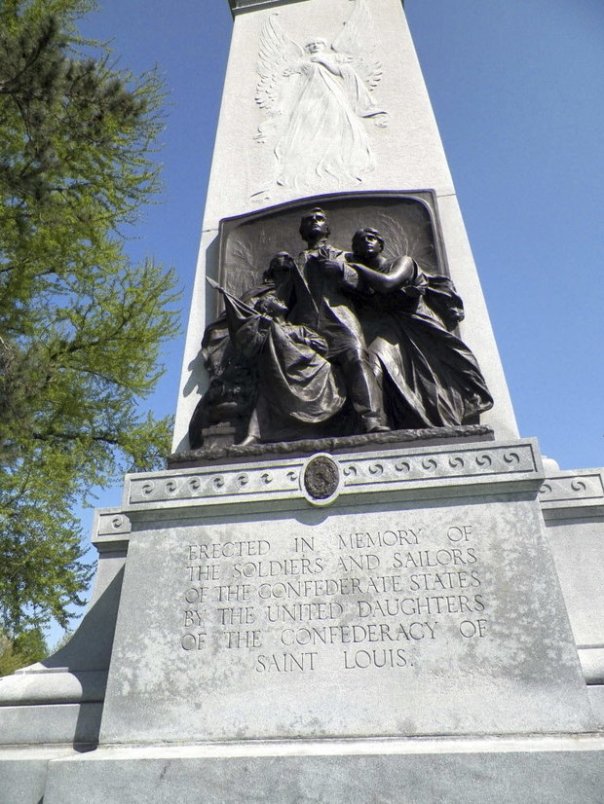
This 32-foot high granite monument honoring Confederate soldiers and sailors has stood in St. Louis’ Forest Park since 1914. St. Louis may soon join the growing list of cities removing monuments to the Confederacy. On the State Line dividing the free state of Kansas and pro-slavery Missouri, Kansas City has no such monuments. (AP Photo/Jim Salter, File)(Jim Salter)
The election of Donald Trump as President of the U.S. has resulted in a flood of commentary in all types of media on the topic of “American identity”. Discussions of “American exceptionalism” (referred to in the last Erasing Borders posting) are just one direction the national soul-searching has taken in response to Trump’s election. Taking a different path, the New York Times columnist David Brooks preferred to discuss the varied “American narratives” in a May 26 column.
What all commentators have in common is the sense that this nation is more fragmented today than anyone has experienced in their lifetime. The consensus prevails that the U.S. is a divided nation and that the Trump election has deepened the lines of division and, it is widely agreed, made those divisions more volatile and dangerous.
In describing four disparate narratives of how the U.S. is seen by its citizens, Brooks comments on how varied they are, “we’re suffering through a national identity crisis. Different groups see themselves living out different national stories and often feel they are living in different nations.” Brooks, however, ignores the deepest division with a history longer than the founding of our nation.
The division between those in this country who, unconsciously or consciously, still cling to racial views and fears which originated during the era of slavery and those who defend equality and the equal rights of all is being addressed at this time like never before. How the white supremacist views used to justify slavery relate to the anti immigrant, “make America great again”, “America first” policies that helped elect Trump is also being addressed. We recall that it was not much more than one hundred years ago that there were Harvard professors, with mainstream followings, who argued that some races were intellectually inferior to whites. We all are more aware now that the coddling of southern States to induce them to join the 1776 union, through the electoral college and other provisions of the Constitution, has compromised our nation’s moral and political recovery following the horrors of the Civil War and the depravity and eventual decline of an economy built on slavery.
We are also more aware that there are white persons in the northern and southern U.S. who in one form or another
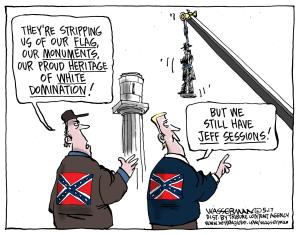
Former Alabama Senator Jeff Sessions, now Trump’s Attorney General, is one of many southern politicians whose political career has served to bolster the white nationalist ethos in the U.S.
still cling to the Confederacy’s propaganda for the Civil War. So it is both hopeful and timely that the Mayor of New Orleans firmly denounced sympathy for the South’s lost, bygone cause in a recent speech. If the U.S. finds itself in an identity crisis today, as Brooks says, this speech is the most hopeful sign in these times that we as a nation are maturing and emerging into responsible adulthood.
After the New Orleans City Council voted in 2015 to remove all the city’s statues honoring southern heroes of the Civil War, Mayor Mitch Landrieu delivered the speech last month following the displacement of the renowned General Robert E. Lee’s statue. “The Confederacy”, the Mayor declared, “was on the wrong side of humanity”. The Mayor summed up what the removal of the statues meant for the City, the South, and the Nation with these words,
“This is however about showing the whole world that we as a city and as a people are able to acknowledge, understand, reconcile and most importantly, choose a better future for ourselves making straight what has been crooked and making right what was wrong. Otherwise, we will continue to pay a price with discord, with division and yes with violence.”
The speech included reminders of two facts of the city’s history for the audience and for the nation. First was a reminder of the founding principle of the Southern Confederacy.
“…..the Vice President of the Confederacy, Alexander Stephens, made it clear that the Confederate cause was about maintaining slavery and white supremacy. He said in his now famous ‘cornerstone speech’ that the Confederacy’s “cornerstone rests upon the great truth, that the negro is not equal to the white man; that slavery — subordination to the superior race — is his natural and normal condition. This, our new government, is the first, in the history of the world, based upon this great physical, philosophical, and moral truth.”
Secondly, he celebrated the variety of cultures represented by those who have built the city and called New Orleans “home”.
“You see — New Orleans is truly a city of many nations, a melting pot, a bubbling caldron of many cultures. There is no other place quite like it in the world that so eloquently exemplifies the uniquely American motto: e pluribus unum — out of many we are one.”
And then, like in a great sermon, the Mayor moves and convicts us by recounting a personal experience:
“Another friend asked me to consider these four monuments from the perspective of an African American mother or father trying to explain to their fifth grade daughter who Robert E. Lee is and why he stands atop of our beautiful city. Can you do it? Can you look into that young girl’s eyes and convince her that Robert E. Lee is there to encourage her? Do you think she will feel inspired and hopeful by that story? Do these monuments help her see a future with limitless potential? Have you ever thought that if her potential is limited, yours and mine are too? We all know the answer to these very simple questions. When you look into this child’s eyes is the moment when the searing truth comes into focus for us.”
As citizens of the nation founded on the “truth” that “all men are created equal”, we know in this era of Trump that we each of us are responsible for making real and living out this lofty founding vision of the nation. We remember that the man who wrote the words of the Declaration of Independence was himself a Virginia owner of slaves who also wrote these words,
“I tremble for my country when I reflect that God is just; that his justice cannot sleep forever.” – Thomas Jefferson
Is it possible that the country will in this time of political crisis finally address some of the ugly and brutal truths of our history and move on to “form a more perfect Union”? Is it possible that in this time we in the U.S. will join in efforts to “more closely connect with integrity to the founding principles of our nation” and move toward the “justice” Thomas Jefferson only dreamed about? The unity and future health of the United States depends on it.


 Erasing Borders