Category Archives: U.S. Peace Movements
Land and Theologies in Conflict
| Territory | Arab and other population | % Arab and other | Jewish population | % Jewish | Total population | |
|---|---|---|---|---|---|---|
| Arab State | 725,000 | 99% | 10,000 | 1% | 735,000 | |
| Jewish State | 407,000 | 45% | 498,000 | 55% | 905,000 | |
| International | 105,000 | 51% | 100,000 | 49% | 205,000 | |
| Total | 1,237,000 | 67% | 608,000 | 33% | 1,845,000 | |
| Data from the Report of UNSCOP: 3 September 1947: CHAPTER 4: A COMMENTARY ON PARTITION | ||||||
Dating back to extensive use of “Kairos” in the New Testament, “kairos” in Christian theology refers to a time when the “kingdom of God” approaches and demands a decision from individuals and societies. In contrast with the Greek “chronos” meaning a segment of time, ordinary time, “kairos” describes a critical moment in a human context of social change. The first Kairos Document was written by an ecumenical team of South African Christian black theologians in 1985 at the height of the black population’s resistance to apartheid.
Secular media paid even less attention to the Kairos Palestine Document of 2009 than they did to the original South African Document or the other theological statements, including those in the U.S. and Europe, responding to the 1985 declaration of South African theologians. Since the Hamas attacks in October 2023 some commentators have noted how little reference to the Palestinian cause or Israel’s Palestinian occupants has been made in our media since founding of the state of Israel in 1948. So it is not surprising that outside of church circles there has been little notice of the Kairos Palestine Document.
The Document begins with an endorsement by thirteen “Patriarchs and Heads of Churches” in Jerusalem; they describe the declaration as “a word of faith, hope and love” calling on “all peoples, political leaders and decision-makers (to,ed.) put pressure on Israel and take legal measures in order to oblige its government to put an end to its oppression and disregard for the international law.” The thirteen Palestinian Christian authors advance a theological position “that the military occupation of our land is a sin against God and humanity, and that any theology that legitimizes the occupation is far from Christian teachings because true Christian theology is a theology of love and solidarity with the oppressed”.
In its theological discussion of the land governed or occupied by the State of Israel, the authors affirm that “the earth is the Lord’s and the fullness thereof” (Ps 24:1) and therefore assert no land can be seen as the possession of any particular people. Exclusion and expulsion of any group or groups from the land cannot be God’s intention. “God gives us the capacity, if we have the will, to live together and establish in it justice and peace, making it in reality God’s land.” The Kairos Palestine Document avers that the promise made by God to Abraham in the Hebrew Bible was to make him father of many nations living in justice and harmony in the land where he had been led.
In the current context of Israel’s continuing its indiscriminate killing of Palestinian civilians in Gaza, the 2009 Document takes on yet more urgent significance as a cry for justice to Christians and non-Christians worldwide. When issued, the conflict no longer was about a purely theological or political issue. “It is a matter of life and death” the authors and signators declared sixteen years ago and, as such, the Word of God in the Bible cannot be used to justify policies or State actions which bring death and destruction. As a living Word which addresses the Hebrew and Christian Bible’s themes of promise, chosen people, and land a literal interpretation makes the Word an instrument of death.
On the Bible’s treatment of the crucial topic of “the land” the Kairos Palestine Document was followed six years later by publication of the book From Land to Lands, from Eden to the Renewed Earth . Written by the young theologian and pastor Munther Isaac (see Erasing Borders blogs of September 1 and January 16, 2024), it is a sweeping study of a “Biblical theology” supporting a thesis of the universalisation of the land, indeed any land. Its lively and clear presentation of the positions of biblical scholars and theologians enables a closer reading of the texts by laypersons and their progress in shaping their own views. Although the author did not participate in creating the Kairos Palestine Document the book was written in service of its aims and concludes by asking, “Can it (the land) become a place where Jews, Muslims and Christians – while retaining their distinctive beliefs – can embrace each other as fellow human beings, and indeed as people of faith, and be reconciled in practice?”
Opposition to U.S. Christian Zionism
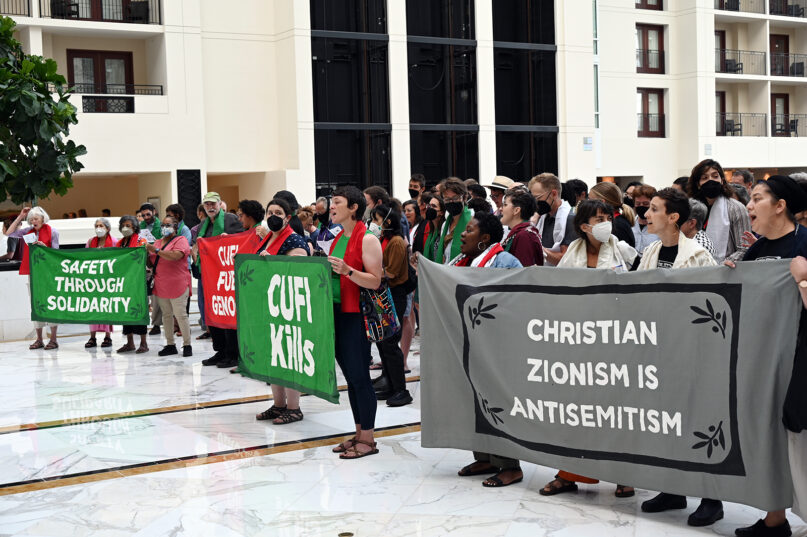
In a coast to coast tour of the U.S., the Palestinian Lutheran Pastor Rev. Munther Isaac, delivered the message to U.S. Christians and their leaders that our “Silence is Complicity”. Citing our unconditional official support for Israel’s War on Gaza and now on the West Bank occupied territories, Rev. Isaac appealed to all Christians to do more than pray in this time of unprecedented death and destruction in Gaza and the West Bank. Rev. Isaac told an interviewer, “I’m here to talk to faith leaders, and particularly church leaders – my own community – to speak louder, for it’s been 10 months now since this war has broken, and we’re tired of void calls for peace.”
The pastor of Bethlehem Christmas Lutheran Church reserved praise for those U.S. Christians joining rallies and demonstrations in opposition to continued sale of U.S. weapons and outright aid to Israel. Condemned most emphatically were the some 10 million members of Christians United for Israel (CUFI). The Palestinian Christian leader was encouraged by rallies held in opposition to the group during the CUFI annual convention held in Maryland this year on the banks of the Potomac River. The interfaith group demonstrating against the group’s position was around 700 people (est. of Religion News Service) with most of the leading U.S faith communities represented. Jewish organizations Jewish Voice for Peace, Rabbis for Ceasefire and If Not Now made a prominent impact during three days of rallies condemning CUFI. Jewish Voice for Peace members created a flotilla of 25 kayaks which unfurled on the Potomac a banner reading “CUFI kills”. The leader of Hindus for Human Rights summarized his organization’s intent in participating, “There is equal and inherent dignity in all of us, and so an attack on the people of Gaza is an attack” on all of humanity. (from the RNS article of July 30, 2024)
Rev. Isaac’s two week tour coincided with the CUFI convention and in interviews and sermons he called attention to the division among U.S. Christians that CUFI has deepened. In his July 30 interview with Amy Goodman of Democracy Now he described the rapidly growing organization’s theology. “The idea was that Jews will someday be restored, using a theological term, which really means convert to Christianity, embrace Jesus as their Messiah. And for that to happen, they must be in Palestine, the biblical land.” Along with this anti-Semitic theological vision is the potent irony that Christian Zionists greatly outnumber and predate Jewish Zionists.
Before returning to Palestine Rev. Munther Isaac preached at Riverside Church in New York City where Rev. Martin Luther King called for a revolution in values in the Church and nation in his April 1967 “Beyond Vietnam” sermon. Rev. Isaac delivered two urgent messages to U.S. Christians prior to his departure. First was the plea to acknowledge that the Palestinian people had lived on the land of the State of Israel long before its creation in 1948. Contrary to the neglect and failure to mention the historic Palestinian presence by the U.S. and Israeli media since 1948, Rev. Isaac reminded audiences that “Israel was not created on an empty land”.
A second message comes from the Pastor’s surveying the response of Christians world wide to the ethnic cleansing taking place under the Israeli occupation of Gaza and the West Bank. “Gaza has become the moral compass of the world” Isaac observed; it has divided even many Christians. And I think that’s a good thing, because we need to know where you stand.”
Nowhere is the division between Christians more pronounced and longstanding than in the country with the world’s largest number of Christians. Nowhere is the division deeper or the political consequences greater than in this nation. Sen. Lindsay Graham spoke for millions of CUFI members and other U.S. Christians when he stated, “As a young man in South Carolina, I was raised to understand that God blesses those who bless Israel, and that’s my foreign policy. It’s not that complicated.”
It is not complicated for Sen Graham and so many U.S. Americans because they have not given thought to the fate of the territory’s original occupants over the last one hundred years. At the beginning of the League of Nations approved British Mandate in 1920 the population of what was commonly called Palestine comprised 757,182 persons of whom 78% were Muslim Arabs, 11% Jewish and 9% Christian. As a Jewish-Arab War raged onin 1946-48, the U.N. created a partition plan of two states using figures reflecting a considerable increase in Jewish numbers. In the plan proposed by the U.N., Jews slightly outnumbered Arab Muslims and Christians in the Jewish state created by the partition plan while Arabs overwhelmed Jewish numbers in the new Arab state.
The 1946-48 War created over 700,000 Arab refugees whose land and homes were seized by Jewish armed force. Since the original “nakba” or disaster in Arabic, the Palestinians residing within the expanding borders of Israel continue their decline. In view of the impunity granted Israel in removing Palestinians by the U.S. and the West’s former colonial powers it is now unlikely the occupiers will ever agree to a “two state solution”. Nor will Palestinians who have resisted the seizure of their historic homeland for more than a century. No U.N. plan or resolution has proposed or will ever propose that Israel rule from “the River to the Sea”.
************************* ***********************
To listen to Rev. Munther Isaac’s sermon “Your Silence is Complicity” preached at Riverside Church New York City go to minute 40 of the You Tube video at: https://www.fosna.org/videos/v/riverside
For his Christmas sermon “Christ in the Rubble” preached at his home church in Bethlehem in Palestine go to the January 16 erasing-borders blog post or to: https://www.youtube.com/watch?v=ZPTrmN6Dzmw&list=FLP7qpo6R2ZdZ4sLKnDwFAng The sermon transcript can also be found there.
Nearer to Gaza November 15, 2023

He couldn’t have been more than 17 seated across from a
middle aged man scrutinizing an Arabic newspaper
at the clothed table facing the
entrance “A snack” he responded quickly to my question about a
spinach/cheese roll wrapped in a delicate pastry dedicated to
protecting his mother from embarrassment with her timorous
perfectly constructed English “Two minutes” she assured me
holding up fingers as her husband made his appearance to
ask something before rushing back to the kitchen in an
effort to avoid messaging impatience I ambled over to
the tea sets displayed on a table under a Palestinian flag
spanning the length of the table and a t.v. tuned to Al-Jazeera
Arabic reporting on a protest at Democratic headquarters and
I said I hear Al-Jazeera English is very different from Al-Jazeera
Arabic the boy said he watches the Arabic only at the restaurant
for his mother the cook assistant to her husband and receptionist
because you know mumbling something “I don’t know if there’s
a difference” and I left wondering why the Arabic restaurant and
grocery also Palestinian owned and managed at the back of the
compound does not have a flag on the wall and whether it takes
courage.
Peace Warrior and Prophet A.J. Muste

Martin Luther King, Jr. commented to Nat Hentoff in the mid-1960’s, “I would say unequivocally that the emphasis on non violent direct action in the civil rights movement is due more to A.J. (Muste) than anyone else in the country.” During the early years of the movement, A.J. Muste as President of the Fellowship of Reconciliation hired the principal organizers of the “freedom rides” on buses in the south. Among them were Bayard Rustin, leader of the 1963 March on Washington, James Farmer founder of CORE and George Houser, founder of the American Committee on Africa.
I wrote several blog posts in 2020 on the pioneer U.S. organizer of non-violent protest A.J. Muste. Following the police killing of George Floyd that year, the human right to demonstrate publicly against the actions of government and powerful institutions was exercised repeatedly as the most effective counter force to policies of the outgoing Trump administration. Civil disobedience and non-violent resistance had at the time already proliferated with the spread of authoritarian regimes worldwide.
Although the life and work of Rev. A.J. Muste has yet to be celebrated in a comprehensive biography, I want to share news of four videos made recently focusing on the leading U.S. revolutionary non-violent resister of the 20th century. The videos total over 6 hours recounting the progression of Muste’s life from his pacifist opposition to WW I to Trotskyite labor organizer, his return to the church and subsequent leadership in civil rights and anti war movements.
The videos’ interviews with trainers and organizers of non violent resistance such as civil rights leader Rev. James Lawson and founder and head of the War Resisters League David McReynolds establish Muste as having introduced non violent theory and practice to key U.S. protest organizers in the last century. In his eighties he continued to organize or serve as lead consultant for anti-Vietnam War demonstrations and draft resistance public actions. His role in shaping the civil rights’ struggle’s reliance on non violent civil disobedience is emphasized by several of the interviewees.
All four videos were made by David Schock, former English professor at Hope College in Michigan, Muste’s alma mater, in collaboration with Dr. Kathleen Verduin also of Hope College. Here is the link to an excerpt, the final minutes of the second video “The No. 1 U.S. Pacifist”, which concludes with Muste’s dream of a peacemaking U.S. foreign policy:
The four complete videos can be accessed on the web site A.J. Muste: Radical for Peace. Also on the site is a request to donate to help cover the video project’s costs covered by the two creators of the film.
In another tribute to Muste’s prominence as the leading opponent of the U.S. war machine and foreign interventions, Professor Noam Chomsky in 1967 wrote at length about the recently deceased Muste’s contributions in the Sidney Lens/Muste Liberation magazine. It is at:
Thich Nhat Hanh and “Mindful” Peacemaking

In the last six months we’ve lost three leaders whose contributions to peace and reconciliation will last beyond our lifetimes. Desmond Tutu’s work on behalf of interpreting and organizing the Truth and Reconciliation Commission in post-apartheid South Africa is best known today. Among activists and advocates for peace, Thich Nhat Hanh’s role as the leading Vietnamese Buddhist peacemaker is well known in the U.S. and Europe. Less widely known at present is the African-American feminist and Buddhist writer bell hooks. Her meeting with “Thay” or “teacher” as Nhat Hanh was called by his followers bolstered hooks’ growth in Buddhist thought.
The former Director of the Fellowship of Reconciliation (FOR) Emma Jordan-Simpson described bell hooks’ account of meeting Thay in the late 1960’s with these words:
“When she (hooks) was introduced to Thay, she blurted it out: “I’m so angry!” Immediately she felt ashamed. In the presence of a loving teacher, she was only able to bring up the ugliness she was feeling inside!” Simpson continues with Thay’s response. “Thay’s words to bell hooks are the words that all of us who are exhausted and depleted by what it means to live in a world perpetually at war, but who are still able to feel anger, need to hear and to hold.”
Thay said to hooks, “Hold on to your anger and use it as compost in your garden.” The FOR Director commented on hooks’ encounter, “We are angry that we live in a perpetual state of war and we are angry about what these times are revealing to us. But we reveal who we are when we can find ways to use that anger as compost in gardens growing peace”.
Martin Luther King acknowledged Thich Nhat Hanh as having helped lead him to oppose publicly the U.S. War in Vietnam. After his “Beyond Vietnam” speech in April, 1967 King nominated the Buddhist leader for the Nobel Peace Prize. His conversation with Thay was arranged by the FOR, which sponsored Nhat Hanh’s tour of the U.S. after the escalation in Vietnam. Thay’s gentle, forceful presence accompanied by words of profound compassion for perpetrators and victims of the War on his country led many other people in the U.S. to question if not strongly oppose their nation’s mission in Vietnam. His stories and views had a profound impact on people’s stance on the War. But it was also his interpretations and descriptions of Buddhist practices that made a lasting impression on the lives of many.
In a 1974 article for Fellowship magazine, the journal of FOR, Thay wrote about one encounter with a U.S. Christian. “One day I was asked by a Christian in a bus: ‘Why do you monks burn yourselves to death? It is an awful thing.’ I tried to explain to him what Thich Quang Duc wanted when he set himself on fire. But the gentleman did not want to listen. He said ‘I can’t understand a religion that allows its members to burn themselves.’”
Thay then reflected in the article on the encounter, “I could have told him that I did not believe that Christianity could allow its followers to go and burn other people either. Thousands of women and children have been burned by napalm that was dropped from the sky. But what is the purpose of such a discussion?” Nhat Hanh concludes, “The only thing that counts is the ability to understand the pain of a brother. And this brother is neither a number nor a concept. This brother is made of real flesh and skin and feeling.” He then comments with the insight, “We cannot recognize our brother through an ideology or a political label. People have been shooting at labels and by doing so they have shot many of their brothers and sisters.”
Thich Nhat Hanh concludes the opening chapter of his best known book in English, The Miracle of Mindfulness with the question, “If you spend all day practicing mindfulness, how will there ever be enough time to change and build an alternative society”. His answer follows with his calligraphy on the next page:

His practice of “breathing mindfully” is clearly and powefully elaborated for readers unfamiliar with Buddhist thought and many in the West have integrated his instructions in their own meditation. When one is able to live mindfully one is in control of our constantly distracted mind and be fully present in the moment. The essential component of “mindfulness” is attention to our breath. Thay explains, “You should know how to breathe to maintain mindfulness, as breathing is a natural and extremely effective tool which can prevent dispersion. Breath is the bridge which connects life to consciousness, which unites your body to your thoughts. Whenever your mind becomes scattered, use your breath as the means to take hold of our mind again.”
********************************
Order a copy of The Miracle of Mindfulness from your local indie bookshop. It comes in all formats including audiobook.
Read about the friendship of Rev. Dr. Martin Luther King and Thich Nhat Hanh in a book available in the Fellowship of Reconciliation bookstore. Also available at the website below is a copy of the Spring 2020 issue of Fellowship magazine devoted to Thich Nhat Hanh’s articles and poems for the magazine as well as peacmakers’ tributes.
https://forusa.org/product-category/books-pamphlets/
On Being host Krista Tippett paid tribute to Thay in a podcast this winter and replayed her earlier interview with him at:
The Global Reach of Martin Luther King’s “Beyond Vietnam” Speech

The views of Dr. Martin Luther King and Malcolm X were transformed in the 1960’s by their heightened awareness of the global context of the African American struggle in the U.S. The Autobiography of Malcolm X describes the dramatic impact on the American Muslim leader’s 1964 sacred pilgrimage to Mecca in Saudi Arabia and also visiting Egypt on the trip. His travels taught him that the revolution for black freedom and equality in his country was bound up with the movement of oppressed peoples around the world. This enlargement of his historic role also took shape in the vision and leadership of Dr. King.
In celebrating King’s legacy on the now federal holiday, the Baptist preacher’s emphasis on global solidarity of the poor from 1965 until his death in ’68 is often ignored. His call for a “revolution of values” is a call for the nation to move from a “thing oriented” system to a “people oriented” system in its international policies. This would mean, he made clear, that the shift would demand giving priority concern to the effect on the poor worldwide of our policies and not only on those of our nation. “Every nation must now develop an overriding loyalty to mankind as a whole in order to preserve the best in their individual societies.”
The speech, delivered in Riverside Church, New York City, one year to the day before his assassination proclaims that the injustice done to anyone in the country is linked to the injustice perpetrated beyond our borders. The title of the speech “Beyond Vietnam”, we need to remember, is a warning that should the nation fail to recognize the humanity of the Vietnamese people and withdraw our armed forces, we will be fighting next in Venezuela, Peru or El Salvador. The 37 million people displaced by the U.S. led “War on Terror” since 2001 testify to our nation’s failure to learn the lessons of the Vietnam debacle and take King’s prophetic message to heart.
Although the criticism of the nation’s leading media sources, i.e. the New York Times and Washington Post, focused on King’s opposition to the war in Vietnam, the critique of U.S. policies and presence in the world went much deeper and farther. It is a speech not just about the U.S. war on Vietnam. It is a speech about the U.S. defense of an unjust global system. It is a speech with a global reach. It is not just a speech for the Vietnam era. It is a speech for us today and for the future of humankind. Here below is the conclusion of the speech:
“Our only hope today lies in our ability to recapture the revolutionary spirit and go out into a sometimes hostile world declaring eternal hostility to poverty, racism and militarism. With this powerful commitment, we shall boldly challenge the status quo and unjust mores and thereby speed the day when “every valley shall be exalted, and every mountain and hill shall be made low, and the crooked shall be made straight and the rough places plain.”
A genuine revolution of values means, in the final analysis, that our loyalties must become ecumenical rather than sectional. Every nation must now develop an overriding loyalty to mankind as a whole in order to preserve the best in their individual societies.
This call for a worldwide fellowship that lifts neighborly concern beyond one’s tribe, race, class and nation is in reality a call for an all-embracing and unconditional love for all mankind. This oft-misunderstood, this oft-misinterpreted concept, so readily dismissed by the Nietzsches of the world as a weak and cowardly force, has now become an absolute necessity for the survival of man.
When I speak of love, I am not speaking of some sentimental and weak response, I am not speaking of that force which is just emotional bosh. I’m speaking of that force which all of the great religions have seen as the supreme unifying principle of life. Love is somehow the key that unlocks the door which leads to ultimate reality. This Hindu-Muslim-Christian-Jewish-Buddhist belief about ultimate reality is beautifully summed up in the First Epistle of Saint John: “Let us love one another; for love is God and everyone that loveth is born of God and knoweth God. He that loveth not knoweth not God; for God is love. If we love one another God dwelleth in us, and his love is perfected in us.

Let us hope that this spirit will become the order of the day. We can no longer afford to worship the god of hate or bow before the altar of retaliation. The oceans of history are made turbulent by the ever-rising tides of hate. History is cluttered with the wreckage of nations and individuals that pursued this self-defeating path of hate. As Arnold Toynbee says, ‘Love is the ultimate force that makes for the saving choice of life and good against the damning choice of death and evil. Therefore the first hope in our inventory must be the hope that love is going to have the last word,’.
We are now faced with the fact, my friends, that tomorrow is today. We are confronted with the fierce urgency of now. In this unfolding conundrum of life and history, there is such a thing as being too late. Procrastination is still the thief of time. Life often leaves us standing bare, naked and dejected with a lost opportunity. The “tide in the affairs of men” does not remain at the flood; it ebbs. We may cry out desperately for time to pause in her passage, but time is adamant to every plea and rushes on. Over the bleached bones and jumbled residues of numerous civilizations are written the pathetic words: “Too late.” There is an invisible book of life that faithfully records our vigilance or our neglect. Omar Khayyam writes, “The moving finger writes, and having writ moves on…” We still have a choice today: nonviolent coexistence or violent co-annihilation.
We must move past indecision to action. We must find new ways to speak for peace in Vietnam and justice throughout the developing world, a world that borders on our doors. If we do not act, we shall surely be dragged down the long dark and shameful corridors of time reserved for those who possess power without compassion, might without morality, and strength without sight.
Now let us begin. Now let us rededicate ourselves to the long and bitter — but beautiful — struggle for a new world. This is the calling of the sons of God, and our brothers wait eagerly for our response. Shall we say the odds are too great? Shall we tell them the struggle is too hard? Will our message be that the forces of American life militate against their arrival as full men, and we send our deepest regrets? Or will there be another message, of longing, of hope, of solidarity with their yearnings, of commitment to their cause, whatever the cost? The choice is ours, and though we might prefer it otherwise, we must choose in this crucial moment of human history.”
*********** ***********************
For an audio recording and the text of the speech go to:
https://www.americanrhetoric.com/speeches/mlkatimetobreaksilence.htm

A.J. Muste Speaks

A.J. Muste’s theology and beliefs were shaped by the “agonizing reappraisal of my beliefs” forced on him by U.S. entry into WW I. His unwavering commitment to living out a Christianity as a “prophetic religion” emerged from his immersion in the imagery and testimony of the prophet Isaiah’s “suffering servant” and the “Way of the Cross” of Jesus. Contrary to most persons’ grim reaction to these passages and the life journey extolled in them, Muste lived with a joy few could fathom. At age 81, on the way to a Saigon jail during the Ky dictatorship, he smiled and said to a companion in the paddy wagon, “It’s a great life, isn’t it?”
Muste on Theology and Religion:
“My religion is Jewish-Christian Prophetism….From this point of view there is no such thing as a Jewish religion and then another Christian religion. There is just one basic prophetic outlook on life and history.”
“We must become revolutionary out of a religious philosophy.”
“Though the religious dimension of life is not the same as the political dimension it is nonetheless true that God created both dimensions and place us in a world where we need to build community that interweaves these two together.”
“Pacifism, the rejection of violence, the emphasis upon the method of suffering love is integral to…..prophetic religion.”
“A dead man on a cross against the atomic bomb….there is no other way.”
“There is no one who has experienced the miracle of grace ….who can believe there is any limit to what the divine power and grace can accomplish.”
“Personally, I always have a certain suspicion of alleged saintliness which lacks the tone of buoyancy and effervescence.”
In an introduction to a 1965 essay titled “Who Has the Spiritual Atom Bomb?” Muste concluded with the words, “Long ago I heard someone – I cannot remember whom – say: ‘A man may be right in a situation, but that does not make him more righteous.’ I was deeply impressed. I do not consider myself more righteous than those with whom I am in disagreement on the matters dealt with in this essay.”
************** **************
On Pacifism and Non-Violent Civil Disobedience
Unlike Gandhi, Muste wrote very little on the theory and practice of non violent civil disobedience. Although he was deemed a brilliant tactician in the application of civil disobedience to oppose growing militarization of the U.S. foreign policy and economy, he largely devoted his writing to exposing the roots and likely results of particular U.S. policies. What is consistent in Muste’s tactical response is his radical, absolutist position. From advocacy of non-cooperation and disobedience of Selective Service requirements to tax resistance, from arguing for unilateral disarmament of nuclear weaponry by the U.S. to immediate withdrawal of all U.S. troops from Vietnam he saw compromise as perpetuating the murder of innocents wherever armed force was the policy.
From Muste’s “Sketches for an Autobiography” 1957
“Spiritual forces are as real as physical or military….the trouble is mainly that we want to have both. We want to trust God and have plenty of H-bombs too, just in case. The fact is, we can’t have it both ways. We have to choose on what level, with what weapons, we shall wage the battle, and accept the risks and consequences involved. There are risks either way.”
“Nonviolence in a broader sense is not our weakness. It is our strength. Violence in a profound sense is the evil, the temptation of our time. Nonviolence –‘gentleness’ as a leader of the French resistance put it in a meeting which I attended in 1947 – is what the victims of war and all makind cry out for now. Nonviolence is in fact ‘weak’ partly because we waver in our own allegiance to it. It is ‘weak’ in practice because our practice of it is sentimental, dogmatic, abstract, and not imaginative, creative and revolutionary. But for nonviolent revolutionaries, it is equally imperative to be nonviolent and revolutionary, to be revolutionary and nonviolent.”
*************** ****************
Political and Social Analysis Of the U.S. Context
Following the burning of their draft cards in 1965 by five young men in New York City, as a speaker at the protest Muste was summoned to testify at a Grand Jury investigation. A portion of his statement there follows:
“I am unable to cooperate in the Grand Jury inquisition into my belief and actions because it is an element, though perhaps a minor one, in the prosecution of the Vietnamese war and in the militarization of this country.” He went on in his statement to the Grand Jury, “Demanding conformity and penalizing dissent is a pattern on which all governments tend to operate in wartime…..To have dissent and opposition in wartime may create a problem for a democratic government, but if it does not have citizens who refuse to be coerced and regimented, it is no longer democratic.”
In Muste’s view, the “neo-orthodox” theology of Reinhold Neibuhr and Karl Barth with its emphasis on human sinfulness helped enable the State in the West to become the “operative religion” for most Christians, especially in the U.S.. He feared that the ultimate result would be greater repression of dissent and enforced loyalty of its citizens by the State. Again, it was his experience during the prelude and after U.S. entry into WWI that shaped his analysis of the “crisis” and his response as a Christian.
It was during WW I, Muste noted, that customs were introduced “of having people rise to sing ‘The Star Spangled Banner’”, the organizing of “military parades” and “salutes and pledges to the flag were introduced in schools.” WW I was also the time when churches began to place the U.S. flag near the altar or the pulpit. This was accompanied by many professed Christians calling those who opposed the War “pro-German” as well as participating in persecuting U.S. citizens of German descent. The sacralization of the State continues today and has contributed mightily to public support for decades of warfare on the Middle East led by this nation’s colossal war machine.
At the height of the Cold War with the Soviet Union and China in 1957, Muste wrote in his “Sketches for an Autobiography”, “All but the smallest wars today are fought for global objectives and for ‘causes’ or ideologies regarded as absolute – ‘better no world than a Communist world,’ etc. – and therefore take on the character of crusades. The instruments with which war is waged have a similar, ‘ultimate-weapons’ character.”
Muste’s prophecies regarding the corrosive effects on democracy of our spiraling militarism remain pertinent and will be until the American public demands a change in our policy making and expenditures. The 1965 essay “Who Has the Spiritual Atom Bomb?” warns “The American tendency to self-satisfaction, to be convinced that it is always the other people who are violent and make trouble, is indeed very powerful and in my opinion is one of the greatest obstacles to peace in the world today. The worst sin, according to a great scripture, is that of the Pharisee who dared to stand in the presence of God and say: ‘God, I thank thee that I am not as other men are, or even as this publican.’
And what is the “spiritual atom bomb” Muste refers to in the 1965 essay of that title? The key paragraph reads, “Now if a power like the United States voluntarily withdraws from the arms race and makes the changes in its own social structure which this entails, this would constitute ‘intervention’ of historic dimensions. It would be a revolutionary development comparable in one sense to the Russian and Chinese revolutions themselves. It would, to use Marshal Lin’s phrase, be ‘a spiritual atom bomb….far more powerful and useful than the physical atom bomb.’ The United States would be able to address itself and to devote its vast resources, human and technological, to aiding the impoverished and exploited masses to lift themselves to independence, to human dignity and to a life where the simple human needs of food, clothing, shelter and beauty would be met. Moreover, the spell of conflict might then be broken, as somehow it has to be before long if the human race is to survive.”
As A.J. Muste’s most widely quoted saying put it, “There is no way to peace; peace is the way.”
The Dangerous Rev. A.J. Muste

“was so central to him that his life cannot be understood without realizing that he was, even at his most political moments, acting out his religious convictions.”
In the 1930’s, theologian Reinhold Neibuhr wrote of A.J. Muste, “Muste was interested in redressing all balances of justice, of championing the interests of workers against employers, of Negroes against the white majority, of India against the British empire.” Having abandoned his own pacifist position Neibuhr maintained a grudging respect for the leading U.S. radical pacifist writing after Muste’s death in 1967, “Perhaps an estimate of rigorous, inconsistent, idealists is beyond the capacity of mere academic critics (himself included here, ed.), who are obsessed with logical consistency, but who also never dared an interview with Ho Chi Minh.” Unlike Neibuhr, for Muste “the term ‘religion’ and the term ‘revolution’ were totally synonymous” in the words of Sidney Lens, his co-editor with Liberation magazine.
Muste’s biographer JoAnn Robinson, herself a leader in the Montgomery bus boycott, gives precedence to his Christian faith as the grounding for his radical politics. “A. J. Muste became “Number One U.S. Pacifist” by virtue of his keen insight into the nature of violence and his unquenchable faith in the power of love. His reputation for political acuity and non-conformist activism revolved around his insight. But the prime and sustaining factor was his faith.” This faith he once described this way, “The true God is the God of love who can and does redeem men. This God is revealed in Jesus Christ. The true church is the ‘ecclesia of those redeemed by infinite love. It must seek to redeem the world without which there is no salvation and that to it are entrusted the ‘keys of the Kingdom of Heaven”.
A French intelligence agent in Dostoyevsky’s The Brothers Karamazov could have been thinking of the radical pacifist and socialist when he said, “We are not, in fact, afraid of all these socialists, anarchists, atheists, and revolutionaries.” The agent then goes on to say, “But there are some special people among them, although not many: these are believers in God and Christians, and at the same time socialists. They are the ones we are most afraid of; they are terrible people! A socialist Christian is more dangerous than a socialist atheist.”
In the mid-twentieth century, Muste did threaten the U.S. political system and the economic system that feeds as well as depends on its militarism, racism and support for exploitation of oppressed peoples. But he also threatened and “afflicted the comfortable” among the Church’s leaders, most of whom had adopted some variant of the “neo-orthodox” realism Neibuhr developed in his theological writing.
It is curious that Neibuhr would imply criticism of Muste being “inconsistent” in his thought when it is precisely the inconsistency of Christian “realism” that must perplex thoughtful truth seekers in the U.S. and the world. How account for even the most progressive American Christian denominations’ support for the Vietnam War in the early years of the fighting? How explain the relative silence of the followers of the “Prince of Peace” in the face of the grotesque spiraling of U.S. arms buildup by the military and now by individuals in the country?
Once Muste left the Trotskyite party he helped found in the mid-30’s to lead the opposition to an armed response to Naziism, he was committed to strengthening the pacifist roots of the Church as the holders of the keys to the “kingdom of heaven”. The struggle for peace, however, was not narrow and single-minded but encompassed early support for the cause of African-American civil rights and the right to self rule of Third World peoples. Post WW II Muste helped found and/or led several pacifist or anti-war organizations but he also devoted himself to many causes that represented “the things that make for peace”.
Shortly Before assuming his transformative leadership of the Fellowship of Reconciliation, Muste wrote in 1939 that the “True International” was not to be found in any anti-capitalist political party but in the Church. “Since all are one in Christ” he professed there is “neither Aryan, Negro, Slav. Japanese, or Malay.” In the same article he lamented that to that date “all of its branches including those called ‘catholic’ have been in effect national, state-worshipping or picayune provincial sects”.

Muste’s pacifism grew from his grounding in Jesus Christ’s boundless and border-less love for all people and the belief and hope in the Church as universal, the “true International”. His application of pacifism and development of strategies of civil disobedience for the American struggle relied on Gandhi and insights into the interaction of “means and ends”. When human beings resort to means that undermine the ends they hope to achieve they are bound to fail. War begets more war. Violence begets more violence is the practical distillation of Muste’s thought. Only the love that seeks to find reconciliation with the “enemy” will fulfill and liberate both those who suffer the attacks and the perpetrators.
The scriptures of the Judeo-Christian faith and recent world history both confirm the truth that those who seek to live out a radical love for other people will be considered “dangerous”. U.S. military solutions to conflicts in Asia, the Middle East and elsewhere confirm the truth that, in Martin Luther King’s words, “we have allowed the means by which we live to outdistance the ends for which we live”. It is the “dangerous” people like A.J. Muste who shepherd humanity in the preservation of the ends of life and the preservation of life itself in these perilous times.

A.J. Muste the Protestant Saint
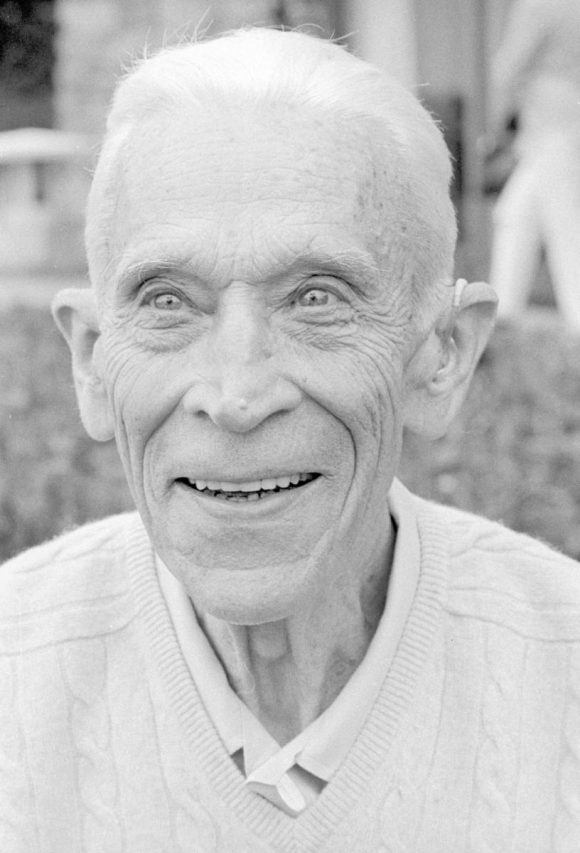
He introduced Martin Luther King Jr. to the theory and practice of non violent civil disobedience.
In 1947 he organized the “Journey of Reconciliation” during which blacks and whites sat together on Greyhound buses traveling through the South. That “Journey” served as the model for the civil rights movement’s “Freedom Rides” in 1961.
He was lead organizer of the first mass protest against the Vietnam War. The march from Central Park to the United Nations on Tax Day, April 15, 1967 was at the time the largest demonstration in U.S. history.
He served as spokesperson for the mostly immigrant workers during the historic Lawrence, MS textile mill strike of 1919.
Following the gains made by the Lawrence workers, he served as the first head of the Amalgamated Textile Workers Union until 1921. In the position, he supported organizing nearly weekly strikes at mills across the U.S.
He trained union organizers as education director of the Brookwood Labor College from 1921 to 1933.
When he died in 1967, obituaries referred to him as the “American Gandhi”.
If you haven’t named who “he” is you are not alone. Few people in churches, or outside them, in the U.S. know about the contributions of Abraham Johannes Muste to the labor and peacemaking movements in the U.S. Yet Muste would be a candidate for sainthood if there were saints in Protestant Christianity. He served the Church as a clergy member in four different U.S. Protestant denominations but his call eventually led him to leadership in the labor and peace movements of his adopted country. Until his death in 1967, Muste remained a radical practitioner of the theology of the “Social Gospel”.
In the first congregation he served, he opposed U.S. entry into the First World War and, against the wishes of many in the congregation, resigned. From the crucible of the WW I era to the end of his life, he helped organize mass actions of civil disobedience in resistance to U.S. warfare and militarism. Muste was the first to declare, “There is no way to peace; peace is the way”. Another Muste saying, often attributed to others, he coined as an early protestor of the Vietnam War. During a White House vigil in a rain storm, someone asked him if he really thought he was going to change U.S. policy that way, he responded, “I’m not out here to change U.S. policies. I’m here to make sure they don’t change me.”
Like no other American Christian of the 20th Century AJ Muste lived out his faith in the nation’s public sphere. In his work and writing, he adhered to the values of the Sermon on the Mount and chapter 25 of the Gospel of Matthew. His radical pacifism grew out of his devotion to living by the roots of the Christian faith. Muste believed that as Christians we are all called to be “Saints for This Age”. While he based this conviction on the lives of the first Christians as reported in The New Testament, his passion for social change was also fired by the horrors of 20th Century militarism and by the example of radical leftists in the labor movement.
In the 1962 essay titled “Saints for This Age”, Muste wrote “It was on the Left – and here the ‘Communists of the period cannot be excluded – that one found people who were truly ‘religious’ in the sense that they were completely committed, they were betting their lives on the cause they embraced. Often they gave up ordinary comforts, security, life itself, with a burning devotion which few Christians display toward the Christ whom they profess as Lord and incarnation of God.” In the next paragraph, he contrasts the “liberal” Christians who professed the “Social Gospel” with these non-Christian radical leftists.
“The Left had the vision, the dream, of a classless and warless world, as the hackneyed phrase goes…..Here was the fellowship drawn together and drawn forward by the Judeo-Christian prophetic vision of a ‘new earth in which righteousness dwelleth’. The now generally despised Christian liberals had had this vision. The liberal Christians were never, in my opinion, wrong in cherishing the vision. Their mistake, and in a sense, their crime, was not to see that it was revolutionary in character and demanded revolutionary living and action of those who claimed to be its votaries.”
Christian faith, and the first Christians who modeled faith for AJ Muste, was profoundly counter-cultural. “I spoke of the early Christians as having ‘broken loose’. They understood that for all its size, seeming stability and power, the ‘world’, the ‘age’ in which they lived was ephemeral, weak, doomed…..They had therefore turned their backs on it, did not give it their ultimate allegiance, were not intimidated by what it could do to them, and did not seek satisfaction and security within its structure, under its standards. They were loose – not tied to ‘business as usual’.” Muste himself was not “tied to ‘business as usual’” and will serve Christianity and humanity as a “saint” for this and for ages to come.
Martin Luther King’s Response to “2019: The Best Year Ever”
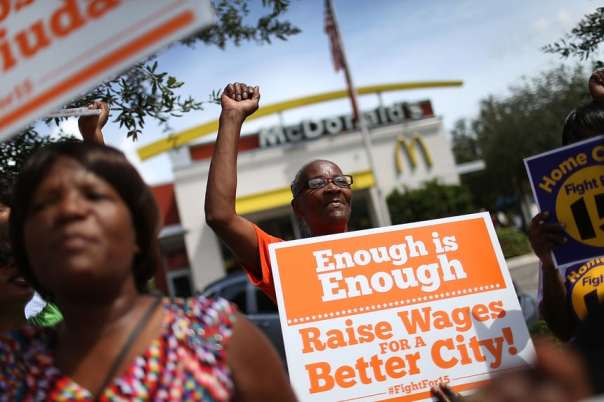
The U.S. federal minimum wage of $7.25/hr. has not been changed in over ten years, the longest delay in history. Photo by Joe Raedle/Getty Images
“There is nothing, except a tragic death wish, to prevent us from reordering our priorities, so that the pursuit of peace will take precedence over the pursuit of war” declared Rev. Dr. Martin Luther King in his “Beyond Vietnam” speech of 1967. Comparing the speech’s description of the state of the poor in the U.S. and the world with Nicholas Kristof’s year end New York Times article “2019: The Best Year Ever” (The focus of our last erasing-borders blog) reveals how far this country is lagging behind in alleviating the effects of poverty and inequality. No reader of King’s speech can doubt the speaker would despair over his country’s failure in the last 52 years to take leadership in championing the “world revolution” that he called for. Instead we find evidence that the “tragic death wish” King referred to has tightened its grip on U.S. political and economic life. We have, in fact, led in taking on “the role of those who make peaceful revolution impossible by refusing to give up the privileges and the pleasures that come from the immense profits of overseas investment”.
In the Comments on Kristof’s article celebrating the advances of the world’s poor in 2019, several readers expressed dismay over conditions in the U.S. “In terms of the United States, I think of a giant ocean liner which takes several miles to turn” one reader wrote. Kristof sympathized with the reader’s view and noted, “It’s striking that life expectancy in the U.S. has now fallen for three years in a row, even as it is lengthening abroad.” Responding to another letter, Kristof wrote, “In Shannon County, South Dakota (with a mostly Native American population), the life expectancy is lower than in Bangladesh.” Another reader of the article emphasized one instance, among many, of the current U.S. administration’s opposition to joint international efforts to fight disease. ‘President Trump called for a 29% cut to the Global Fund to Fight AIDS, TB and Malaria for 2020 and his administration didn’t even show up to Global Fund preparatory funding meetings”.
The continuing tendency of the U.S. to gl
o it alone or with the support of very few “coalition” partners in its wars and policies of international politics might cause Dr. King the greatest concern were he alive today. He declared in the speech, given one year to the day before his death, “A genuine revolution of values means in the final analysis that our loyalties must become ecumenical rather than sectional.” Rather than feeding humanity’s inclinations to tribalism, suspicion and fear of “the other”, King urged, “Every nation must now develop an overriding loyalty to mankind as a whole in order to preserve the best in their individual societies.” The urgency of his call for international cooperation reaches its height in the speech’s concluding section. Turn from the national “death wish”, he pleads, for “We can no longer afford to worship the god of hate or bow before the altar of retaliation.” He pleads for love of all “mankind” on the part of us all: “History is cluttered with the wreckage of nations and individuals that pursued this self-defeating path of hate.”
As citizens of the U.S. begin the presidential election year of 2020 many doubt the possibility of their nation reversing its course of self destruction. Of those, many would agree with Dr. King’s diagnosis of the nation’s persistent ills in the 1967 “Beyond Vietnam” speech. But many of them would not share his vision that “America, the richest and most powerful nation in the world”, can now lead the way in this revolution of values. “There is nothing”, our nation’s prophet declared, “to keep us from molding a recalcitrant status quo with bruised hands until we have fashioned it into a brotherhood.” Certainly there are many who also have doubted the truth of the three thousand year old prophecy that “every valley shall be exalted, and every mountain and hill shall be made low” (Isa. 40)
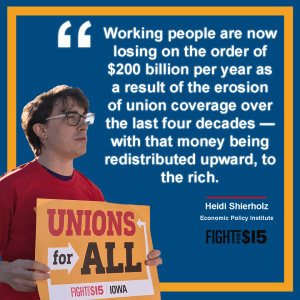
Sen. Sanders has defended the rights of workers to organize strong unions throughout his 40 year career in politics.
As a person of faith in a loving Creator, as a person who has seen in my own lifetime the great vision of Isaiah become a reality in the lives of families and societies, I do believe the people of this nation can mold a new status quo and do it in the year 2020. I believe there is a presidential candidate who represents and has represented for over 40 years the kind of change the prophets Isaiah and Dr. King called for. And I believe this candidate is well on the way to creating a movement, stronger and more durable than any campaign organization, that will carry him to victory in the election and will continue to advocate and organize support for policies of peace and justice long after his victory. There is a leading candidate for U.S. President who has over a forty year career in politics fought for the “revolution of values” Dr. King spoke about. The candidate’s name is Senator Bernie Sanders.
Sen. Sanders is the only politician in the U.S. capable of leading a presidential administration committed to putting “people above profits”. He is the only candidate for president whose victory would enable pride that our democracy still can bear the dramatic change, the “peaceful revolution”, King called for years ago. With the election of Sen. Sanders as president no one loses and everyone gains a more hopeful world in 2020.

Alexandria Ocasio Cortez (AOC) worked for the Sanders campaign in 2016 and was elected to Congress in 2018 along with other progressive young women newly elected that year. Three of the four members of the group, now known as the Squad, have endorsed Sanders. Photo from Commondreams.org


 Erasing Borders