Monthly Archives: January 2020
Martin Luther King’s Response to “2019: The Best Year Ever”
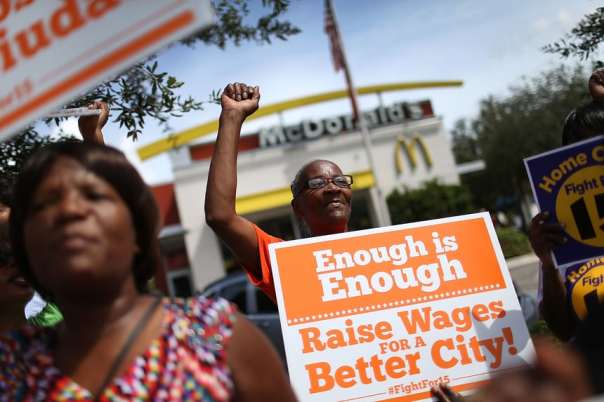
The U.S. federal minimum wage of $7.25/hr. has not been changed in over ten years, the longest delay in history. Photo by Joe Raedle/Getty Images
“There is nothing, except a tragic death wish, to prevent us from reordering our priorities, so that the pursuit of peace will take precedence over the pursuit of war” declared Rev. Dr. Martin Luther King in his “Beyond Vietnam” speech of 1967. Comparing the speech’s description of the state of the poor in the U.S. and the world with Nicholas Kristof’s year end New York Times article “2019: The Best Year Ever” (The focus of our last erasing-borders blog) reveals how far this country is lagging behind in alleviating the effects of poverty and inequality. No reader of King’s speech can doubt the speaker would despair over his country’s failure in the last 52 years to take leadership in championing the “world revolution” that he called for. Instead we find evidence that the “tragic death wish” King referred to has tightened its grip on U.S. political and economic life. We have, in fact, led in taking on “the role of those who make peaceful revolution impossible by refusing to give up the privileges and the pleasures that come from the immense profits of overseas investment”.
In the Comments on Kristof’s article celebrating the advances of the world’s poor in 2019, several readers expressed dismay over conditions in the U.S. “In terms of the United States, I think of a giant ocean liner which takes several miles to turn” one reader wrote. Kristof sympathized with the reader’s view and noted, “It’s striking that life expectancy in the U.S. has now fallen for three years in a row, even as it is lengthening abroad.” Responding to another letter, Kristof wrote, “In Shannon County, South Dakota (with a mostly Native American population), the life expectancy is lower than in Bangladesh.” Another reader of the article emphasized one instance, among many, of the current U.S. administration’s opposition to joint international efforts to fight disease. ‘President Trump called for a 29% cut to the Global Fund to Fight AIDS, TB and Malaria for 2020 and his administration didn’t even show up to Global Fund preparatory funding meetings”.
The continuing tendency of the U.S. to gl
o it alone or with the support of very few “coalition” partners in its wars and policies of international politics might cause Dr. King the greatest concern were he alive today. He declared in the speech, given one year to the day before his death, “A genuine revolution of values means in the final analysis that our loyalties must become ecumenical rather than sectional.” Rather than feeding humanity’s inclinations to tribalism, suspicion and fear of “the other”, King urged, “Every nation must now develop an overriding loyalty to mankind as a whole in order to preserve the best in their individual societies.” The urgency of his call for international cooperation reaches its height in the speech’s concluding section. Turn from the national “death wish”, he pleads, for “We can no longer afford to worship the god of hate or bow before the altar of retaliation.” He pleads for love of all “mankind” on the part of us all: “History is cluttered with the wreckage of nations and individuals that pursued this self-defeating path of hate.”
As citizens of the U.S. begin the presidential election year of 2020 many doubt the possibility of their nation reversing its course of self destruction. Of those, many would agree with Dr. King’s diagnosis of the nation’s persistent ills in the 1967 “Beyond Vietnam” speech. But many of them would not share his vision that “America, the richest and most powerful nation in the world”, can now lead the way in this revolution of values. “There is nothing”, our nation’s prophet declared, “to keep us from molding a recalcitrant status quo with bruised hands until we have fashioned it into a brotherhood.” Certainly there are many who also have doubted the truth of the three thousand year old prophecy that “every valley shall be exalted, and every mountain and hill shall be made low” (Isa. 40)

Sen. Sanders has defended the rights of workers to organize strong unions throughout his 40 year career in politics.
As a person of faith in a loving Creator, as a person who has seen in my own lifetime the great vision of Isaiah become a reality in the lives of families and societies, I do believe the people of this nation can mold a new status quo and do it in the year 2020. I believe there is a presidential candidate who represents and has represented for over 40 years the kind of change the prophets Isaiah and Dr. King called for. And I believe this candidate is well on the way to creating a movement, stronger and more durable than any campaign organization, that will carry him to victory in the election and will continue to advocate and organize support for policies of peace and justice long after his victory. There is a leading candidate for U.S. President who has over a forty year career in politics fought for the “revolution of values” Dr. King spoke about. The candidate’s name is Senator Bernie Sanders.
Sen. Sanders is the only politician in the U.S. capable of leading a presidential administration committed to putting “people above profits”. He is the only candidate for president whose victory would enable pride that our democracy still can bear the dramatic change, the “peaceful revolution”, King called for years ago. With the election of Sen. Sanders as president no one loses and everyone gains a more hopeful world in 2020.

Alexandria Ocasio Cortez (AOC) worked for the Sanders campaign in 2016 and was elected to Congress in 2018 along with other progressive young women newly elected that year. Three of the four members of the group, now known as the Squad, have endorsed Sanders. Photo from Commondreams.org
2019: “The Best Year Ever”

Decline in persons living on less than $1.90 per day from 42 % in 1981 to 10 % in 2015. World Bank data.
I can’t imagine a more attention-grabbing headline than one published at the end of 2019, “This is the Best Year Ever”. Tempted mightily to despair over the course of political news in the U.S. and the UK in 2019, Nicholas Kristof’s report on the progress made last year in health, education and economic development worldwide could not be ignored.
The article (published in the New York Times on December 28) was subtitled “For Humanity Overall Life Just Keeps Getting Better”. To substantiate this bold claim, Kristof introduces data reflecting progress made by the world’s poorest people in the poorest nations with these words:
“Since modern humans emerged about 200,000 years ago, 2019 was probably the year in which children were least likely to die, adults were least likely to be illiterate and people were least likely to suffer excruciating and disfiguring diseases.”
Here is a selection from the data supplied by Kristov to support his claim:
• Every single day in recent years, another 325,000 people got their first access to electricity. Each day, more than 200,000 got piped water for the first time. And some 650,000 went online for the first time, every single day.
• As recently as 1950, 27 percent of all children still died by age 15. Now that figure has dropped to about 4 percent.
• A half century ago, a majority of the world’s people had always been illiterate; now we are approaching 90 percent adult literacy.
The last statistic deserves to be highlighted because the increase in world literacy is largely due to recognition of the importance of educating women in sub Saharan Africa and other areas of the world where women have emerged from the confines of domestic life to play a much greater role in society. In recent decades women have led in organizing community projects to expand literacy education, clean water access, enhance agricultural development and other anti-poverty efforts. Education of women and women organizing new local and nation-wide community service programs have also contributed to significant declines in the birth rate in poor nations.
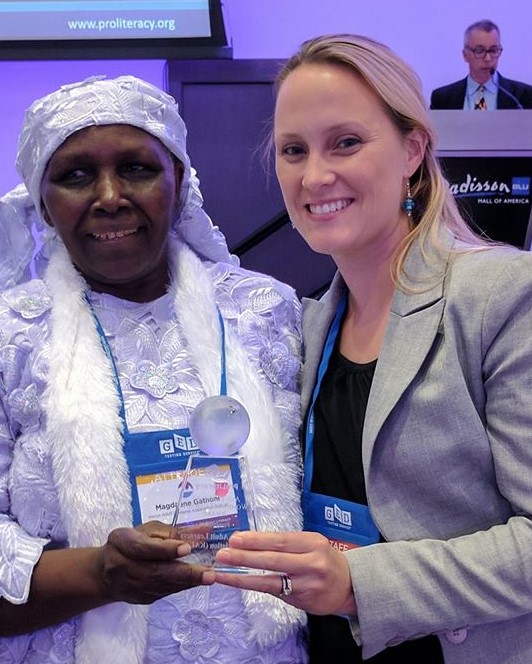
Magdalena Gathoni, founder of Kenya Adult Learner Association, receives UN literacy organizing award in 2017
Dramatic evidence for the correlation of women’s education levels and the birth rate is provided by Bangladesh. Once described “by Henry Kissinger as a ‘basket case’,” Kristof notes that now “its economy grows much faster than America’s and Bangladeshi women average just 2.1 births (down from 6.9 in 1973)”. We need not go so far as South Asia for evidence that higher levels of education of women bring significant reduction in the birth rate. The “total fertility rate” (TFR) in Mexico has fallen from 5.7 births per female to 2.2 TFR in recent years. This trend of fewer children birthed with more education of the parents, regardless of vast cultural differences, counters dire predictions of global overpopulation. Again and again figures have shown that more education, and more educational opportunity for women in particular, is the most effective birth control method.
Two trends will hamper further progress by humanity according to Kristof. He states in the article’s conclusion, “Climate change remains a huge threat to our globe, as does compassion fatigue in the rich world”. I would add to those two the much greater aid funding provided poor nations by the U.S. and other developed nations for weapons purchases and security training than for economic and social development. A recent study by the U.S. Council on Foreign Relations (CFR) concluded, “National security concerns have continued to drive U.S. assistance policy”. Our wars in the Middle East have demanded far greater expenditures than the expenditures for foreign aid in general. A highly disputed estimate by the Pentagon in early 2018 that the U.S. would spend 45 billion that year on the Afghan war alone (the estimate did not include disability claims and payments for injuries suffered by our soldiers) compares to the 35 billion dollars foreign aid budget passed by Congress for 2018.
Optimism with humanity’s progress toward eliminating extreme poverty and its effects must be tempered then by consideration of what would be possible should foreign aid be devoted primarily to development aid and not to combat and training for war. In countries of the Middle East, do the citizens associate the U.S. with aid for economic and social progress or with the perpetuation of conflict between inhabitants of that region?
In the next post we’ll look at some readers’ responses to the Nicholas Kristof article at https://www.nytimes.com/2019/12/28/opinion/sunday/2019-best-year-poverty.html


 Erasing Borders