Blog Archives
Mayan Cultivation of the Human Heart

The traditional Mayan today lives by the metaphors inherited not only from their forebears’ poetic imaginations. They are also guided by intense and prolonged study of the night sky. The Quiche Mayan “Council Book”, the Popol Vuh, recounts the first dawning of our Sun, the coming of light, following the appearance of the “daybringer” star Venus in the heavens.
But it is not only celestial events and events in the natural world that take on metaphorical depth and meaning in ancestral Mayan thought. Topographic features of a landscape are, in Christian poet Gerard Manley Hopkins’ words, “charged with the grandeur of God”. A mountain or a lake is not just seen in geological and geographic terms. It is first and foremost a manifestation of the divine. Pilgrimages are made to a mountain or a people’s abandoned city to honor and enter into dialog with the presence of the ancestral spirits and the divine there.
“I lift up my eyes to the mountains where my help comes from; help comes to me from the Lord, the maker of heaven and earth” declares Psalm 121 of the Hebrew Bible. As in the ancient Hebrew scriptures, the Lord is referred to with multiple names by the Mayans. As the name Yahweh gains precedence in the oldest Hebrew passages, “Heart of Sky and Heart of Earth” is favored by the Mayan faithful. There is also agreement in the Mayan and Hebrew traditions that the purpose of human beings is to give honor and praise to the divine presence around and within them.
When the “daybringer” Venus ascended from the underworld to the morning sky, the “Council Book” tells us that human beings had gathered “in unity” to await the sun’s first appearance. They celebrated and gave thanks with lighting of copal incense and with feasting on the sacred mountain and they still do so when the diviner’s reading of the calendar directs. Humanity had to be created, out of water and corn meal, to be present and give thanks and praise for the first light of the sun. According to the Popol Vuh, such praise and thanks fulfill our purpose as a species.
For many Mayans today, every night still reenacts the sowing of seed in the earth, the “Underworld”, when the sun sets to be reborn as a sprout and a new day. Dawn takes on another metaphorical meaning in the human context. Conception of a human being occurs with the planting of seed in the womb and a child’s birth and subsequent growth. While there may be other dawnings in human existence, the dawning of the first sun and subsequent suns, of the plant sown and of a human being are the foremost events in human life and given the most attention in Mayan thought and religion.
Thanks for these “dawnings” are expressed to the Heart of Sky and Earth with offerings of incense and blood, usually deer and bird blood today, at a shrine or sacred site or community altar. In the ceremony of building an altar described in the last blog, incense and smudging also help prepare heart and spirit of the participants with purification and clarity. According to the INESIN handout on the altar’s significance to the community, the copal (or alternatively ocote, heart of pine) “harmonizes the integrity of the individuals and group”.
In the altar ceremony, in Mayan prayer and worship in general, there is special attention to the state of each person’s feelings, or “heart”, as well as to the harmony of the community. The building of the altar, the preparation of the setting, accompanies a self diagnosis focused on our heart, “like when we feel our pulse”. The altar experience aims to enable the heart of each individual to be guided in selecting a personal intention on which to focus in coming days. In concluding the ceremony, candles of a particular color (see the last blog for the colors’ symbolism) are chosen and “planted” around the periphery of the altar. The various intentions may then be shared verbally with the group, with another individual or kept to oneself. They may include a better harvest, healthy relationships in a new house, a safe and worthwhile journey.
The revolutionaries of the Zapatista movement found their defense of the Mayan land and human rights in Chiapas on the hearts of their followers. In one of their manifestos, they include a message to foreigners who are likely to ignore or misunderstand this principal tenet of their position, “The ancestral philosophy of the Zapatistas which declares -without shame or fear- that the place of knowledge, truth and speech is in the heart”. It might be said that their attention to the heart of followers and the opposition has enabled the movement to continue to organize villagers and improve education, health and harmony in rural settings under their control today. In so doing they follow the ancient Chinese philosopher Lao Tzu who said, “there are many paths to enlightenment. Be sure to take one with a heart.”
The Heart to Heart Spirituality of the Mayans
The practice and significance of a Mayan community creating a sacred altar is described in what follows. It is based on a handout provided visitors to the Institute of Intercultural Studies and Research (INESIN) in San Cristobal de las Casas, Chiapas, Mexico. All quotations are from the handout written by the Institute’s Mayan staff members.
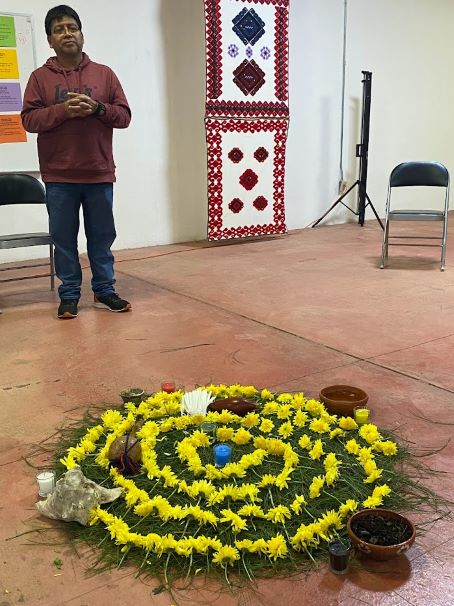
“The altar begins to take shape as the community gathers” the handout tells us. Most of us have read it before making our group’s altar following INESIN staff member jPetul’s instruction. “Each brings his or her offering from the fruits of their gardens or other labor” the handout continues. Our church group from Kansas City bring our desire to experience at a deeper level the Mayan culture and religion of forty percent of the population of San Cristobal de las Casas, Chiapas where the Institute is based.
So we read in preparation that “In the Chiapan Highlands, we often begin by spreading a bed of pine needles as a base that marks the ritual space with color, sound and smell….” Adorning the altar with their “flowers, fruits, seeds and symbols” the participants create “a representation of the whole community”. Candles of a variety colors are placed at the four compass points on the altar.
“The Mayan altar represents the cosmos and the universe” the handout relates. So the colors’ association with the four directions of our world are a crucial element in the symbolism of the altar ceremony. After the Spaniards brought wax and candlemaking to the New World, the candles’ colors were matched to their location in the “vision of the universe as seen by our grandparents”.

The red candle on the altar’s east side “represents sunrise, the birth of life, strength, love and the color of blood.” It also represents “the birth of God”. Incense is burned on the east side where red flowers, red beans and corn and red fruit are also placed. A guardian of this side is dressed in red.
On the West, a black (or purple) candle “represents sunset, darkness, rest and death”. In the Mayan worldview, darkness and night occur when the sun dies, passes toward the underworld, walks in other worlds and finally is “born again as a new, radiant sun.” This passage and its color signifies “the death of God, who dies to give us life”. For us humans the passage enacts whatever we do to nurture life and “leave behind that which destroys life”. In concrete terms for us humans, the passage signifies sowing seeds “when we bury these in the belly of the mother earth”. Purple flowers, black beans, corn and black soil are placed on the westside of the altar where a guardian would be dressed in black.
In Mayan belief, the colors of the altar also reflect our unity as human beings. Red is the color of our blood; black is our hair; white is our teeth and bones and yellow is the color of our skin. The Mayan tradition affirms that we humans share common traits while every person is also different. Our handout further states that the altar’s colors “represent the diversity of languages, thoughts, beliefs and ways of seeing the world of peoples and cultures”. Participation in the creation of an altar invites us to “ respect and appreciate our differentness and our oneness, our uniqueness and our sameness”.
We learned that the passage from red to black, from East to West, is the way of God. The passage from North to South “is the way of humankind”. The white candle of the North represents the “side of the sky, the wisdom of our ancestors, the peace and tranquility of the heart, the search for truth and clarity in thought and feeling”. The North also tests us: “cold rain and wind, the winter freezes, sickness and death also come from the North”. Bones, white beans and corn, white flowers, shells and seeds, a sea conch may be placed on the North side of the altar. The guardian “and protector” is clad in white.
The yellow candle of the South is associated with the feminine, and the direction from which comes good crops and abundant harvests. “Yellow flowers, yellow seeds and corn, yellow fruits, and water” are found on the South side with a guardian dressed in the same color.
A human’s life passage to maturity and fullness is symbolized in the altar’s depiction of movement from North to South. Intersecting with God’s path from East to West, the Center is where “humankind participates in the divine and the divine in the nature of humanity”. The two paths are also seen as the passage for God and for humankind from life to death and death to life.
In the Center is a blue candle, symbol of the “heart of the sky” and the eternal, “that which does not end”. Water is sometimes placed in the Center and someone may be assigned to wear blue and serve as guardian of the sky’s path. The green candle in the Center stands for the earth, for nature, for life that continues. Along with nature, men and women make up “the community of divine creation”. We, like all of nature, are divine “because we have the ‘ch’ulel’, the spirit that comes from the Sacred, ‘Ch’ul’ (or) the divine breath”. Earth or soil may be placed in the Center. Symbolic elements of the Center remind us that “our grandparents taught us that all that exists has ‘ch’ulel’, spirit and heart”.
In the Mayan view, our spirituality is cultivated and grows from the heart. Before each person plants one or more candles on the altar’s periphery, we were instructed to diagnose the present state of our heart. We were to ask ourselves, “how is your heart or how has your heart arrived in this place?” Our handout notes this question is “asked from the heart to the heart, for we as Mayans speak from there.”

In some villages of the Chiapan highlands, residents greet one another by asking “how is your heart seen or what is your heart feeling?” The response can be “my heart is blooming” or “my heart is full of flowers”. Harmony and good will reign when Mayans say they are of one heart or, in one of the leading Mayan languages, when they say “jun o’tonal”.
The significance of incense and smudging in the altar ceremony, the prayers and significance of placing the candles before concluding will be described in the next and final article on the Mayan sacred altar. It too will be based on the handout “Theological Perspectives on the Mayan Altar” written by jPetul and other Mayan workshop leaders of the Institute for Intercultural Studies and Research (INESIN) in San Cristobal de las Casas. A community’s periodic creation of a sacred altar has contributed significantly to the survival of five million Maya for three thousand years as a people and culture.
The fine Institute website in Spanish and English is at http://inesin-mx.org/
Erasing Borders in Chiapas

I’ve just returned from a week long stay in Chiapas, the southernmost State of Mexico. I went with six other adults from my Peace Christian Church (United Church of Christ/Disciples of Christ) in Kansas City. We did not go to “help” those who hosted us in any substantial, tangible way. On what can be best described as a “decolonizing mission” pilgrimage, we went to learn about the legacy of Spanish seizure of land, suppression of indigenous culture and the native resistance to the foreign presence and influence in Chiapas. These all remain sources of the multiple conflicts Chiapas has experienced in recent years. In tandem with the oppression of the indigenous people, religious differences have been used by the Mexican State, foreign corporations and the cartels to stir conflict among the indigenous Mayan peoples and others in the State.
One of our partner agencies in global mission today hosted our delegation and introduced us to how they work for inter-religious and inter cultural understanding, reconciliation and peace. The INESIN staff represent and interpret well the diverse cultures of the Mexican State of Chiapas. There is jPetul, a former Catholic priest of Lacandon Mayan origin, who instructed us in the meanings and practice of creating a Mayan sacred altar. His spouse is a former nun led us one morning in moving through the Catholic daily meditation on “the liturgy of the hours”. In his welcome and introduction to the history of INESIN, the director told us he serves too as pastor of a Protestant church in the Chiapas capital, Tuxtla Gutierrez. We worshipped there on the Sunday of our week long stay.
We learned about the sources of the multiple conflicts in Chiapas after the Conquest through three hundred years of Spanish colonial rule from another partner of our denominations’ “Global Ministries”. Sipaz (https://www.sipaz.org) presents workshops designed to free and protect the population from Chiapas’ cycles of violence while other programs aim to educate and encourage advocacy among foreign visitors. The Sipaz director for the past 20 years is a woman who described recent political and economic developments as well as Chiapas’ historical context.
Marina noted that the trafficking in migrants through the State of Chiapas and on to the U.S. is now largely controlled by leading Mexican cartels, formerly primarily engaged in the drug trade. Lax security and immigration enforcement at the Guatemalan border reflects Mexican Government border policy, funded by the U.S., of interdicting undocumented migrants on the roads of Chiapas. The immigration attorney among our pilgrims had prior to our trip discovered that the Guatemalan State and one of the country’s leading banks have profited from their fellow citizens’ migration. Failure to repay loans for the U.S. journey results in loss of a Guatemalan migrant’s land.
Another grim aspect of the situation is the targeting of older children and youth in recruitment by the cartels and local militias. We observed the third of our denominations’ partner agencies in San Cristobal working with poor children, of Mayan families, who are encouraged and trained by Melel Xojobal (“true light” in the Tzotzil Mayan language) to value their earning potential outside the cartels’ grip and to defend their human rights. Melel Xojobal (https://www.melelxojobal.org.mx/ ) meets and organizes groups of children at the markets. A recent series of protests by Melel children won expansion of bathroom facilities in the City’s largest markets.
With a crammed schedule on little sleep, I took a break mid-week and missed the trip to the Guatemalan border with stops at two Precolumbian centers of Mayan culture and religion. The recently excavated ruins were built and flourished during what some scholars refer to as the “Dark Ages” in Europe. Between the third and tenth centuries A.D. the Mayans made their most significant contributions to the advance of our species. Viewing the vestiges of the Mayan legacy in the early 1500’s, and judging them as “pagan”, the Spanish missionaries and soldiers destroyed all they could identify as Mayan. Of the hundreds of books written on scrolls of bark by Mayan scribes, only three remain to instruct us on Mayan civilization.
Oppression of the Mayans under Spanish colonialism and decades of discrimination have led to speculation, even at present, that the magnificent Mayan temples, observatories and stone sculptures were created by members of Atlantis’ lost continent or another fabled people. Sadly there are Mexicans who still hold, along with their neighbors in the U.S., demeaning views of the indigenous people of their country. Anyone today who spends time in Yucatan or Chiapas or one of the four Central American nations inhabited by Mayan peoples today cannot question the resemblance of the figures depicted on the ancient sculptures and the indigenous people around them.
After visit of a great Mayan city of the past like Palenque in Chiapas, one is moved to think that the capacity of over 5 million Mayans to have survived centuries of exploitation and genocidal attack is in itself a remarkable achievement. The leading U.S. scholar of Mayan history and culture, Michael Coe, attributes the endurance of the Mayan peoples to three factors. In the ninth edition of his book The Maya he writes,
“What has kept the Maya people culturally and even phsically viable is their hold on the land (and that land on them), a devotion to their community and an all-pervading and meaningful belief system.” Coe then comments, “It is small wonder that their oppressors have concentrated on these three areas in incessant attempts to exploit them as a politically helpless labor force.”

I had in a 1980 journey through Chiapas been able to spend a day at Palenque which is touted by many visitors as the most dramatic and beautiful of the Mayan centers revealed to date. Our hosts advised against a visit as there is now a relatively insecure and substandard 200 km. plus route from San Cristobal to Palenque. Comparable in my mind to the majesty and achievement represented by the French cathedrals of Mont St. Michel and Chartres, an experience of Palenque insists that we revisit our stereotypes of the Mexican people and the Mayans of Mexico in particular. After taking in Palenque one cannot fail to be amazed and moved that the waiter serving you dinner or the woman cleaning your room comes from an ancestry that created such monumental beauty.
Unity Emphasis in Global Christian Mission Today

Elena Huegel is a “Mission Co Worker” in San Cristobal de las Casas , Chiapas, Mexico. She is assigned to work with INESIN, a local human rights and peacemaking agency, and leads workshops for the staff and community. INESIN is one of many “partner agencies” of the Global Ministries work of the theologically progressive U.S. Protestant denominations, the United Church of Christ (UCC) and the Disciples of Christ (DOC).
Like most partners of Global Ministries outside the U.S., it is ecumenical in nature and does not aim to found churches. Mission churches started decades ago with the help of missionaries of the two Global Ministries denominations are now self-governing and self-propagating. Most are growing much faster than the U.S denominations and benefit from Elena’s and other Mission Co Workers’ presence in the their programs of community economic development, agriculture, healthcare, education and protection of human rights.
Elena’s grandfather, Frederick Huegel, went to Mexico early in the twentieth century, as a missionary trained in preaching and evangelism with the intention of growing the Disciples of Christ presence in central Mexico. Elena’s parents also worked with the new churches of the Disciples of Christ in Mexico. Bilingual at an early age, Elena has been a Mission Co Worker in Chile for over twenty years and in Paraguay before returning to Mexico to work with INESIN staff.
The following interview with Elena Huegel took place last August while driving her to a speaking engagement in the U.S.
DS: So Elena what does INESIN stand for?

EH: The Institute for Intercultural Studies and Research.
DS: Tell us a bit about the history of that organization.
EH: When Rios Montt was President of Guatemala and all the refugees from the country were crossing the border into México, the Catholic Bishop (Bp Samuel Ruiz) had people all along the border helping with the refugee crisis. The UCC and Mennonites from the States had mission workers helping as well and they all got to know each other. In fact when opportunities opened for resettlement back into Guatemala the mission workers all began to accompany them back as human rights watchers. That resettlement began in January of ’94.
That’s also when Canada, the U.S. and México signed the Fair Trade agreement (NAFTA) and the Zapatistas had said that if the trade agreement was signed they were going into open warfare against the Mexican government. It was signed and the revolution explodes, the heart of it being San Cristóbal and the communities around it. So with that the inter-religious turmoil that there already had been between Catholics and Protestants was heightened. It took on a whole different turn because the government began taking advantage of the Protestants who were among the most oppressed of the population. The government encouraged creation of paramilitary groups among the Protestants. The groups were mainly children of Protestant converts from what I can tell.
DS: But you say there had been turmoil and tension between Protestants and Catholics before the Zapatistas came on the scene. What was that about?
EH: This is a simple question to a very complex situation. To read more I suggest:
There are many points of view as to why there are conflicts between the different protestant and Pentecostal groups and the different Catholic groups as well as newer religions (mainly Muslims) in Chiapas in general and the Chiapan Highlands (including San Cristóbal de las Casas) in particular. I would summarize by saying that there have been and are political and economic forces that have used religious differences to divide and conquer the Mayan communities. Nowadays, organized crime has also come onto the scene sowing further confusion and chaos within communities and, in some cases, bringing different religious groups together in the struggle against the cartels while in others causing further unrest and division. There is a very long history of violence connected to the different religious expressions, with victims and perpetrators connected directly or indirectly to different religious affiliations.
DS: So the Protestant grievances about the Catholics had been long standing and were used by the government.
EH: The government was trying to get at the Zapatistas from different directions. And as the inter religious strife got worse the Bishop (Samuel Ruiz) realized that he needed someone to help him build a bridge and talk to the Protestants. He had already done quite a few things to build bridges. There were a whole lot of Protestants driven off their lands in the Chamula area and he supported the ones who fled to San Cristóbal. As the Bishop saw better what was happening, he went to the UCC and Mennonites who had worked with Catholics on the border and together they went on to found INESIN, the Institute for Intercultural Studies and Research. It was to create a space for inter-religious and inter-cultural dialog using various forums and projects to do that.
DS: Did the UCC have people in place there to participate in INESIN’s creation with the Catholics, Bishop Ruiz in particular?
EH: The UCC overseas mission office, Global Ministries, had a couple down there at the time. The couple were preparing to go down in late ’93 but finally arrived in February ’94 and were there then for some pretty incredible things. They were Paula Biddle and George. They knew the area as they had been working with Guatemalan refugees in Chicago and had been traveling back and forth from Chicago to Chiapas since the refugees began crossing the border.
DS: And what are you doing at INESIN now?
EH: So I am helping in staff development and education in trauma healing and conflict transformation primarily with the staff of INESIN. Protestants in Chiapas have seen INESIN as a Catholic organization and there is a lot of distrust and suspicion of any Catholic program among the Protestants. It’s going to take a long time of trust building before they join with Catholics in a process of trauma and conflict healing. So I’ve had some small groups and I’ve done some Christian Education trainings for Protestant Sunday School teachers which have attracted larger groups. I do other things as a way to start building up trust and relationship. I am also the local, national and international coordinator, facilitator, and trainer of the Retoños en las Ruinas: Esperanza en el Trauma (Roots or New Shoots in the Ruins: Hope in Trauma) program with facilitators in Chiapas, different states of Mexico and 5 other countries in Latin America.
DS: In addition to your training for trauma healing and conflict transformation you’ve been trained in environmental education?
EH: My undergraduate training was in recreation and outdoor education and my first love has always been environmental education.
DS: What is the tie between trauma healing and the environmental education?
EH: I came to realize there is a soul wound in our relationship with the earth and that’s one of the great things about being here with the Mayans. There’s the opportunity to come full circle. It used to be environmental education was concentrating on how we take care of the earth. Now, coming full circle with the help of the Mayans and other indigenous groups we understand better how the earth takes care of us.

We can’t be fully healed unless we attend to this relationship with the earth and how this is an essential part of our wholeness. Many people among the Mayans have that very clear. How a healthy relationship with the earth is essential to our relationship with oneself, with others and with God. So I’ve been thinking more in the last four years here about how our reconnecting with nature brings about our healing and how for example a sense of awe is essential to our recognizing something bigger than ourselves, something where hope lies, something that moves our souls. I’m doing more work around that now. How immersing people in nature can be part of their healing process.
DS: So how is this Mayan tradition of relationship with nature transmitted these days?
EH: I would say that not all Mayans today practice or have experience of the relationship. One of the things that the Institute has been doing especially on the Catholic side is helping to reconnect to that spirituality that was connected to Mother Earth. So one of the things that is still practiced but not everyone practices is the Mayan altar. The Mayan altar is always transitory. It is made from things from nature. It is created by the community. Using different flowers but it can also have dirt and seeds and fruit. These are placed in four quadrants representing the four cardinal directions.
And that transitory altar also has candles on it. Once the candles are lit they’re not put out. And the altar lasts as long as the candles last and once the candles die down, the altar is taken apart and the fruits are eaten and everything goes back into nature again.
DS: And the altar is built at a certain time of year.
EH: No it can be at any time the community needs to gather. And we at INESIN always have groups that visit us build a Mayan altar together.


 Erasing Borders