Category Archives: U.S. Protest Movements
Land and Theologies in Conflict
| Territory | Arab and other population | % Arab and other | Jewish population | % Jewish | Total population | |
|---|---|---|---|---|---|---|
| Arab State | 725,000 | 99% | 10,000 | 1% | 735,000 | |
| Jewish State | 407,000 | 45% | 498,000 | 55% | 905,000 | |
| International | 105,000 | 51% | 100,000 | 49% | 205,000 | |
| Total | 1,237,000 | 67% | 608,000 | 33% | 1,845,000 | |
| Data from the Report of UNSCOP: 3 September 1947: CHAPTER 4: A COMMENTARY ON PARTITION | ||||||
Dating back to extensive use of “Kairos” in the New Testament, “kairos” in Christian theology refers to a time when the “kingdom of God” approaches and demands a decision from individuals and societies. In contrast with the Greek “chronos” meaning a segment of time, ordinary time, “kairos” describes a critical moment in a human context of social change. The first Kairos Document was written by an ecumenical team of South African Christian black theologians in 1985 at the height of the black population’s resistance to apartheid.
Secular media paid even less attention to the Kairos Palestine Document of 2009 than they did to the original South African Document or the other theological statements, including those in the U.S. and Europe, responding to the 1985 declaration of South African theologians. Since the Hamas attacks in October 2023 some commentators have noted how little reference to the Palestinian cause or Israel’s Palestinian occupants has been made in our media since founding of the state of Israel in 1948. So it is not surprising that outside of church circles there has been little notice of the Kairos Palestine Document.
The Document begins with an endorsement by thirteen “Patriarchs and Heads of Churches” in Jerusalem; they describe the declaration as “a word of faith, hope and love” calling on “all peoples, political leaders and decision-makers (to,ed.) put pressure on Israel and take legal measures in order to oblige its government to put an end to its oppression and disregard for the international law.” The thirteen Palestinian Christian authors advance a theological position “that the military occupation of our land is a sin against God and humanity, and that any theology that legitimizes the occupation is far from Christian teachings because true Christian theology is a theology of love and solidarity with the oppressed”.
In its theological discussion of the land governed or occupied by the State of Israel, the authors affirm that “the earth is the Lord’s and the fullness thereof” (Ps 24:1) and therefore assert no land can be seen as the possession of any particular people. Exclusion and expulsion of any group or groups from the land cannot be God’s intention. “God gives us the capacity, if we have the will, to live together and establish in it justice and peace, making it in reality God’s land.” The Kairos Palestine Document avers that the promise made by God to Abraham in the Hebrew Bible was to make him father of many nations living in justice and harmony in the land where he had been led.
In the current context of Israel’s continuing its indiscriminate killing of Palestinian civilians in Gaza, the 2009 Document takes on yet more urgent significance as a cry for justice to Christians and non-Christians worldwide. When issued, the conflict no longer was about a purely theological or political issue. “It is a matter of life and death” the authors and signators declared sixteen years ago and, as such, the Word of God in the Bible cannot be used to justify policies or State actions which bring death and destruction. As a living Word which addresses the Hebrew and Christian Bible’s themes of promise, chosen people, and land a literal interpretation makes the Word an instrument of death.
On the Bible’s treatment of the crucial topic of “the land” the Kairos Palestine Document was followed six years later by publication of the book From Land to Lands, from Eden to the Renewed Earth . Written by the young theologian and pastor Munther Isaac (see Erasing Borders blogs of September 1 and January 16, 2024), it is a sweeping study of a “Biblical theology” supporting a thesis of the universalisation of the land, indeed any land. Its lively and clear presentation of the positions of biblical scholars and theologians enables a closer reading of the texts by laypersons and their progress in shaping their own views. Although the author did not participate in creating the Kairos Palestine Document the book was written in service of its aims and concludes by asking, “Can it (the land) become a place where Jews, Muslims and Christians – while retaining their distinctive beliefs – can embrace each other as fellow human beings, and indeed as people of faith, and be reconciled in practice?”
Christmas on the Border, 1929
The poet Albert Rios based this poem on newspaper accounts and personal recollections of residents who were children in Nogales at the time of the event.
1929, the early days of the Great Depression.
The desert air was biting, but the spirit of the season was alive.
Despite hard times, the town of Nogales, Arizona, determined
They would host a grand Christmas party
For the children in the area—a celebration that would defy
The gloom of the year, the headlines in the paper, and winter itself.
In the heart of town, a towering Christmas tree stood,
A pine in the desert.
Its branches, they promised, would be adorned
With over 3,000 gifts. 3,000.
The thought at first was to illuminate the tree like at home,
With candles, but it was already a little dry.
Needles were beginning to contemplate jumping.
A finger along a branch made them all fall off.
People brought candles anyway. The church sent over
Some used ones, too. The grocery store sent
Some paper bags, which settled things.
Everyone knew what to do.
They filled the bags with sand from the fire station,
Put the candles in them, making a big pool of lighted luminarias.
From a distance the tree was floating in a lake of light—
Fire so normally a terror in the desert, but here so close to miracle.
For the tree itself, people brought garlands from home, garlands
Made of everything, walnuts and small gourds and flowers,
Chilies, too—the chilies themselves looking
A little like flames.
The townspeople strung them all over the beast—
It kept getting bigger, after all, with each new addition,
This curious donkey whose burden was joy.
At the end, the final touch was tinsel, tinsel everywhere, more tinsel.
Children from nearby communities were invited, and so were those
From across the border, in Nogales, Sonora, a stone’s throw away.
But there was a problem. The border.
As the festive day approached, it became painfully clear—
The children in Nogales, Sonora, would not be able to cross over.
They were, quite literally, on the wrong side of Christmas.
Determined to find a solution, the people of Nogales, Arizona,
Collaborated with Mexican authorities on the other side.
In a gesture as generous as it was bold, as happy as it was cold:
On Christmas Eve, 1929,
For a few transcendent hours,
The border movedOfficials shifted it north, past city hall, in this way bringing
The Christmas tree within reach of children from both towns.
On Christmas Day, thousands of children—
American and Mexican, Indigenous and orphaned—
Gathered around the tree, hands outstretched,
Eyes wide, with shouting and singing both.
Gifts were passed out, candy canes were licked,
And for one day, there was no border.
When the last present had been handed out,
When the last child returned home,
The border resumed its usual place,
Separating the two towns once again.
For those few hours, however, the line in the sand disappeared.
The only thing that mattered was Christmas.
Newspapers reported no incidents that day, nothing beyond
The running of children, their pockets stuffed with candy and toys,
Milling people on both sides,
The music of so many peppermint candies being unwrapped.
On that chilly December day, the people of Nogales
Gathered and did what seemed impossible:
However quietly regarding the outside world,
They simply redrew the border.
In doing so, they brought a little more warmth to the desert winter.
On the border, on this day, they had a problem and they solved it.
The poet resists any social commentary in describing his poem’s genesis. It appeared, however, as the Academy of American Poets’ “Poem of the Day on December 22, 2024 a month after the U.S. election of a viciously anti-immigrant, white supremacist President. Like other memorable poems, it celebrates the best of human nature and defies any attempts, even by the most powerful, to deny, contradict or pervert the good within each of us. We celebrate today the vision and courage of the “officials” of Nogales with the hope that we may individually and collectively open ourselves to the opportunities in these times to move borders. For the sake of the children in and around us.
Rios commented on his poem, “I didn’t live through the Christmas of 1929, but growing up in Nogales, the border was always there—constant, imposing, dividing and connecting at the same time. This poem reflects on a story from before my time, when the border wasn’t just a barrier but something that became a solution. It tells of a community that, for one Christmas, chose unity over division, moving the line in the sand to bring joy to children from both Nogales, Arizona, and Nogales, Sonora. Growing up with the border always in sight, this story resonates deeply for me—proof that even in separation, people’s determination can make the impossible happen.”
Peace Warrior and Prophet A.J. Muste

Martin Luther King, Jr. commented to Nat Hentoff in the mid-1960’s, “I would say unequivocally that the emphasis on non violent direct action in the civil rights movement is due more to A.J. (Muste) than anyone else in the country.” During the early years of the movement, A.J. Muste as President of the Fellowship of Reconciliation hired the principal organizers of the “freedom rides” on buses in the south. Among them were Bayard Rustin, leader of the 1963 March on Washington, James Farmer founder of CORE and George Houser, founder of the American Committee on Africa.
I wrote several blog posts in 2020 on the pioneer U.S. organizer of non-violent protest A.J. Muste. Following the police killing of George Floyd that year, the human right to demonstrate publicly against the actions of government and powerful institutions was exercised repeatedly as the most effective counter force to policies of the outgoing Trump administration. Civil disobedience and non-violent resistance had at the time already proliferated with the spread of authoritarian regimes worldwide.
Although the life and work of Rev. A.J. Muste has yet to be celebrated in a comprehensive biography, I want to share news of four videos made recently focusing on the leading U.S. revolutionary non-violent resister of the 20th century. The videos total over 6 hours recounting the progression of Muste’s life from his pacifist opposition to WW I to Trotskyite labor organizer, his return to the church and subsequent leadership in civil rights and anti war movements.
The videos’ interviews with trainers and organizers of non violent resistance such as civil rights leader Rev. James Lawson and founder and head of the War Resisters League David McReynolds establish Muste as having introduced non violent theory and practice to key U.S. protest organizers in the last century. In his eighties he continued to organize or serve as lead consultant for anti-Vietnam War demonstrations and draft resistance public actions. His role in shaping the civil rights’ struggle’s reliance on non violent civil disobedience is emphasized by several of the interviewees.
All four videos were made by David Schock, former English professor at Hope College in Michigan, Muste’s alma mater, in collaboration with Dr. Kathleen Verduin also of Hope College. Here is the link to an excerpt, the final minutes of the second video “The No. 1 U.S. Pacifist”, which concludes with Muste’s dream of a peacemaking U.S. foreign policy:
The four complete videos can be accessed on the web site A.J. Muste: Radical for Peace. Also on the site is a request to donate to help cover the video project’s costs covered by the two creators of the film.
In another tribute to Muste’s prominence as the leading opponent of the U.S. war machine and foreign interventions, Professor Noam Chomsky in 1967 wrote at length about the recently deceased Muste’s contributions in the Sidney Lens/Muste Liberation magazine. It is at:
Thich Nhat Hanh and “Mindful” Peacemaking

In the last six months we’ve lost three leaders whose contributions to peace and reconciliation will last beyond our lifetimes. Desmond Tutu’s work on behalf of interpreting and organizing the Truth and Reconciliation Commission in post-apartheid South Africa is best known today. Among activists and advocates for peace, Thich Nhat Hanh’s role as the leading Vietnamese Buddhist peacemaker is well known in the U.S. and Europe. Less widely known at present is the African-American feminist and Buddhist writer bell hooks. Her meeting with “Thay” or “teacher” as Nhat Hanh was called by his followers bolstered hooks’ growth in Buddhist thought.
The former Director of the Fellowship of Reconciliation (FOR) Emma Jordan-Simpson described bell hooks’ account of meeting Thay in the late 1960’s with these words:
“When she (hooks) was introduced to Thay, she blurted it out: “I’m so angry!” Immediately she felt ashamed. In the presence of a loving teacher, she was only able to bring up the ugliness she was feeling inside!” Simpson continues with Thay’s response. “Thay’s words to bell hooks are the words that all of us who are exhausted and depleted by what it means to live in a world perpetually at war, but who are still able to feel anger, need to hear and to hold.”
Thay said to hooks, “Hold on to your anger and use it as compost in your garden.” The FOR Director commented on hooks’ encounter, “We are angry that we live in a perpetual state of war and we are angry about what these times are revealing to us. But we reveal who we are when we can find ways to use that anger as compost in gardens growing peace”.
Martin Luther King acknowledged Thich Nhat Hanh as having helped lead him to oppose publicly the U.S. War in Vietnam. After his “Beyond Vietnam” speech in April, 1967 King nominated the Buddhist leader for the Nobel Peace Prize. His conversation with Thay was arranged by the FOR, which sponsored Nhat Hanh’s tour of the U.S. after the escalation in Vietnam. Thay’s gentle, forceful presence accompanied by words of profound compassion for perpetrators and victims of the War on his country led many other people in the U.S. to question if not strongly oppose their nation’s mission in Vietnam. His stories and views had a profound impact on people’s stance on the War. But it was also his interpretations and descriptions of Buddhist practices that made a lasting impression on the lives of many.
In a 1974 article for Fellowship magazine, the journal of FOR, Thay wrote about one encounter with a U.S. Christian. “One day I was asked by a Christian in a bus: ‘Why do you monks burn yourselves to death? It is an awful thing.’ I tried to explain to him what Thich Quang Duc wanted when he set himself on fire. But the gentleman did not want to listen. He said ‘I can’t understand a religion that allows its members to burn themselves.’”
Thay then reflected in the article on the encounter, “I could have told him that I did not believe that Christianity could allow its followers to go and burn other people either. Thousands of women and children have been burned by napalm that was dropped from the sky. But what is the purpose of such a discussion?” Nhat Hanh concludes, “The only thing that counts is the ability to understand the pain of a brother. And this brother is neither a number nor a concept. This brother is made of real flesh and skin and feeling.” He then comments with the insight, “We cannot recognize our brother through an ideology or a political label. People have been shooting at labels and by doing so they have shot many of their brothers and sisters.”
Thich Nhat Hanh concludes the opening chapter of his best known book in English, The Miracle of Mindfulness with the question, “If you spend all day practicing mindfulness, how will there ever be enough time to change and build an alternative society”. His answer follows with his calligraphy on the next page:

His practice of “breathing mindfully” is clearly and powefully elaborated for readers unfamiliar with Buddhist thought and many in the West have integrated his instructions in their own meditation. When one is able to live mindfully one is in control of our constantly distracted mind and be fully present in the moment. The essential component of “mindfulness” is attention to our breath. Thay explains, “You should know how to breathe to maintain mindfulness, as breathing is a natural and extremely effective tool which can prevent dispersion. Breath is the bridge which connects life to consciousness, which unites your body to your thoughts. Whenever your mind becomes scattered, use your breath as the means to take hold of our mind again.”
********************************
Order a copy of The Miracle of Mindfulness from your local indie bookshop. It comes in all formats including audiobook.
Read about the friendship of Rev. Dr. Martin Luther King and Thich Nhat Hanh in a book available in the Fellowship of Reconciliation bookstore. Also available at the website below is a copy of the Spring 2020 issue of Fellowship magazine devoted to Thich Nhat Hanh’s articles and poems for the magazine as well as peacmakers’ tributes.
https://forusa.org/product-category/books-pamphlets/
On Being host Krista Tippett paid tribute to Thay in a podcast this winter and replayed her earlier interview with him at:
Is Socialism No Longer a “Dirty Word” in the U.S.?

If a health care system which serves all residents and citizens
If free quality education for all children from pre school through university
If the public ownership of all natural resources essential for human life – water, power, and natural gas
If foremost priority in public expenditure is given to improved systems serving citizens and residents and not to securing the control of resources in other nations
If an economy driven by production for human consumption and use and not the production of weaponry
If international collaboration rather than competition in meeting global crises: climate change, nuclear weapons proliferation, and pandemics
If progress toward making one or more of these aims our reality requires adopting our own form of socialist rule in the U.S., then I am all for it.
The increasing U.S. rule by a corporate and financial elite supported by the knee-jerk charge that a policy is “socialism” serves to defend a flagrantly unjust and unsustainable status quo. Does making some dramatic changes in this country’s economic and political systems necessitate serious consideration of socialist solutions? Yes, it does and yes it will. Evidence mounts that in European nations with some mix of socialist and capitalist economic policies the people are healthier and happier and increasingly more financially secure than here.
Those nations also prove that adopting a form of socialism does not require authoritarian rule and loss of individual freedoms as most people in this nation seem to think. The youth in this country are more aware than most adults that making socialism a “bugaboo”, as one commentator recently called it, serves only the small minority who gorge on profiting from the status quo. It now appears more likely that the charge of “socialism” assigned universal health care and similar programs by conservatives and some liberals is now approaching its expiration date. As a hold over from the Cold War propaganda of the 50’s, increased allocations for an already bloated budget for defense (and the corporations subsidized by the defense budget) at the expense of increased budgeting for health care, education and public utilities has begun to lose force in shaping public opinion. At the same time, we in this country remain under the sway of an extreme form of capitalist economics that subverts the aims of the majority who work more and die earlier year by year.
As we consider the consequences of ignoring and now in some states banning discussions of race and the history of white supremacy in classrooms, it would be helpful to look at how discussion of contemporary examples of socialist and capitalist economic strategies have also been largely ignored in our schools. That someone is now and has been able for many years to graduate from a U.S. secondary education with the conviction that only socialism leads to authoritarian rule is not by chance. To ignore completely the history of capitalist Germany’s descent into barbarous, genocidal rule in the last century is to avoid by intention serious critique of our form of capitalism which now threatens the country’s survival as a democracy. That many of Germany’s leading corporations and members of the economic elite supported the Nazi regime is still kept secret from most of our students throughout their education.
But I would be renouncing my call as a Christian to neglect mention of some personal and social developments of our time that many U.S. Christians and others ignore. First, on the personal level there is an even more precipitous decline in church attendance and membership in leading Western democracies, such as Germany, than in this nation. At the same time, the China Christian Council of what we identify as “godless” Communist China has experienced growth that would be the envy of “mega-churches” in the U.S. When restrictions were lifted in the early 1980’s by the Communist Party and Chinese state, the China Christian Council as the unified Protestant Church and the heir of the work of pre-1949 missionaries has been hard pressed to build enough churches and seminaries to keep up with the rising number of Christians in China.
On the social plane, is it not time for Christians who oppose universal health care in the world’s richest nation to reconsider their position in the light of Jesus’ example? How can followers of the healer and advocate for the poor favor an economic system driven by one’s own interest over an economic and political system based on “from each according to his/her abilities to each according to their needs”. It is now time to ensure that the mischaracterization of socialism as inherently or practically against faith in a higher power be ruled out of our public policy discussions. To continue to equate socialism with either authoritarian or godless rule is to make an argument founded on lies and fear. How many of the NATO members which have implemented social welfare policies many persons here characterize as socialist have banned religion or severely restricted public religious activity?
How do so many U.S. Christians justify the ethical principles of many members of our corporate/financial ruling elite? Let me single out the example of our former Chair of the Federal Reserve Alan Greenspan whose ethics were shaped by the Objectivist philosophy of Ayn Rand. The system of thought condemns altruistic behavior and elevates self interest as the fundamental principle of a free society. Through his forties, Greenspan contributed articles to the Objectivist movement’s newsletter in the 60’s and remained close to Rand until her death. As an upper class refugee from the deprivations of the early years of the Soviet Union, Rand developed a philosophy of life that extolled the extreme individualistic ethics of capitalism. Greenspan’s background as a devoted Rank acolyte did not hinder his rise to prominence in service of the U.S. economy, deregulation of the financial industries and free market trade policies.
That the influence of a declared socialist Senator from Vermont has risen significantly and that so many of our country’s youth now condemn the unfettered capitalist economy in the U.S. can be attributed to the crises that overwhelm our country today. Not having experienced the fear mongering of the Cold War they perceive lame anti-socialist policy arguments rooted in corporate domination of our political discourse as impeding the nation’s progress in eliminating fossil fuel production, the priority of spending for defense, criminal justice practices which divide white workers from workers of color, and fierce opposition to union and other organizing to make change. Will we in the U.S. progress toward the implementation of a mixture of socialist and capitalist policies in our political economy? Yes, we will, provided our rule by and for the people survives and defeats the current onslaught making voting for many persons harder in defense of a grotesquely unequal and unjust status quo.
A Powerful Tool to Uncover and Uproot the Origins of White Supremacy
“The most politically radical and intellectually challenging work of nonfiction ever made for television” Time magazine called “Exterminate All the Brutes”. The new four episode television series tracing the history and origins of Western colonialism was funded by and can be seen on HBO. The director and co-writer of the series, Raoul Peck, comments in one of the episodes, “The very existence of this film is a miracle.” The U.S. website The Intercept agrees and noted it’s no coincidence we had to wait until this time for such a documentary to be made. Its reviewer commented that for AT&T, one of the largest U.S. corporations and owner of HBO, to have funded its making “demonstrates that something profound about the world is changing”.
Peck begins the series by demythologizing the history most citizens have been taught about the United States. President Obama’s declaration that “America was not a colonial nation” is refuted by the film’s assertion that “America IS a colonial nation.” The first episode retells the story of our “settler colonialism” requiring wars on the native American population and the appropriation of their lands and resources.
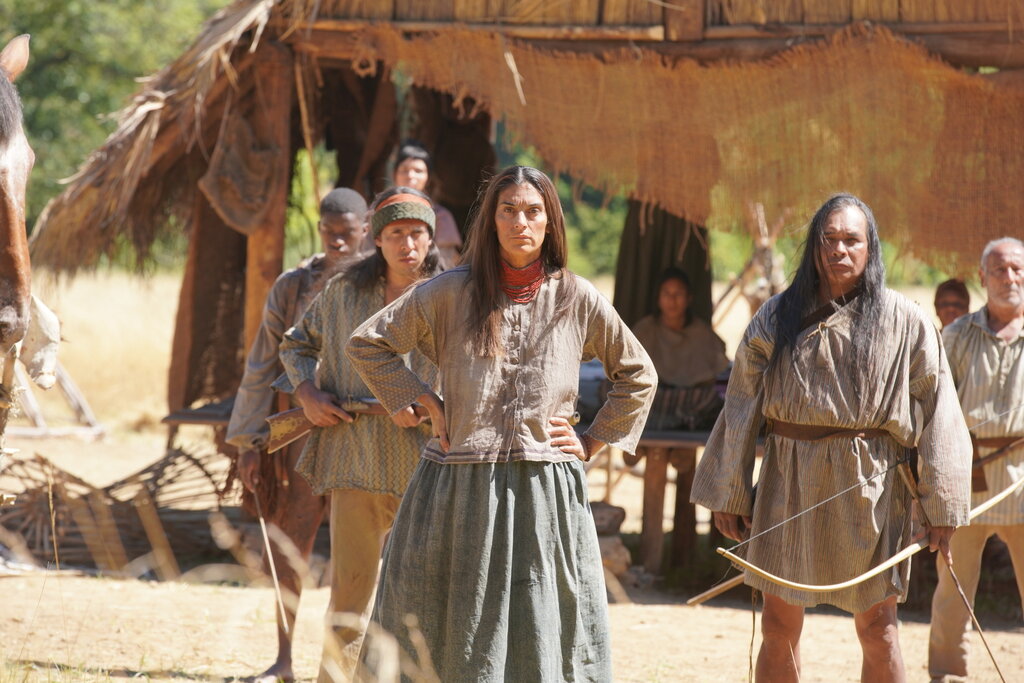
The prevailing mythology of the U.S. as a beneficent nation of immigrants has been elaborated by those in power from the Pilgrim days to the present. The film’s themes and analysis flow from its change in perspective. “The whole vision of the film is based on changing the point of view of who is telling the story” Peck told one interviewer. In dramatizing the fatal encounter of the Seminole female chief Osceola with a commander of the troops assigned to displace her tribe, the first episode gives voice to those who suffered the consequences of the settlers’ encroachment. “You steal land; you steal life; you steal human beings. What kind of a species are you?” Osceola asks.
In a later episode the film tells the story of the Haitian slave rebellion and the founding in 1804 of the first nation in the Americas to free all human beings on its soil. The Haitian born Peck reminds us that the example of the Haitian revolution and its freed slaves’ democratic rule was widely feared in the U.S. In response the U.S. opposed recognition of the new nation until 1862. Some U.S. political leaders continue to portray Haiti as a “s..hole country” while their powerful northern neighbor continues to corrupt and manipulate Haitian politicians to the present day.
This film represents a powerful tool for those who are committed to this era’s project of truth telling that connects the dots of colonial expansionism with current systems that seek to maintain white supremacy and white privilege. Republican leadership foresees political gain is to be made in defending the prevailing myth of U.S. history. Confronting some of the truth long suppressed is feared as a threat to their power. An April 30 letter of Senate Minority Leader McConnell warned the new administration’s Secretary of Education that “powerful institutions increasingly subject Americans to a drumbeat of revisionism and negativity about our nation’s history and identity”.
There is, however, widespread agreement in the U.S. today that if the nation is to progress in creating the multi-racial society we have envisioned its citizens must come to grips with the legacy of slavery and the expropriation and elimination of native Americans. Decades ago, James Baldwin, the subject of Peck’s previous documentary “I Am Not a Negro”, described well the film’s potential role in helping the change come about in the U.S. “Not everything that is faced can be changed” Baldwin stated. “But nothing can be changed that is not faced.”
Peck’s intention in making the film was not to shame or point fingers at anyone. In interviews he has consistently upheld Baldwin’s position that the truth must be confronted before substantive change can take place. “What must be denounced here is not so much the reality of the Native American genocide, or the reality of slavery, or the reality of the Holocaust” he has said. “What needs to be denounced here are the consequences of these realities in our lives and in life today.”
Adding to the strength of the film’s impact is its placement of U.S. “settler colonialism” in the context of European theories of racial hierarchies and the era of exploration, slave trading and colonial rule. Peck credits three historians including the native American scholar Roxanne Dunbar Ortiz for helping him trace the origin of racial hierarchy schemes with whites at the pinnacle to the Spanish Inquisition. In reclaiming Spain after centuries of Moorish rule, those Arabs and Jews who had converted to Christianity were assigned a lower rank and later persecuted and killed. Doctrines of protecting the purity of race evolved with the Crusades and continued to evolve until deployed to enable the Nazi rise to power in Germany.
Those doctrines maintain their hold in Europe and the U.S. today in the anti-immigration politics and erosion of the human rights of persons of color in many Western countries. An appreciative review of the film in The New Yorker magazine highlights its effective exploration of “the connection of Nazis to the rhetoric, the symbolism, and the violence of current-day white supremacists”. While most advocates for anti-immigrant policies in the U.S. today would bristle at their placement in the supremacist camp, the historical antecedents for their position are powerfully detailed in this film. Peck as narrator notes the word “exterminate” derives from the Latin words meaning “drive out” and “boundaries”.
From Piacenza to Alabama – Amazon Workers Unite
Amazon employees are joining internationally to oppose the mega corporation’s squeezing of its workers for huge gains in profits and stock price. While the loss of the Alabama vote to form a union disappointed, the company is facing a swelling tide of indignation over the heartless treatment of its workers. One of them who helped lead the organizing at the Bessemer, Alabama warehouse pointed to the international impact of their movement. 58 year old Perry Connelly told In These Times that the organizing team realized that if a union could be formed in the most anti-union region of the U.S. “we’ll be making a huge difference not only in Alabama, but globally”.
Coinciding with the end of voting in Alabama, workers went on strike at six Amazon warehouses in Germany on the Monday of Easter week. The German strike was planned with the traditional Easter buying surge as well as the customary Polish workers’ holiday in mind. This prevented the company from relying on its Polish Amazon warehouses to fill the season’s orders. A worker at one of the German Amazon “fulfillment centers”, the company’s term for its warehouses, led in organizing Amazon Workers International (AWI) that has enlisted workers at 175 Amazon facilities worldwide.
Another German Amazon worker described coordinated international strikes as Amazon’s “biggest fear”. He went on to summarize the importance of the Alabama struggle to form a union, “If there’s a union in the USA, this will multiply,” he said and further emphasized, “If one fulfilment center falls, everything will go.” His assessment is supported by the magnitude and variety of Amazon tactics to defeat the union in Alabama.
The company initially counted 1500 workers as the warehouse labor force but at the National Labor Relations Board hearing two months later (after the U.S. presidential election) submitted 5,800 as the total. The union organizers had no trouble garnering the threshold of 30% of the work force’s signatures to hold the election, but they could not counter the intimidation tactics that led many card-signing workers to vote no.

The company had Bessemer change the location of traffic lights to force organizers to contact workers directly in front of the warehouse entrance. A postal service mailbox was installed in the facility parking lot and employees were encouraged to use it for their election ballots. Outspoken union supporters were removed from and/or not allowed in the mandatory anti-union one hour “training sessions” the company repeatedly held in the pre-election period. A few days after its defeat, the Retail, Wholesale, and Department Store Union (RWDSU) filed 23 complaints with the National Labor Relations Board (NLRB). Not included in the list of charges is the fact that Amazon hired a consultant with the Center for Independent Employees to advise on how to defeat the union. The Center receives substantial funding from the ultra-conservative billionaire Charles Koch and its President also heads RWP Labor which declares its mission is to maintain union-free workplaces across the U.S.
Amazon’s intimidation of individual employees and threats to cut pay and benefits, if not close the warehouse, are standard tactics in U.S. companies’ response to union organizing. Widespread media coverage of the Alabama vote along with support by the Biden administration have helped call attention to the need for the U.S. Senate to pass the House bill to Protect the Right to Organize or PRO Act. Nearly all the anti-union practices deployed by Amazon during the Bessemer campaign would be illegal under the PRO legislation.
In his summary of how U.S. labor law currently favors companies in their defeat of union organizing one union official drew a comparison. “Imagine the 2020 elections but only [former President Donald] Trump was allowed to talk to voters” Ryan Kekeris told journalist Rebekah Entralgo. “Biden had to stay in Canada and shout over the border, and Trump and his supporters had unfettered access to corral U.S. voters into a room, forbid you from leaving, and tell you that you had to vote for Trump,” Kekeris continued. He concluded by noting, “Now imagine that under the eyes of the law this is considered completely fair and legal. That is how U.S. labor law works right now.”
Senate passage of the PRO Act appears unlikely but the U.S. Labor Relations Board (NLRB) may well call for another vote in the Bessemer Amazon warehouse. And the Alabama workers’ dramatic and bold example has fired organizing at warehouses in Baltimore, New Orleans, Portland, Denver, and southern California. Rev. William Barber of the Poor Peoples Campaign stated following the announcement of the defeat in Alabama, “This is just the first round.” He emphasized that “Amazon did things to intimidate and suppress the vote”. The North Carolina-based leader praised the Alabama workers as having “set a fresh trend in the South”.
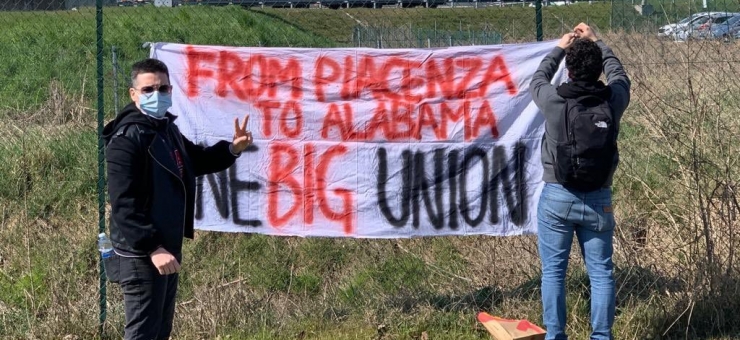
Likely to be of even greater concern to Amazon in the long run is the progress made among labor organizers in creating ties with workers in the U.S. and internationally. There are currently an estimated 1,538 Amazon facilities in the world: 290 in Europe, 294 in India and 887 in North America. When workers went on strike at 15 of the company’s warehouses in Italy, some carried banners that read, “From Piacenza to Alabama – One Big Union”. A Dutch Amazon worker involved in the international organization Make Amazon Pay told The Intercept last year, “Amazon is able to build power by operating on a global level without opposition”. Concluding his case for support of its work force uniting across borders, he noted, “We have to match the transnational scope of its organization with an internationalist strategy.”
U.S. Workers at a Crossroads

On this Good Friday in the U.S. we await the result of the most significant union organizing drive in decades. Workers in Amazon’s Bessemer, Alabama warehouse have voted this month on creating the first collective bargaining unit in one of this country’s multiple Amazon “fulfillment centers”. A yes vote will mean the 6,000 Bessemer warehouse workers will negotiate on their wages, benefits and working conditions that now are determined solely by the corporation’s management and board with the aim of maximizing profits and the price of company stock.
With growth of the global economy in the late sixties and early seventies, the number and strength of union organized workers has fallen dramatically in the U.S. As manufacturing jobs in “heavy industries” like steel and automobile have grown overseas, they have been replaced by jobs in the retail sales, restaurants and fast food, transport and warehouses of the “service sector”. Global trade distributes products to consumers around the world products made outside their country’s borders. This applies as well to purchases made by U.S. manufacturing companies for assembly of their products.
The largest retail sales company in the U.S. and the world today did not exist before 1962. Wal Mart was founded and has grown on a business plan wholly dependent on the global economy and lower costs for labor. Advances in shipping and air transport permitted the company to rely on importing products made at much lower wages, from China in particular, and selling them in sprawling stores at prices below the competition. Low wage labor overseas was complemented by steadfast, and often fierce, opposition to unions being formed by their U.S. workers. The result is a dependence by many Wal Mart workers on meager U.S. government programs of food stamps, health care, and housing.
Little progress in union organizing has been made in the past five decades among the U.S. service industries’ workers. Prevailing anti-union media references, the dwindling power and funding of union organizing and state and federal governments’ failure to defend the right to organize have militated against the organizing of service sector workers. The “neo-liberal” economic policies proposed by politicians of both parties, ex-President Clinton being the leading example among Democrats, have left workers with little support from those in power.
Among President Biden’s programs and positions representing reform of U.S. capitalism the most significant among them could be the administration’s outspoken support for unions and organized labor. A former union leader has been named to the Cabinet position of Secretary of Labor for the first time in fifty years. More vigilant oversight of company malpractice in opposing organizing and the holding of elections is promised. And President Biden himself has urged Amazon workers to vote yes on a union at the Alabama warehouse. These gestures could signal growing recognition of the role of organized labor in creating a stronger economy and healthier social climate in this country.

The organizing campaign among the Alabama Amazon workers has been aided by an international effort to “Make Amazon Pay” higher taxes in all countries where the company operates and by Amazon’s shoddy treatment of its workers during the pandemic. At the outset its white collar staff were told to work from home while the warehouse workers were offered unlimited unpaid leave. As consumer orders immediately increased in March 2020, the company raised the hourly wage $2 an hour and doubled overtime pay to further motivate workers. For workers proving a positive COVID test result for themselves or a family member, two weeks of paid leave was offered.
Once Amazon had hired more workers for its 500 U.S. warehouses, the unpaid unlimited sick leave was rescinded in May 2020 and the wage increases revoked the next month. By July the total shareholder value of Amazon had increased $500 million to $1.4 trillion confirming founder Jeff Bezos’ status as the richest person in the world. Company growth did not lead to favorable responses by unionized workers in the European countries where Amazon operates and the workers in Germany announced a strike prior to Black Friday, the day after Thanksgiving. Amazon then trumpeted the awarding of Thanksgiving worker bonuses amounting to $300 for full time workers and $150 for its part-time workers.
The Amazon worker bonuses received an unanticipated reaction from the global coalition which organized Black Friday protests in 15 countries. UNI Global Union, Amazon Workers International and other participating groups in a statement noted Bezos could give $105,000 bonuses to every Amazon employee and not have lost in net wealth during the spread of the COVID virus. The coalition statement on Black Friday last year faulted the company’s impact on the environment asserting that its “growing delivery and cloud computing businesses are accelerating climate breakdown”. Amazon’s “carbon footprint” is “larger than two thirds of all countries in the world” the multiple coalition groups, including OXFAM, the Sunrise Movement and Public Citizen, stated. A coalition leader, Global Union’s Christy Hoffman, responded to the Thanksgiving worker bonuses, “To show it values its workforce, Amazon should collectively bargain wages and conditions with workers throughout its operations, rather than make one time unilateral gestures”.
Unlike the U.S. employees, Amazon workers in most of the countries where Black Friday protests took place have been able to organize unions to negotiate with the company and/or appeal to the courts to address their needs. Activist workers in this country are vulnerable to being fired with no defense by a union. Support for Amazon organizing from the Biden administration could also foretell increased pressure to pay higher taxes in this country. Tax avoidance through the use of profit shifting, tax havens and loopholes enabled the company to pay just under 2 per cent of its profits in 2019 tax reporting and no taxes in the previous two years. In the country where it was founded and still has its headquarters, Amazon pays little to nothing to uphold the public infrastructure and the “common good”.
There is now growing recognition in this country that major corporations devote little attention, let alone concern, to the “common good” or the well being of their rank and file workers. Executive compensation and performance of the company stock are given priority through their public relations campaigns, tax dodges, hire of anti-union consultants and dismissal of workers with complaints. The grotesque preoccupation with profit taking by executives and company boards dehumanizes all participants in an economy which threatens world survival. On this Good Friday, the U.S. worker hangs on a cross of corporate greed. There is more at stake in the Amazon worker vote than just forming a union in one “fulfillment center”, as the company calls its warehouses. Amazon’s fear is justified that a worker victory in Alabama will lead to organizing campaigns among its warehouse employees nationwide. We can only hope that is the outcome.
The Conjunctions of 2020

The winter solstice of 2020 also brought the “Great Conjunction” of the planets Saturn and Jupiter. The event was hailed by many as the return of the “Star of Bethlehem” which guided the magi to the manger cradle of the baby Jesus. Although that designation remains conjecture, there is no disputing that 2020 was an extraordinary year in the life of our world.
As we begin 2021 with vaccines, the eagerness to return to “normal” is tempered by what we have learned during the past year. The failures of the U.S. in protecting and treating its citizenry during the pandemic and yet more graphic evidence of the nation’s devaluing of its black residents and persons of color in general cry out for change. It is as though the guardians of our hyper individualistic political and economic order must in 2021 ponder the needs of the disadvantaged and discriminated and allow significant change to begin to take shape.

The poem following reflects on this time of “Kairos”, crisis, and chaos and what the “Great Conjunction” of 2020 might be messaging us.
 The Great Conjunction

 Phenomenal but how interpret the orbits’
          coincidence?
 A tryst, a search, a studied return or a
          reconciliation?
 Don’t ask Galileo since his lenses
          were trained elsewhere.
 Your answer discloses clues of what you
          were looking for.
 Its appearance yet a visitation while longing
          for connection
 Fed by centuries of bearing us to a place
          of rebirth
 Or bearing us to our contemplation starving
          for a sign.

 On first sighting the illumination turned the lens
          back on us
 Turned where the ancient message belonged before
          we left the slime
 When the addressee remained unknown
          with no forwarding
 As we hurtled through the heavens fiddling
          to our end.
 The clock ticks toll louder ‘til defeaned
          by the rage
 We find ourselves released to join the dance
          of heavens’ embrace
 Calling us to explore the wink of elements
          in our lives.

 What do the lights tell us now that we know
          they are two
 Their brief approach again creating
          that great light
 For the seers and all those who notice
          such things
 And allows our access to all the darkness
          within
 our complicity in the scheme of things which ignores
          the magi
 who returned from the cradle of love
          a new way
 Wondering if the babe will overcome 456 million miles
          of separation.


 Erasing Borders