Category Archives: Solidarity, Community and Citizenship
Uruguay from Dictatorship to Democracy
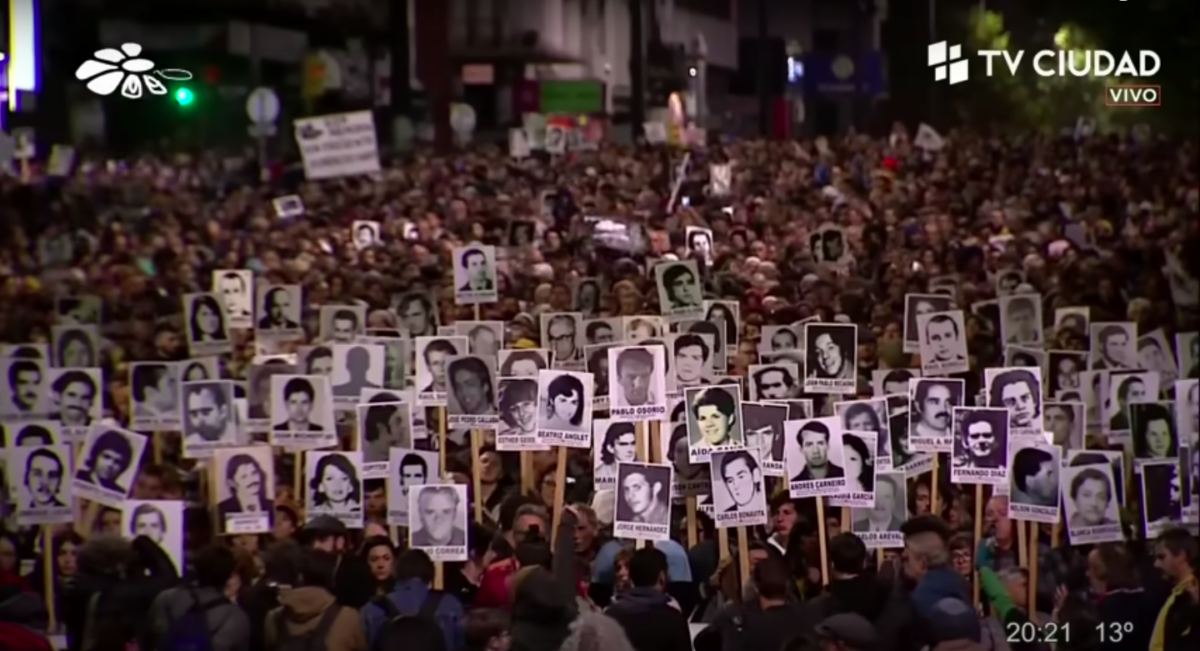
On May 20 for the past 28 years thousands have marched in 77 places across Uruguary and abroad in remembrance of those disappeared and detained by the military dictatorship from 1973 to 1985. Marchers call silently for “State terrorism never again”.
In Uruguay, shortly before the November 1971 Presidential election was held, the Broad Front, a coalition of leftist political parties was formed. Authoritarian regimes in Brazil and Argentina along with the United States feared another democratically elected socialist victory like Allende’s in Chile the previous year. The Uruguayan election was held against a background of an economy and a government in shambles and a growing Tupamaro guerrilla threat. U.S. National Security files indicate that the “superpower” feared the rise of the Broad Front coalition more than the Tupamaros.
Despite the election of a conservative President and defeat of the coalition, amidst multiple reports of harassment of its candidates, the U.S. increased its “security training” of the Uruguayan police and army. Failure of measures to improve worsening economic conditions and increased activity of the Tupamaros led to take over by the military in 1973. Brutal repression of dissent and advocacy of leftist policies were met by incarceration and torture on the advice of U.S. security advisors. During the military rule from 1973 to 1985, even mention of the word “politics” or “Tupamaros” could lead to imprisonment. For several years, Uruguay led the world in percapita jailing of political prisoners.
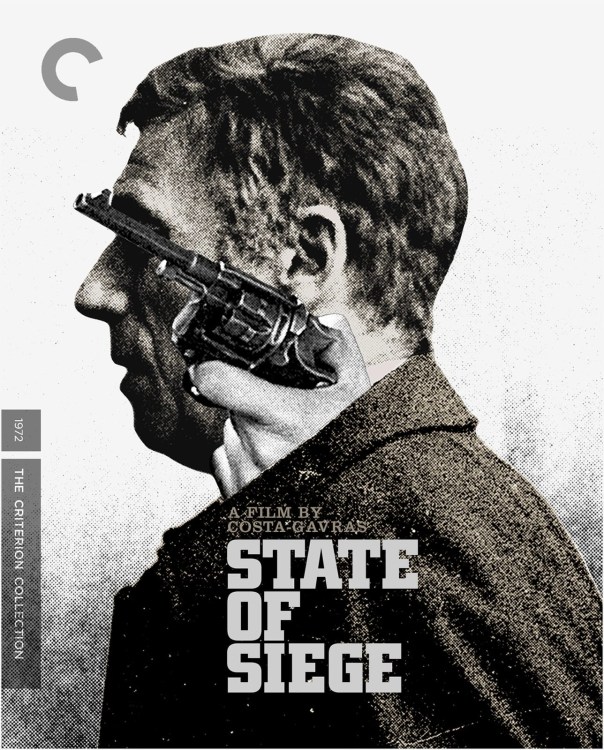
The 1972 film “State of Siege” by the makers of “Z” was inspired by the Uruguayan military’s violent repression of the Tupamaros guerrilla movement.
By 1984 the country formerly known as “the Switzerland of Latin America” had declined further and elections were held. Bolstered by rising prices for its exports, moderate to conservative governments held on to power until the historic election of the Broad Front Presidential candidate in 2004. With the Government implementing a plethora of economic and social policy reforms Uruguay became a showcase for democratic progressive rule in Latin America and indeed the Western Hemisphere.
When Tabare Vazquez of the Broad Front came to power in 2005, the rate of poverty measured 40 percent but by 2020 had dropped to under 9 percent. As the country with the lowest economic inequality in South America, Uruguay created a National Health Service for all its citizens. Pro labor legislation was approved, financial regulation, tax and pension reform enacted. Major increases in the minimum wage and social welfare payments contributed significantly in lowering economic inequality and poverty in the country.

The second Broad Front President, Jose “Pepe” Mujica, was known internationally as the “poorest President” in the world. As a Tupamaro combatant he was tortured and jailed for thirteen years under the most severe conditions. While President he drove an old VW Beetle, lived in a modest farmhouse and gave away 90 percent of his salary to organizations serving the poor and marginalized. Under his leadership (2015-20) the Congress made abortion legal and approved gay marriage. In a move to counter drug cartels’ control of the illicit drug trade, Uruguay became the first nation in the world to legalize marijuana production and consumption. The first Latin American nation to grant women the right to vote in 1927, the Broad Front led by Mujica’s party restored Uruguay’s standing as one of the most progressive democracies in the Western Hemisphere.
In retirement, he and his wife, also a former Tupamaro combatant, grew chrysanthemums at their farm and continued to drive the Beetle. At “Pepe” Mujica’s funeral procession last year, 100,000 Uruguayans honored his courageous commitment to the poor and the advance of his country.
In the next blog, erasing-borders will delve into his philosophy of the good life and his vision for the country’s future. We will consider how he contributed to Uruguay becoming a world leader in renewable energy production.
***************************
For more on the era of military rule and U.S. involvement in creating the security apparatus see:
Hidden Terrors by A.J. Langguth
Starring Yves Montand as a U.S. security agent kidnapped by the Tupamaros, “State of Siege” received a 7.7 rating from critics and movie goers. It can be seen on Prime Video.
Land and Theologies in Conflict
| Territory | Arab and other population | % Arab and other | Jewish population | % Jewish | Total population | |
|---|---|---|---|---|---|---|
| Arab State | 725,000 | 99% | 10,000 | 1% | 735,000 | |
| Jewish State | 407,000 | 45% | 498,000 | 55% | 905,000 | |
| International | 105,000 | 51% | 100,000 | 49% | 205,000 | |
| Total | 1,237,000 | 67% | 608,000 | 33% | 1,845,000 | |
| Data from the Report of UNSCOP: 3 September 1947: CHAPTER 4: A COMMENTARY ON PARTITION | ||||||
Dating back to extensive use of “Kairos” in the New Testament, “kairos” in Christian theology refers to a time when the “kingdom of God” approaches and demands a decision from individuals and societies. In contrast with the Greek “chronos” meaning a segment of time, ordinary time, “kairos” describes a critical moment in a human context of social change. The first Kairos Document was written by an ecumenical team of South African Christian black theologians in 1985 at the height of the black population’s resistance to apartheid.
Secular media paid even less attention to the Kairos Palestine Document of 2009 than they did to the original South African Document or the other theological statements, including those in the U.S. and Europe, responding to the 1985 declaration of South African theologians. Since the Hamas attacks in October 2023 some commentators have noted how little reference to the Palestinian cause or Israel’s Palestinian occupants has been made in our media since founding of the state of Israel in 1948. So it is not surprising that outside of church circles there has been little notice of the Kairos Palestine Document.
The Document begins with an endorsement by thirteen “Patriarchs and Heads of Churches” in Jerusalem; they describe the declaration as “a word of faith, hope and love” calling on “all peoples, political leaders and decision-makers (to,ed.) put pressure on Israel and take legal measures in order to oblige its government to put an end to its oppression and disregard for the international law.” The thirteen Palestinian Christian authors advance a theological position “that the military occupation of our land is a sin against God and humanity, and that any theology that legitimizes the occupation is far from Christian teachings because true Christian theology is a theology of love and solidarity with the oppressed”.
In its theological discussion of the land governed or occupied by the State of Israel, the authors affirm that “the earth is the Lord’s and the fullness thereof” (Ps 24:1) and therefore assert no land can be seen as the possession of any particular people. Exclusion and expulsion of any group or groups from the land cannot be God’s intention. “God gives us the capacity, if we have the will, to live together and establish in it justice and peace, making it in reality God’s land.” The Kairos Palestine Document avers that the promise made by God to Abraham in the Hebrew Bible was to make him father of many nations living in justice and harmony in the land where he had been led.
In the current context of Israel’s continuing its indiscriminate killing of Palestinian civilians in Gaza, the 2009 Document takes on yet more urgent significance as a cry for justice to Christians and non-Christians worldwide. When issued, the conflict no longer was about a purely theological or political issue. “It is a matter of life and death” the authors and signators declared sixteen years ago and, as such, the Word of God in the Bible cannot be used to justify policies or State actions which bring death and destruction. As a living Word which addresses the Hebrew and Christian Bible’s themes of promise, chosen people, and land a literal interpretation makes the Word an instrument of death.
On the Bible’s treatment of the crucial topic of “the land” the Kairos Palestine Document was followed six years later by publication of the book From Land to Lands, from Eden to the Renewed Earth . Written by the young theologian and pastor Munther Isaac (see Erasing Borders blogs of September 1 and January 16, 2024), it is a sweeping study of a “Biblical theology” supporting a thesis of the universalisation of the land, indeed any land. Its lively and clear presentation of the positions of biblical scholars and theologians enables a closer reading of the texts by laypersons and their progress in shaping their own views. Although the author did not participate in creating the Kairos Palestine Document the book was written in service of its aims and concludes by asking, “Can it (the land) become a place where Jews, Muslims and Christians – while retaining their distinctive beliefs – can embrace each other as fellow human beings, and indeed as people of faith, and be reconciled in practice?”
Christmas on the Border, 1929
The poet Albert Rios based this poem on newspaper accounts and personal recollections of residents who were children in Nogales at the time of the event.
1929, the early days of the Great Depression.
The desert air was biting, but the spirit of the season was alive.
Despite hard times, the town of Nogales, Arizona, determined
They would host a grand Christmas party
For the children in the area—a celebration that would defy
The gloom of the year, the headlines in the paper, and winter itself.
In the heart of town, a towering Christmas tree stood,
A pine in the desert.
Its branches, they promised, would be adorned
With over 3,000 gifts. 3,000.
The thought at first was to illuminate the tree like at home,
With candles, but it was already a little dry.
Needles were beginning to contemplate jumping.
A finger along a branch made them all fall off.
People brought candles anyway. The church sent over
Some used ones, too. The grocery store sent
Some paper bags, which settled things.
Everyone knew what to do.
They filled the bags with sand from the fire station,
Put the candles in them, making a big pool of lighted luminarias.
From a distance the tree was floating in a lake of light—
Fire so normally a terror in the desert, but here so close to miracle.
For the tree itself, people brought garlands from home, garlands
Made of everything, walnuts and small gourds and flowers,
Chilies, too—the chilies themselves looking
A little like flames.
The townspeople strung them all over the beast—
It kept getting bigger, after all, with each new addition,
This curious donkey whose burden was joy.
At the end, the final touch was tinsel, tinsel everywhere, more tinsel.
Children from nearby communities were invited, and so were those
From across the border, in Nogales, Sonora, a stone’s throw away.
But there was a problem. The border.
As the festive day approached, it became painfully clear—
The children in Nogales, Sonora, would not be able to cross over.
They were, quite literally, on the wrong side of Christmas.
Determined to find a solution, the people of Nogales, Arizona,
Collaborated with Mexican authorities on the other side.
In a gesture as generous as it was bold, as happy as it was cold:
On Christmas Eve, 1929,
For a few transcendent hours,
The border movedOfficials shifted it north, past city hall, in this way bringing
The Christmas tree within reach of children from both towns.
On Christmas Day, thousands of children—
American and Mexican, Indigenous and orphaned—
Gathered around the tree, hands outstretched,
Eyes wide, with shouting and singing both.
Gifts were passed out, candy canes were licked,
And for one day, there was no border.
When the last present had been handed out,
When the last child returned home,
The border resumed its usual place,
Separating the two towns once again.
For those few hours, however, the line in the sand disappeared.
The only thing that mattered was Christmas.
Newspapers reported no incidents that day, nothing beyond
The running of children, their pockets stuffed with candy and toys,
Milling people on both sides,
The music of so many peppermint candies being unwrapped.
On that chilly December day, the people of Nogales
Gathered and did what seemed impossible:
However quietly regarding the outside world,
They simply redrew the border.
In doing so, they brought a little more warmth to the desert winter.
On the border, on this day, they had a problem and they solved it.
The poet resists any social commentary in describing his poem’s genesis. It appeared, however, as the Academy of American Poets’ “Poem of the Day on December 22, 2024 a month after the U.S. election of a viciously anti-immigrant, white supremacist President. Like other memorable poems, it celebrates the best of human nature and defies any attempts, even by the most powerful, to deny, contradict or pervert the good within each of us. We celebrate today the vision and courage of the “officials” of Nogales with the hope that we may individually and collectively open ourselves to the opportunities in these times to move borders. For the sake of the children in and around us.
Rios commented on his poem, “I didn’t live through the Christmas of 1929, but growing up in Nogales, the border was always there—constant, imposing, dividing and connecting at the same time. This poem reflects on a story from before my time, when the border wasn’t just a barrier but something that became a solution. It tells of a community that, for one Christmas, chose unity over division, moving the line in the sand to bring joy to children from both Nogales, Arizona, and Nogales, Sonora. Growing up with the border always in sight, this story resonates deeply for me—proof that even in separation, people’s determination can make the impossible happen.”
“Make American White Again”
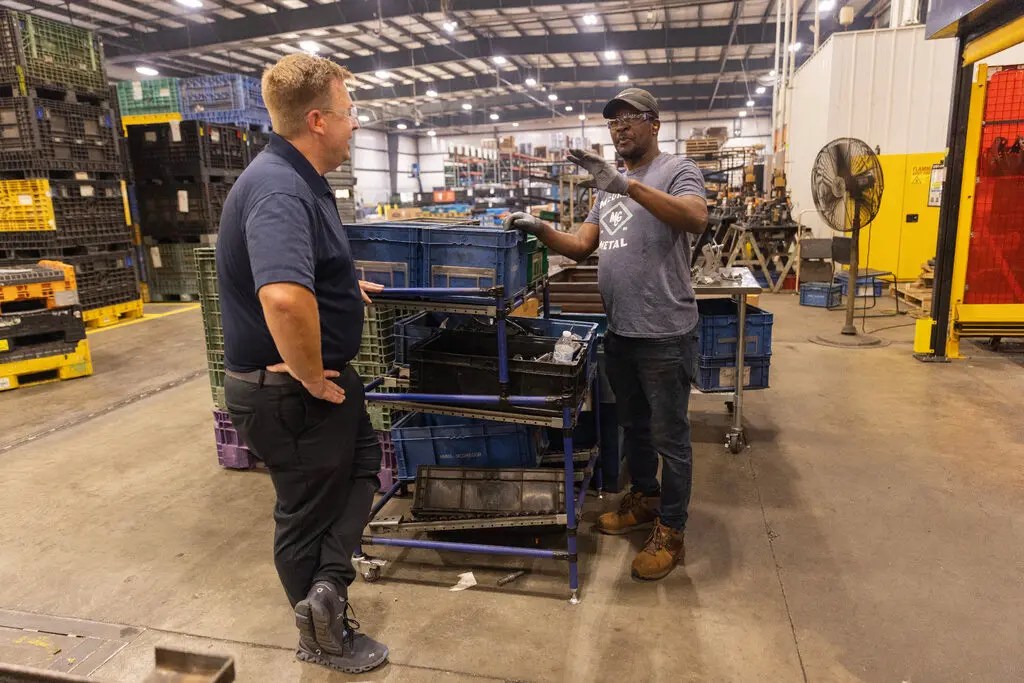
The U.S. economy has long relied on immigrant labor in its growth. The United States is a nation of immigrants. The 19th century transition from an economy devoted to agriculture to a modern industrial system funded by agricultural produce depended on the import of immigrants, with Germans and the Irish leading the way. Along with their essential labor for the new manufacturing sector and the expansion of farming, their arrival and that of immigrants after them brought deep political division reflecting the conflicts in work places and neighborhoods. Charismatic personalities have for two hundred plus years made political careers out of those divisions. Using the tools of distortion, lies, religious differences and buffonery, nation-wide political movements have been created and the nation’s ethnic divisions deepened.
The U.S. Civil War resulted from decades of simmering conflict over the proper role for the African immigrant brought to these shores as slave labor. Sacred texts dated as two millenia and more in origin were interpreted as assigning back breaking labor in fields and estates to the African sold as a slave. Low to no wages producing lucrative crops, cotton especially, for the world made the southern U.S. the supplier of much of the capital for the new nation’s financiers of south and north.
Angry debate over the causes and meaning of the Civil War continues today. Our most hallowed symbol of the United States as a welcoming refuge, the Statue of Liberty, was subjected to controversy and opposition in its creation one hundred fifty years ago. The Frenchman who created the original design saw the Statue as a celebration of the abolition of slavery with broken shackles to be draped from Liberty’s left hand. But to avoid the protests of former slaveholders and their supporters, who portray slavery as an idyllic era, the shackles now are partially hidden by her gown’s layers of folds and are barely visible from the ground level promenade.

America’s long history of anti-black racism and professed white superiority makes the nation’s response to the rise in the world’s immigrant population especially challenging, emotionally and politically. In the comprehensive study of world immigration by the U.S. Pew Research Center, it was found that one out of five immigrants in the world live in the U.S. While we now have far more immigrants and children of immigrants inside our borders, the majority of our more recent arrivals are persons of color, not the white adults and children from Europe and Scandanavia of the 19th century. As late as 1920, most of the newly arrived came from Italy and Germany, with Canada a distant third. Much of the shift to the immigration of persons of color has occurred since passage of the 1965 immigration reform. In 2022 the nation’s largest immigrant populations hailed from Mexico and India.
The 1965 Immigration and Nationality Act supported the shift in the origin of immigrants. Eliminating quota provisions favoring immigration from Europe, it gave preference to skilled workers and immigrants from anywhere with family members already settled in the U.S. The Act thus contributed to the rise in immigrants of color primarily from the earth’s southern hemisphere and a considerable increase in the numbers of immigrants in the country.
In the fifty years after passage of the 1965 law there were a total of 72 million immigrants and their children who came to the “land of freedom”. They accounted for 55% of the growth in U.S. population and Pew researchers project they will make up 88% of the growth from 2015 to 2065 when the nation will number 441 million persons and no ethnic group will constitute a majority of the population. Whereas non-Hispanic whites totaled 84% of the U.S. population in 1965, Pew studies project they will number 46 % in 2065. Continuing immigration from Latin America will make Hispanics 25% of the population and by 2065 14% of the nation will be Asian in origin.
Given voting trends in recent elections showing Hispanics favoring Democrats, the Republican party leadership has been particularly concerned by the dizzying increase in their numbers. Their current response is to support with near unanimity a candidate for U.S. President who has made the country wide settlement of immigrants of color the focus of his campaigns. His primary policy proposal, virtually his only concrete pledge, is to return two million recent immigrants to their countries of origin. The Republican candidate has repeatedly characterized Democrats’ relatively lenient response to the shift in immigration from the southern hemisphere as admitting “criminals and rapists” into our communities. In this month’s debate between the Democratic and Republican candidates for President, regardless of the question at hand Trump returned again and again to foreign nations sending their most dangerous citizens across our borders.
Trump’s history of racist rhetoric and commentary reveals the underlying message of the campaign slogan “Make America Great Again” for his 2016 and 2024 campaigns for President. A Wikipedia article on the phrase reports the candidate still denies the influence of Ronald Reagan’s successful 1980 campaign use of “Let’s Make America Great Again” as a slogan. Trump does outdo Reagan in disclosing the covert intent of its use as “Let’s Make America White Again”.
His outrageous claim that Haitians, migrants from one of the “shithole countries”, are eating the pets of residents of Springfield in the crucial State of Ohio may, however, have back fired. Not only did the city’s top administrator deny the report which Trump culled from an extreme racist’s social media posting, the town’s populace has been patronizing the Haitian restaurants as never before and emphasizing their new businesses and Haitian labor as vital to the growth of the local economy.
While the heavily Republican area may still vote for Trump in this year’s election, the recent affimation of the Haitian immigrants by many Springfield residents illustrates the central question raised by the candidates. Will the U.S. citizenry finally signal their embrace of the nation’s image as a haven of welcome for people of any and all ethnicities? Or will it step up its effort to hold back the migration patterns of our modern era in a futile effort to return the U.S. to a time when its white population were a majority. Representing the nation’s ideals as embedded in its history of immigration moving the economy, the culture, the community life forward, the opposition Democratic Party candidate is a woman of mixed Asian and African ancestry. If Harris’ Democratic Party is able to safeguard a victory in the upcoming election, the outcome will mark the nation’s progress to becoming a true “multi-racial democracy”.
Kansas City Haberdasher and the Founding of Israel
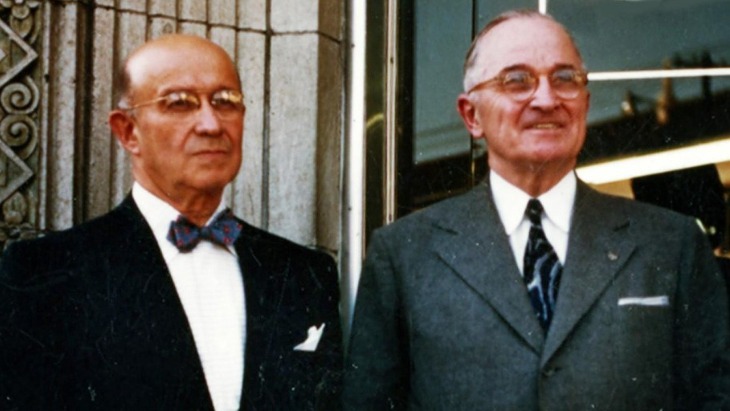
The 1948 announcement of Israel’s creation owed a great deal to a notable friendship. In his unqualified endorsement of the move President Harry Truman defied Secretary of State George Marshall and the U.S. foreign policy establishment. In doing so he did, however, demonstrate his loyalty to an enduring relationship.
Harry Trumans’s buddy Edward Jacobson grew up with the thirty-third U.S. President in Kansas City. After the Jewish Jacobson and the Presbyterian/Baptist Truman served together in the Army during WWI, they opened a hat and clothing store in their hometown. After the store’s failure, they remained close as Jacobson continued to sell clothing and Truman entered public service and politics. When Britain ceded to the U.N. continued rule of Palestine, Jacobson influenced Truman and and the U.S. support for the partition plan that created the State of Israel.
By then owner of a clothing store in his hometown, Jacobson was identified by Zionist stratgists as a key U.S. contact in shaping the partition plans and his nation’s approval of the agreement. The story is told in a footnote to a recent account of Palestine’s history from 1920 to 1948. “The Road to 1948 and the Roots of a Perpetual Conflict” appeared as a February 4, 2024 article in the New York Times Magazine which brought together six Jewish and Arab historians to discuss the beginning of the British Mandate in 1920 to the founding of the new State of Israel.
The partition plan which called for two states, Palestine and Jewish, to be recognized was a highly delicate, complicated issue for the powerful Allied leader and U.S. post WW II diplomacy. Drafted by a Special Committee of the new international organization, it was opposed by the Palestinians, the new Arab States – Jordan, Syria, Lebanon – created by the end of French colonialism in the Middle East and most of the rest of the Arab world.
Today it may appear to have been a grave mistake for the Palestinians to oppose the partition plan and the two state solution offered in 1947. However, as Professor Abigail Jacobsen of Jerusalem’s Hebrew Union College points out, “It’s important not to read history retrospectively. When you look at the demographic realities of 1947 and the division of the land, it was 55 percent for the Jewish state and 45 percent for the Palestinian state even though there were double the number of Palestinians as Jews at that point. If you were a Palestinian in 1947, would you accept this offer?” Prof. Jacobson seems to commend the Palestinians when she also reminds us that “the Palestinian national movement was ready to accept the Jews as a minority within an Arab state”.
Zionist defense of the new State of Israel yielded an overwhelming victory. The moderator of the Times’ discussion, Emily Bazelon, writes in her background for the academics’ commentary, “Before the war, there were around 500,000 Jews and 450,000 Palestinians on the 55 percent of the land that the U.N. designated for a Jewish state. When the Arab-Israeli war ended in July 1949, Israel controlled 78 percent of the former British Mandate and the population was mostly Jewish, with only 155,000 Palestinians.”
In response to Bazelon’s ensuing question of why the Palestinians were not permitted to return to their homeland, Harvard’s Derek Penslar responds, “As the war wore on, the Israeli government issued a decree not to allow the refugees to return.” Expulsion of Palestinian residents and seizure of their land and property is now called “the nakba” or “catastrophe” in English. Current and past Israeli administrations have encouraged the view that security of the fledging State facing the Arab threat required such defense of the diplomatic and military gains made in 1947-49.
Eddie Jacobson’s role in cementing the close ties of the U.S. with the new Jewish State did not go unrecognized. In their description of the Jacobson file at the Harry Truman Library, its archivisits wrote, “Through a variety of tributes and honors, Israelis and Americans alike recognized his contribution to the founding of the Jewish state.” As one example of his large influence, the archivists note that it was Jacobson who arranged Truman’s meeting with the Zionist leader Dr. Chaim Weizmann. Two months after their conversation in the White House, Zionist leadership proclaimed the founding of Israel and less than an hour later the U.S. became the first nation to grant diplomatic recognition to the State of Israel.
The Library’s last Jacobson letter is the former President’s 1955 handwritten note referring to plans for a visit to Israel, likely accompanied by his old friend. Shortly after the letter, Jacobson died and Truman never made the trip. As a tribute to his friend, the archivists draw our attention to President Truman’s statement that Edddie Jacobson was “as fine a man who ever walked”.
“The Road to 1948 and the Roots of a Perpetual Conflict” published in the February 1, 2024 New York Times Magazine is a fine summary of the leaders and developments in Israel-Palestine prior to May, 1948. https://www.nytimes.com/issue/magazine/2024/02/02/the-2424-issue

Palestinian Christians Call for Repentance
Raised by Christian minister parents I married a Jewish woman from a Conservative Jewish family and at age 35 did so with a commitment to Judaism. Following Jewish custom, the offspring’s religious education would be her responsibility and domain. Five years later the first of our two daughters was born and I was ordained as a pastor. My “call” to serve was thanks to a vibrant, progressive Christian Church I had joined and the rich discovery of the prophets/”nabi” of the Hebrew Bible. On visits of my wife’s family, their seder meals and shabat candle lighting deepened my honoring of the Jewish faith traditions.
Contemporary Israel and the ongoing struggle to share the land was never discussed on those visits but my wife may have informed her family of my views. They came in part from study of Africa’s colonial experience and my spending two years in the Congo which continues to suffer exploitation and oppression by the former colonizers allied with the new nation’s ruling class. My position on safeguarding Israel’s future was also shaped by my conscientious objector status and opposition to the War in Vietnam.
The leading U.S. pacifist organizer of the last century, A.J. Muste (see my former posts about Muste) originated the quote, “There is no way to peace. Peace is the way.” The 76 year history of the wars in the Middle East are for me conclusive evidence that war is not the way to peace for Arabs or Israelis. I understand, however, how American, Soviet and their allied armies’ war on three fascist regimes in WWII have influenced U.S. and Israel’s policies on making peace with Palestinians who were forcibly expelled in 1948.
Today as a Christian minister and life-long student I have faith that the Hebrew and Greek holy writings reveal enduring truths about contemporary human societies and cultures. The truth that the Jewish-Christian authors of the New Testament proclaim Jesus as showing humanity the way to peace. The truth that we hear today false prophets and their errant rulers crying “Peace, peace when there is no peace” (Jer 6:14 and Jer 8:11). And that in the time of Ezekiel, “they have misled my people, saying ‘peace’ when there is no peace; and because, when the people build a wall, these prophets smear whitewash on it.” (Ezek. 13:10)
My faith has led me over the years to listen to the cries of anguish coming from Palestinians and support their rights affirmed by U.N. Resolution 194 in 1948. The unity and solidarity with all oppressed people that is envisioned by holy texts requires no less. The Sabeel Ecumenical Liberation Center (sabeel.org), created by Palestinian Churches and based in Jerusalem, has, for four decades, helped me sympathize with the cries of Palestinians living under Israel’s unequal and exclusionary occupation of their former homeland. In reading the letter I’ve excerpted below, I believe I hear the voice of God responding to the spiraling of the Israel-Palestine conflict since October 7. Less than two weeks after the Hamas attacks and initial Israeli bombardment of Gaza, Sabeel and several other Palestinian Christian organizations appealed for solidarity of all Christians and ultimately all of humanity. It appeals to all to pray with Thomas Merton that “if today I hear the voice of God, may I not resist a softer, more compassionate heart.”
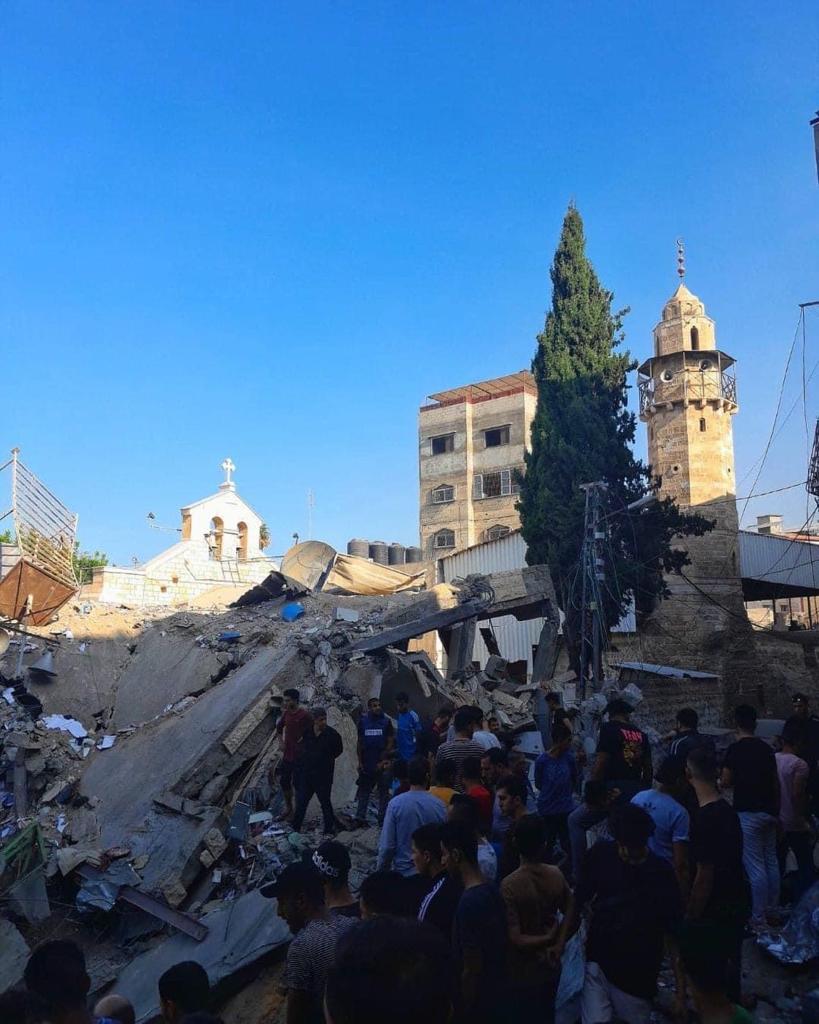
Dated the day Israel bombed the Church in the above photo, Sabeel and other Christian organizations in Israel-Palestine addressed their plea to Western church leaders and theologians. “Words fail to express our shock and horror with regards to the on-going war in our land. We deeply mourn the death and suffering of all people because it is our firm conviction that all humans are made in God’s image. We are also profoundly troubled when the name of God is invoked to promote violence and religious national ideologies” we read in the letter’s first paragraph.
The writers begin the second with “we watch with horror the way many western Christians are offering unwavering support to Israel’s war against the people of Palestine. While we recognize the numerous voices that have spoken and continue to speak for the cause of truth and justice in our land, we write to challenge western theologians and church leaders who have voiced uncritical support for Israel and to call them to repent and change.”
The Palestinian Christians then ’grieve and lament’ the Israeli military’s use of tactics that target civilians: “such as the use of white phosphorus, the cutting off of water, fuel, and electricity, and the bombardment of schools, hospitals, and places of worship—including the heinous massacre at Al-Ahli Anglican-Baptist Hospital and the bombardment of the Greek Orthodox Church of Saint Porphyrius which wiped out entire Palestinian Christian families.”
The letter ends with resounding notes of faith “remembering that God ‘will judge the world in justice’ (Acts 17:31). We also remind ourselves and our Palestinian people that our sumud (“steadfastness”) is anchored in our just cause and our historical rootedness in this land. As Palestinian Christians, we also continue to find our courage and consolation in the God who dwells with those of a contrite and humble spirit (Isa 57:15). We find courage in the solidarity we receive from the crucified Christ, and we find hope in the empty tomb. We are also encouraged and empowered by the costly solidarity and support of many churches and grassroots faith movements around the world, challenging the dominance of ideologies of power and supremacy. We refuse to give in, even when our siblings abandon us. We are steadfast in our hope, resilient in our witness, and continue to be committed to the Gospel of faith, hope, and love, in the face of tyranny and darkness.”
When I prepared for a surgery this week, my thoughts turned to the destruction of Gaza hospitals and dearth of medical supplies. I thought of the children in Gaza undergoing amputations and other excruciating procedures without benefit of anesthesia. I tried to imagine what had enabled those children to accept and survive what was happening to them. Their example helped me in an unfathomable way to prepare for the outcome of my surgery whatever it might be. In my gratitude afterwards for its success, along with doctors, nurses and other hospital care givers, I gave thanks for the resolute courage of the children of Gaza.
******************* *******************
Nearer to Gaza November 15, 2023

He couldn’t have been more than 17 seated across from a
middle aged man scrutinizing an Arabic newspaper
at the clothed table facing the
entrance “A snack” he responded quickly to my question about a
spinach/cheese roll wrapped in a delicate pastry dedicated to
protecting his mother from embarrassment with her timorous
perfectly constructed English “Two minutes” she assured me
holding up fingers as her husband made his appearance to
ask something before rushing back to the kitchen in an
effort to avoid messaging impatience I ambled over to
the tea sets displayed on a table under a Palestinian flag
spanning the length of the table and a t.v. tuned to Al-Jazeera
Arabic reporting on a protest at Democratic headquarters and
I said I hear Al-Jazeera English is very different from Al-Jazeera
Arabic the boy said he watches the Arabic only at the restaurant
for his mother the cook assistant to her husband and receptionist
because you know mumbling something “I don’t know if there’s
a difference” and I left wondering why the Arabic restaurant and
grocery also Palestinian owned and managed at the back of the
compound does not have a flag on the wall and whether it takes
courage.
What Congo Gets for Mining Its Cobalt

Before buying an electric vehicle you may want to consider the cost in human lives and environmental ruin at the first level of the EV battery’s supply chain. Congo (DRC) mines 70 per cent of the world’s cobalt and despite the claims of the hi tech corporations, the mining of its cobalt is destroying Congolese lives and their land. So goes the summary of Siddarth Kara’s findings reported in his 2023 book Cobalt Red: How the Blood of the Congo Powers Our Lives. Kara pulls back the cover on cobalt mining laid by the beneficiaries of this rare, essential mineral’s supply chain.
Demand for cobalt accelerated with spiraling sales of smartphones, laptops, I Pads and Pods, etc. in the 90’s but the digging for cobalt rivals the U.S. gold rush with the demand created by EV manufacture in the new century. EV battery packs require over 1000 times more cobalt than smartphones. The forecast of how and where the demand will be met is tragically familiar.
Beginning with the trade in African slaves through satisfying the global demand for ivory followed by rubber, palm oil and in supplying strategic minerals for modern warfare, the systems of resource extraction initiated by Belgian King Leopold’s Congo Free State then restructured by the colony of Belgian Congo are now implemented by the neo-colony of the Democratic Republic of Congo. Each system of governance has positioned Congo to contribute the preponderant share of critical resources to the global economy. Relevant to the mining of cobalt is the attempt of southern Congo’s Katanga Province to secede from the newly independent nation in 1960. Plotted and financed by Belgian copper mining interests, when the elected Prime Minister Patrice Lumumba defied foreign control of Congo’s resources in 1960 he was flown to Katanga to be tortured and assassinated by the Belgian military.
The Katangan copper mines with their byproduct of cobalt are now managed and partially owned by Chinese companies. As a side note, it is important to state that U.S. companies depend on China for the bulk of their cobalt supply. In 2016, a Chinese company purchased from a U.S. mining firm the largest copper/cobalt mine in Congo.
In his tours of cobalt mining in southern Congo, Kara focused his attention on the individual miners, haulers and washers of the “artisanal” mines. Supplying an estimated 30 percent of Congo’s annual cobalt production the ravages of artisanal miners’ lives and their environment are as appalling as they are hidden by the multi-leveled supply chain and white washing of the extraction practices. With little to no provision for their fair payment or miner safety, Congolese President Kabila urged citizens in the late 90’s to reap the bonanza brought about by the increasing global demand for cobalt.
But it was Kabila’s son Joseph whose mining deals with the Chinese to produce an essential element for EV’s brought about the unprecedented growth of artisanal mining by entire families. An elderly woman observed that the President and other Congolese who exploit villagers’ labor fabricated tales of riches to be made from cobalt and then sold what the diggers extracted at a price much higher than what the miner received. After recounting incidents of children being maimed or killed in mining accidents the grandmother concluded in despair, “this is what cobalt has done to Congolese children. They have no more future.”
In their quest for the highest grade cobalt, and a higher payment received, some artisanal miners dig tunnels in the mineral rich earth. With some tunnels up to thirty meters below the surface, the miners accept staggering risks in wagering their labor. Rarely are beams used in tunnels and while air blowers may be installed the dust stirred up and breathed is toxic and stifling. In his interviews with miners, Kara listened to gruesome accounts detailing the loss of life and limbs brought on by common artisanal practices.
Why would villagers dig for cobalt when fully aware of the danger and sure erosion of their health? There are simply no other opportunities to earn a cash income and contrary to the government’s pledge of free public education through middle school, fees must be paid to the school to employ a teacher and enroll a child. The goal of providing their children an education was shared with Kara by many of the artisanal miners.
For a nation endowed with abundant sought after resources, it is shocking that the national budget cannot meet the bill for free education in the primary grades. Kara cites that the entire 2021 national budget totaled $7.2 billion, comparable to that of the State of Idaho with a population one fiftieth the number of Congolese. The budget increased very little from 2019-21 in spite of the 100 percent increase in the global price for cobalt. Clearly the structure of Congolese resource extraction supplies only a few nationals with massive wealth. There has been no accounting for the billions paid by the Chinese for southern Congo’s mines and processing plants during the administrations of the Kabilas, father and son.
Kara describes how the structure of corruption benefiting the Congolese elite is matched by the foreign companies’ rigged accounting and white washing of the cobalt mining practices. In exposing the truth of what he witnessed in artisanal mining of cobalt, Kara’s book offers dramatic evidence to be used in lawsuits and reform movements deployed to save Congolese lives and enhance the country’s future.

are “trafficked” by entrepreneurs and soldiers
to work in the mines.
From a Congolese child’s digging of rocks laden with cobalt to the battery in our home computer, Kindle and electric vehicle is a circuitous route. As Kara writes, “The realities (of the mining, ed.) are hidden behind numerous layers of multinational supply chains that serve to erode accountability”. On parting with his translator in Congo after a visit, Kara asked what he would like him to write. The man replied, “Please tell the people in your country, a child in the Congo dies every day so that they can plug in their phones.”
********************** *************************
This book review is posted in recognition of Congo Week October 15-21, 2023. Congo Week has been organized anually for more than a decade to “break the silence” on the ongoing injustices of the extraction of Congo’s vast resources. For more information on Congo Week and on Congo in general go to friendsofthecongo.org. For more on cobalt mining in the country and court cases brought against its practices do a search for more posts on the topic at the blog lokoleyacongo.org .


 Erasing Borders
What We Need
Nov 3
Posted by erasingborders
Until the election this year, no U.S. Presidential candidate has identified so many enemies within the nation whom we should fear. The Republican Party’s candidate for President has made, as in 2016, purging of immigrants within our borders the foremost plank of his policy platform. But they are not the only group targeted for condemnation and reprisals. His opponents in 32 felony cases in which he has been convicted have now also been put on notice. Media outlets intent on lifting the veil of lying, depravity in relationships with women, violation of business contracts and attack dog strategy in multiple court cases, any persons or group publicizing the truth of his grotesque mendacity may expect reprisals.
Although he has been classified as a would be dictator. a leader in the mold of other authoritarian rulers today and in the past century, an accurate assessment of his biography of misdeeds may require a comparison with figures farther back in history. My own search for a true match has been prompted by the following poem of David Budbill:
“The emperor
His bullies and
Henchmen
every day
Terrorize the world
Which is why
Every day
We need
A little poem
Of kindness
A small song
Of peace
A brief moment
Of joy
– Written by David Budbill in 2005. Budbill was posthumously named “The People’s Poet of Vermont” by the Vermont legislature.
Contemplating the possibility of this nation elevating a depraved egotist to our highest office the Book of Psalms gave voice to what I felt. Here in Psalm 5, written over 2500 years ago, I found an apt description of the man who threatens to become the President of our formerly united States.
“There is no truth in their mouths;
their hearts are destruction;
their throats are open graves;
they flatter with their tongues.
Make them bear their guilt,
O God:
let them fall by their own
counsels
because of their many
transgressions cast them
out,
for they have rebelled against
you.
Those are verses 9 and 10 of Psalm 5, in the New Revised Standard Version translation of the Hebrew Bible. Psalm 133 suggests a source for the “brief moment of joy” for our “every day” as Budbill calls for in his poem “What We Need”.
“How very good and pleasant it is
when kindred live together in
unity!
……..
For there the Lord ordained his
blessing
life forevermore.”
Those are verses 1 and 3b of Psalm 133 in the NRSV translation.
We in the U.S. are blessed by the presence of people from many of the world’s nations who have chosen to make this nation their home. They come in many colors. They come speaking many languages, eating a delightful variety of foods, following many different customs. We encounter them as our yard tenders, bricklayers, journalists, tree trimmers, nurses, meal servers, bus and truck drivers, long term care givers, crop harvesters, doctors, shop owners and clerks and public servants. Every day most of us have the opportunity to show gratitude for their presence and their service. Every day we can all share with them a “brief moment of joy” with a smile, with words of kindness, with words of thanks.
Posted in Global Economy, Interfaith Relations and Politics, Solidarity, Community and Citizenship, U.S. Immigration and Refugee Policies, U.S. Political Developments
6 Comments
Tags: A would be emperor of the U.S., David Budbill, Growing diversity of U.S. population, The Psalms' commentary on the 2024 U.S. election