Category Archives: Interfaith Relations and Politics
Opposition to U.S. Christian Zionism
In a coast to coast tour of the U.S., the Palestinian Lutheran Pastor Rev. Munther Isaac, delivered the message to U.S. Christians and their leaders that our “Silence is Complicity”. Citing our unconditional official support for Israel’s War on Gaza and now on the West Bank occupied territories, Rev. Isaac appealed to all Christians to do more than pray in this time of unprecedented death and destruction in Gaza and the West Bank. Rev. Isaac told an interviewer, “I’m here to talk to faith leaders, and particularly church leaders – my own community – to speak louder, for it’s been 10 months now since this war has broken, and we’re tired of void calls for peace.”
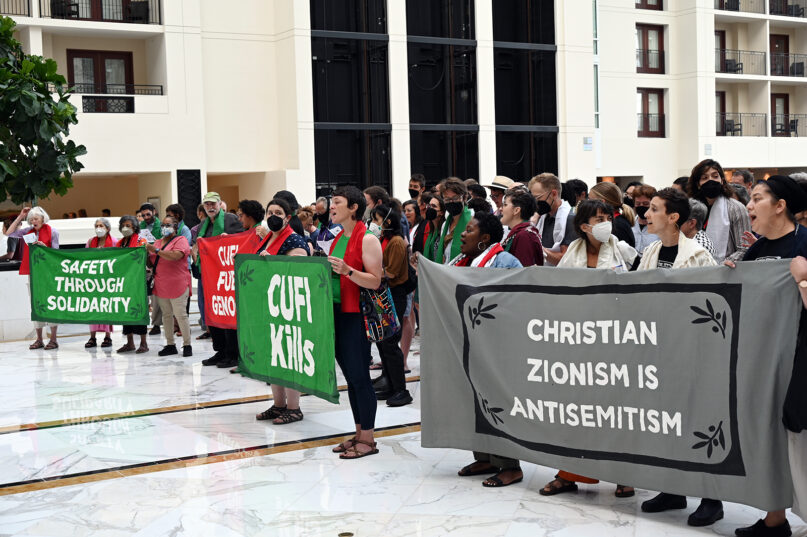
The pastor of Bethlehem Christmas Lutheran Church reserved praise for those U.S. Christians joining rallies and demonstrations in opposition to continued sale of U.S. weapons and outright aid to Israel. Condemned most emphatically were the some 10 million members of Christians United for Israel (CUFI). The Palestinian Christian leader was encouraged by rallies held in opposition to the group during the CUFI annual convention held in Maryland this year on the banks of the Potomac River. The interfaith group demonstrating against the group’s position was around 700 people (est. of Religion News Service) with most of the leading U.S faith communities represented. Jewish organizations Jewish Voice for Peace, Rabbis for Ceasefire and If Not Now made a prominent impact during three days of rallies condemning CUFI. Jewish Voice for Peace members created a flotilla of 25 kayaks which unfurled on the Potomac a banner reading “CUFI kills”. The leader of Hindus for Human Rights summarized his organization’s intent in participating, “There is equal and inherent dignity in all of us, and so an attack on the people of Gaza is an attack” on all of humanity. (from the RNS article of July 30, 2024)
Rev. Isaac’s two week tour coincided with the CUFI convention and in interviews and sermons he called attention to the division among U.S. Christians that CUFI has deepened. In his July 30 interview with Amy Goodman of Democracy Now he described the rapidly growing organization’s theology. “The idea was that Jews will someday be restored, using a theological term, which really means convert to Christianity, embrace Jesus as their Messiah. And for that to happen, they must be in Palestine, the biblical land.” Along with this anti-Semitic theological vision is the potent irony that Christian Zionists greatly outnumber and predate Jewish Zionists.
Before returning to Palestine Rev. Munther Isaac preached at Riverside Church in New York City where Rev. Martin Luther King called for a revolution in values in the Church and nation in his April 1967 “Beyond Vietnam” sermon. Rev. Isaac delivered two urgent messages to U.S. Christians prior to his departure. First was the plea to acknowledge that the Palestinian people had lived on the land of the State of Israel long before its creation in 1948. Contrary to the neglect and failure to mention the historic Palestinian presence by the U.S. and Israeli media since 1948, Rev. Isaac reminded audiences that “Israel was not created on an empty land”.
A second message comes from the Pastor’s surveying the response of Christians world wide to the ethnic cleansing taking place under the Israeli occupation of Gaza and the West Bank. “Gaza has become the moral compass of the world” Isaac observed; it has divided even many Christians. And I think that’s a good thing, because we need to know where you stand.”
Nowhere is the division between Christians more pronounced and longstanding than in the country with the world’s largest number of Christians. Nowhere is the division deeper or the political consequences greater than in this nation. Sen. Lindsay Graham spoke for millions of CUFI members and other U.S. Christians when he stated, “As a young man in South Carolina, I was raised to understand that God blesses those who bless Israel, and that’s my foreign policy. It’s not that complicated.”
It is not complicated for Sen Graham and so many U.S. Americans because they have not given thought to the fate of the territory’s original occupants over the last one hundred years. At the beginning of the League of Nations approved British Mandate in 1920 the population of what was commonly called Palestine comprised 757,182 persons of whom 78% were Muslim Arabs, 11% Jewish and 9% Christian. As a Jewish-Arab War raged onin 1946-48, the U.N. created a partition plan of two states using figures reflecting a considerable increase in Jewish numbers. In the plan proposed by the U.N., Jews slightly outnumbered Arab Muslims and Christians in the Jewish state created by the partition plan while Arabs overwhelmed Jewish numbers in the new Arab state.
The 1946-48 War created over 700,000 Arab refugees whose land and homes were seized by Jewish armed force. Since the original “nakba” or disaster in Arabic, the Palestinians residing within the expanding borders of Israel continue their decline. In view of the impunity granted Israel in removing Palestinians by the U.S. and the West’s former colonial powers it is now unlikely the occupiers will ever agree to a “two state solution”. Nor will Palestinians who have resisted the seizure of their historic homeland for more than a century. No U.N. plan or resolution has proposed or will ever propose that Israel rule from “the River to the Sea”.
************************* ***********************
To listen to Rev. Munther Isaac’s sermon “Your Silence is Complicity” preached at Riverside Church New York City go to minute 40 of the You Tube video at: https://www.fosna.org/videos/v/riverside
For his Christmas sermon “Christ in the Rubble” preached at his home church in Bethlehem in Palestine go to the January 16 erasing-borders blog post or to: https://www.youtube.com/watch?v=ZPTrmN6Dzmw&list=FLP7qpo6R2ZdZ4sLKnDwFAng The sermon transcript can also be found there.
Kansas City Haberdasher and the Founding of Israel
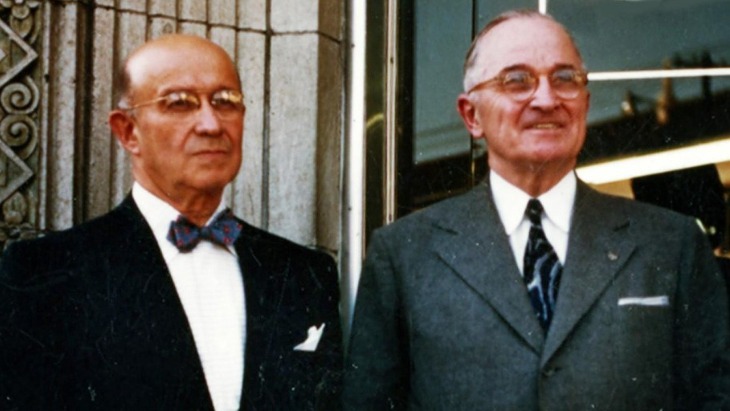
The 1948 announcement of Israel’s creation owed a great deal to a notable friendship. In his unqualified endorsement of the move President Harry Truman defied Secretary of State George Marshall and the U.S. foreign policy establishment. In doing so he did, however, demonstrate his loyalty to an enduring relationship.
Harry Trumans’s buddy Edward Jacobson grew up with the thirty-third U.S. President in Kansas City. After the Jewish Jacobson and the Presbyterian/Baptist Truman served together in the Army during WWI, they opened a hat and clothing store in their hometown. After the store’s failure, they remained close as Jacobson continued to sell clothing and Truman entered public service and politics. When Britain ceded to the U.N. continued rule of Palestine, Jacobson influenced Truman and and the U.S. support for the partition plan that created the State of Israel.
By then owner of a clothing store in his hometown, Jacobson was identified by Zionist stratgists as a key U.S. contact in shaping the partition plans and his nation’s approval of the agreement. The story is told in a footnote to a recent account of Palestine’s history from 1920 to 1948. “The Road to 1948 and the Roots of a Perpetual Conflict” appeared as a February 4, 2024 article in the New York Times Magazine which brought together six Jewish and Arab historians to discuss the beginning of the British Mandate in 1920 to the founding of the new State of Israel.
The partition plan which called for two states, Palestine and Jewish, to be recognized was a highly delicate, complicated issue for the powerful Allied leader and U.S. post WW II diplomacy. Drafted by a Special Committee of the new international organization, it was opposed by the Palestinians, the new Arab States – Jordan, Syria, Lebanon – created by the end of French colonialism in the Middle East and most of the rest of the Arab world.
Today it may appear to have been a grave mistake for the Palestinians to oppose the partition plan and the two state solution offered in 1947. However, as Professor Abigail Jacobsen of Jerusalem’s Hebrew Union College points out, “It’s important not to read history retrospectively. When you look at the demographic realities of 1947 and the division of the land, it was 55 percent for the Jewish state and 45 percent for the Palestinian state even though there were double the number of Palestinians as Jews at that point. If you were a Palestinian in 1947, would you accept this offer?” Prof. Jacobson seems to commend the Palestinians when she also reminds us that “the Palestinian national movement was ready to accept the Jews as a minority within an Arab state”.
Zionist defense of the new State of Israel yielded an overwhelming victory. The moderator of the Times’ discussion, Emily Bazelon, writes in her background for the academics’ commentary, “Before the war, there were around 500,000 Jews and 450,000 Palestinians on the 55 percent of the land that the U.N. designated for a Jewish state. When the Arab-Israeli war ended in July 1949, Israel controlled 78 percent of the former British Mandate and the population was mostly Jewish, with only 155,000 Palestinians.”
In response to Bazelon’s ensuing question of why the Palestinians were not permitted to return to their homeland, Harvard’s Derek Penslar responds, “As the war wore on, the Israeli government issued a decree not to allow the refugees to return.” Expulsion of Palestinian residents and seizure of their land and property is now called “the nakba” or “catastrophe” in English. Current and past Israeli administrations have encouraged the view that security of the fledging State facing the Arab threat required such defense of the diplomatic and military gains made in 1947-49.
Eddie Jacobson’s role in cementing the close ties of the U.S. with the new Jewish State did not go unrecognized. In their description of the Jacobson file at the Harry Truman Library, its archivisits wrote, “Through a variety of tributes and honors, Israelis and Americans alike recognized his contribution to the founding of the Jewish state.” As one example of his large influence, the archivists note that it was Jacobson who arranged Truman’s meeting with the Zionist leader Dr. Chaim Weizmann. Two months after their conversation in the White House, Zionist leadership proclaimed the founding of Israel and less than an hour later the U.S. became the first nation to grant diplomatic recognition to the State of Israel.
The Library’s last Jacobson letter is the former President’s 1955 handwritten note referring to plans for a visit to Israel, likely accompanied by his old friend. Shortly after the letter, Jacobson died and Truman never made the trip. As a tribute to his friend, the archivists draw our attention to President Truman’s statement that Edddie Jacobson was “as fine a man who ever walked”.
“The Road to 1948 and the Roots of a Perpetual Conflict” published in the February 1, 2024 New York Times Magazine is a fine summary of the leaders and developments in Israel-Palestine prior to May, 1948. https://www.nytimes.com/issue/magazine/2024/02/02/the-2424-issue

Palestinian Christians Call for Repentance
Raised by Christian minister parents I married a Jewish woman from a Conservative Jewish family and at age 35 did so with a commitment to Judaism. Following Jewish custom, the offspring’s religious education would be her responsibility and domain. Five years later the first of our two daughters was born and I was ordained as a pastor. My “call” to serve was thanks to a vibrant, progressive Christian Church I had joined and the rich discovery of the prophets/”nabi” of the Hebrew Bible. On visits of my wife’s family, their seder meals and shabat candle lighting deepened my honoring of the Jewish faith traditions.
Contemporary Israel and the ongoing struggle to share the land was never discussed on those visits but my wife may have informed her family of my views. They came in part from study of Africa’s colonial experience and my spending two years in the Congo which continues to suffer exploitation and oppression by the former colonizers allied with the new nation’s ruling class. My position on safeguarding Israel’s future was also shaped by my conscientious objector status and opposition to the War in Vietnam.
The leading U.S. pacifist organizer of the last century, A.J. Muste (see my former posts about Muste) originated the quote, “There is no way to peace. Peace is the way.” The 76 year history of the wars in the Middle East are for me conclusive evidence that war is not the way to peace for Arabs or Israelis. I understand, however, how American, Soviet and their allied armies’ war on three fascist regimes in WWII have influenced U.S. and Israel’s policies on making peace with Palestinians who were forcibly expelled in 1948.
Today as a Christian minister and life-long student I have faith that the Hebrew and Greek holy writings reveal enduring truths about contemporary human societies and cultures. The truth that the Jewish-Christian authors of the New Testament proclaim Jesus as showing humanity the way to peace. The truth that we hear today false prophets and their errant rulers crying “Peace, peace when there is no peace” (Jer 6:14 and Jer 8:11). And that in the time of Ezekiel, “they have misled my people, saying ‘peace’ when there is no peace; and because, when the people build a wall, these prophets smear whitewash on it.” (Ezek. 13:10)
My faith has led me over the years to listen to the cries of anguish coming from Palestinians and support their rights affirmed by U.N. Resolution 194 in 1948. The unity and solidarity with all oppressed people that is envisioned by holy texts requires no less. The Sabeel Ecumenical Liberation Center (sabeel.org), created by Palestinian Churches and based in Jerusalem, has, for four decades, helped me sympathize with the cries of Palestinians living under Israel’s unequal and exclusionary occupation of their former homeland. In reading the letter I’ve excerpted below, I believe I hear the voice of God responding to the spiraling of the Israel-Palestine conflict since October 7. Less than two weeks after the Hamas attacks and initial Israeli bombardment of Gaza, Sabeel and several other Palestinian Christian organizations appealed for solidarity of all Christians and ultimately all of humanity. It appeals to all to pray with Thomas Merton that “if today I hear the voice of God, may I not resist a softer, more compassionate heart.”
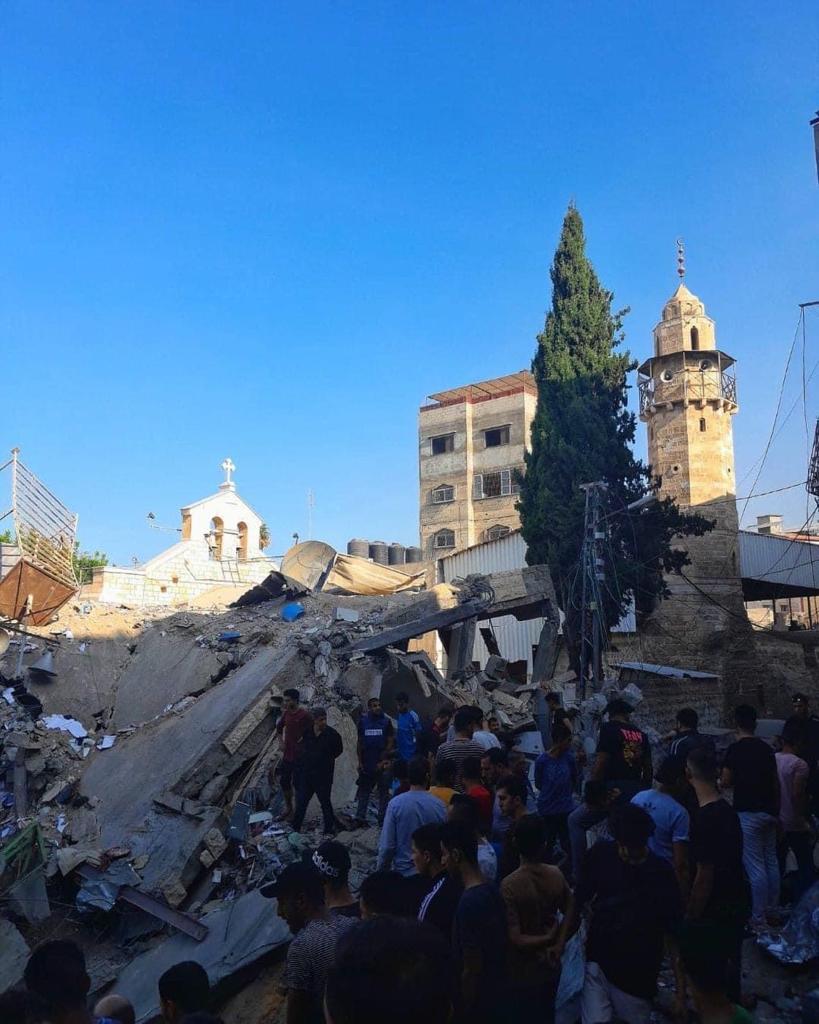
Dated the day Israel bombed the Church in the above photo, Sabeel and other Christian organizations in Israel-Palestine addressed their plea to Western church leaders and theologians. “Words fail to express our shock and horror with regards to the on-going war in our land. We deeply mourn the death and suffering of all people because it is our firm conviction that all humans are made in God’s image. We are also profoundly troubled when the name of God is invoked to promote violence and religious national ideologies” we read in the letter’s first paragraph.
The writers begin the second with “we watch with horror the way many western Christians are offering unwavering support to Israel’s war against the people of Palestine. While we recognize the numerous voices that have spoken and continue to speak for the cause of truth and justice in our land, we write to challenge western theologians and church leaders who have voiced uncritical support for Israel and to call them to repent and change.”
The Palestinian Christians then ’grieve and lament’ the Israeli military’s use of tactics that target civilians: “such as the use of white phosphorus, the cutting off of water, fuel, and electricity, and the bombardment of schools, hospitals, and places of worship—including the heinous massacre at Al-Ahli Anglican-Baptist Hospital and the bombardment of the Greek Orthodox Church of Saint Porphyrius which wiped out entire Palestinian Christian families.”
The letter ends with resounding notes of faith “remembering that God ‘will judge the world in justice’ (Acts 17:31). We also remind ourselves and our Palestinian people that our sumud (“steadfastness”) is anchored in our just cause and our historical rootedness in this land. As Palestinian Christians, we also continue to find our courage and consolation in the God who dwells with those of a contrite and humble spirit (Isa 57:15). We find courage in the solidarity we receive from the crucified Christ, and we find hope in the empty tomb. We are also encouraged and empowered by the costly solidarity and support of many churches and grassroots faith movements around the world, challenging the dominance of ideologies of power and supremacy. We refuse to give in, even when our siblings abandon us. We are steadfast in our hope, resilient in our witness, and continue to be committed to the Gospel of faith, hope, and love, in the face of tyranny and darkness.”
When I prepared for a surgery this week, my thoughts turned to the destruction of Gaza hospitals and dearth of medical supplies. I thought of the children in Gaza undergoing amputations and other excruciating procedures without benefit of anesthesia. I tried to imagine what had enabled those children to accept and survive what was happening to them. Their example helped me in an unfathomable way to prepare for the outcome of my surgery whatever it might be. In my gratitude afterwards for its success, along with doctors, nurses and other hospital care givers, I gave thanks for the resolute courage of the children of Gaza.
******************* *******************
U.S. Expansion of “Christian Nationalism” as a “Theology of Empire”

Among all the nation states now dominated by a form of religious nationalism – be it India, Afghanistan or Myanmar or others – there is only one nation in the world today beholden to a “theology of empire” and it is the U.S. The nation shaped originally by a theology of “exceptionalism” of a chosen people has today become the most far reaching, dominant military power in the history of the world. With over 800 bases in 85 countries, the U.S. capacity to influence and intervene in the politics of other governments is unprecedented. The fact that U.S. armed forces have conducted or led 211 deployments since 1945 (How to Hide an Empire, Daniel Immerwaher, 1945) reveals the nation’s aim of enforcing its worldwide economic and political dominance.
What began as leadership of the opposition to the expansion of “godless communism” has evolved since WW II as “endless war” in defense of the nation’s “national interest”. Contrary to those expecting a “peace dividend” after the break up of the Soviet Union’s republics, the 1990’s brought further growth of the U.S. armed forces and presence around the world. The Arabian peoples and the Muslim religion replaced Communism as the primary, most insidious threat to our way of life.
Following the 9/11 attacks, while the Bush and Obama administrations resisted subscribing to a “good” versus “evil” depiction of the U.S. and its allies’ actions, the ferocious conflicts and costs incurred did signal extremist views as justifying the empire’s invasions. Characterizing Arabs and the Muslim religion as congenitally hostile to the “infidels” dominated popular media and even academic discourse. The leading scholar cited and interviewed most often in the early 2000’s, Princeton’s Bernard Lewis, had long made elucidating his theory of the “conflict of civilizations” the basis for his scholarship.
The “theology of empire” of U.S. evangelical Christians touts Christianity as the only pathway to individual salvation and social coherence. In their eyes, every military campaign aimed at a Muslim society representing a religion with over one billion adherents worldwide is a precursor to the final Armagedden. Such a view helps justify a military budget of nearly 900 billion dollars, and brings hubris based on our status as the lone “superpower” in the world and the leading defender of free and democratic nations. Considering the nearly one trillion dollars spent on U.S. Middle East military intervention and the hundreds of thousands lives lost in those wars, the theology proclaimed by U.S. evangelical Christianity seems worthy of Pascal’s observation generations ago. “Men never do evil so cheerfully as when they do it from religious conviction” the philosopher wrote.
With billions of dollars to broadcast, fund evangelism tours and support like-minded church bodies, the U.S. “theology of empire” has been imprinted on the minds and communications of evangelical Christians outside the U.S.. Ten years ago I was distressed during several tours of Protestant churches in Mexico by the anti-Muslim comments of some of the laypeople. More disheartening, however, is how conservative evangelicals have sided with foreign companies extracting Latin America’s natural resources when opposed by the local citizens most affected.
Evangelical pastors and laypeople have been encouraged to scorn protestors of foreign seizure of natural resources as socialist-leaning trouble makers. The evangelical Protestant President of Guatemala Gen. Rios-Montt was the notorious adherent in the early 80’s of the U.S. evangelicals’ theology. Trained by U.S. advisers and espousing a virulent anti-communism, in a short lived rule the Gen. led a campaign that took the lives of thousands of indigenous Guatemalan villagers. During his two years as President, Rios-Montt delivered what were called weekly “Sunday sermons” deploring cheating, stealing, lying and promoting individual values. This emphasis, joined by an “otherworld” emphasis on the social plane, is characteristic of many evangelical groups throughout Latin America and holds special appeal in association with law and order politics even when accompanied by state violence.
Despite evangelical Protestant sharing of virulent opposition to abortion and gay rights with the Catholic hierarchy, there is often hostility to the Catholics where there has been significant Protestant growth. Chiapas now claims more Protestants than any other State in Mexico and has been the scene of some violent Catholic-Protestant conflict. During a February Mexico visit, I learned of the massacre of 45 Catholics in the village of Acteal, Chiapas. Pacifist supporters of Zapatista organizing in their village and others, they were attacked in the village’s Catholic Church. Residents of San Cristobal de las Casas 20 miles away described the paramilitary force responsible as having been largely recruited among the Protestant converts.
The prophets of the Hebrew Bible largely ignore the policies of succeeding empires of their times directing their messages rather to the settlers of the nations of Israel and Judea. Jesus also devotes himself to the reform and uplift of the “House of Israel”. The fundamental theme of his preaching and ministry is the treatment of the poor by the leaders of the nation he knows best. His spite and condemnation reaches a peak when observing those who exploit the downtrodden with a guise of piety.
Rev. Dr. King greatly expanded our vision of human rights to citizens of our nation when he declared that a nation that spends more on its military than on the well being of its people is a nation approaching spiritual death. Through the the 1960’s and later, the U.S. lawyer-theologian William Stringfellow called his nation to repentance. He wrote of repentance in a 1984 essay, “Repentance is not about forswearing wickedness as such; repentance concerns the confession of vanity.” Without such a confession, he wrote, “For America – for any nation at any time ……. the very presumption of the righteousness of the American cause as a nation is blasphemy.”
Erasing Borders of Global Acceptance and Agreement

One of this blog’s readers asked recently in the Comments section what I have in mind by the title “erasing borders”. I am grateful for the question enabling a written dialog between this writer and the blog readers.
In responding I begin with the observation that among the tectonic shifts we humans must grapple with today there is one transformation of the global landscape that represents hope for our species as well as unprecedented challenge. With the evolution of the multiple crises forcing themselves on all human beings we are becoming more and more aware that no single nation state can acting alone remedy any of them.
It is, however, equally evident that the history and global politics of the United States is uniquely unprepared and ill fit for participation much less leadership in shaping such global actions. As the world’s remaining superpower of the Cold War era, the U.S. policy-making elite are used to preserving our right to go it alone. When we consider collaboration with nations formerly identified as the communist bloc and with those now stereotyped as Islamic terrorist states heavy lies the crown on the head of the leading “defender of the free world”. What is required of us now entails the kind of change called for by the idealistic vision of “erasing borders”.
“Erasing borders” is not therefore intended as solely applying to a nation state’s immigration policies and border enforcement. Its metaphorical content calls for no borders in our compassion; no borders in our respect and appreciation of other cultures; no borders in our relationships; no borders in building trust. “Erasing borders” was chosen to express with a short phrase the conviction that our “national interest” has now become obsolete in guiding our relationships and agreements. It is now more and more evident that what is in the interest of all nations is what promises to be the best for the U.S.
When the largest U.S. corporations now prosper by means of expanding their “global reach” ** we find little to no evidence that the U.S. national interest is a priority of their manufacturing, marketing strategies, corporate tax planning and so on. All our crises today – whether it be the spiral in the number of refugees and migrants, the threats to species survival dealt us by the production and consumption of fossil fuels, the emergence of global pandemics or the pall cast over our lives by the “strategic deployment” of nuclear weapons – our reliance on national interest and military might as the primary security strategy is as antiquated as relying on an operator to make a long distance call. When has U.S. led military interventions overseas contributed to long term advances in resolving any of the global crises?
The Christian faith serves my interpretation and response to the message of our troubled times. That message urges us to dream and proclaim the kind of radical change – the kind of change represented by technological change from the horse and buggy to interplanatary travel – and to begin thinking about what will improve the lives of all peoples. The handwriting on the wall that “erasing borders” interprets is “work together or perish together”.
All the world’s major religions appeal for unity among all peoples. In the first pages of the Jewish Christian scriptures, the creation of humankind begins with the creation of one family as our shared ancestors. Christianity originally grew from the vision of celebrating our common ancestry across the barriers of language, nation and culture in praise and thanksgiving of our one God, creator of all.
While living in France in the summer of 1963, I learned about the proposal to create a common enconomic network, a “Common Market”, on that continent. The details were still to be worked out and while my informant, a Protestant pastor, referred to serious opposition to the plan he had no doubt such an ambitious change was not only possible but inevitable. Among the fundamental changes he mentioned were abolition or lowering of tariffs and no control over Europeans’ travel across the continent’s borders.
Although we in the U.S. may not be ready to design abolition of our borders, the sudden behavioral changes demanded by the COVID pandemic indicates our general population may be more prepared than our economic and political elite for radical change. The resolution of the multiple global crises through universal dialog and agreement demands change from our unilateral approach that is at least as radical as the opening of borders by all nations.
*********************** ********************
** Global Reach: The Power of the Multinational Corporations is a 1976 book by Richard Barnet and Ronald Miller which forecast the changes brought about by the cross national operations of U.S. based corporations.
Mayan Cultivation of the Human Heart

The traditional Mayan today lives by the metaphors inherited not only from their forebears’ poetic imaginations. They are also guided by intense and prolonged study of the night sky. The Quiche Mayan “Council Book”, the Popol Vuh, recounts the first dawning of our Sun, the coming of light, following the appearance of the “daybringer” star Venus in the heavens.
But it is not only celestial events and events in the natural world that take on metaphorical depth and meaning in ancestral Mayan thought. Topographic features of a landscape are, in Christian poet Gerard Manley Hopkins’ words, “charged with the grandeur of God”. A mountain or a lake is not just seen in geological and geographic terms. It is first and foremost a manifestation of the divine. Pilgrimages are made to a mountain or a people’s abandoned city to honor and enter into dialog with the presence of the ancestral spirits and the divine there.
“I lift up my eyes to the mountains where my help comes from; help comes to me from the Lord, the maker of heaven and earth” declares Psalm 121 of the Hebrew Bible. As in the ancient Hebrew scriptures, the Lord is referred to with multiple names by the Mayans. As the name Yahweh gains precedence in the oldest Hebrew passages, “Heart of Sky and Heart of Earth” is favored by the Mayan faithful. There is also agreement in the Mayan and Hebrew traditions that the purpose of human beings is to give honor and praise to the divine presence around and within them.
When the “daybringer” Venus ascended from the underworld to the morning sky, the “Council Book” tells us that human beings had gathered “in unity” to await the sun’s first appearance. They celebrated and gave thanks with lighting of copal incense and with feasting on the sacred mountain and they still do so when the diviner’s reading of the calendar directs. Humanity had to be created, out of water and corn meal, to be present and give thanks and praise for the first light of the sun. According to the Popol Vuh, such praise and thanks fulfill our purpose as a species.
For many Mayans today, every night still reenacts the sowing of seed in the earth, the “Underworld”, when the sun sets to be reborn as a sprout and a new day. Dawn takes on another metaphorical meaning in the human context. Conception of a human being occurs with the planting of seed in the womb and a child’s birth and subsequent growth. While there may be other dawnings in human existence, the dawning of the first sun and subsequent suns, of the plant sown and of a human being are the foremost events in human life and given the most attention in Mayan thought and religion.
Thanks for these “dawnings” are expressed to the Heart of Sky and Earth with offerings of incense and blood, usually deer and bird blood today, at a shrine or sacred site or community altar. In the ceremony of building an altar described in the last blog, incense and smudging also help prepare heart and spirit of the participants with purification and clarity. According to the INESIN handout on the altar’s significance to the community, the copal (or alternatively ocote, heart of pine) “harmonizes the integrity of the individuals and group”.
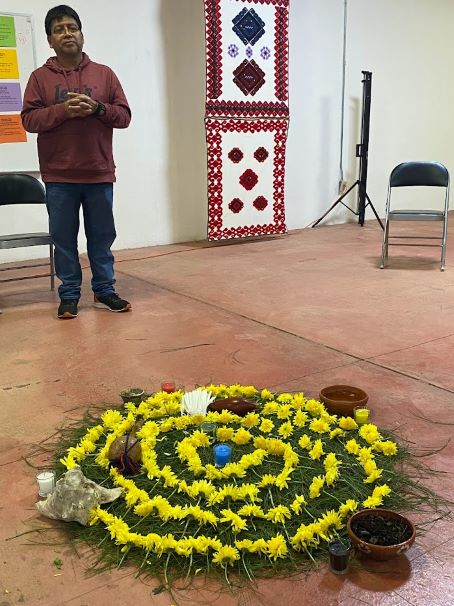
In the altar ceremony, in Mayan prayer and worship in general, there is special attention to the state of each person’s feelings, or “heart”, as well as to the harmony of the community. The building of the altar, the preparation of the setting, accompanies a self diagnosis focused on our heart, “like when we feel our pulse”. The altar experience aims to enable the heart of each individual to be guided in selecting a personal intention on which to focus in coming days. In concluding the ceremony, candles of a particular color (see the last blog for the colors’ symbolism) are chosen and “planted” around the periphery of the altar. The various intentions may then be shared verbally with the group, with another individual or kept to oneself. They may include a better harvest, healthy relationships in a new house, a safe and worthwhile journey.
The revolutionaries of the Zapatista movement found their defense of the Mayan land and human rights in Chiapas on the hearts of their followers. In one of their manifestos, they include a message to foreigners who are likely to ignore or misunderstand this principal tenet of their position, “The ancestral philosophy of the Zapatistas which declares -without shame or fear- that the place of knowledge, truth and speech is in the heart”. It might be said that their attention to the heart of followers and the opposition has enabled the movement to continue to organize villagers and improve education, health and harmony in rural settings under their control today. In so doing they follow the ancient Chinese philosopher Lao Tzu who said, “there are many paths to enlightenment. Be sure to take one with a heart.”
The Heart to Heart Spirituality of the Mayans
The practice and significance of a Mayan community creating a sacred altar is described in what follows. It is based on a handout provided visitors to the Institute of Intercultural Studies and Research (INESIN) in San Cristobal de las Casas, Chiapas, Mexico. All quotations are from the handout written by the Institute’s Mayan staff members.
“The altar begins to take shape as the community gathers” the handout tells us. Most of us have read it before making our group’s altar following INESIN staff member jPetul’s instruction. “Each brings his or her offering from the fruits of their gardens or other labor” the handout continues. Our church group from Kansas City bring our desire to experience at a deeper level the Mayan culture and religion of forty percent of the population of San Cristobal de las Casas, Chiapas where the Institute is based.
So we read in preparation that “In the Chiapan Highlands, we often begin by spreading a bed of pine needles as a base that marks the ritual space with color, sound and smell….” Adorning the altar with their “flowers, fruits, seeds and symbols” the participants create “a representation of the whole community”. Candles of a variety colors are placed at the four compass points on the altar.
“The Mayan altar represents the cosmos and the universe” the handout relates. So the colors’ association with the four directions of our world are a crucial element in the symbolism of the altar ceremony. After the Spaniards brought wax and candlemaking to the New World, the candles’ colors were matched to their location in the “vision of the universe as seen by our grandparents”.

The red candle on the altar’s east side “represents sunrise, the birth of life, strength, love and the color of blood.” It also represents “the birth of God”. Incense is burned on the east side where red flowers, red beans and corn and red fruit are also placed. A guardian of this side is dressed in red.
On the West, a black (or purple) candle “represents sunset, darkness, rest and death”. In the Mayan worldview, darkness and night occur when the sun dies, passes toward the underworld, walks in other worlds and finally is “born again as a new, radiant sun.” This passage and its color signifies “the death of God, who dies to give us life”. For us humans the passage enacts whatever we do to nurture life and “leave behind that which destroys life”. In concrete terms for us humans, the passage signifies sowing seeds “when we bury these in the belly of the mother earth”. Purple flowers, black beans, corn and black soil are placed on the westside of the altar where a guardian would be dressed in black.
In Mayan belief, the colors of the altar also reflect our unity as human beings. Red is the color of our blood; black is our hair; white is our teeth and bones and yellow is the color of our skin. The Mayan tradition affirms that we humans share common traits while every person is also different. Our handout further states that the altar’s colors “represent the diversity of languages, thoughts, beliefs and ways of seeing the world of peoples and cultures”. Participation in the creation of an altar invites us to “ respect and appreciate our differentness and our oneness, our uniqueness and our sameness”.
We learned that the passage from red to black, from East to West, is the way of God. The passage from North to South “is the way of humankind”. The white candle of the North represents the “side of the sky, the wisdom of our ancestors, the peace and tranquility of the heart, the search for truth and clarity in thought and feeling”. The North also tests us: “cold rain and wind, the winter freezes, sickness and death also come from the North”. Bones, white beans and corn, white flowers, shells and seeds, a sea conch may be placed on the North side of the altar. The guardian “and protector” is clad in white.
The yellow candle of the South is associated with the feminine, and the direction from which comes good crops and abundant harvests. “Yellow flowers, yellow seeds and corn, yellow fruits, and water” are found on the South side with a guardian dressed in the same color.
A human’s life passage to maturity and fullness is symbolized in the altar’s depiction of movement from North to South. Intersecting with God’s path from East to West, the Center is where “humankind participates in the divine and the divine in the nature of humanity”. The two paths are also seen as the passage for God and for humankind from life to death and death to life.
In the Center is a blue candle, symbol of the “heart of the sky” and the eternal, “that which does not end”. Water is sometimes placed in the Center and someone may be assigned to wear blue and serve as guardian of the sky’s path. The green candle in the Center stands for the earth, for nature, for life that continues. Along with nature, men and women make up “the community of divine creation”. We, like all of nature, are divine “because we have the ‘ch’ulel’, the spirit that comes from the Sacred, ‘Ch’ul’ (or) the divine breath”. Earth or soil may be placed in the Center. Symbolic elements of the Center remind us that “our grandparents taught us that all that exists has ‘ch’ulel’, spirit and heart”.
In the Mayan view, our spirituality is cultivated and grows from the heart. Before each person plants one or more candles on the altar’s periphery, we were instructed to diagnose the present state of our heart. We were to ask ourselves, “how is your heart or how has your heart arrived in this place?” Our handout notes this question is “asked from the heart to the heart, for we as Mayans speak from there.”

In some villages of the Chiapan highlands, residents greet one another by asking “how is your heart seen or what is your heart feeling?” The response can be “my heart is blooming” or “my heart is full of flowers”. Harmony and good will reign when Mayans say they are of one heart or, in one of the leading Mayan languages, when they say “jun o’tonal”.
The significance of incense and smudging in the altar ceremony, the prayers and significance of placing the candles before concluding will be described in the next and final article on the Mayan sacred altar. It too will be based on the handout “Theological Perspectives on the Mayan Altar” written by jPetul and other Mayan workshop leaders of the Institute for Intercultural Studies and Research (INESIN) in San Cristobal de las Casas. A community’s periodic creation of a sacred altar has contributed significantly to the survival of five million Maya for three thousand years as a people and culture.
The fine Institute website in Spanish and English is at http://inesin-mx.org/
Erasing Borders in Chiapas

I’ve just returned from a week long stay in Chiapas, the southernmost State of Mexico. I went with six other adults from my Peace Christian Church (United Church of Christ/Disciples of Christ) in Kansas City. We did not go to “help” those who hosted us in any substantial, tangible way. On what can be best described as a “decolonizing mission” pilgrimage, we went to learn about the legacy of Spanish seizure of land, suppression of indigenous culture and the native resistance to the foreign presence and influence in Chiapas. These all remain sources of the multiple conflicts Chiapas has experienced in recent years. In tandem with the oppression of the indigenous people, religious differences have been used by the Mexican State, foreign corporations and the cartels to stir conflict among the indigenous Mayan peoples and others in the State.
One of our partner agencies in global mission today hosted our delegation and introduced us to how they work for inter-religious and inter cultural understanding, reconciliation and peace. The INESIN staff represent and interpret well the diverse cultures of the Mexican State of Chiapas. There is jPetul, a former Catholic priest of Lacandon Mayan origin, who instructed us in the meanings and practice of creating a Mayan sacred altar. His spouse is a former nun led us one morning in moving through the Catholic daily meditation on “the liturgy of the hours”. In his welcome and introduction to the history of INESIN, the director told us he serves too as pastor of a Protestant church in the Chiapas capital, Tuxtla Gutierrez. We worshipped there on the Sunday of our week long stay.
We learned about the sources of the multiple conflicts in Chiapas after the Conquest through three hundred years of Spanish colonial rule from another partner of our denominations’ “Global Ministries”. Sipaz (https://www.sipaz.org) presents workshops designed to free and protect the population from Chiapas’ cycles of violence while other programs aim to educate and encourage advocacy among foreign visitors. The Sipaz director for the past 20 years is a woman who described recent political and economic developments as well as Chiapas’ historical context.
Marina noted that the trafficking in migrants through the State of Chiapas and on to the U.S. is now largely controlled by leading Mexican cartels, formerly primarily engaged in the drug trade. Lax security and immigration enforcement at the Guatemalan border reflects Mexican Government border policy, funded by the U.S., of interdicting undocumented migrants on the roads of Chiapas. The immigration attorney among our pilgrims had prior to our trip discovered that the Guatemalan State and one of the country’s leading banks have profited from their fellow citizens’ migration. Failure to repay loans for the U.S. journey results in loss of a Guatemalan migrant’s land.
Another grim aspect of the situation is the targeting of older children and youth in recruitment by the cartels and local militias. We observed the third of our denominations’ partner agencies in San Cristobal working with poor children, of Mayan families, who are encouraged and trained by Melel Xojobal (“true light” in the Tzotzil Mayan language) to value their earning potential outside the cartels’ grip and to defend their human rights. Melel Xojobal (https://www.melelxojobal.org.mx/ ) meets and organizes groups of children at the markets. A recent series of protests by Melel children won expansion of bathroom facilities in the City’s largest markets.
With a crammed schedule on little sleep, I took a break mid-week and missed the trip to the Guatemalan border with stops at two Precolumbian centers of Mayan culture and religion. The recently excavated ruins were built and flourished during what some scholars refer to as the “Dark Ages” in Europe. Between the third and tenth centuries A.D. the Mayans made their most significant contributions to the advance of our species. Viewing the vestiges of the Mayan legacy in the early 1500’s, and judging them as “pagan”, the Spanish missionaries and soldiers destroyed all they could identify as Mayan. Of the hundreds of books written on scrolls of bark by Mayan scribes, only three remain to instruct us on Mayan civilization.
Oppression of the Mayans under Spanish colonialism and decades of discrimination have led to speculation, even at present, that the magnificent Mayan temples, observatories and stone sculptures were created by members of Atlantis’ lost continent or another fabled people. Sadly there are Mexicans who still hold, along with their neighbors in the U.S., demeaning views of the indigenous people of their country. Anyone today who spends time in Yucatan or Chiapas or one of the four Central American nations inhabited by Mayan peoples today cannot question the resemblance of the figures depicted on the ancient sculptures and the indigenous people around them.
After visit of a great Mayan city of the past like Palenque in Chiapas, one is moved to think that the capacity of over 5 million Mayans to have survived centuries of exploitation and genocidal attack is in itself a remarkable achievement. The leading U.S. scholar of Mayan history and culture, Michael Coe, attributes the endurance of the Mayan peoples to three factors. In the ninth edition of his book The Maya he writes,
“What has kept the Maya people culturally and even phsically viable is their hold on the land (and that land on them), a devotion to their community and an all-pervading and meaningful belief system.” Coe then comments, “It is small wonder that their oppressors have concentrated on these three areas in incessant attempts to exploit them as a politically helpless labor force.”

I had in a 1980 journey through Chiapas been able to spend a day at Palenque which is touted by many visitors as the most dramatic and beautiful of the Mayan centers revealed to date. Our hosts advised against a visit as there is now a relatively insecure and substandard 200 km. plus route from San Cristobal to Palenque. Comparable in my mind to the majesty and achievement represented by the French cathedrals of Mont St. Michel and Chartres, an experience of Palenque insists that we revisit our stereotypes of the Mexican people and the Mayans of Mexico in particular. After taking in Palenque one cannot fail to be amazed and moved that the waiter serving you dinner or the woman cleaning your room comes from an ancestry that created such monumental beauty.
Climbing the Mountain in Japan
There continues to be surveys and accounts of the decline in attendance and affiliation with churches in the U.S. Although often characterized as evidence of the increasing secularization of the society, I believe this mischaracterizes what is really happening. At the very least, more consideration needs to be given to the trend among persons under the age of 35-40 to adopt practices of meditation and even faith in a power beyond our self from a buffet of beliefs. It is long past time to reject the label secular for any non-Christian or non-Church organized belief or form of meditation.
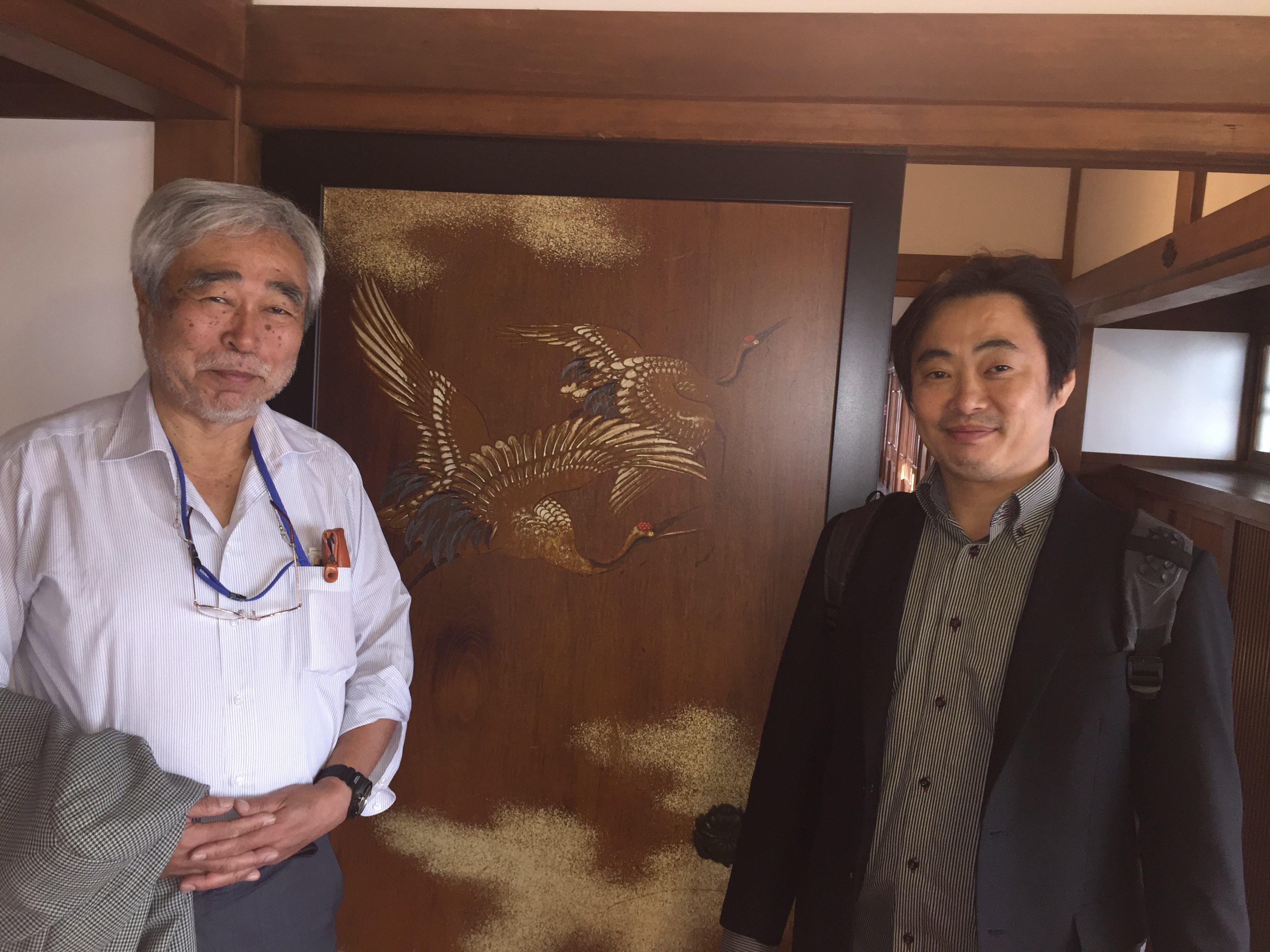
I am certain that for a majority of U.S. Christians the ten days I just spent in Japan were devoted to a “secular” cause. In accepting the privilege of meeting with the staff of Church World Service Japan for the second time, the first being pre-pandemic in 2018, there was no intention to gain adherents or bolster the churches there. My aim and that of the CWS Japan invitation was for me to assist in developing a public fund raising and outreach strategy for the humanitarian aid agency in a land where 98% of the population is non-Christian. Only one of the six full time staff members, Ms. Yukiko Maki, is Christian and active in the United Church of Japan. Her portfolio as Director of Programs includes cultivating the relationship with the Christian international aid network of the World Council of Churches’ ACT Alliance.
Since its creation in 2011 to help respond to the devastation of the massive earthquake, tsunami and Fukushima nuclear disaster, CWS Japan has grown significantly in its capacity and programs. Its General Secretary Takeshi Komino is now a leading voice in Japan and across Asia in the field of Disaster Risk Reduction. In a few years Mr. Komino has led other chief executives in Japan’s non profit sector in setting standards of accountability and engaging in partnerships with the Japanese Government and corporations.
So were my preparations and efforts to help further the presence and public support of CWS Japan to be considered as “secular” in nature? Only if we define religious, as do many U.S. Christians and analysts of social trends, as confined to activity advocating or espousing belief in Jesus Christ.
In fact, in my own tradition of the Christian faith, proselytism has for decades been superseded by another aim of “mission” in other lands. The founding of indigenous-governed churches in Asia, Africa and Latin America has made redundant and obsolete mission and “missionaries” primarily focused on conversion. The joint Global Ministries office of the United Church of Christ and Christian Church (Disciples of Christ) in the U.S. now recruit their partisans to “accompany” Christians and non-Christians in tasks which enhance and protect lives and the land where they are invited to do so.
One may well respond to this “call” to “accompanimiento”, as the Latin American origin of this approach to mission describes it, as a pilgrimage with people abroad and our Creator to restore and “make all things new”. This is, however, a significant historic departure from the traditional U.S. Christians’ view of “mission” in other countries. The Global Ministries avoidance of referring to their personnel deployed overseas as “missionaries” in favor of the term “Mission Co-Worker” grows out of the dramatic changes in the 20th century world. The struggles for independent nation status and self reliance resulting in the decolonization of the Euro-American colonies found support among progressive and aware U.S. Christians and their church denominations.
The new outlook on world mission that emerged in the more contemporary church bodies demanded a wholly different set of skills of their mission “co workers” in other countries. Gone was the emphasis on sending “authoritative” voices on the scriptures and preachers of “the Word” to be replaced by mutual learning, listening, affirmation and “accompanimiento”. To build relationship in an effective partnership with a colleague or colleagues in the foreign setting, one first had to devote oneself to learning about the local context. Never appropriate or needed was someone who, with little listening or learning in the local context, presumed to offer “expert” advice on any activity or program.
My rewards in taking such a posture and approach flow from the sense of solidarity and mutual affirmation I have experienced. Rather than a tally of converts I celebrate the beginning and the growth of relationships with those who fulfill the purpose of their lives with life-enhancing, loving works. Following my recent trip, I am grateful for the meeting of new CWS Japan staff and for the deepening of my relationship with those staff I interacted with in 2018. Vastly different but equally fulfilling have been the relationships enabled by mission assignments in Congo (1969-71 and 2010), Mexico (2012-2015), and with Church World Service US donors in Kenya (periodic visits 2003-2011).
A primary difference in my recent experience in Japan has been the strengthening of my conviction that there are many paths up the mountain of faith. Christians are by no means alone in their life work of seeking and paying homage to the hope, peace, joy and love we celebrate at Christmas as Jesus’ offering to all humankind. During this latest Japan visit, I found new strength and assurance from those of other faith traditions and no faith at all in my own trek up the mountain of faith. As we join persons taking a different path we can all know the solidarity and love of Christmas every day as we climb to the mountaintop.
***************** ********************** ****************
Visit the CWS Japan English website at https://www.cwsjapan.org/english/. Make a monthly or one time donation while there!


 Erasing Borders
What We Need
Nov 3
Posted by erasingborders
Until the election this year, no U.S. Presidential candidate has identified so many enemies within the nation whom we should fear. The Republican Party’s candidate for President has made, as in 2016, purging of immigrants within our borders the foremost plank of his policy platform. But they are not the only group targeted for condemnation and reprisals. His opponents in 32 felony cases in which he has been convicted have now also been put on notice. Media outlets intent on lifting the veil of lying, depravity in relationships with women, violation of business contracts and attack dog strategy in multiple court cases, any persons or group publicizing the truth of his grotesque mendacity may expect reprisals.
Although he has been classified as a would be dictator. a leader in the mold of other authoritarian rulers today and in the past century, an accurate assessment of his biography of misdeeds may require a comparison with figures farther back in history. My own search for a true match has been prompted by the following poem of David Budbill:
“The emperor
His bullies and
Henchmen
every day
Terrorize the world
Which is why
Every day
We need
A little poem
Of kindness
A small song
Of peace
A brief moment
Of joy
– Written by David Budbill in 2005. Budbill was posthumously named “The People’s Poet of Vermont” by the Vermont legislature.
Contemplating the possibility of this nation elevating a depraved egotist to our highest office the Book of Psalms gave voice to what I felt. Here in Psalm 5, written over 2500 years ago, I found an apt description of the man who threatens to become the President of our formerly united States.
“There is no truth in their mouths;
their hearts are destruction;
their throats are open graves;
they flatter with their tongues.
Make them bear their guilt,
O God:
let them fall by their own
counsels
because of their many
transgressions cast them
out,
for they have rebelled against
you.
Those are verses 9 and 10 of Psalm 5, in the New Revised Standard Version translation of the Hebrew Bible. Psalm 133 suggests a source for the “brief moment of joy” for our “every day” as Budbill calls for in his poem “What We Need”.
“How very good and pleasant it is
when kindred live together in
unity!
……..
For there the Lord ordained his
blessing
life forevermore.”
Those are verses 1 and 3b of Psalm 133 in the NRSV translation.
We in the U.S. are blessed by the presence of people from many of the world’s nations who have chosen to make this nation their home. They come in many colors. They come speaking many languages, eating a delightful variety of foods, following many different customs. We encounter them as our yard tenders, bricklayers, journalists, tree trimmers, nurses, meal servers, bus and truck drivers, long term care givers, crop harvesters, doctors, shop owners and clerks and public servants. Every day most of us have the opportunity to show gratitude for their presence and their service. Every day we can all share with them a “brief moment of joy” with a smile, with words of kindness, with words of thanks.
Posted in Global Economy, Interfaith Relations and Politics, Solidarity, Community and Citizenship, U.S. Immigration and Refugee Policies, U.S. Political Developments
6 Comments
Tags: A would be emperor of the U.S., David Budbill, Growing diversity of U.S. population, The Psalms' commentary on the 2024 U.S. election