Category Archives: Global Economy
Renewable Energy Frees National Economies
Renewable Sources and National Soverignty
For most countries lacking fossil fuel reserves the increased cost of oil due to the war on Iran will mean more indebtedness. Loans from the World Bank and/or the International Monetary Fund (IMF) will come at the high cost of austerity measures cutting government services ranging from subsidies for the poor to health systems and education. The lending country often will also be required to transfer extraction of vital natural resources from the government to private enterprise.
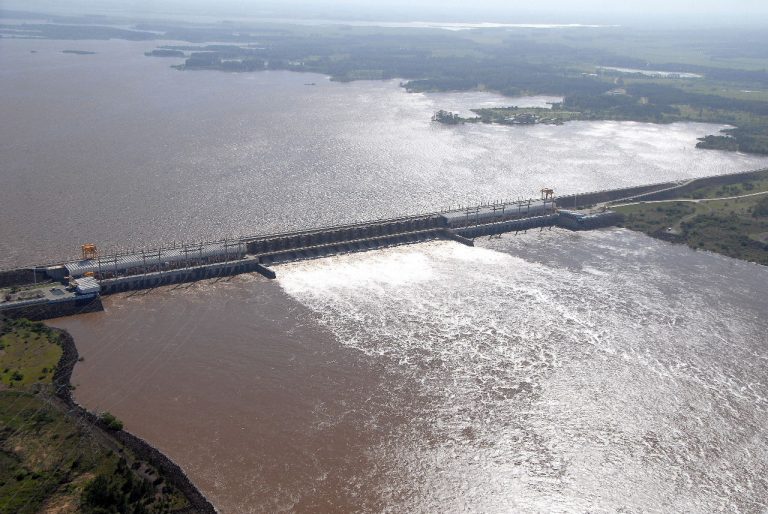
Although Uruguay lacks fossil fuels in its subbsoils, it will escape the pressures of relying on the world financial system due to its transition to renewable energy sources. This was accomplished thanks to nearly half of its power coming from its dams on major rivers and the renewable energy commitment of the leftist-liberal Broad Front coalition which gained the Presidency and legislative control for the first time in 2005.
When a NYT journalist interviewed Uruguayans in 2023, he referred to the country’s transition to renewable energy as a Latin American revolution and was surprised by the common response: “Well, there wasn’t really a revolution in the Latin American sense. It was that we were worried about sovereignty. We were worried about the future. We were worried about our economy being yoked to commodity prices that were being affected by global wars that were very far away from Uruguay.”
Wind Power Led the Way
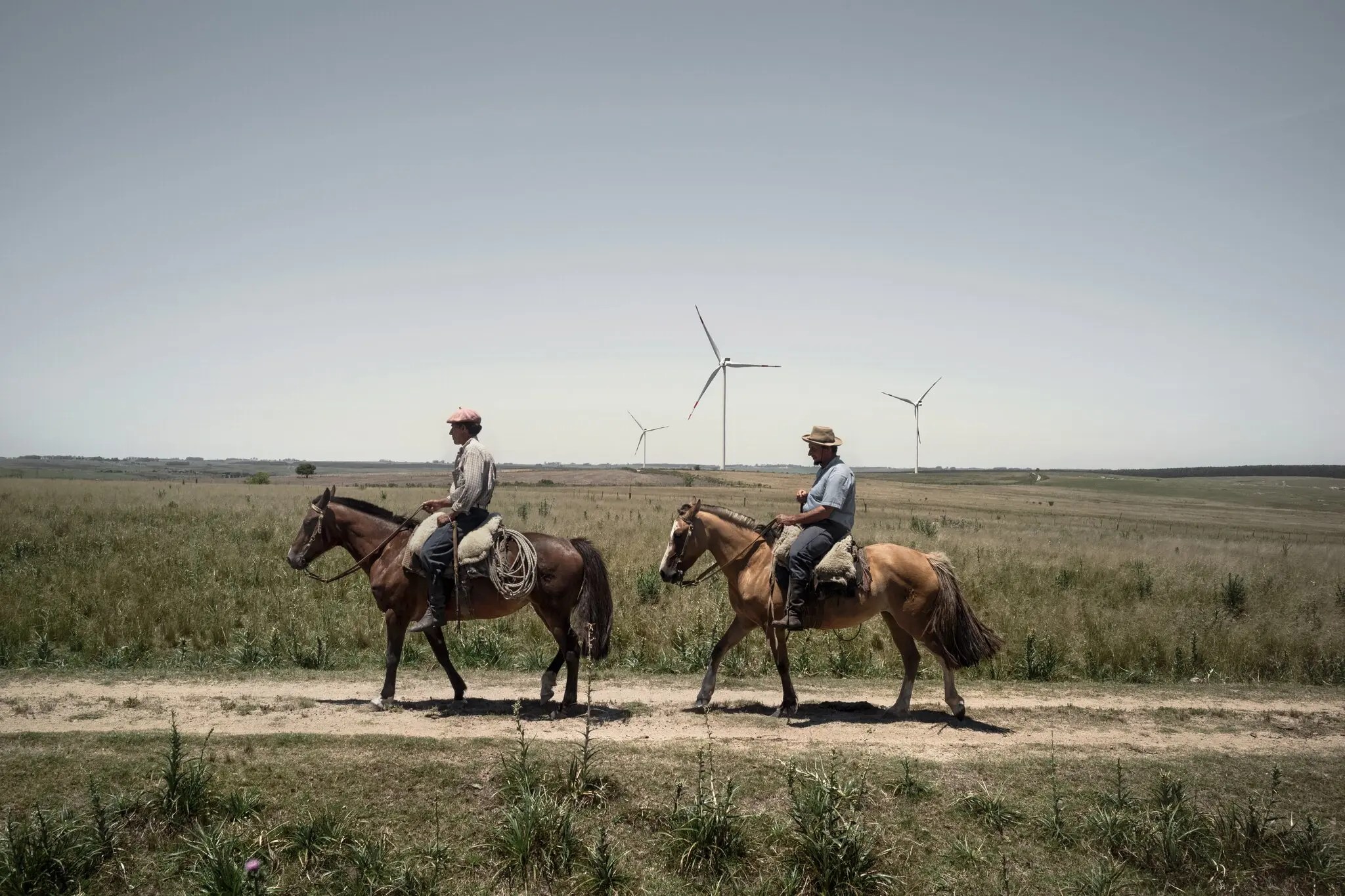
When the Broad Front took power, it was evident that the increases and fluctuations in the price of natural gas and oil restricted their ambitions to develop social services and reduce inequality in Uruguay. Rather than continuing to devote over 2 % of the Gross Domestic Product to fossil fuel purchases, the Broad Front coalition created a National Directorate of Energy as one of its first acts. Growth of wind power through public-private partnerships was the new Department’s first emphasis.
Within a few years, wind power was supplying over 30 per cent of Uruguay’s energy needs, had provided jobs to 50,000 workers and enabled smaller, family farms to survive in the face of rising costs. After fifteen years of coalition rule (2005-2020), wind, hydro and biofuel combustion accounted for 98 % of the country’s power.
Largely due to the development of the wind power grid, by 2020, Uruguay’s nation wide power company had made electricity available in every home in the country and all its rural schools. Heading the company, known as UTE, for a decade was an electrical engineer who now states that he’s always considered delivery of power as a tool of income redistribution.
Energy Savings Enabled Social Services Reforms
When the leftist Coalition ceded power to a neoliberal one in 2020, multiple social reforms had been implemented and a National Health Service created. The poverty rate had dropped from nearly 20 % when the Broad Front began to rule to 8.8 % in 2019. Much of the progress in reversing hardships of the poor was made possible by savings in the energy sector.
The Director of the Energy Department has stated,“We didn’t need to depend on imported fossil fuels or on the energy markets or the energy fluctuation of energy commodity prices. So there was a better solution” . Although trained as a nuclear physicist, the Directer of the new Department has also stated that nuclear energy was ruled out early in Uruguay’s transition to renewable sources. “I realized that this was not the best solution for us because we still are having to continue importing technology, importing uranium. We don’t have uranium, either” he points out.
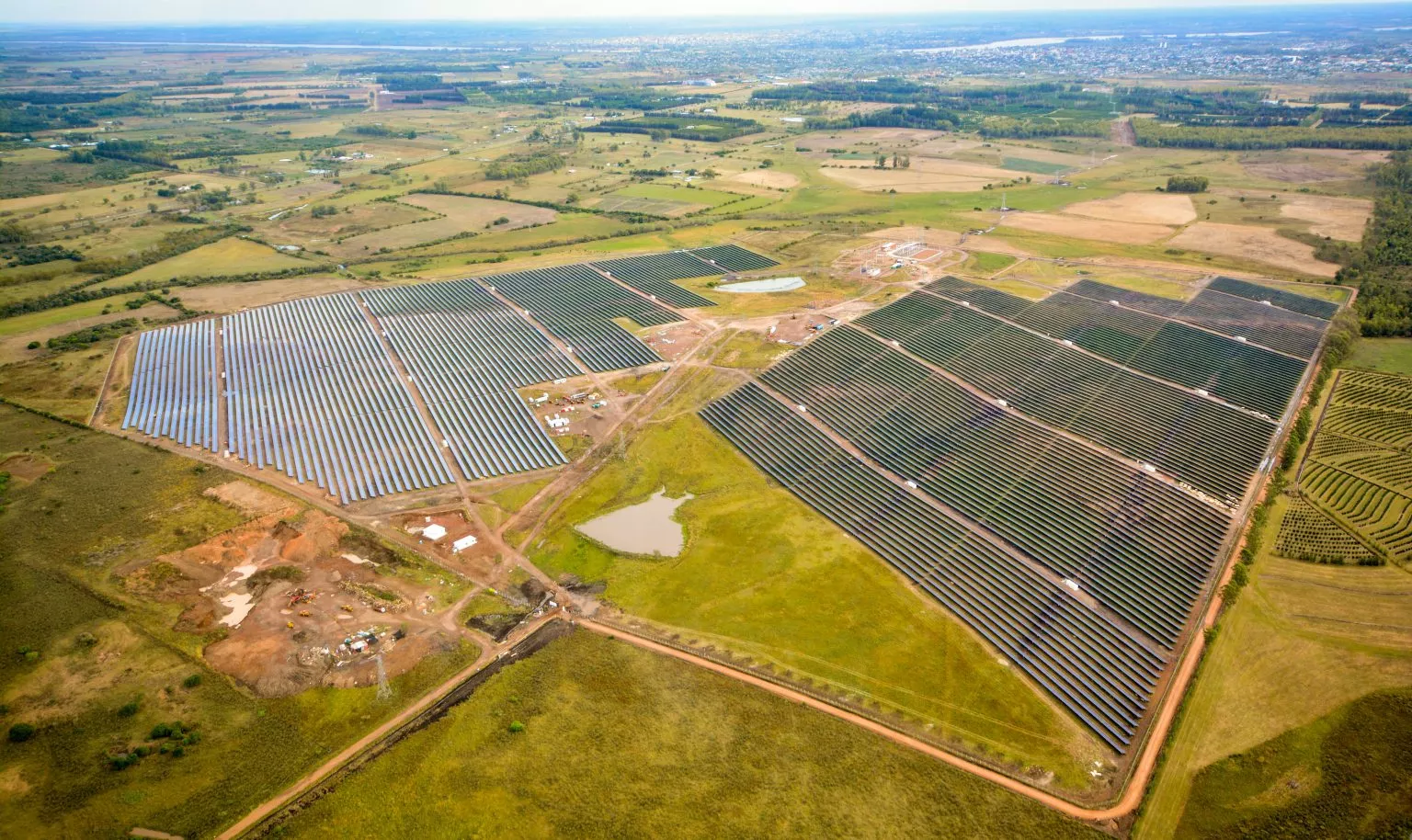
With solar energy now contributing less than 5% to the power grid, its development will be the primary aim of the new Department of Energy with the Broad Front’s 2025 return to the Presidency. Savings gained with the minimal use of fossil fuels will be devoted to new solar projects and further upgrades of the nation’s power grid. Uruguay now leads poor nations in relying on their own natural resources to supply all their energy needs. The country is at the front in demonstrating the benefits of transforming the world’s economic order from one with a fossil fuel engine to a system powered by domestic energy sources.
Pope Francis’ Heart for the People

In aligning the Church with the world’s poor and marginalized and avoiding the defense of its traditional positions on LBGTQ issues, abortion and the role of women Pope Francis has made the Church an ally of the progressive forces creating a more equitable, peaceful and sustainable world. With his actions, his simple lifestyle and his words he has sought to ensure the Church’s relevance and role in responding to our global crisis.
Pope Francis’ thirteen year papacy coincided with the further degredation of the planet Earth and its species. As the threats caused by the burning of fossil fuels and overconsumption in general became more evident, the Pope’s written reflections on the ecological crisis became more pointed. Issued in 2023, his “apostolic exhortation” titled Laudate Deum or “Praise God” was addressed to “all people of good will on the climate crisis”. His much longer, didactic 2015 “encyclical letter” titled “Laudate Si” (“Praise to You, my Lord”) was sub titled “on care for our common home”.
In the Laudate Deum the former Argentine Bishop more directly addresses the world’s leaders guided by the “technocratic paradigm” he deplored in the earlier “encyclical letter”. The insights of his “exhortation” more clearly describe the threat posed by our leaders and technocrats: “We have made impressive and awesome technological advances, and we have not realized that at the same time we have turned into highly dangerous beings, capable of threatening the lives of many beings and our own survival.” The document’s warnings conclude with the words, ‘“Praise God” is the title of this letter. For when human beings claim to take God’s place, they become their own worst enemies.”
While Francis spares us the anger of the prophets of the Hebrew Bible, his “exhortation” should be considered a firm repudiation of thinking “goodness and truth automatically flow from technological and economic power as such”. Destruction of our environment results from accepting the “idea of infinite or unlimited growth which proves so attractive to economists, financiers and experts in technology”.
In his travels, actions and lifestyle as Pope, Francis remained wedded to the simplicity demonstrated by his veneration of Francis of Assisi and the motto he chose for his term in office, “Miserando atque eligendo” or “lowly but chosen”. He embraced the significance of being named the first Pope born and raised outside Europe since the 8th Century. As a child of the Southern Hemisphere he represented well the aspirations and heartache of the peoples where the Church continues to grow the fastest. As a leader in the Argentine Catholic Church during the military junta’s “dirty war” of the seventies and early eighties, he shared the suffering of a population subjected to violent repression, lying and harsh deprivation of the poor. His praise of the writings of Gustavo Gutierrez, the pioneering liberation theologian, marks a radical change in the Vatican’s position on the theology that grew from the Latin American struggle against exploitation by foreigners and national collaborators.
Prior to Francis’ going to Mexico in February 2016, he shared the purpose in visiting the world’s second largest population of Catholics was to:
To be close to the people and places where there is most need:
The Indians in San Cristobal, Chiapas.
The violence in Michoacan.
The Migrants in Juarez City (on US Border)
Defense of the rights of indigenous peoples worldwide, pastoral ministry with families grieving members lost to drug cartel and state violence, and the plight of migrants preyed on in Mexico had early on become the Pope’s priority concerns. One journalist noted that Pope Benedict in his 2012 visit of Mexico’s Catholic heartland of Guanajuato failed to mention the over 100,000 dead and thousands disappeared in Mexico’s war on the cartels. Following Francis’ visit, he named Michoacan’s leading Catholic prelate to Cardinal to help protect him from the violence.
Francis’ impact seems destined to grow in the future. In his few years in office he was able to make the Church less Eurocentric and more globally oriented. In the upcoming conclave 80 per cent of the Cardinals naming the new Pope will have been appointed by Francis. A significant increase in the number of Cardinals from Asia and Africa will be there. Over half of those selecting the new Pope have served the Church in formerly colonized nations. As a prophet foresaw 2800 years ago, “As the rain and the snow come down from heaven…….giving seed to the sower and bread to the eater, so shall the word be that goes out from my mouth; it shall not return to me empty.” (Isa 55:10-11)
In a final statement issued on Easter Sunday, Francis made an “ appeal to all those in positions of political responsibility in our world not to yield to the logic of fear which only leads to isolation from others, but rather to use the resources available to help the needy, to fight hunger and to encourage weapons that build the future, instead of sowing seeds of death!” This appeal was preceded by his Easter affirmation of hope and encouragment, “Evil has not disappeared from history; it will remain until the end, but it no longer has the upper hand; it no longer has power over those who accept the grace of this day.” In praying for peace his final “Orbi et Urbi” highlighted Israel’s war on the Palestinians in Gaza and the Holy Land.
“Make American White Again”
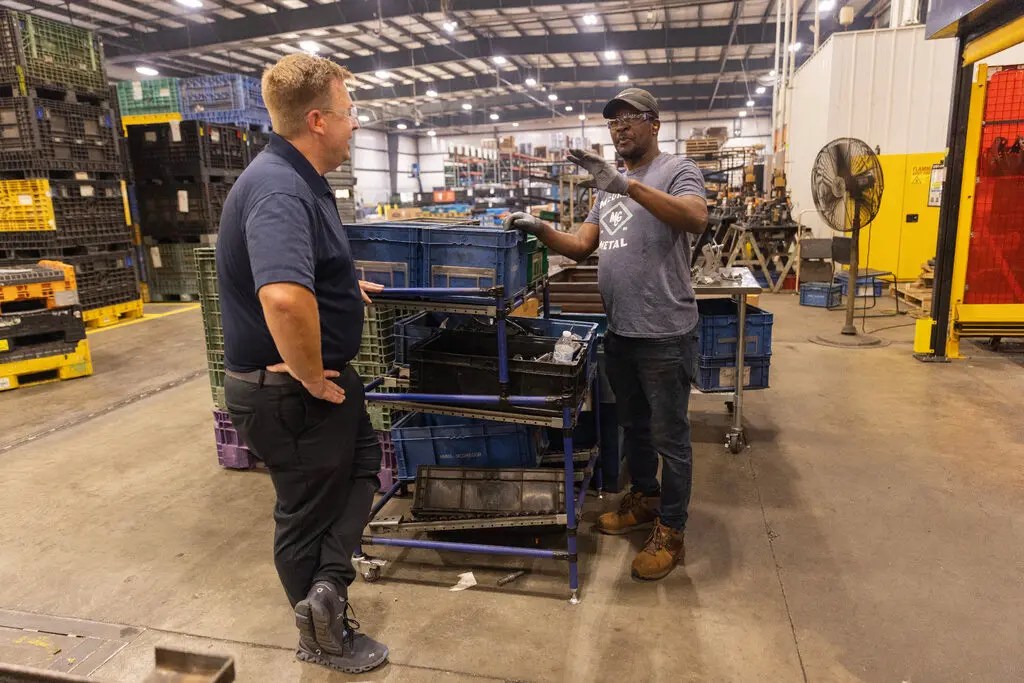
The U.S. economy has long relied on immigrant labor in its growth. The United States is a nation of immigrants. The 19th century transition from an economy devoted to agriculture to a modern industrial system funded by agricultural produce depended on the import of immigrants, with Germans and the Irish leading the way. Along with their essential labor for the new manufacturing sector and the expansion of farming, their arrival and that of immigrants after them brought deep political division reflecting the conflicts in work places and neighborhoods. Charismatic personalities have for two hundred plus years made political careers out of those divisions. Using the tools of distortion, lies, religious differences and buffonery, nation-wide political movements have been created and the nation’s ethnic divisions deepened.
The U.S. Civil War resulted from decades of simmering conflict over the proper role for the African immigrant brought to these shores as slave labor. Sacred texts dated as two millenia and more in origin were interpreted as assigning back breaking labor in fields and estates to the African sold as a slave. Low to no wages producing lucrative crops, cotton especially, for the world made the southern U.S. the supplier of much of the capital for the new nation’s financiers of south and north.
Angry debate over the causes and meaning of the Civil War continues today. Our most hallowed symbol of the United States as a welcoming refuge, the Statue of Liberty, was subjected to controversy and opposition in its creation one hundred fifty years ago. The Frenchman who created the original design saw the Statue as a celebration of the abolition of slavery with broken shackles to be draped from Liberty’s left hand. But to avoid the protests of former slaveholders and their supporters, who portray slavery as an idyllic era, the shackles now are partially hidden by her gown’s layers of folds and are barely visible from the ground level promenade.

America’s long history of anti-black racism and professed white superiority makes the nation’s response to the rise in the world’s immigrant population especially challenging, emotionally and politically. In the comprehensive study of world immigration by the U.S. Pew Research Center, it was found that one out of five immigrants in the world live in the U.S. While we now have far more immigrants and children of immigrants inside our borders, the majority of our more recent arrivals are persons of color, not the white adults and children from Europe and Scandanavia of the 19th century. As late as 1920, most of the newly arrived came from Italy and Germany, with Canada a distant third. Much of the shift to the immigration of persons of color has occurred since passage of the 1965 immigration reform. In 2022 the nation’s largest immigrant populations hailed from Mexico and India.
The 1965 Immigration and Nationality Act supported the shift in the origin of immigrants. Eliminating quota provisions favoring immigration from Europe, it gave preference to skilled workers and immigrants from anywhere with family members already settled in the U.S. The Act thus contributed to the rise in immigrants of color primarily from the earth’s southern hemisphere and a considerable increase in the numbers of immigrants in the country.
In the fifty years after passage of the 1965 law there were a total of 72 million immigrants and their children who came to the “land of freedom”. They accounted for 55% of the growth in U.S. population and Pew researchers project they will make up 88% of the growth from 2015 to 2065 when the nation will number 441 million persons and no ethnic group will constitute a majority of the population. Whereas non-Hispanic whites totaled 84% of the U.S. population in 1965, Pew studies project they will number 46 % in 2065. Continuing immigration from Latin America will make Hispanics 25% of the population and by 2065 14% of the nation will be Asian in origin.
Given voting trends in recent elections showing Hispanics favoring Democrats, the Republican party leadership has been particularly concerned by the dizzying increase in their numbers. Their current response is to support with near unanimity a candidate for U.S. President who has made the country wide settlement of immigrants of color the focus of his campaigns. His primary policy proposal, virtually his only concrete pledge, is to return two million recent immigrants to their countries of origin. The Republican candidate has repeatedly characterized Democrats’ relatively lenient response to the shift in immigration from the southern hemisphere as admitting “criminals and rapists” into our communities. In this month’s debate between the Democratic and Republican candidates for President, regardless of the question at hand Trump returned again and again to foreign nations sending their most dangerous citizens across our borders.
Trump’s history of racist rhetoric and commentary reveals the underlying message of the campaign slogan “Make America Great Again” for his 2016 and 2024 campaigns for President. A Wikipedia article on the phrase reports the candidate still denies the influence of Ronald Reagan’s successful 1980 campaign use of “Let’s Make America Great Again” as a slogan. Trump does outdo Reagan in disclosing the covert intent of its use as “Let’s Make America White Again”.
His outrageous claim that Haitians, migrants from one of the “shithole countries”, are eating the pets of residents of Springfield in the crucial State of Ohio may, however, have back fired. Not only did the city’s top administrator deny the report which Trump culled from an extreme racist’s social media posting, the town’s populace has been patronizing the Haitian restaurants as never before and emphasizing their new businesses and Haitian labor as vital to the growth of the local economy.
While the heavily Republican area may still vote for Trump in this year’s election, the recent affimation of the Haitian immigrants by many Springfield residents illustrates the central question raised by the candidates. Will the U.S. citizenry finally signal their embrace of the nation’s image as a haven of welcome for people of any and all ethnicities? Or will it step up its effort to hold back the migration patterns of our modern era in a futile effort to return the U.S. to a time when its white population were a majority. Representing the nation’s ideals as embedded in its history of immigration moving the economy, the culture, the community life forward, the opposition Democratic Party candidate is a woman of mixed Asian and African ancestry. If Harris’ Democratic Party is able to safeguard a victory in the upcoming election, the outcome will mark the nation’s progress to becoming a true “multi-racial democracy”.
What Congo Gets for Mining Its Cobalt

Before buying an electric vehicle you may want to consider the cost in human lives and environmental ruin at the first level of the EV battery’s supply chain. Congo (DRC) mines 70 per cent of the world’s cobalt and despite the claims of the hi tech corporations, the mining of its cobalt is destroying Congolese lives and their land. So goes the summary of Siddarth Kara’s findings reported in his 2023 book Cobalt Red: How the Blood of the Congo Powers Our Lives. Kara pulls back the cover on cobalt mining laid by the beneficiaries of this rare, essential mineral’s supply chain.
Demand for cobalt accelerated with spiraling sales of smartphones, laptops, I Pads and Pods, etc. in the 90’s but the digging for cobalt rivals the U.S. gold rush with the demand created by EV manufacture in the new century. EV battery packs require over 1000 times more cobalt than smartphones. The forecast of how and where the demand will be met is tragically familiar.
Beginning with the trade in African slaves through satisfying the global demand for ivory followed by rubber, palm oil and in supplying strategic minerals for modern warfare, the systems of resource extraction initiated by Belgian King Leopold’s Congo Free State then restructured by the colony of Belgian Congo are now implemented by the neo-colony of the Democratic Republic of Congo. Each system of governance has positioned Congo to contribute the preponderant share of critical resources to the global economy. Relevant to the mining of cobalt is the attempt of southern Congo’s Katanga Province to secede from the newly independent nation in 1960. Plotted and financed by Belgian copper mining interests, when the elected Prime Minister Patrice Lumumba defied foreign control of Congo’s resources in 1960 he was flown to Katanga to be tortured and assassinated by the Belgian military.
The Katangan copper mines with their byproduct of cobalt are now managed and partially owned by Chinese companies. As a side note, it is important to state that U.S. companies depend on China for the bulk of their cobalt supply. In 2016, a Chinese company purchased from a U.S. mining firm the largest copper/cobalt mine in Congo.
In his tours of cobalt mining in southern Congo, Kara focused his attention on the individual miners, haulers and washers of the “artisanal” mines. Supplying an estimated 30 percent of Congo’s annual cobalt production the ravages of artisanal miners’ lives and their environment are as appalling as they are hidden by the multi-leveled supply chain and white washing of the extraction practices. With little to no provision for their fair payment or miner safety, Congolese President Kabila urged citizens in the late 90’s to reap the bonanza brought about by the increasing global demand for cobalt.
But it was Kabila’s son Joseph whose mining deals with the Chinese to produce an essential element for EV’s brought about the unprecedented growth of artisanal mining by entire families. An elderly woman observed that the President and other Congolese who exploit villagers’ labor fabricated tales of riches to be made from cobalt and then sold what the diggers extracted at a price much higher than what the miner received. After recounting incidents of children being maimed or killed in mining accidents the grandmother concluded in despair, “this is what cobalt has done to Congolese children. They have no more future.”
In their quest for the highest grade cobalt, and a higher payment received, some artisanal miners dig tunnels in the mineral rich earth. With some tunnels up to thirty meters below the surface, the miners accept staggering risks in wagering their labor. Rarely are beams used in tunnels and while air blowers may be installed the dust stirred up and breathed is toxic and stifling. In his interviews with miners, Kara listened to gruesome accounts detailing the loss of life and limbs brought on by common artisanal practices.
Why would villagers dig for cobalt when fully aware of the danger and sure erosion of their health? There are simply no other opportunities to earn a cash income and contrary to the government’s pledge of free public education through middle school, fees must be paid to the school to employ a teacher and enroll a child. The goal of providing their children an education was shared with Kara by many of the artisanal miners.
For a nation endowed with abundant sought after resources, it is shocking that the national budget cannot meet the bill for free education in the primary grades. Kara cites that the entire 2021 national budget totaled $7.2 billion, comparable to that of the State of Idaho with a population one fiftieth the number of Congolese. The budget increased very little from 2019-21 in spite of the 100 percent increase in the global price for cobalt. Clearly the structure of Congolese resource extraction supplies only a few nationals with massive wealth. There has been no accounting for the billions paid by the Chinese for southern Congo’s mines and processing plants during the administrations of the Kabilas, father and son.
Kara describes how the structure of corruption benefiting the Congolese elite is matched by the foreign companies’ rigged accounting and white washing of the cobalt mining practices. In exposing the truth of what he witnessed in artisanal mining of cobalt, Kara’s book offers dramatic evidence to be used in lawsuits and reform movements deployed to save Congolese lives and enhance the country’s future.

are “trafficked” by entrepreneurs and soldiers
to work in the mines.
From a Congolese child’s digging of rocks laden with cobalt to the battery in our home computer, Kindle and electric vehicle is a circuitous route. As Kara writes, “The realities (of the mining, ed.) are hidden behind numerous layers of multinational supply chains that serve to erode accountability”. On parting with his translator in Congo after a visit, Kara asked what he would like him to write. The man replied, “Please tell the people in your country, a child in the Congo dies every day so that they can plug in their phones.”
********************** *************************
This book review is posted in recognition of Congo Week October 15-21, 2023. Congo Week has been organized anually for more than a decade to “break the silence” on the ongoing injustices of the extraction of Congo’s vast resources. For more information on Congo Week and on Congo in general go to friendsofthecongo.org. For more on cobalt mining in the country and court cases brought against its practices do a search for more posts on the topic at the blog lokoleyacongo.org .


 Erasing Borders
What We Need
Nov 3
Posted by erasingborders
Until the election this year, no U.S. Presidential candidate has identified so many enemies within the nation whom we should fear. The Republican Party’s candidate for President has made, as in 2016, purging of immigrants within our borders the foremost plank of his policy platform. But they are not the only group targeted for condemnation and reprisals. His opponents in 32 felony cases in which he has been convicted have now also been put on notice. Media outlets intent on lifting the veil of lying, depravity in relationships with women, violation of business contracts and attack dog strategy in multiple court cases, any persons or group publicizing the truth of his grotesque mendacity may expect reprisals.
Although he has been classified as a would be dictator. a leader in the mold of other authoritarian rulers today and in the past century, an accurate assessment of his biography of misdeeds may require a comparison with figures farther back in history. My own search for a true match has been prompted by the following poem of David Budbill:
“The emperor
His bullies and
Henchmen
every day
Terrorize the world
Which is why
Every day
We need
A little poem
Of kindness
A small song
Of peace
A brief moment
Of joy
– Written by David Budbill in 2005. Budbill was posthumously named “The People’s Poet of Vermont” by the Vermont legislature.
Contemplating the possibility of this nation elevating a depraved egotist to our highest office the Book of Psalms gave voice to what I felt. Here in Psalm 5, written over 2500 years ago, I found an apt description of the man who threatens to become the President of our formerly united States.
“There is no truth in their mouths;
their hearts are destruction;
their throats are open graves;
they flatter with their tongues.
Make them bear their guilt,
O God:
let them fall by their own
counsels
because of their many
transgressions cast them
out,
for they have rebelled against
you.
Those are verses 9 and 10 of Psalm 5, in the New Revised Standard Version translation of the Hebrew Bible. Psalm 133 suggests a source for the “brief moment of joy” for our “every day” as Budbill calls for in his poem “What We Need”.
“How very good and pleasant it is
when kindred live together in
unity!
……..
For there the Lord ordained his
blessing
life forevermore.”
Those are verses 1 and 3b of Psalm 133 in the NRSV translation.
We in the U.S. are blessed by the presence of people from many of the world’s nations who have chosen to make this nation their home. They come in many colors. They come speaking many languages, eating a delightful variety of foods, following many different customs. We encounter them as our yard tenders, bricklayers, journalists, tree trimmers, nurses, meal servers, bus and truck drivers, long term care givers, crop harvesters, doctors, shop owners and clerks and public servants. Every day most of us have the opportunity to show gratitude for their presence and their service. Every day we can all share with them a “brief moment of joy” with a smile, with words of kindness, with words of thanks.
Posted in Global Economy, Interfaith Relations and Politics, Solidarity, Community and Citizenship, U.S. Immigration and Refugee Policies, U.S. Political Developments
6 Comments
Tags: A would be emperor of the U.S., David Budbill, Growing diversity of U.S. population, The Psalms' commentary on the 2024 U.S. election