Author Archives: erasingborders
Renewable Energy Frees National Economies

Renewable Sources and National Soverignty
For most countries lacking fossil fuel reserves the increased cost of oil due to the war on Iran will mean more indebtedness. Loans from the World Bank and/or the International Monetary Fund (IMF) will come at the high cost of austerity measures cutting government services ranging from subsidies for the poor to health systems and education. The lending country often will also be required to transfer extraction of vital natural resources from the government to private enterprise.
Although Uruguay lacks fossil fuels in its subbsoils, it will escape the pressures of relying on the world financial system due to its transition to renewable energy sources. This was accomplished thanks to nearly half of its power coming from its dams on major rivers and the renewable energy commitment of the leftist-liberal Broad Front coalition which gained the Presidency and legislative control for the first time in 2005.
When a NYT journalist interviewed Uruguayans in 2023, he referred to the country’s transition to renewable energy as a Latin American revolution and was surprised by the common response: “Well, there wasn’t really a revolution in the Latin American sense. It was that we were worried about sovereignty. We were worried about the future. We were worried about our economy being yoked to commodity prices that were being affected by global wars that were very far away from Uruguay.”
Wind Power Led the Way
When the Broad Front took power, it was evident that the increases and fluctuations in the price of natural gas and oil restricted their ambitions to develop social services and reduce inequality in Uruguay. Rather than continuing to devote over 2 % of the Gross Domestic Product to fossil fuel purchases, the Broad Front coalition created a National Directorate of Energy as one of its first acts. Growth of wind power through public-private partnerships was the new Department’s first emphasis.
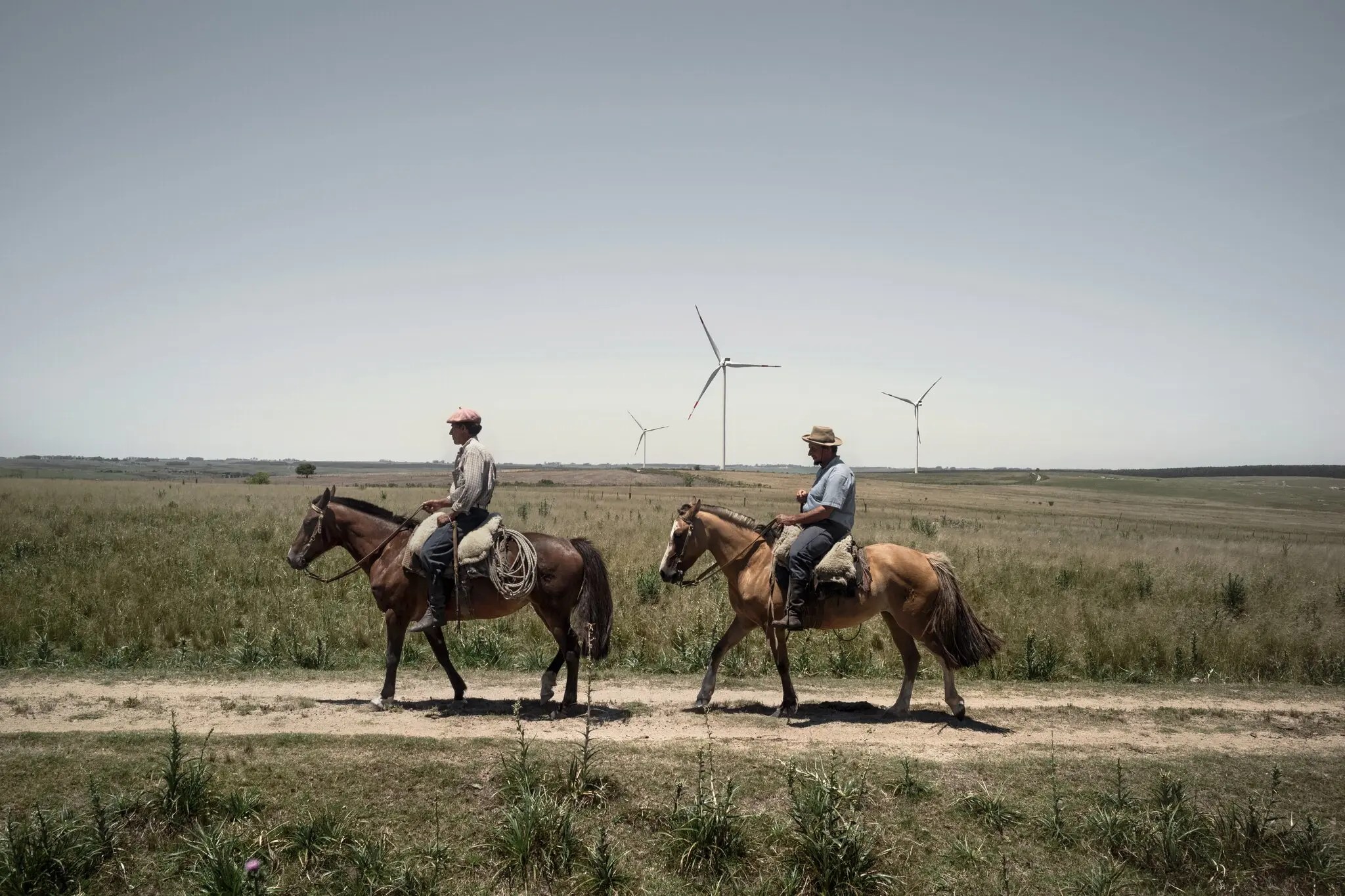
Within a few years, wind power was supplying over 30 per cent of Uruguay’s energy needs, had provided jobs to 50,000 workers and enabled smaller, family farms to survive in the face of rising costs. After fifteen years of coalition rule (2005-2020), wind, hydro and biofuel combustion accounted for 98 % of the country’s power.
Largely due to the development of the wind power grid, by 2020, Uruguay’s nation wide power company had made electricity available in every home in the country and all its rural schools. Heading the company, known as UTE, for a decade was an electrical engineer who now states that he’s always considered delivery of power as a tool of income redistribution.
Energy Savings Enabled Social Services Reforms
When the leftist Coalition ceded power to a neoliberal one in 2020, multiple social reforms had been implemented and a National Health Service created. The poverty rate had dropped from nearly 20 % when the Broad Front began to rule to 8.8 % in 2019. Much of the progress in reversing hardships of the poor was made possible by savings in the energy sector.
The Director of the Energy Department has stated,“We didn’t need to depend on imported fossil fuels or on the energy markets or the energy fluctuation of energy commodity prices. So there was a better solution” . Although trained as a nuclear physicist, the Directer of the new Department has also stated that nuclear energy was ruled out early in Uruguay’s transition to renewable sources. “I realized that this was not the best solution for us because we still are having to continue importing technology, importing uranium. We don’t have uranium, either” he points out.
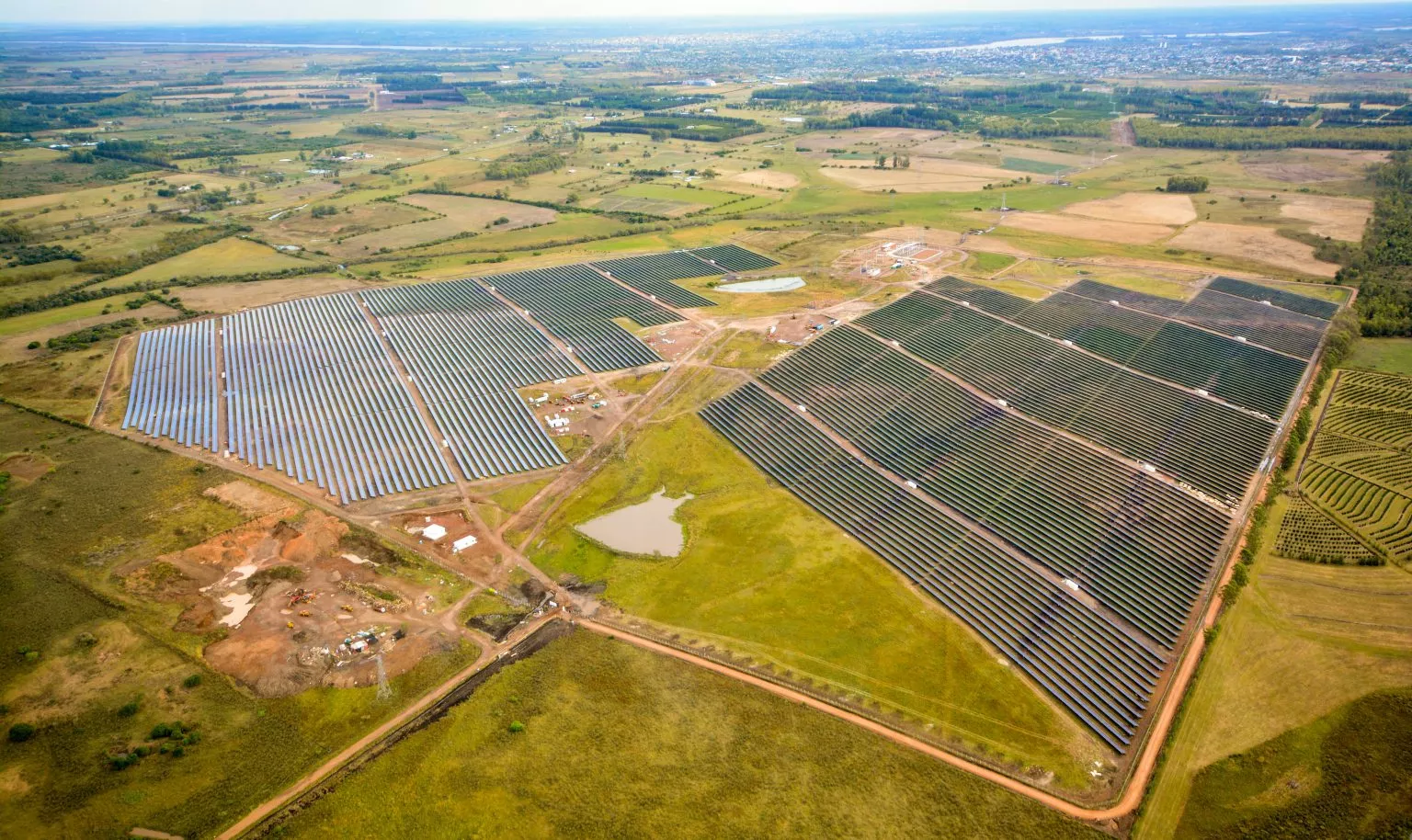
With solar energy now contributing less than 5% to the power grid, its development will be the primary aim of the new Department of Energy with the Broad Front’s 2025 return to the Presidency. Savings gained with the minimal use of fossil fuels will be devoted to new solar projects and further upgrades of the nation’s power grid. Uruguay now leads poor nations in relying on their own natural resources to supply all their energy needs. The country is at the front in demonstrating the benefits of transforming the world’s economic order from one with a fossil fuel engine to a system powered by domestic energy sources.
José “El Pepe” Mujica Describes the “Unsustainable” Global Economic Order

When Jose “El Pepe” Mujica became President of Uruguay, the country was already well on its way to freeing itself from fossil fuels. During his five year term, he led in gaining consensus from all of Uruguay’s political parties for relying on renewable sources. As a result of continued growth in hydro, wind and solar power the country began exporting its excess power to neighboring Argentina and Brazil. Payments for its power exports enabled increases in funds for programs benefiting workers and the poor.
Following the 2014 election, Mujica soon gained an international reputation as the “poorest President in the world”. He remained housed in the three room farmhouse owned by his wife Lucia, also a veteran of the Tupamaros guerrilla movement. He rode public transit and drove a vintage VW beetle. Ninety percent of his presidential salary the couple gave away to small businesses and non profits benefiting the poor.
“El Pepe“ objected to being described as “poor”. In correcting this miscaracterization he usually cited the Stoic philosophers, “As the old thinkers Epicurus and Seneca defined it, and as the Aymara people, indigenous to South America do: it is not the one who has little who is poor. The one who is truly poor is the one who needs infinitely more, the one who is never satisfied.”
Our current international system which compels us to think we need more to be fulfilled and live happily is simply unsustainable. At the 2012 UN Conference for Sustainable Development, Mujica declared, “The real problem is not climate change”. He explained, “Humanity is in grave danger because of the system we have created.”
His diagnosis of the problem conveys the solution: “The danger is rooted in what we have come to seek to make us happy.” It seems Mujica’s fifteen years in the military dictatorship’s jails, seven of which he was denied any books, may have taught him the primacy of living simply. “My message is very simple: Economic growth and progress must add to human happiness, not take away from it.”
Our current system is not only not sustainable he reminded leaders at the Rio Conference: “Does the world have enough resources for the entire human race, seven to eight billion of us, to live like the Western societies that keep making more and buying more than they need?” What is the effect on relationships with other people he then asked, “Can we really talk about the solidarity of humankind and kindness to each other, even togetherness, when we are constantly competing to outdo each other?”
He then concluded his talk with these words: “These are the building blocks of our happiness as humans: having satisfying relationships with others; raising children; making friends; spreading love in the world.” One is again led to ponder how his years of solitary confinement contributed to “El Pepe’s” bold, simple wisdom.
Uruguay from Dictatorship to Democracy
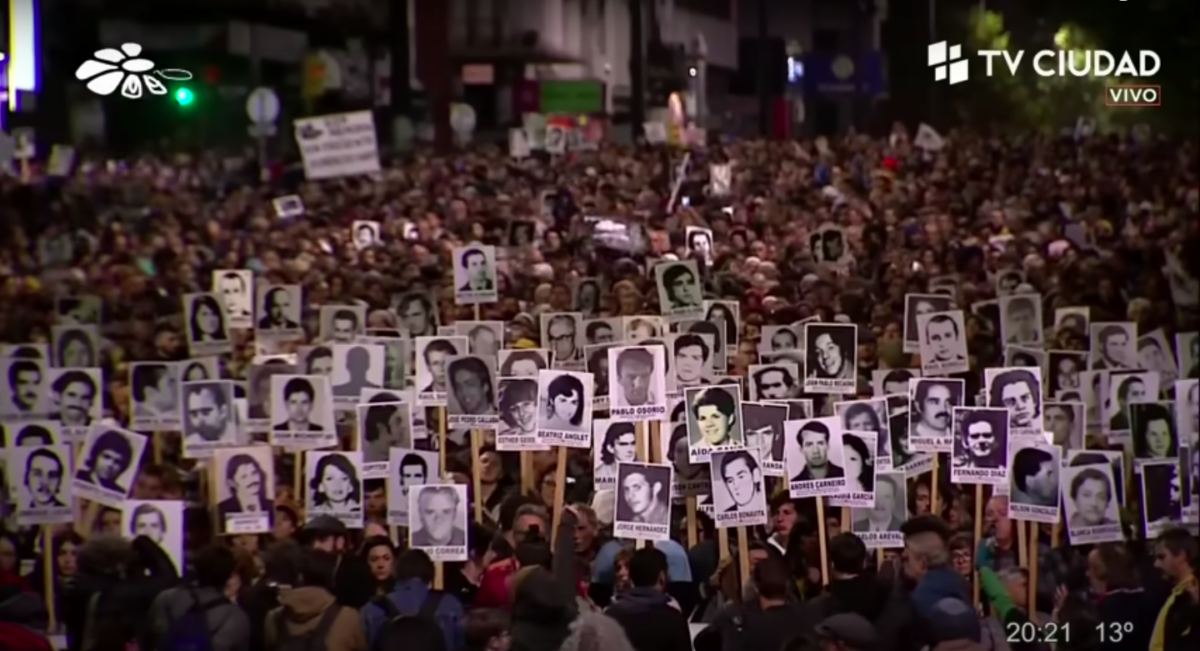
On May 20 for the past 28 years thousands have marched in 77 places across Uruguary and abroad in remembrance of those disappeared and detained by the military dictatorship from 1973 to 1985. Marchers call silently for “State terrorism never again”.
In Uruguay, shortly before the November 1971 Presidential election was held, the Broad Front, a coalition of leftist political parties was formed. Authoritarian regimes in Brazil and Argentina along with the United States feared another democratically elected socialist victory like Allende’s in Chile the previous year. The Uruguayan election was held against a background of an economy and a government in shambles and a growing Tupamaro guerrilla threat. U.S. National Security files indicate that the “superpower” feared the rise of the Broad Front coalition more than the Tupamaros.
Despite the election of a conservative President and defeat of the coalition, amidst multiple reports of harassment of its candidates, the U.S. increased its “security training” of the Uruguayan police and army. Failure of measures to improve worsening economic conditions and increased activity of the Tupamaros led to take over by the military in 1973. Brutal repression of dissent and advocacy of leftist policies were met by incarceration and torture on the advice of U.S. security advisors. During the military rule from 1973 to 1985, even mention of the word “politics” or “Tupamaros” could lead to imprisonment. For several years, Uruguay led the world in percapita jailing of political prisoners.
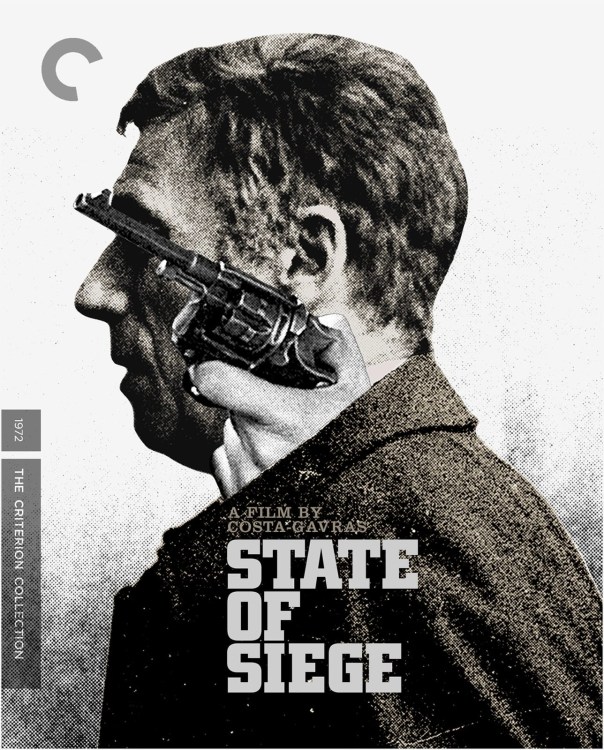
The 1972 film “State of Siege” by the makers of “Z” was inspired by the Uruguayan military’s violent repression of the Tupamaros guerrilla movement.
By 1984 the country formerly known as “the Switzerland of Latin America” had declined further and elections were held. Bolstered by rising prices for its exports, moderate to conservative governments held on to power until the historic election of the Broad Front Presidential candidate in 2004. With the Government implementing a plethora of economic and social policy reforms Uruguay became a showcase for democratic progressive rule in Latin America and indeed the Western Hemisphere.
When Tabare Vazquez of the Broad Front came to power in 2005, the rate of poverty measured 40 percent but by 2020 had dropped to under 9 percent. As the country with the lowest economic inequality in South America, Uruguay created a National Health Service for all its citizens. Pro labor legislation was approved, financial regulation, tax and pension reform enacted. Major increases in the minimum wage and social welfare payments contributed significantly in lowering economic inequality and poverty in the country.

The second Broad Front President, Jose “Pepe” Mujica, was known internationally as the “poorest President” in the world. As a Tupamaro combatant he was tortured and jailed for thirteen years under the most severe conditions. While President he drove an old VW Beetle, lived in a modest farmhouse and gave away 90 percent of his salary to organizations serving the poor and marginalized. Under his leadership (2015-20) the Congress made abortion legal and approved gay marriage. In a move to counter drug cartels’ control of the illicit drug trade, Uruguay became the first nation in the world to legalize marijuana production and consumption. The first Latin American nation to grant women the right to vote in 1927, the Broad Front led by Mujica’s party restored Uruguay’s standing as one of the most progressive democracies in the Western Hemisphere.
In retirement, he and his wife, also a former Tupamaro combatant, grew chrysanthemums at their farm and continued to drive the Beetle. At “Pepe” Mujica’s funeral procession last year, 100,000 Uruguayans honored his courageous commitment to the poor and the advance of his country.
In the next blog, erasing-borders will delve into his philosophy of the good life and his vision for the country’s future. We will consider how he contributed to Uruguay becoming a world leader in renewable energy production.
***************************
For more on the era of military rule and U.S. involvement in creating the security apparatus see:
Hidden Terrors by A.J. Langguth
Starring Yves Montand as a U.S. security agent kidnapped by the Tupamaros, “State of Siege” received a 7.7 rating from critics and movie goers. It can be seen on Prime Video.
What a Progressive Democracy Looks Like: the Case of Uruguay

Omar, our taxi driver from the Montevideo airport was a lifelong resident of the capital. We didn’t learn the origin of his Arabic name but we asked about the name “Azul” tattooed on his arm. It served him as a perpetual reminder of the infant daughter he had lost years ago. Omar did not hesitate telling us more about his family of four and the large extended family as he guided us around the capital on six occasions.

On the trip to our hotel he called attention to the sprawling Roosevelt Park across from the Rambla (“malecon” in Mexico) paths and avenue bordering the inland sea. Over 350 kms. wide at Montevideo the estuary of the Rio de la Plata (named after the silver the Spaniards never found upriver) appears to be the Atlantic Ocean that washes Uruguay’s long shoreline beginning an hour’s drive away.
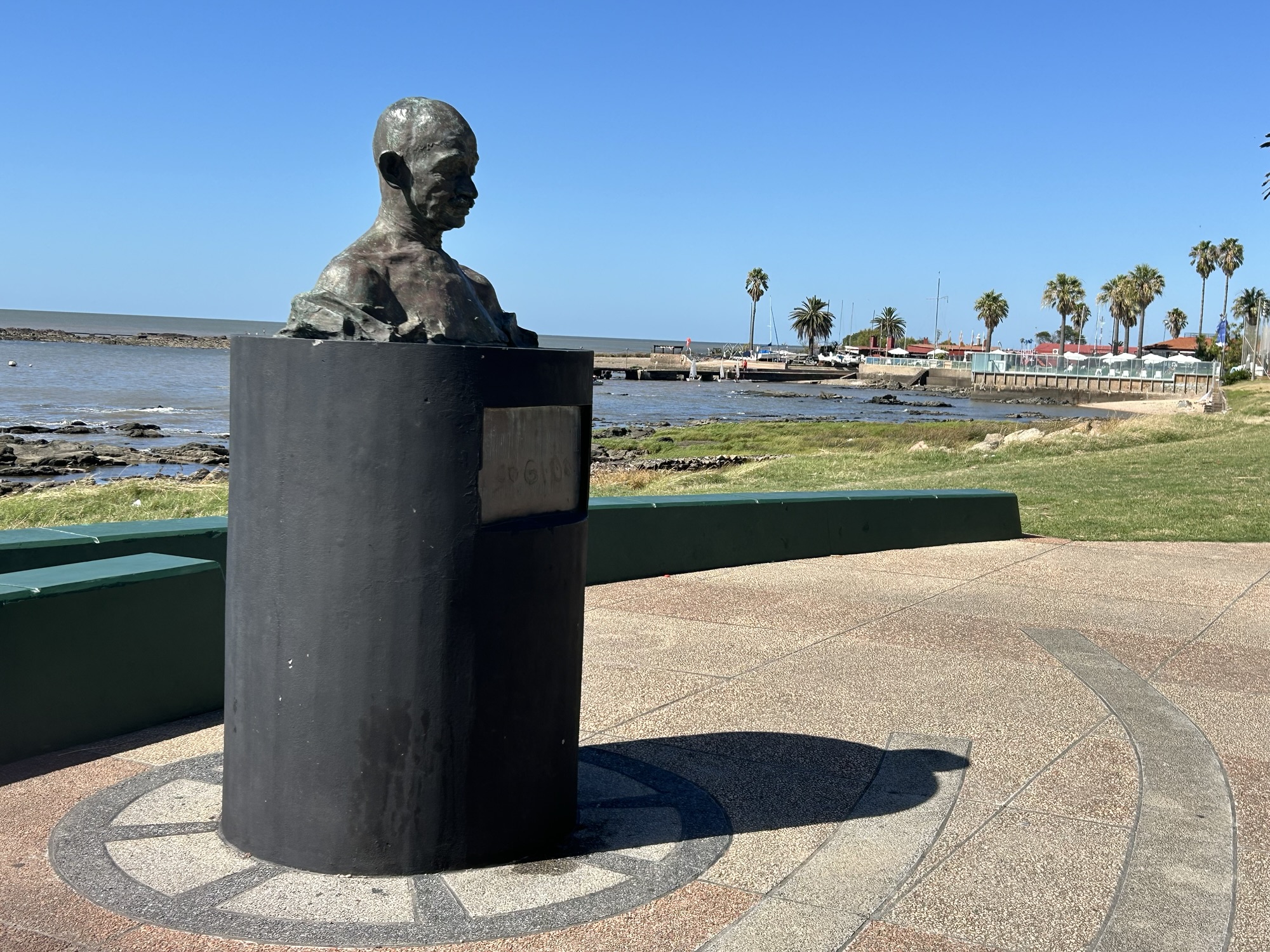
Along the rambla, the architecture of the older apartment buildings and homes of the wealthy brought to mind the diverse European cultures represented by the 19th century immigrants to the country. Italian and German styles predominate though one or two residences appear to commemorate the heritage of wealthy Swiss citizens. Our destination was a short walk from the “Gandhi Rambla” and the bust of the pioneer of non violent struggle.
Before arrival at the hotel, on Omar’s advice, we stopped at a gas station adjoining a currency exchange. There we had to deal with Uruguay’s policy of requiring dollars in cash in the exchange for pesos. So our multiple cards in hand would not be accepted and we would have to be content with leaving most of the dollars we could dig up in the country. Fortunately most of the restaurants and even small businesses would accept our credit cards and our meal servers usually told us that with use of a card no tax would be charged visitors to Uruguay.
After a good dinner and comfortable rest, we were met with the most disagreeable surprise of the journey. The Italian cruise company, MSC Cruises, denied us embarking for the voyage up the Uruguayan and Brazilian coast to Rio. Boarding passes in hand we encountered the Italian non-Spanish speaking agent who explained that without having received the Brazilian visa we had applied for we could not enter the territorial waters of that country. The visa requiredment is one of several measures of “reciprociaty” implented by Brazil last year in response to Trump’s imposition of a 50 % tariff on the import of goods from that country.
This disheartening news left us with eight more days in Uruguay we had not planned for. Overcoming her anger and disappointment, my partner Kate booked five nights in a hotel in the center of the City’s social and cultural life. Three blocks from the hotel the following night Montevideo’s main street would be electric with dancers and spectators celebrating the opening of the world’s longest Carnaval festival. For the next forty days barrios and leading cultural venues would feature music and dance, theater and mime, social and political commentators and humorists.
For the city-wide spectacle’s first two nighs the collective imagination would be reflected in the masks, costumes, songs, and dancing in two parades in the City center. Neither Kate nor I were prepared to be cast into the maelstrom of exuberance and creativity inspired by the traditions of Carnaval in Montevideo. Though ignorant of the meaning and roles of the parade participants it would be impossible not to feel, momentarily at least, that in the cavorting and foolishness we the spectators savor the sweetness of life’s drama. Even a cursory introduction to the candombe’s African originated music and dance and the murga Spanish derived traditions of satire and social commentary might ignite the desire to explore further the roots and interpretation of Uruguay’s Carnaval.



As in its unique Carnaval celebration, Uruguay shares with its neighboring countries the daily ritual of maté consumption. Unlike coffee you will not see maté on the menu and maté cafés are rare. The devotée of the drink carries to work or an event a thermos of hot water to be added throughout the day to the stimulant’s leaves. They brew in a cup made from a dried, hollowed out squash covered in leather. Critical to the drink is the “bombilla” straw filtering the herb leaves. People can be seen on the street passing a cup around while discussing a current news item. For North Americans it is curious to note that some carry their thermos and cup in a wooden box resembling the shoe shine boxes formerly seen in train and bus stations.
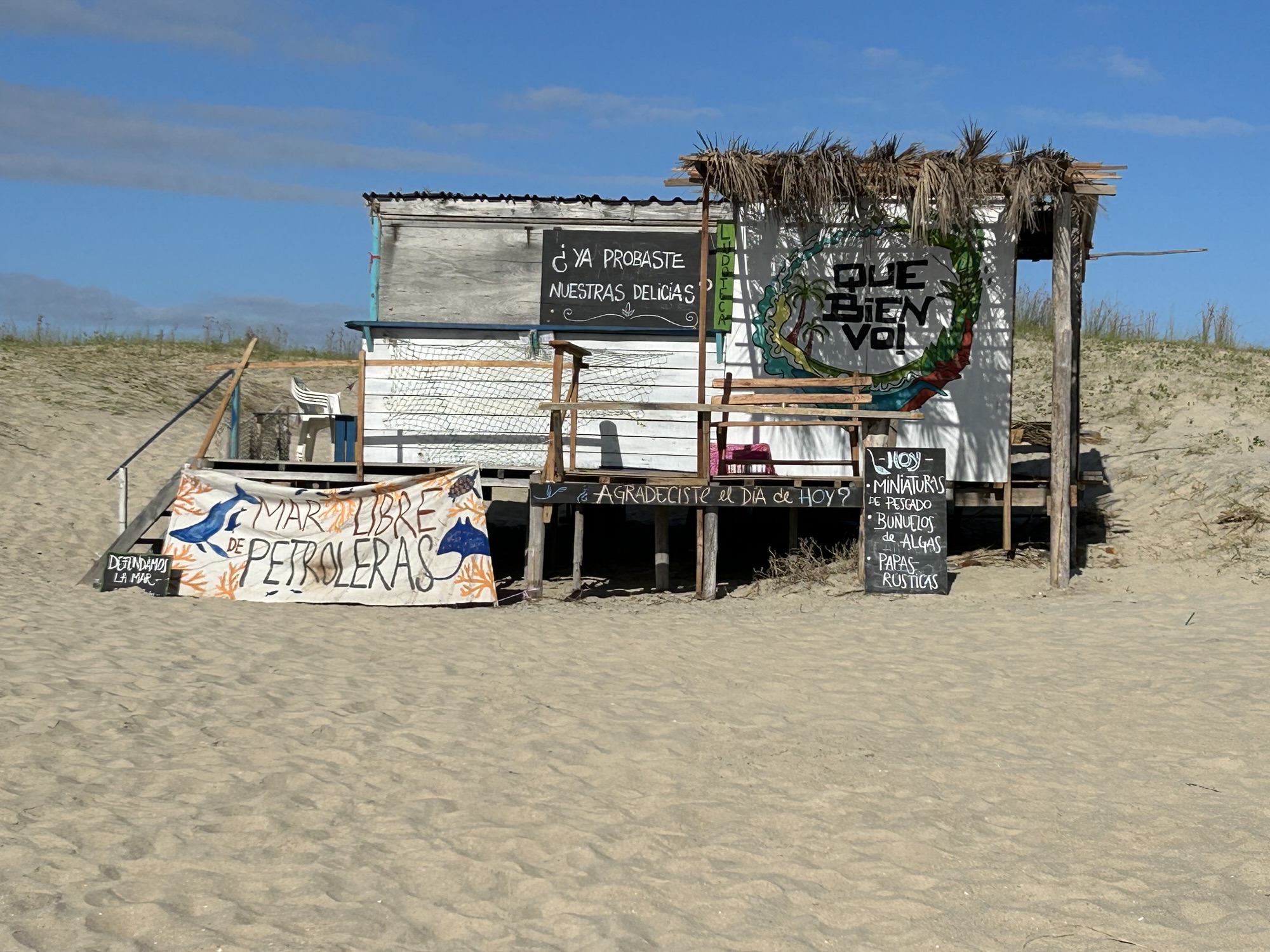
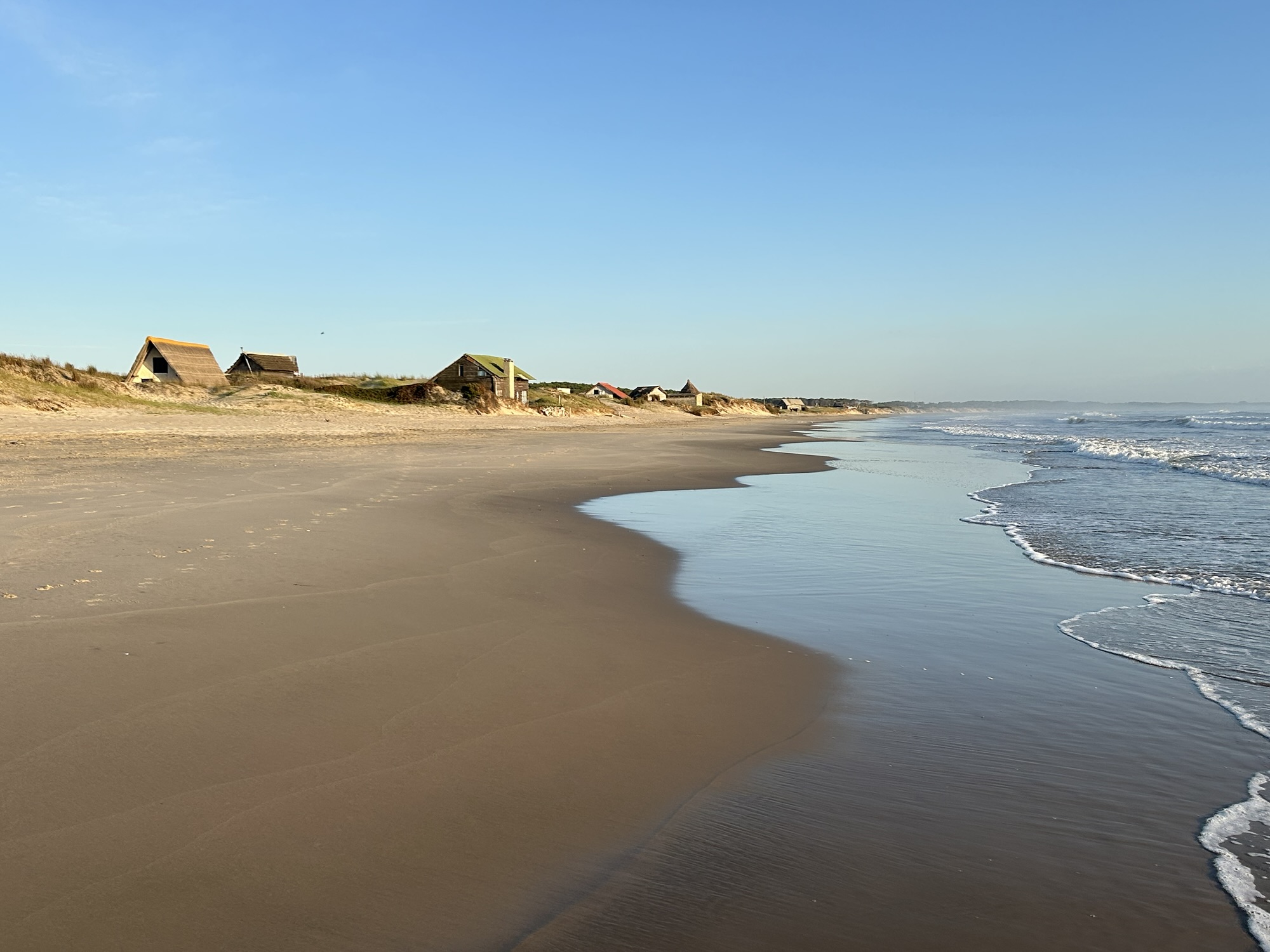
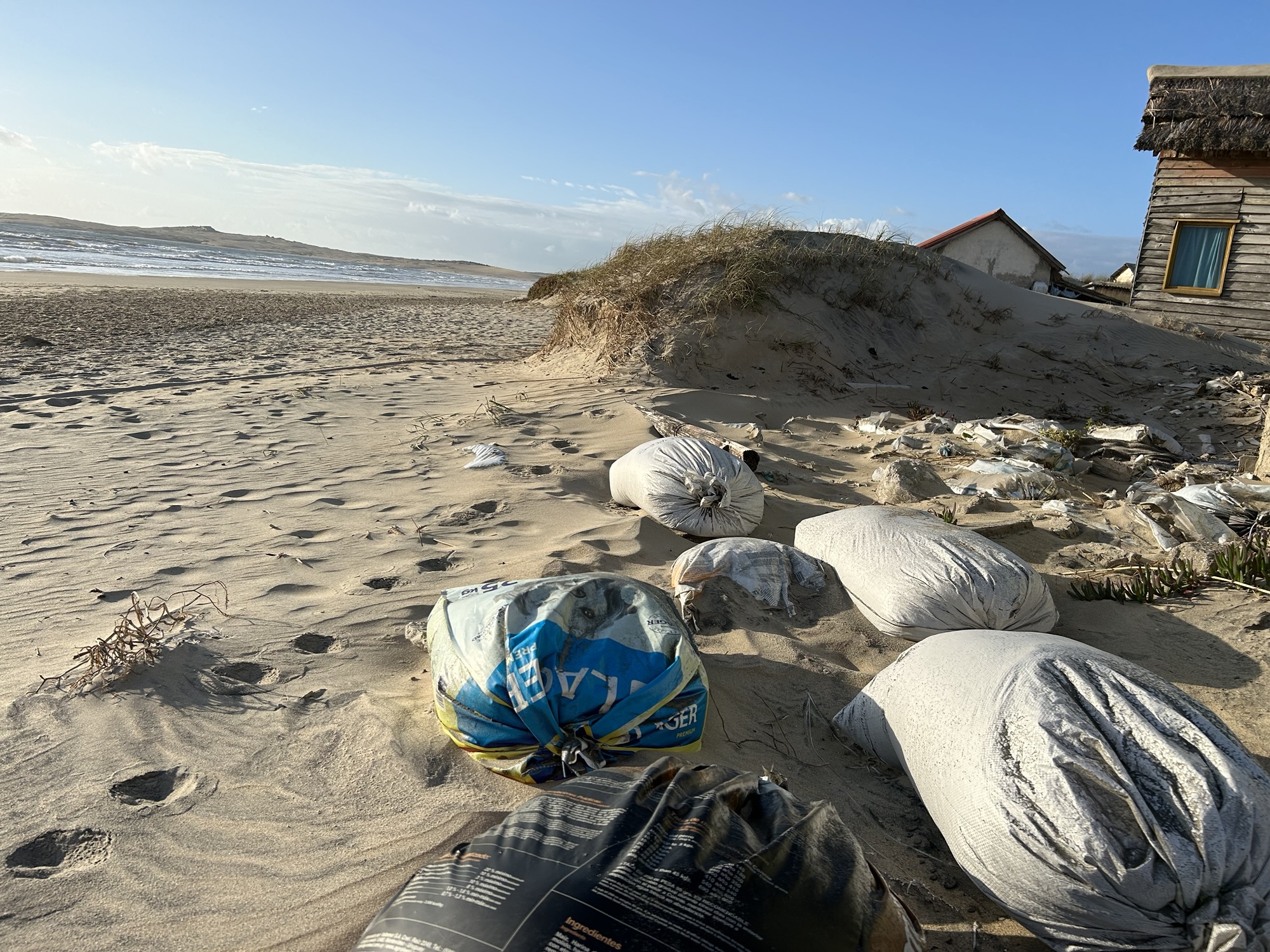
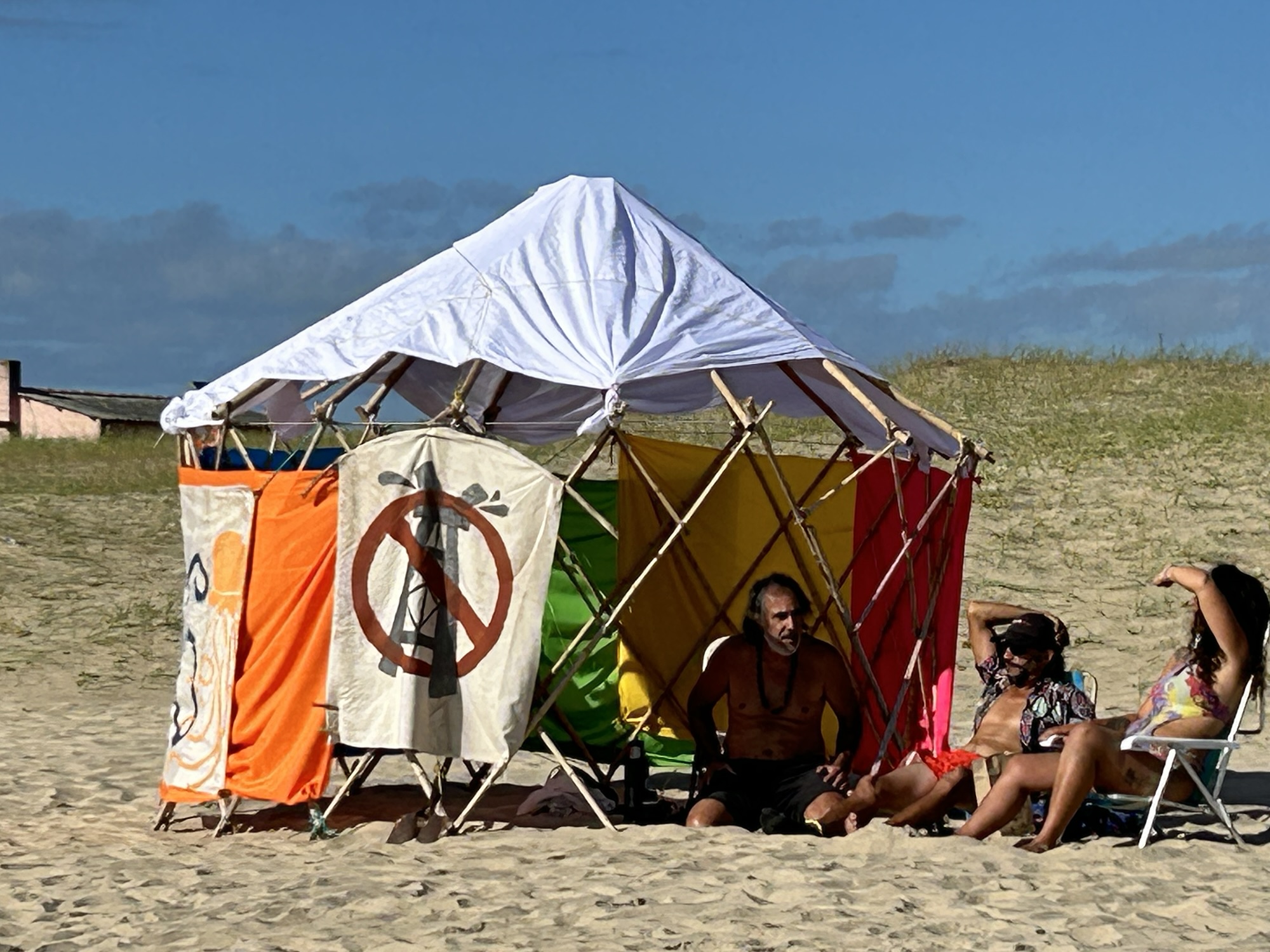
Our stay during the Uruguayan summer concluded as planned with six days on a beach less than four hours north from Montevideo. Soft golden sands massaged our feet, temperate water roared invitingly, solitary early morning walks, and the afternoon panorama of beautiful, bronzed bodies whispered to us from the deep. Sale of food and drink was advertised outside several shacks along the beach which invariably also had posted signs opposing any future oil exploration along the coast. This hostility to fossil fuels was a lone reminder of the country’s oppressive, deadly rule by the military 1973-1985 during which dissent was brutally repressed. The next blog of erasing-borders.com will be devoted to the transition from dictatorship to the flourishing democracy Uruguay enjoys today.
Land and Theologies in Conflict
| Territory | Arab and other population | % Arab and other | Jewish population | % Jewish | Total population | |
|---|---|---|---|---|---|---|
| Arab State | 725,000 | 99% | 10,000 | 1% | 735,000 | |
| Jewish State | 407,000 | 45% | 498,000 | 55% | 905,000 | |
| International | 105,000 | 51% | 100,000 | 49% | 205,000 | |
| Total | 1,237,000 | 67% | 608,000 | 33% | 1,845,000 | |
| Data from the Report of UNSCOP: 3 September 1947: CHAPTER 4: A COMMENTARY ON PARTITION | ||||||
Dating back to extensive use of “Kairos” in the New Testament, “kairos” in Christian theology refers to a time when the “kingdom of God” approaches and demands a decision from individuals and societies. In contrast with the Greek “chronos” meaning a segment of time, ordinary time, “kairos” describes a critical moment in a human context of social change. The first Kairos Document was written by an ecumenical team of South African Christian black theologians in 1985 at the height of the black population’s resistance to apartheid.
Secular media paid even less attention to the Kairos Palestine Document of 2009 than they did to the original South African Document or the other theological statements, including those in the U.S. and Europe, responding to the 1985 declaration of South African theologians. Since the Hamas attacks in October 2023 some commentators have noted how little reference to the Palestinian cause or Israel’s Palestinian occupants has been made in our media since founding of the state of Israel in 1948. So it is not surprising that outside of church circles there has been little notice of the Kairos Palestine Document.
The Document begins with an endorsement by thirteen “Patriarchs and Heads of Churches” in Jerusalem; they describe the declaration as “a word of faith, hope and love” calling on “all peoples, political leaders and decision-makers (to,ed.) put pressure on Israel and take legal measures in order to oblige its government to put an end to its oppression and disregard for the international law.” The thirteen Palestinian Christian authors advance a theological position “that the military occupation of our land is a sin against God and humanity, and that any theology that legitimizes the occupation is far from Christian teachings because true Christian theology is a theology of love and solidarity with the oppressed”.
In its theological discussion of the land governed or occupied by the State of Israel, the authors affirm that “the earth is the Lord’s and the fullness thereof” (Ps 24:1) and therefore assert no land can be seen as the possession of any particular people. Exclusion and expulsion of any group or groups from the land cannot be God’s intention. “God gives us the capacity, if we have the will, to live together and establish in it justice and peace, making it in reality God’s land.” The Kairos Palestine Document avers that the promise made by God to Abraham in the Hebrew Bible was to make him father of many nations living in justice and harmony in the land where he had been led.
In the current context of Israel’s continuing its indiscriminate killing of Palestinian civilians in Gaza, the 2009 Document takes on yet more urgent significance as a cry for justice to Christians and non-Christians worldwide. When issued, the conflict no longer was about a purely theological or political issue. “It is a matter of life and death” the authors and signators declared sixteen years ago and, as such, the Word of God in the Bible cannot be used to justify policies or State actions which bring death and destruction. As a living Word which addresses the Hebrew and Christian Bible’s themes of promise, chosen people, and land a literal interpretation makes the Word an instrument of death.
On the Bible’s treatment of the crucial topic of “the land” the Kairos Palestine Document was followed six years later by publication of the book From Land to Lands, from Eden to the Renewed Earth . Written by the young theologian and pastor Munther Isaac (see Erasing Borders blogs of September 1 and January 16, 2024), it is a sweeping study of a “Biblical theology” supporting a thesis of the universalisation of the land, indeed any land. Its lively and clear presentation of the positions of biblical scholars and theologians enables a closer reading of the texts by laypersons and their progress in shaping their own views. Although the author did not participate in creating the Kairos Palestine Document the book was written in service of its aims and concludes by asking, “Can it (the land) become a place where Jews, Muslims and Christians – while retaining their distinctive beliefs – can embrace each other as fellow human beings, and indeed as people of faith, and be reconciled in practice?”
Pope Francis’ Heart for the People

In aligning the Church with the world’s poor and marginalized and avoiding the defense of its traditional positions on LBGTQ issues, abortion and the role of women Pope Francis has made the Church an ally of the progressive forces creating a more equitable, peaceful and sustainable world. With his actions, his simple lifestyle and his words he has sought to ensure the Church’s relevance and role in responding to our global crisis.
Pope Francis’ thirteen year papacy coincided with the further degredation of the planet Earth and its species. As the threats caused by the burning of fossil fuels and overconsumption in general became more evident, the Pope’s written reflections on the ecological crisis became more pointed. Issued in 2023, his “apostolic exhortation” titled Laudate Deum or “Praise God” was addressed to “all people of good will on the climate crisis”. His much longer, didactic 2015 “encyclical letter” titled “Laudate Si” (“Praise to You, my Lord”) was sub titled “on care for our common home”.
In the Laudate Deum the former Argentine Bishop more directly addresses the world’s leaders guided by the “technocratic paradigm” he deplored in the earlier “encyclical letter”. The insights of his “exhortation” more clearly describe the threat posed by our leaders and technocrats: “We have made impressive and awesome technological advances, and we have not realized that at the same time we have turned into highly dangerous beings, capable of threatening the lives of many beings and our own survival.” The document’s warnings conclude with the words, ‘“Praise God” is the title of this letter. For when human beings claim to take God’s place, they become their own worst enemies.”
While Francis spares us the anger of the prophets of the Hebrew Bible, his “exhortation” should be considered a firm repudiation of thinking “goodness and truth automatically flow from technological and economic power as such”. Destruction of our environment results from accepting the “idea of infinite or unlimited growth which proves so attractive to economists, financiers and experts in technology”.
In his travels, actions and lifestyle as Pope, Francis remained wedded to the simplicity demonstrated by his veneration of Francis of Assisi and the motto he chose for his term in office, “Miserando atque eligendo” or “lowly but chosen”. He embraced the significance of being named the first Pope born and raised outside Europe since the 8th Century. As a child of the Southern Hemisphere he represented well the aspirations and heartache of the peoples where the Church continues to grow the fastest. As a leader in the Argentine Catholic Church during the military junta’s “dirty war” of the seventies and early eighties, he shared the suffering of a population subjected to violent repression, lying and harsh deprivation of the poor. His praise of the writings of Gustavo Gutierrez, the pioneering liberation theologian, marks a radical change in the Vatican’s position on the theology that grew from the Latin American struggle against exploitation by foreigners and national collaborators.
Prior to Francis’ going to Mexico in February 2016, he shared the purpose in visiting the world’s second largest population of Catholics was to:
To be close to the people and places where there is most need:
The Indians in San Cristobal, Chiapas.
The violence in Michoacan.
The Migrants in Juarez City (on US Border)
Defense of the rights of indigenous peoples worldwide, pastoral ministry with families grieving members lost to drug cartel and state violence, and the plight of migrants preyed on in Mexico had early on become the Pope’s priority concerns. One journalist noted that Pope Benedict in his 2012 visit of Mexico’s Catholic heartland of Guanajuato failed to mention the over 100,000 dead and thousands disappeared in Mexico’s war on the cartels. Following Francis’ visit, he named Michoacan’s leading Catholic prelate to Cardinal to help protect him from the violence.
Francis’ impact seems destined to grow in the future. In his few years in office he was able to make the Church less Eurocentric and more globally oriented. In the upcoming conclave 80 per cent of the Cardinals naming the new Pope will have been appointed by Francis. A significant increase in the number of Cardinals from Asia and Africa will be there. Over half of those selecting the new Pope have served the Church in formerly colonized nations. As a prophet foresaw 2800 years ago, “As the rain and the snow come down from heaven…….giving seed to the sower and bread to the eater, so shall the word be that goes out from my mouth; it shall not return to me empty.” (Isa 55:10-11)
In a final statement issued on Easter Sunday, Francis made an “ appeal to all those in positions of political responsibility in our world not to yield to the logic of fear which only leads to isolation from others, but rather to use the resources available to help the needy, to fight hunger and to encourage weapons that build the future, instead of sowing seeds of death!” This appeal was preceded by his Easter affirmation of hope and encouragment, “Evil has not disappeared from history; it will remain until the end, but it no longer has the upper hand; it no longer has power over those who accept the grace of this day.” In praying for peace his final “Orbi et Urbi” highlighted Israel’s war on the Palestinians in Gaza and the Holy Land.
Christmas on the Border, 1929
The poet Albert Rios based this poem on newspaper accounts and personal recollections of residents who were children in Nogales at the time of the event.
1929, the early days of the Great Depression.
The desert air was biting, but the spirit of the season was alive.
Despite hard times, the town of Nogales, Arizona, determined
They would host a grand Christmas party
For the children in the area—a celebration that would defy
The gloom of the year, the headlines in the paper, and winter itself.
In the heart of town, a towering Christmas tree stood,
A pine in the desert.
Its branches, they promised, would be adorned
With over 3,000 gifts. 3,000.
The thought at first was to illuminate the tree like at home,
With candles, but it was already a little dry.
Needles were beginning to contemplate jumping.
A finger along a branch made them all fall off.
People brought candles anyway. The church sent over
Some used ones, too. The grocery store sent
Some paper bags, which settled things.
Everyone knew what to do.
They filled the bags with sand from the fire station,
Put the candles in them, making a big pool of lighted luminarias.
From a distance the tree was floating in a lake of light—
Fire so normally a terror in the desert, but here so close to miracle.
For the tree itself, people brought garlands from home, garlands
Made of everything, walnuts and small gourds and flowers,
Chilies, too—the chilies themselves looking
A little like flames.
The townspeople strung them all over the beast—
It kept getting bigger, after all, with each new addition,
This curious donkey whose burden was joy.
At the end, the final touch was tinsel, tinsel everywhere, more tinsel.
Children from nearby communities were invited, and so were those
From across the border, in Nogales, Sonora, a stone’s throw away.
But there was a problem. The border.
As the festive day approached, it became painfully clear—
The children in Nogales, Sonora, would not be able to cross over.
They were, quite literally, on the wrong side of Christmas.
Determined to find a solution, the people of Nogales, Arizona,
Collaborated with Mexican authorities on the other side.
In a gesture as generous as it was bold, as happy as it was cold:
On Christmas Eve, 1929,
For a few transcendent hours,
The border movedOfficials shifted it north, past city hall, in this way bringing
The Christmas tree within reach of children from both towns.
On Christmas Day, thousands of children—
American and Mexican, Indigenous and orphaned—
Gathered around the tree, hands outstretched,
Eyes wide, with shouting and singing both.
Gifts were passed out, candy canes were licked,
And for one day, there was no border.
When the last present had been handed out,
When the last child returned home,
The border resumed its usual place,
Separating the two towns once again.
For those few hours, however, the line in the sand disappeared.
The only thing that mattered was Christmas.
Newspapers reported no incidents that day, nothing beyond
The running of children, their pockets stuffed with candy and toys,
Milling people on both sides,
The music of so many peppermint candies being unwrapped.
On that chilly December day, the people of Nogales
Gathered and did what seemed impossible:
However quietly regarding the outside world,
They simply redrew the border.
In doing so, they brought a little more warmth to the desert winter.
On the border, on this day, they had a problem and they solved it.
The poet resists any social commentary in describing his poem’s genesis. It appeared, however, as the Academy of American Poets’ “Poem of the Day on December 22, 2024 a month after the U.S. election of a viciously anti-immigrant, white supremacist President. Like other memorable poems, it celebrates the best of human nature and defies any attempts, even by the most powerful, to deny, contradict or pervert the good within each of us. We celebrate today the vision and courage of the “officials” of Nogales with the hope that we may individually and collectively open ourselves to the opportunities in these times to move borders. For the sake of the children in and around us.
Rios commented on his poem, “I didn’t live through the Christmas of 1929, but growing up in Nogales, the border was always there—constant, imposing, dividing and connecting at the same time. This poem reflects on a story from before my time, when the border wasn’t just a barrier but something that became a solution. It tells of a community that, for one Christmas, chose unity over division, moving the line in the sand to bring joy to children from both Nogales, Arizona, and Nogales, Sonora. Growing up with the border always in sight, this story resonates deeply for me—proof that even in separation, people’s determination can make the impossible happen.”
From Aid to Empire

“But seek the welfare of the city where I have sent you into exile, and pray to the Lord on its behalf, for in its welfare you will find your welfare.” (Jer 29:7)
We now know that we have not just lost an election. Those declared victorious are intent on desecrating and destroying the best values of a nation ruled by and for its people. They have dedicated themselves to creating a state ruled by and for its wealthiest citizens and crippling if not eliminating programs to further the equal opportunity of the most disadvantaged. We have not just lost an election; the victors aim to reverse all advances we have made towards becoming a multi-racial democracy. They trample on this vision. They hurl abuse on it with their decrees are intended to silence us and seize the country from us. They would exile us with their reign of lies, intimidation and fear.
The election measured for us the distance between our prophets’ vision and a nation yet gripped by degrading lies, xenophobia, racism, and rampant militarism. We have been cast back to an age of empire when most of the globe is seen as supplying the resources for the economic development of select countries. Aid for new or long impoverished nations to enhance the well being of their people was one of the first targets of the multi billionaire charged with enhancing government efficiency.
I have personal experience of some of the benefit a small U.S. AID grant can have on lives in poor nations. I administered the $10,000 grant the Disciples’ Church in Congo received in 1970 for construction of a dormitory at its farmer training center. Youth from many villages were housed there while training in animal husbandry and growing vegetables in dense rain forest. Pigs raised at the Ikengo Farm were prized in the provincial capital with the Governor visiting often to purchase a pig or two. In a visit forty years after the dorm was completed the majority of the trainees were young men of “pygmy” Batswa ethnicity formerly ostracized by Ikengo’s Bantu villagers.
Entitled solely by personal fiat, Elon Musk intends to curtail, or at least, severely cripple U.S. AID programs. Created by the Kennedy Administration to support the economic development of the new nations freed from colonial rule, the agency soon became the lead agency in U.S. contributions to fighting hunger, disease and poverty in the world. Musk and the new President’s attempt to eliminate U.S. AID’s programs carries out an aim to reverse history and return the world to a colonial era of white European domination in South Africa and the world.
Another Musk-inspired decree withdraws all forms of U.S. aid for black majority ruled South Africa. The focus on South Africa reveals the influence of Musk’s upbringing to age 18 as the heir of a white nationalist grandfather and father in the time of apartheid. These facts make difficult an escape from interpreting this important U.S. foreign policy decision as anything but an act of resentment and vengeance for South African legislation returning land seized by whites to black farmers. Withdrawal of U.S. support for the further growth of the largest economy in Africa also seeks to punish South Africa’s firm opposition to Israel’s war on Palestinians in Gaza and the West Bank.
Presenting the case in the International Court of Justice that Israel is bent on genocide of Palestinians confirms 21st Century South Africa’s independence from its colonial masters. The new nation was one of the original members of the BRICS alliance of countries balancing U.S. and European dominance in world politics. The strength of that new alliance can be seen in South African leaders’ resolute position on the Israeli War.
We exiles need not remain discouraged by policies inspired by white nationalist ideologies of empire. We are joined in opposition by the vast majority of the world’s people who have thrown off the yoke of imperial rule and become independent nations in this ever evolving world. As British Prime Minister Harold MacMillan, a Tory, noted shortly before numerous African nations declared their independence in the early 1960’s, “the winds of change” are blowing across the continent – and the world he might have added. Those winds can never be reversed.
Formation of the new BRICS alliance of nations now encourages new and the long oppressed nations of Latin America, Asia and Africa to be steadfast in their independent political and economic positions. They are our allies in our acts of resistance and opposition to policies and ideologies aiming to turn back the “winds of change” continuing to blow across our world.
Jeremiah in the 7th Century BCE foresaw the rise of other empires to challenge that of Babylonia. After 70 years of their exile in Babylon, the Jews were freed by the Kingdom of Persia from their captivity and exile. The prophet had paid attention to the “winds of change” in the world of that time and saw that in their return to Judah and Israel God would offer a new covenant to the exiles and would “write it on their hearts”. Gaining their freedom confirmed they would now know their God to be a God of justice. Jeremiah’s words were echoed by Martin Luther King when he proclaimed “the arc of the moral universe is long but it bends toward justice”. An abolitionist minister first spoke those words in the 1850’s.
“Make American White Again”
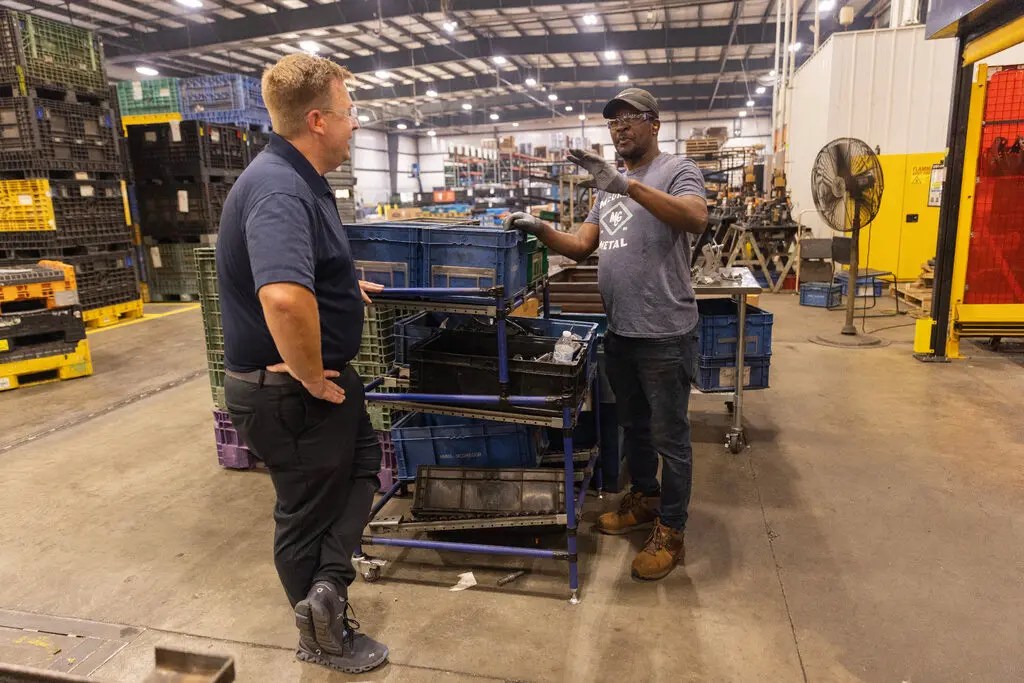
The U.S. economy has long relied on immigrant labor in its growth. The United States is a nation of immigrants. The 19th century transition from an economy devoted to agriculture to a modern industrial system funded by agricultural produce depended on the import of immigrants, with Germans and the Irish leading the way. Along with their essential labor for the new manufacturing sector and the expansion of farming, their arrival and that of immigrants after them brought deep political division reflecting the conflicts in work places and neighborhoods. Charismatic personalities have for two hundred plus years made political careers out of those divisions. Using the tools of distortion, lies, religious differences and buffonery, nation-wide political movements have been created and the nation’s ethnic divisions deepened.
The U.S. Civil War resulted from decades of simmering conflict over the proper role for the African immigrant brought to these shores as slave labor. Sacred texts dated as two millenia and more in origin were interpreted as assigning back breaking labor in fields and estates to the African sold as a slave. Low to no wages producing lucrative crops, cotton especially, for the world made the southern U.S. the supplier of much of the capital for the new nation’s financiers of south and north.
Angry debate over the causes and meaning of the Civil War continues today. Our most hallowed symbol of the United States as a welcoming refuge, the Statue of Liberty, was subjected to controversy and opposition in its creation one hundred fifty years ago. The Frenchman who created the original design saw the Statue as a celebration of the abolition of slavery with broken shackles to be draped from Liberty’s left hand. But to avoid the protests of former slaveholders and their supporters, who portray slavery as an idyllic era, the shackles now are partially hidden by her gown’s layers of folds and are barely visible from the ground level promenade.

America’s long history of anti-black racism and professed white superiority makes the nation’s response to the rise in the world’s immigrant population especially challenging, emotionally and politically. In the comprehensive study of world immigration by the U.S. Pew Research Center, it was found that one out of five immigrants in the world live in the U.S. While we now have far more immigrants and children of immigrants inside our borders, the majority of our more recent arrivals are persons of color, not the white adults and children from Europe and Scandanavia of the 19th century. As late as 1920, most of the newly arrived came from Italy and Germany, with Canada a distant third. Much of the shift to the immigration of persons of color has occurred since passage of the 1965 immigration reform. In 2022 the nation’s largest immigrant populations hailed from Mexico and India.
The 1965 Immigration and Nationality Act supported the shift in the origin of immigrants. Eliminating quota provisions favoring immigration from Europe, it gave preference to skilled workers and immigrants from anywhere with family members already settled in the U.S. The Act thus contributed to the rise in immigrants of color primarily from the earth’s southern hemisphere and a considerable increase in the numbers of immigrants in the country.
In the fifty years after passage of the 1965 law there were a total of 72 million immigrants and their children who came to the “land of freedom”. They accounted for 55% of the growth in U.S. population and Pew researchers project they will make up 88% of the growth from 2015 to 2065 when the nation will number 441 million persons and no ethnic group will constitute a majority of the population. Whereas non-Hispanic whites totaled 84% of the U.S. population in 1965, Pew studies project they will number 46 % in 2065. Continuing immigration from Latin America will make Hispanics 25% of the population and by 2065 14% of the nation will be Asian in origin.
Given voting trends in recent elections showing Hispanics favoring Democrats, the Republican party leadership has been particularly concerned by the dizzying increase in their numbers. Their current response is to support with near unanimity a candidate for U.S. President who has made the country wide settlement of immigrants of color the focus of his campaigns. His primary policy proposal, virtually his only concrete pledge, is to return two million recent immigrants to their countries of origin. The Republican candidate has repeatedly characterized Democrats’ relatively lenient response to the shift in immigration from the southern hemisphere as admitting “criminals and rapists” into our communities. In this month’s debate between the Democratic and Republican candidates for President, regardless of the question at hand Trump returned again and again to foreign nations sending their most dangerous citizens across our borders.
Trump’s history of racist rhetoric and commentary reveals the underlying message of the campaign slogan “Make America Great Again” for his 2016 and 2024 campaigns for President. A Wikipedia article on the phrase reports the candidate still denies the influence of Ronald Reagan’s successful 1980 campaign use of “Let’s Make America Great Again” as a slogan. Trump does outdo Reagan in disclosing the covert intent of its use as “Let’s Make America White Again”.
His outrageous claim that Haitians, migrants from one of the “shithole countries”, are eating the pets of residents of Springfield in the crucial State of Ohio may, however, have back fired. Not only did the city’s top administrator deny the report which Trump culled from an extreme racist’s social media posting, the town’s populace has been patronizing the Haitian restaurants as never before and emphasizing their new businesses and Haitian labor as vital to the growth of the local economy.
While the heavily Republican area may still vote for Trump in this year’s election, the recent affimation of the Haitian immigrants by many Springfield residents illustrates the central question raised by the candidates. Will the U.S. citizenry finally signal their embrace of the nation’s image as a haven of welcome for people of any and all ethnicities? Or will it step up its effort to hold back the migration patterns of our modern era in a futile effort to return the U.S. to a time when its white population were a majority. Representing the nation’s ideals as embedded in its history of immigration moving the economy, the culture, the community life forward, the opposition Democratic Party candidate is a woman of mixed Asian and African ancestry. If Harris’ Democratic Party is able to safeguard a victory in the upcoming election, the outcome will mark the nation’s progress to becoming a true “multi-racial democracy”.


 Erasing Borders
What We Need
Nov 3
Posted by erasingborders
Until the election this year, no U.S. Presidential candidate has identified so many enemies within the nation whom we should fear. The Republican Party’s candidate for President has made, as in 2016, purging of immigrants within our borders the foremost plank of his policy platform. But they are not the only group targeted for condemnation and reprisals. His opponents in 32 felony cases in which he has been convicted have now also been put on notice. Media outlets intent on lifting the veil of lying, depravity in relationships with women, violation of business contracts and attack dog strategy in multiple court cases, any persons or group publicizing the truth of his grotesque mendacity may expect reprisals.
Although he has been classified as a would be dictator. a leader in the mold of other authoritarian rulers today and in the past century, an accurate assessment of his biography of misdeeds may require a comparison with figures farther back in history. My own search for a true match has been prompted by the following poem of David Budbill:
“The emperor
His bullies and
Henchmen
every day
Terrorize the world
Which is why
Every day
We need
A little poem
Of kindness
A small song
Of peace
A brief moment
Of joy
– Written by David Budbill in 2005. Budbill was posthumously named “The People’s Poet of Vermont” by the Vermont legislature.
Contemplating the possibility of this nation elevating a depraved egotist to our highest office the Book of Psalms gave voice to what I felt. Here in Psalm 5, written over 2500 years ago, I found an apt description of the man who threatens to become the President of our formerly united States.
“There is no truth in their mouths;
their hearts are destruction;
their throats are open graves;
they flatter with their tongues.
Make them bear their guilt,
O God:
let them fall by their own
counsels
because of their many
transgressions cast them
out,
for they have rebelled against
you.
Those are verses 9 and 10 of Psalm 5, in the New Revised Standard Version translation of the Hebrew Bible. Psalm 133 suggests a source for the “brief moment of joy” for our “every day” as Budbill calls for in his poem “What We Need”.
“How very good and pleasant it is
when kindred live together in
unity!
……..
For there the Lord ordained his
blessing
life forevermore.”
Those are verses 1 and 3b of Psalm 133 in the NRSV translation.
We in the U.S. are blessed by the presence of people from many of the world’s nations who have chosen to make this nation their home. They come in many colors. They come speaking many languages, eating a delightful variety of foods, following many different customs. We encounter them as our yard tenders, bricklayers, journalists, tree trimmers, nurses, meal servers, bus and truck drivers, long term care givers, crop harvesters, doctors, shop owners and clerks and public servants. Every day most of us have the opportunity to show gratitude for their presence and their service. Every day we can all share with them a “brief moment of joy” with a smile, with words of kindness, with words of thanks.
Posted in Global Economy, Interfaith Relations and Politics, Solidarity, Community and Citizenship, U.S. Immigration and Refugee Policies, U.S. Political Developments
6 Comments
Tags: A would be emperor of the U.S., David Budbill, Growing diversity of U.S. population, The Psalms' commentary on the 2024 U.S. election