Kansas City Haberdasher and the Founding of Israel
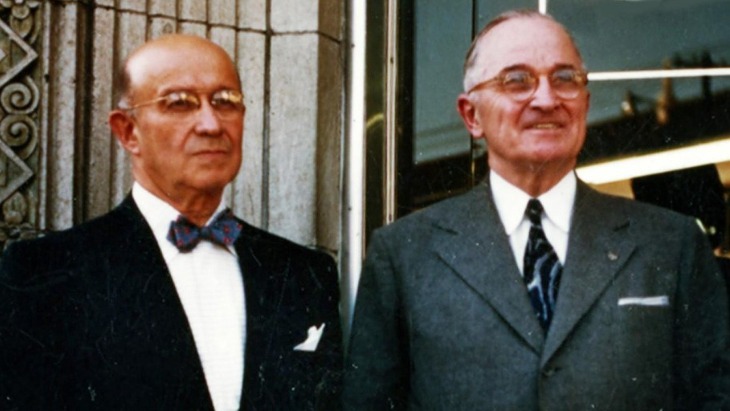
The 1948 announcement of Israel’s creation owed a great deal to a notable friendship. In his unqualified endorsement of the move President Harry Truman defied Secretary of State George Marshall and the U.S. foreign policy establishment. In doing so he did, however, demonstrate his loyalty to an enduring relationship.
Harry Trumans’s buddy Edward Jacobson grew up with the thirty-third U.S. President in Kansas City. After the Jewish Jacobson and the Presbyterian/Baptist Truman served together in the Army during WWI, they opened a hat and clothing store in their hometown. After the store’s failure, they remained close as Jacobson continued to sell clothing and Truman entered public service and politics. When Britain ceded to the U.N. continued rule of Palestine, Jacobson influenced Truman and and the U.S. support for the partition plan that created the State of Israel.
By then owner of a clothing store in his hometown, Jacobson was identified by Zionist stratgists as a key U.S. contact in shaping the partition plans and his nation’s approval of the agreement. The story is told in a footnote to a recent account of Palestine’s history from 1920 to 1948. “The Road to 1948 and the Roots of a Perpetual Conflict” appeared as a February 4, 2024 article in the New York Times Magazine which brought together six Jewish and Arab historians to discuss the beginning of the British Mandate in 1920 to the founding of the new State of Israel.
The partition plan which called for two states, Palestine and Jewish, to be recognized was a highly delicate, complicated issue for the powerful Allied leader and U.S. post WW II diplomacy. Drafted by a Special Committee of the new international organization, it was opposed by the Palestinians, the new Arab States – Jordan, Syria, Lebanon – created by the end of French colonialism in the Middle East and most of the rest of the Arab world.
Today it may appear to have been a grave mistake for the Palestinians to oppose the partition plan and the two state solution offered in 1947. However, as Professor Abigail Jacobsen of Jerusalem’s Hebrew Union College points out, “It’s important not to read history retrospectively. When you look at the demographic realities of 1947 and the division of the land, it was 55 percent for the Jewish state and 45 percent for the Palestinian state even though there were double the number of Palestinians as Jews at that point. If you were a Palestinian in 1947, would you accept this offer?” Prof. Jacobson seems to commend the Palestinians when she also reminds us that “the Palestinian national movement was ready to accept the Jews as a minority within an Arab state”.
Zionist defense of the new State of Israel yielded an overwhelming victory. The moderator of the Times’ discussion, Emily Bazelon, writes in her background for the academics’ commentary, “Before the war, there were around 500,000 Jews and 450,000 Palestinians on the 55 percent of the land that the U.N. designated for a Jewish state. When the Arab-Israeli war ended in July 1949, Israel controlled 78 percent of the former British Mandate and the population was mostly Jewish, with only 155,000 Palestinians.”
In response to Bazelon’s ensuing question of why the Palestinians were not permitted to return to their homeland, Harvard’s Derek Penslar responds, “As the war wore on, the Israeli government issued a decree not to allow the refugees to return.” Expulsion of Palestinian residents and seizure of their land and property is now called “the nakba” or “catastrophe” in English. Current and past Israeli administrations have encouraged the view that security of the fledging State facing the Arab threat required such defense of the diplomatic and military gains made in 1947-49.
Eddie Jacobson’s role in cementing the close ties of the U.S. with the new Jewish State did not go unrecognized. In their description of the Jacobson file at the Harry Truman Library, its archivisits wrote, “Through a variety of tributes and honors, Israelis and Americans alike recognized his contribution to the founding of the Jewish state.” As one example of his large influence, the archivists note that it was Jacobson who arranged Truman’s meeting with the Zionist leader Dr. Chaim Weizmann. Two months after their conversation in the White House, Zionist leadership proclaimed the founding of Israel and less than an hour later the U.S. became the first nation to grant diplomatic recognition to the State of Israel.
The Library’s last Jacobson letter is the former President’s 1955 handwritten note referring to plans for a visit to Israel, likely accompanied by his old friend. Shortly after the letter, Jacobson died and Truman never made the trip. As a tribute to his friend, the archivists draw our attention to President Truman’s statement that Edddie Jacobson was “as fine a man who ever walked”.
“The Road to 1948 and the Roots of a Perpetual Conflict” published in the February 1, 2024 New York Times Magazine is a fine summary of the leaders and developments in Israel-Palestine prior to May, 1948. https://www.nytimes.com/issue/magazine/2024/02/02/the-2424-issue

Posted on August 10, 2024, in Interfaith Relations and Politics, Solidarity, Community and Citizenship, U.S. Political Developments and tagged Edward Jacobson and Israel's founding, Harry Truman's friendship with Eddie Jacobson, Origins of U.S. aid of Israel, Truman's support for Israel. Bookmark the permalink. Leave a comment.


 Erasing Borders
Leave a comment
Comments 0